July 7, 2026
China Northern Rare Earth Group milestones represent unprecedented consolidation in critical materials processing, fundamentally reshaping global technology supply chains. This strategic positioning extends beyond simple resource extraction into complex value chains where processing capability, manufacturing integration, and market infrastructure control create compounding advantages. Understanding these mechanisms becomes essential for investors, policymakers, and industry strategists navigating an increasingly fragmented global economy.
This dynamic extends beyond simple resource extraction into complex value chains where processing capability, manufacturing integration, and market infrastructure control create compounding advantages. Furthermore, critical minerals energy security concerns are driving mining industry evolution across multiple regions.
How Is China Northern Rare Earth Group Reshaping Global Supply Chain Dynamics?
China Northern Rare Earth Group milestones represent a fundamental shift in global materials processing architecture. The company's strategic expansion encompasses mining operations, separation facilities, magnet production, and motor manufacturing under unified corporate control.
Strategic Infrastructure Expansion Framework
China currently processes approximately 70% of global rare earth materials, with refining capacity concentrated in Inner Mongolia and surrounding regions. According to recent analysis from China-Briefing, China's dominance in rare earth separation and refining remains the primary strategic constraint for Western supply chains.
Global Production Capacity Comparison:
| Region | Annual Processing Capacity | Market Share |
|---|---|---|
| China (Total) | 150,000+ metric tons | 70% |
| United States | 12,000 metric tons | 5.5% |
| Australia/Malaysia | 15,000 metric tons | 7% |
| Rest of World | 35,000 metric tons | 17.5% |
The capacity expansion represents more than simple scale increases. Modern rare earth processing employs increasingly sophisticated separation technologies, including solvent extraction cascades and ion exchange chromatography, requiring substantial capital investment and technical expertise.
Moreover, recent developments in battery recycling breakthrough technologies demonstrate how integrated processing capabilities enhance resource recovery efficiency.
Technical Advancement Alert: The implementation of "green smelting" processes reduces acid consumption by 20-30% whilst improving environmental controls on leaching operations.
Geographic positioning in Inner Mongolia provides multiple strategic advantages:
• Access to established mineral deposits with existing processing infrastructure
• Workforce expertise developed over three decades of rare earth operations
• Industrial ecosystem supporting downstream magnet and alloy production
• Transportation networks connecting mining, processing, and manufacturing facilities
Investment allocation patterns demonstrate systematic value chain integration. Rather than focusing solely on upstream mining capacity, China Northern Rare Earth Group milestones emphasise processing, manufacturing, and technology development across multiple production stages.
Cost-per-ton efficiency emerges from several factors beyond labour cost differentials. Economies of scale in separation facilities, integrated waste management systems, and optimised transportation reduce total production costs by an estimated 15-30% compared to distributed processing networks.
When big ASX news breaks, our subscribers know first
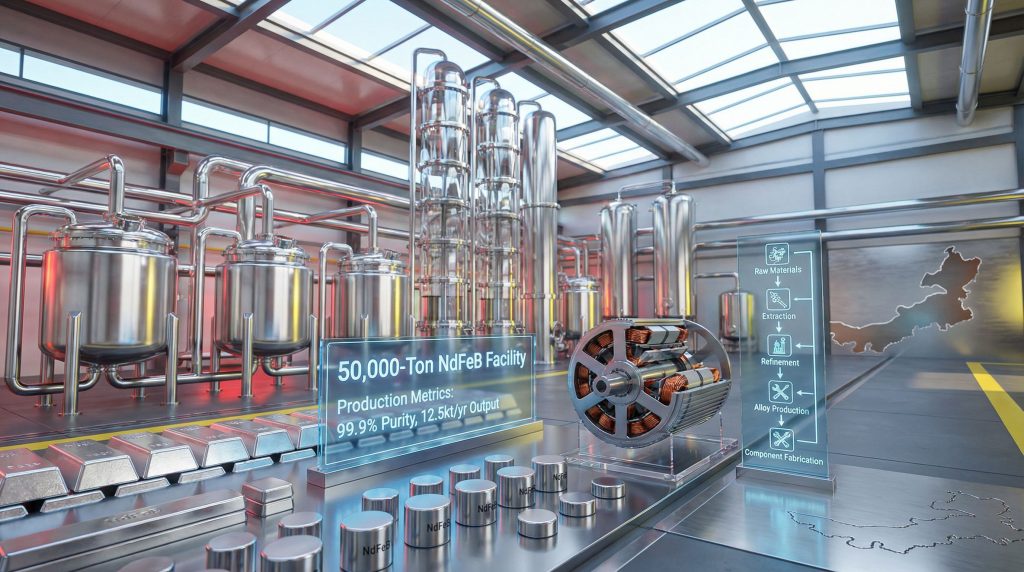
What Makes the 50,000-Ton NdFeB Facility a Game-Changer?
Neodymium-iron-boron magnet production represents the most strategically sensitive segment of the rare earth value chain. Global NdFeB magnet production reached approximately 210,000-220,000 metric tons annually in 2023, with China controlling 85-90% of worldwide supply.
Magnet Alloy Production Economics
The proposed 50,000-ton facility would represent approximately 23-25% of current global NdFeB production capacity if operational at full scale. This concentration level creates significant market influence across multiple application sectors.
Scale Economics Impact:
• Capital efficiency: Large facilities achieve 10-20% cost advantages per unit versus smaller competitors
• Quality standardisation: Automated processes reduce variability in magnetic properties
• Inventory optimisation: Integrated production reduces working capital requirements
• Technology deployment: Advanced automation becomes economically viable at scale
Modern NdFeB production involves complex metallurgical processes requiring precise control:
- Alloy Casting: Induction melting under controlled atmosphere prevents oxidation
- Powder Preparation: Hydrogen decrepitation creates optimal particle size distribution
- Magnetic Alignment: Field-assisted pressing optimises magnetic anisotropy
- Sintering Control: Temperature and atmosphere management determines final properties
- Quality Testing: Magnetic property verification ensures performance specifications
Automation integration addresses multiple production challenges. Robotic handling systems manage high-temperature materials safely, whilst computer-controlled sintering furnaces maintain precise atmospheric conditions. These improvements reduce per-unit labour costs whilst improving product consistency.
Competitive Positioning Analysis
Strategic timing aligns with explosive growth in electric vehicle markets. Global EV sales expanded from 3.2 million units in 2020 to 14.3 million units in 2023, representing 18% of total vehicle sales. Each electric vehicle requires 500-1000 grams of NdFeB magnet material in traction motors alone.
Application Market Growth Drivers:
| Sector | Annual Demand Growth | Magnet Grade Requirements |
|---|---|---|
| EV Traction Motors | +18-22% | N45-N52SH (high temperature) |
| Wind Turbines | +12-15% | N42SH-N48SH (corrosion resistant) |
| Industrial Automation | +8-12% | N38-N45 (cost-optimised) |
| Defence Systems | +3-5% | N45H-N52UH (extreme conditions) |
Market share implications extend beyond simple capacity calculations. Integrated production from raw materials through finished magnets provides pricing flexibility and supply security advantages that independent magnet producers cannot match.
Investment Insight: Rare earth magnet facilities typically require $200-400 million in initial capital investment, creating significant barriers to entry for new competitors.
Technology gap assessment reveals substantial challenges for Western competitors. Advanced sintering techniques, automated magnetic testing systems, and integrated quality control require both capital investment and technical expertise accumulated over decades of production experience.
Why Does Vertical Integration Strategy Matter for Global Markets?
Vertical integration across the rare earth value chain creates multiple strategic advantages that compound over time. China Northern Rare Earth Group milestones demonstrate systematic integration from mining operations through finished motor production.
From Raw Materials to Finished Components
The rare earth supply chain contains critical control points where single entities exert disproportionate influence:
Supply Chain Control Analysis:
• Mining Stage: Geographic concentration in China, Myanmar, and limited Western sources
• Separation/Refining: China controls 85-90% of global capacity (primary chokepoint)
• Magnet Production: China dominates 85%+ of global manufacturing
• Specialised Applications: Niche markets with additional concentration risks
Vertical integration across all four stages provides leverage at each chokepoint whilst reducing dependency on external suppliers. This control extends beyond simple cost advantages into strategic supply security and technology development.
Risk Mitigation Through Integration:
| Risk Factor | Independent Sourcing | Vertical Integration |
|---|---|---|
| Supply Security | High external dependency | Internal sourcing control |
| Price Volatility | Full exposure to spot markets | Margin capture across chain |
| Quality Variability | Limited input control | Direct specification management |
| Technology Access | External licensing required | Integrated R&D development |
Lead time reduction represents a significant operational advantage. Vertically integrated producers achieve 2-3 month internal transfer cycles compared to 6-9 months for independent sourcing networks. This responsiveness becomes critical in rapidly evolving technology markets.
Axial-Flux Motor Technology Implications
The launch of axial-flux motor production demonstrates continued downstream integration. These motors offer significant performance advantages over conventional radial-flux designs:
Technical Performance Comparison:
• Size/Weight: 30-40% reduction in motor volume for equivalent power output
• Efficiency: 2-5% improvement in energy conversion efficiency
• Thermal Management: Enhanced heat dissipation through disc architecture
• Integration: Simplified mounting and connection systems
Application sectors benefit differently from these characteristics. Electric vehicle thermal management systems require compact, lightweight designs. Drone propulsion demands optimal power-to-weight ratios. Industrial robotics benefits from integrated magnet-motor architectures that reduce system complexity.
Motor technology integration captures additional value whilst reducing design iteration cycles. Direct control over magnet specifications enables optimised motor performance that independent manufacturers cannot achieve through standard component sourcing.
Technology Alert: Axial-flux motors using advanced NdFeB magnets achieve power densities 40-60% higher than conventional designs in specific applications.
How Does China's Pricing Infrastructure Influence Global Markets?
Market control extends beyond production capacity into pricing infrastructure and transaction systems. The establishment of national price indices represents systematic efforts to influence global benchmark pricing mechanisms.
National Price Index Development
China's formal launch of a national rare earth price index in December 2025 builds on domestic exchange transaction data and standardised government methodologies. This infrastructure strengthens market control through several mechanisms:
Market Control Mechanisms:
• Benchmark Authority: Establishes Chinese markets as primary price reference
• Contract Leverage: Provides standardised pricing basis for international negotiations
• Transparency Control: Manages information flow and market expectations
• Policy Coordination: Integrates pricing with broader industrial policy objectives
Alternative pricing hub development faces substantial challenges. Western markets lack sufficient transaction volume, standardised products, and integrated supply chains to establish credible benchmark pricing systems. Limited spot market development restricts price discovery mechanisms.
Price Formation Factors:
- Production Costs: Mining, separation, and processing economics
- Inventory Levels: Strategic and commercial stockpile management
- Demand Cycles: Seasonal and technological adoption patterns
- Policy Intervention: Export quotas, environmental regulations, tax policies
- Currency Effects: Exchange rate impacts on international competitiveness
Transaction data integration provides comprehensive market intelligence that individual buyers cannot access. Government methodology standardisation ensures consistency across different product grades and regional markets.
Market Power Consolidation Effects
Price index development complements physical supply chain control with market infrastructure dominance. Combined effects include:
• Enhanced contract negotiation leverage through standardised benchmarks
• Reduced pricing transparency for international buyers
• Integration of spot and contract markets under unified systems
• Policy coordination between pricing and supply allocation decisions
Western procurement strategies must adapt to Chinese pricing infrastructure whilst developing limited alternative mechanisms. This dependency extends market influence beyond direct supply relationships into financial and contracting systems.
What Are the Strategic Implications for Non-Chinese Markets?
Capacity gap analysis reveals the scale of challenges facing Western supply chain development. China Northern Rare Earth Group milestones underscore widening technological and economic advantages that compound over time.
Capacity Gap Analysis
Western production capabilities remain limited across multiple value chain stages:
Production Capability Comparison:
| Stage | China Capacity | Western Capacity | Gap Ratio |
|---|---|---|---|
| Mining/Ore | 140,000+ tons | 27,000 tons | 5.2:1 |
| Separation/Refining | 150,000+ tons | 27,000 tons | 5.6:1 |
| Magnet Production | 190,000 tons | 15,000 tons | 12.7:1 |
| Motor Integration | Dominant | Limited | 20+:1 |
Infrastructure development timelines extend far beyond typical industrial project cycles. Rare earth separation facilities require 5-8 years from initial permitting through operational startup, assuming streamlined regulatory processes and available financing.
In addition, the development of an European CRM facility demonstrates regional efforts to address these capacity constraints. However, the Australia strategic reserve initiative indicates the scale of government intervention required.
Development Challenge Factors:
• Technical Expertise: Skilled workforce development requires decades
• Environmental Permitting: Complex regulatory approval processes
• Capital Requirements: High initial investment with uncertain returns
• Market Access: Competition with established, cost-optimised suppliers
Technology readiness levels vary significantly across processing stages. Mining operations can achieve commercial viability relatively quickly with sufficient investment. Separation and refining require more advanced technical capabilities and environmental management systems. Magnet production demands precision manufacturing and quality control expertise.
Policy Response Requirements
Industrial policy framework development becomes essential for competitive supply chain establishment. Required elements include:
Government Support Mechanisms:
• Direct Investment: Public funding for facility development and technology acquisition
• Risk Mitigation: Loan guarantees and market assurance programmes
• Research Coordination: Joint public-private technology development initiatives
• Regulatory Streamlining: Accelerated permitting for strategic material projects
Financing mechanism development addresses market failures in strategic material investments. Private capital markets typically under-invest in long-term infrastructure projects competing with subsidised foreign suppliers.
International cooperation frameworks offer potential for risk and cost sharing. Allied nations can coordinate investment, share technology development, and establish mutual supply agreements to reduce individual country exposure.
Policy Reality Check: Building competitive rare earth processing capacity requires sustained government support over 10-15 year timeframes with uncertain commercial returns.
How Do Recycling Technologies Affect Long-Term Market Dynamics?
Advanced recycling technologies potentially reshape long-term supply-demand balance whilst reducing environmental impacts. China Northern Rare Earth Group milestones include bio-leaching and urban mining pilot programmes targeting alternative feedstock sources.
Bio-Leaching and Urban Mining Advances
Recycling technology development addresses multiple strategic objectives simultaneously:
Sustainability Technology Benefits:
• Resource Security: Reduced dependence on primary mining operations
• Environmental Impact: Lower tailings generation and acid consumption
• Cost Optimisation: Potentially lower processing costs for high-grade feedstocks
• Supply Diversification: Geographic distribution of recycling facilities
Bio-leaching employs bacterial systems to extract rare earth elements from low-grade ores and waste materials. These biological processes operate at ambient temperatures and pressures, potentially reducing energy consumption compared to traditional acid leaching.
Recycling Technology Performance:
| Technology | Recovery Rate | Feedstock Type | Commercial Status |
|---|---|---|---|
| Bio-leaching | 60-80% | Tailings/Low-grade ore | Pilot scale |
| Acid Leaching | 85-95% | E-waste/Magnets | Commercial |
| Molten Salt | 90-98% | High-grade scrap | Development |
| Hydrometallurgical | 75-90% | Mixed waste | Limited commercial |
Urban mining targets end-of-life electronic devices, automotive components, and industrial equipment containing rare earth materials. Potential feedstock volumes could supply 15-25% of global demand if comprehensive collection and processing systems develop.
Pilot programme scalability depends on several factors:
• Collection Infrastructure: Systematic e-waste gathering and sorting
• Processing Economics: Cost-competitive recovery versus primary production
• Product Quality: Consistent purity levels for demanding applications
• Regulatory Framework: Environmental and safety standards for recycling operations
Supply Security Implications
Recycling technology development creates strategic advantages beyond simple cost reduction. Geographic distribution of recycling facilities reduces concentration risks whilst providing alternative supply sources during primary production disruptions.
Circular economy integration benefits include reduced waste generation, lower environmental impact, and improved public acceptance of rare earth-dependent technologies. These factors support long-term market growth whilst addressing sustainability concerns.
Strategic stockpile management becomes more complex with recycling integration. Government reserves must balance primary and secondary supply sources whilst maintaining technology compatibility across different feedstock types.
Long-term Perspective: Recycling technologies could supply 20-30% of global rare earth demand by 2035, but require systematic infrastructure development starting immediately.
The next major ASX story will hit our subscribers first
What Investment Opportunities Emerge from These Developments?
Market dynamics create multiple investment themes across different risk and return profiles. China Northern Rare Earth Group milestones influence investment opportunities through supply chain positioning and technology development.
Sector-Specific Growth Drivers
Application market projections demonstrate divergent growth patterns requiring different strategic approaches:
Investment Theme Analysis:
| Sector | Growth Rate | Investment Focus | Risk Level |
|---|---|---|---|
| Electric Vehicles | +18-22% annually | Motor/battery tech | Medium-High |
| Renewable Energy | +12-15% annually | Generator systems | Medium |
| Defence/Aerospace | +3-5% annually | Specialised components | Low-Medium |
| Consumer Electronics | -2% to +5% annually | Efficiency improvements | High |
Electric vehicle markets drive primary demand growth whilst creating new technology requirements. Advanced motor designs, battery systems, and charging infrastructure require specialised rare earth materials with demanding performance specifications.
Wind energy sector growth provides stable, long-term demand for generator magnets. Large-scale installations require multi-megawatt generators with substantial rare earth content per unit, supporting sustained market expansion.
Supply Chain Diversification Opportunities:
• Alternative Processing: Western separation and refining capacity development
• Recycling Systems: E-waste collection and processing infrastructure
• Technology Innovation: Advanced separation methods and substitute materials
• Downstream Integration: Magnet production and motor manufacturing capabilities
Geographic market distribution affects investment strategies. Asian markets demonstrate highest growth rates but also highest competitive intensity. Western markets offer premium pricing for supply security but require substantial initial investment.
Risk Assessment Framework
Investment evaluation must address multiple risk categories:
Investment Risk Considerations:
• Geopolitical Supply Chain Risks: Potential export restrictions or supply disruptions
• Technology Obsolescence: Alternative materials or manufacturing processes
• Regulatory Environment Changes: Environmental standards or trade policy shifts
• Market Volatility: Cyclical demand patterns and pricing fluctuations
Portfolio diversification strategies should balance exposure across value chain stages, geographic regions, and application sectors. Pure-play rare earth investments carry high concentration risk, whilst diversified materials companies offer broader market exposure.
Technology investment requires careful evaluation of commercial viability timelines. Advanced recycling technologies, alternative separation methods, and substitute materials may offer substantial returns but involve significant development risk.
Investment Reality: Rare earth sector investments require 5-10 year holding periods to capture full value chain development cycles.
How Should Western Governments Respond to Supply Chain Concentration?
Government policy responses must balance immediate supply security concerns with long-term competitive positioning. China Northern Rare Earth Group milestones demonstrate systematic integration that requires comprehensive strategic responses.
Strategic Response Options
Policy intervention models offer different approaches to supply chain diversification:
Government Response Comparison:
| Country/Region | Policy Approach | Funding Commitment | Timeline |
|---|---|---|---|
| United States | Direct investment + partnerships | $3.1 billion (IRA) | 2025-2030 |
| European Union | Green Deal + strategic autonomy | €2.8 billion | 2024-2027 |
| Japan | Public-private partnerships | ¥200 billion | 2023-2028 |
| Australia | Resource development focus | A$2 billion | 2024-2029 |
Direct investment in domestic capacity provides greatest supply security but requires substantial public funding with uncertain commercial returns. Facility development costs for competitive rare earth processing range from $500 million to $2 billion depending on capacity and integration scope.
International partnership development offers risk and cost sharing opportunities. According to Strategic Metals Invest, allied nations can coordinate technology development, share processing capacity, and establish mutual supply agreements to reduce individual exposure.
Strategic Partnership Benefits:
• Cost Sharing: Distributed investment across multiple countries
• Technology Access: Combined R&D capabilities and expertise
• Market Diversification: Multiple demand sources supporting facility economics
• Political Sustainability: Broader coalition supporting long-term commitments
Strategic reserve accumulation provides short-term supply security whilst longer-term capacity develops. Government stockpiles require careful management to avoid market disruption whilst maintaining material quality and technological relevance.
Regulatory framework development addresses environmental permitting, safety standards, and trade policies affecting rare earth operations. Streamlined processes can reduce development timelines by 2-4 years whilst maintaining environmental protection.
Long-Term Competitiveness Factors
Sustainable competitive advantage requires more than facility construction. Critical success factors include:
Competitiveness Requirements:
• Technology Innovation: Advanced processing methods and automation systems
• Workforce Development: Specialised technical expertise and operational knowledge
• Supply Chain Integration: Coordination across mining, processing, and manufacturing
• Market Access: Customer relationships and product quality certification
Technology innovation requirements extend beyond copying existing processes. Next-generation separation methods, environmental controls, and automation systems could provide competitive advantages whilst addressing cost and sustainability challenges.
Workforce development priorities include technical training, research capabilities, and operational expertise. Building competitive human capital requires 10-15 years of sustained educational and industrial development.
Strategic Timeline: Competitive rare earth processing capability requires sustained 10-15 year government commitment with patient capital investment.
What makes rare earth processing so challenging?
Rare earth separation requires precise control of chemical processes involving multiple elements with similar properties. Technical expertise, environmental management, and scale economics create significant barriers to entry.
How long does it take to build competitive capacity?
Comprehensive rare earth processing facilities require 5-8 years from initial permitting through operational startup, with an additional 2-3 years to achieve full production efficiency.
What role do international partnerships play?
Allied nation cooperation can share costs, risks, and technology development whilst creating sufficient market scale to support competitive facility economics.
Strategic Positioning in a Concentrated Market
Market concentration dynamics create fundamental challenges for Western economic security and technological sovereignty. China Northern Rare Earth Group milestones demonstrate systematic end-to-end control spanning mining, processing, manufacturing, and market infrastructure.
Key Strategic Takeaways:
• Consolidated Control: China's integration across all value chain stages creates compounding advantages
• Response Challenges: Western capacity development faces substantial technical, financial, and timeline constraints
• Investment Requirements: Competitive positioning requires sustained multi-billion dollar commitments over decades
• Technology Gaps: Advanced processing capabilities and integrated manufacturing systems require significant development
Future scenario analysis suggests continued Chinese dominance absent coordinated Western response involving substantial public investment, international cooperation, and regulatory reform. Market forces alone appear insufficient to address strategic supply chain vulnerabilities.
Investment strategies must balance supply security objectives with commercial returns whilst managing geopolitical and technological risks. Portfolio approaches spanning multiple value chain stages, geographic regions, and application sectors offer optimal risk-adjusted positioning.
Strategic decision-making frameworks for governments, investors, and industrial users require long-term perspectives recognising that competitive positioning develops over decades rather than business cycles. Immediate actions determine strategic options available in future market configurations.
Final Assessment: China Northern Rare Earth Group milestones represent systematic consolidation of global supply chain control requiring comprehensive Western strategic responses extending far beyond traditional market mechanisms.
Ready to Position Yourself Ahead of Critical Minerals Market Movements?
Discovery Alert's proprietary Discovery IQ model delivers real-time notifications on significant ASX mineral discoveries, including critical minerals essential for the global energy transition. With historic discoveries generating substantial returns, subscribers gain actionable insights into trading and investment opportunities ahead of the broader market, ensuring informed decision-making in this rapidly evolving sector.