August 20, 2026
Global energy markets are experiencing unprecedented transformation as traditional supply relationships face mounting geopolitical pressures. The convergence of sanctions enforcement, strategic realignments, and accelerating energy transition challenges is reshaping how major economies secure their petroleum requirements. Furthermore, China oil imports from Iran and Venezuela represent a critical component of this evolving landscape, presenting both immediate operational challenges and long-term strategic imperatives that extend far beyond simple price considerations.
Understanding China's Energy Import Vulnerability Matrix
China's position as the world's largest crude oil importer creates inherent vulnerabilities when traditional supply sources face restrictions. The nation's appetite for petroleum products continues growing despite rapid electric vehicle adoption, making supply chain resilience a critical economic security concern.
Quantifying China's Sanctioned Oil Dependency
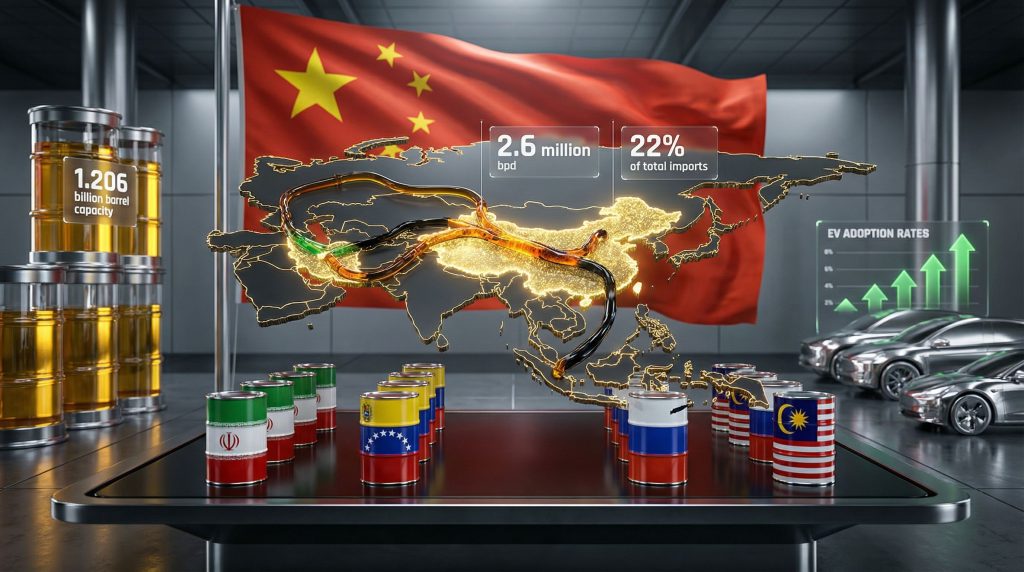
Recent trade intelligence data reveals significant discrepancies between official customs records and actual energy flows. While Chinese customs data shows minimal direct imports from certain sanctioned nations, independent tracking suggests approximately 2.6 million barrels per day flow from restricted sources, representing roughly 22% of total seaborne crude volumes.
The economic implications of these arrangements extend beyond simple procurement costs. Iranian crude typically trades at discounts of $8-10 per barrel compared to benchmark pricing, providing substantial savings for refiners willing to navigate complex transaction structures. This price differential becomes particularly significant for China's independent refineries, concentrated primarily in Shandong province, where profit margins depend heavily on feedstock cost optimisation.
Key vulnerability metrics include:
- Shandong province concentration: Over 60% of China's independent refineries operate in this region
- Processing capacity: Independent refiners handle approximately 3.2 million barrels per day
- Import dependency ratio: China imports roughly 75% of its crude oil requirements
- Strategic reserve coverage: Current reserves provide approximately 104 days of import coverage
The Shadow Fleet Economics Behind Unofficial Trade Flows
Complex transshipment mechanisms have evolved to facilitate continued energy trade despite sanctions frameworks. These systems typically involve ship-to-ship transfers in international waters, cargo blending operations, and sophisticated documentation practices that obscure ultimate origins and destinations.
Malaysian and Indonesian facilities serve as critical transshipment hubs, where crude cargoes undergo technical modifications that alter their official classification. This process, known as "crude washing," involves blending sanctioned oil with compliant sources to create new product identities that meet international trading requirements.
The shadow fleet phenomenon represents one of the most significant adaptations in global energy logistics, with vessels specifically modified for sanctions evasion operations.
Financial settlement mechanisms have also evolved considerably. Traditional dollar-denominated transactions face increasing scrutiny, leading to expanded use of renminbi settlements and alternative payment systems. Some transactions now utilise cryptocurrency-based stablecoins, though these remain limited due to volatility concerns and regulatory uncertainties.
When big ASX news breaks, our subscribers know first
What Are the Macro-Economic Implications of Disrupted Supply Chains?
Supply chain disruptions create cascading effects throughout China's energy ecosystem, influencing everything from refinery operations to broader economic competitiveness. Understanding these interconnections requires examining both immediate operational impacts and longer-term structural adjustments that mirror broader trade war strategies.
Price Elasticity and Market Substitution Dynamics
When traditional suppliers become unavailable, replacement crude sources typically command premium pricing. Canadian heavy crude, Brazilian offshore production, and Middle Eastern grades often trade at $3-7 per barrel premiums compared to discounted sanctioned alternatives.
This premium pricing creates several economic pressures:
- Refinery margin compression: Independent processors face reduced profitability
- Consumer price transmission: Higher input costs eventually influence downstream product pricing
- Trade balance impacts: Increased import costs affect China's current account position
- Currency demand shifts: Alternative suppliers typically require dollar settlements
Substitution dynamics also reveal technical constraints. Many Chinese refineries are specifically configured to process particular crude grades, making rapid supplier transitions operationally challenging. Heavy crude processors, for example, cannot easily switch to light sweet alternatives without significant modifications.
Strategic Petroleum Reserve Utilisation Patterns
China's strategic petroleum reserves, totalling 1.206 billion barrels across multiple facilities, serve as critical buffers during supply disruptions. However, reserve utilisation involves complex economic calculations balancing immediate supply security against longer-term strategic positioning.
Reserve deployment typically follows specific protocols:
- Tactical releases: Small volumes to smooth short-term price spikes
- Strategic drawdowns: Larger releases during extended supply disruptions
- Emergency mobilisation: Maximum deployment during national security threats
- Commercial coordination: Working with private sector inventories for market stability
The effectiveness of these reserves depends heavily on China's refined product storage capacity and distribution infrastructure. Current systems can handle approximately 180 million barrels of refined products, though regional distribution bottlenecks can limit rapid deployment effectiveness.
How Is China's Energy Transition Mitigating Import Dependencies?
Accelerating energy transition initiatives represent China's most significant long-term strategy for reducing petroleum import vulnerabilities. These efforts encompass transportation electrification, industrial process modifications, and domestic energy production expansion, creating opportunities similar to those explored in the Saudi exploration impact.
Electric Vehicle Adoption as Demand Destruction Strategy
China's electric vehicle deployment has reached unprecedented scales, with over 8.1 million EVs sold in 2024 alone. This transformation directly reduces petroleum consumption forecasts, though the timeline for meaningful import reduction extends over multiple years.
Current EV adoption metrics demonstrate accelerating momentum:
| Year | EV Sales (Million Units) | Market Penetration | Gasoline Demand Impact |
|---|---|---|---|
| 2022 | 6.9 | 27.6% | -0.3 million bpd |
| 2023 | 8.0 | 31.2% | -0.5 million bpd |
| 2024 | 8.1 | 35.7% | -0.7 million bpd |
However, EV adoption faces several implementation challenges. Charging infrastructure development lags behind vehicle production, particularly in rural regions. Additionally, electricity generation still relies heavily on coal, creating indirect fossil fuel dependencies that complicate sustainability calculations.
Domestic Fossil Fuel Production Scaling Initiatives
China has intensified domestic oil and gas exploration efforts, though geological constraints limit potential output expansion. Current domestic crude production averages approximately 4.1 million barrels per day, representing roughly one-third of total consumption requirements.
Unconventional resource development shows promise but requires significant technological advancement. Shale oil formations in regions like the Ordos Basin contain substantial reserves, though extraction costs remain elevated compared to conventional sources. Enhanced oil recovery techniques are being deployed at mature fields to extend productive lifespans.
Recent discoveries in the South China Sea have generated optimism, though territorial disputes complicate development timelines. Offshore production capacity could potentially increase by 500,000 barrels per day over the next decade, assuming favourable political and technical conditions.
What Regional Economic Shifts Will Emerge From Supply Disruptions?
Regional economic impacts from energy supply disruptions will vary significantly across China's diverse industrial landscape. Coastal refining centres face different challenges than inland petrochemical complexes, while transportation costs and infrastructure capabilities influence adaptation strategies.
Shandong Province Refinery Sector Transformation
Shandong's independent refinery sector, dominated by smaller-scale "teapot" refiners, faces particular vulnerability to supply chain disruptions. These facilities typically operate with lower profit margins and limited financial resources for rapid feedstock transitions. Consequently, the situation resembles broader patterns observed in the US oil production decline.
Industry consolidation pressures are intensifying as smaller operators struggle with compliance costs and operational complexities. Government policies increasingly favour larger, more technically advanced facilities capable of processing diverse crude grades while meeting environmental standards.
Employment implications remain significant, with the refining sector supporting approximately 350,000 direct jobs in Shandong province. Facility closures or capacity reductions could create substantial socioeconomic disruptions in communities dependent on petrochemical industries.
Global Oil Market Rebalancing Scenarios
China's procurement adjustments influence global crude oil pricing patterns and trade flows. When major buyers shift supplier preferences, producing nations must seek alternative markets, creating opportunities for arbitrage and price convergence.
Venezuelan crude redirection patterns will depend heavily on political developments and sanctions modifications. The country's production capacity, currently estimated at approximately 900,000 barrels per day, could potentially increase if international investment resumes under favourable conditions.
Iranian export capacity remains constrained by sanctions enforcement and infrastructure limitations. Despite substantial reserves, current production levels of roughly 3.2 million barrels per day represent significant underutilisation of potential capacity.
Which Long-Term Structural Changes Will Define Energy Security?
Structural transformations in China's energy security architecture will extend far beyond immediate supply source adjustments. These changes encompass technological adaptations, financial system modifications, and strategic infrastructure investments designed to enhance resilience against future disruptions.
Geopolitical Risk Premium Integration
Energy security planning increasingly incorporates geopolitical risk assessments that extend beyond traditional supply and demand analysis. The Strait of Hormuz, through which approximately 21% of global petroleum liquids transit, represents a critical vulnerability requiring contingency planning.
Risk mitigation strategies include:
- Alternative transportation routes: Pipeline development through Central Asia and Russia
- Strategic partnership diversification: Expanded relationships with African and Latin American producers
- Financial instrument hedging: Long-term contracts with price protection mechanisms
- Emergency coordination protocols: Multilateral arrangements for crisis response
Middle East conflict spillover effects create additional uncertainty layers. Regional instability can disrupt production, transportation, and financial settlement systems simultaneously, requiring comprehensive contingency planning across multiple scenarios that could trigger an oil price rally.
Technology and Infrastructure Adaptation Pathways
Technological adaptations focus on enhancing operational flexibility and reducing dependencies on specific crude grades or supply sources. Advanced refinery configurations can process wider ranges of feedstock qualities, though these modifications require substantial capital investments.
Infrastructure priorities include:
- Storage capacity expansion: Additional strategic and commercial inventory facilities
- Pipeline network development: Direct connections to alternative supplier regions
- Port facility upgrades: Enhanced capability for handling diverse crude grades
- Processing technology advancement: Equipment suitable for unconventional feedstocks
Financial system adaptations support sanctions-compliant trade while maintaining operational efficiency. This includes expanded renminbi settlement systems, enhanced trade finance mechanisms, and improved transaction monitoring capabilities.
The next major ASX story will hit our subscribers first
Strategic Energy Independence Timeline
China's path toward enhanced energy security follows a phased approach balancing immediate operational requirements with longer-term structural transformation objectives. Success depends on coordinating multiple policy initiatives while maintaining economic competitiveness.
Policy Response Framework and Implementation Phases
Short-term initiatives (1-3 years) focus on immediate supply chain stabilisation:
- Strategic reserve tactical deployment during market disruptions
- Accelerated supplier diversification through commercial agreements
- Enhanced monitoring systems for trade compliance and risk management
- Expanded domestic refining capacity utilisation optimisation
Medium-term developments (3-7 years) emphasise structural adaptations:
- Significant expansion of renewable energy capacity deployment
- Electric vehicle infrastructure completion in major metropolitan areas
- Domestic oil and gas production capacity enhancement through technology advancement
- Regional energy integration through pipeline and transportation infrastructure
Long-term transformation (7-15 years) targets fundamental energy system restructuring:
- Petroleum import dependency reduction to below 50% of total consumption
- Comprehensive electrification of transportation and industrial sectors
- Advanced energy storage and distribution systems deployment
- Full integration with regional and global clean energy networks
According to recent analysis from Chinese oil firms, the shift toward Iranian crude reflects broader strategic considerations beyond simple cost calculations. Furthermore, as Columbia Energy Policy research demonstrates, China oil imports from Iran and Venezuela continue evolving despite international sanctions frameworks.
This analysis is for educational purposes only and does not constitute investment advice. Energy market dynamics involve substantial risks and uncertainties that can significantly impact investment outcomes. Readers should conduct their own research and consult qualified financial professionals before making investment decisions.
The evolution of China's energy security strategy reflects broader global transitions toward more resilient, diversified, and sustainable energy systems. While immediate challenges from supply disruptions create operational pressures, these same forces accelerate longer-term structural changes that may ultimately enhance energy independence and economic stability. In addition, the complex dynamics surrounding China oil imports from Iran and Venezuela will continue shaping global energy markets for years to come.
Ready to Capitalise on Global Energy Market Disruptions?
Discovery Alert's proprietary Discovery IQ model delivers real-time alerts on significant ASX mineral discoveries in critical energy transition commodities, instantly empowering subscribers to identify actionable opportunities ahead of the broader market. Begin your 14-day free trial today and secure your market-leading advantage as global energy dynamics create unprecedented investment opportunities in the resources sector.