August 5, 2026
When the Buffer Becomes a Liability: America's Strategic Oil Reserve at a Crossroads
Energy security debates rarely surface in mainstream conversation until something breaks. For most of the past decade, the U.S. Strategic Petroleum Reserve operated as a largely invisible backstop, a geological insurance policy buried in Louisiana and Texas salt caverns that most Americans never thought about. That invisibility is now gone. With pump prices climbing past levels not seen since the post-Ukraine shock of 2022, and the reserve itself drawn down to depths not witnessed since the Reagan era, the SPR has moved from policy footnote to front-page crisis. The Trump oil under U.S. military bases for Strategic Petroleum Reserve proposal represents perhaps the most unconventional response yet, and the Trump administration is reportedly exploring options that would have seemed extraordinary just a few years ago.
Understanding why this idea is gaining traction requires stepping back from the headline and examining the structural forces that made it thinkable in the first place.
When big ASX news breaks, our subscribers know first
The Strategic Petroleum Reserve: Architecture of a Safety Net
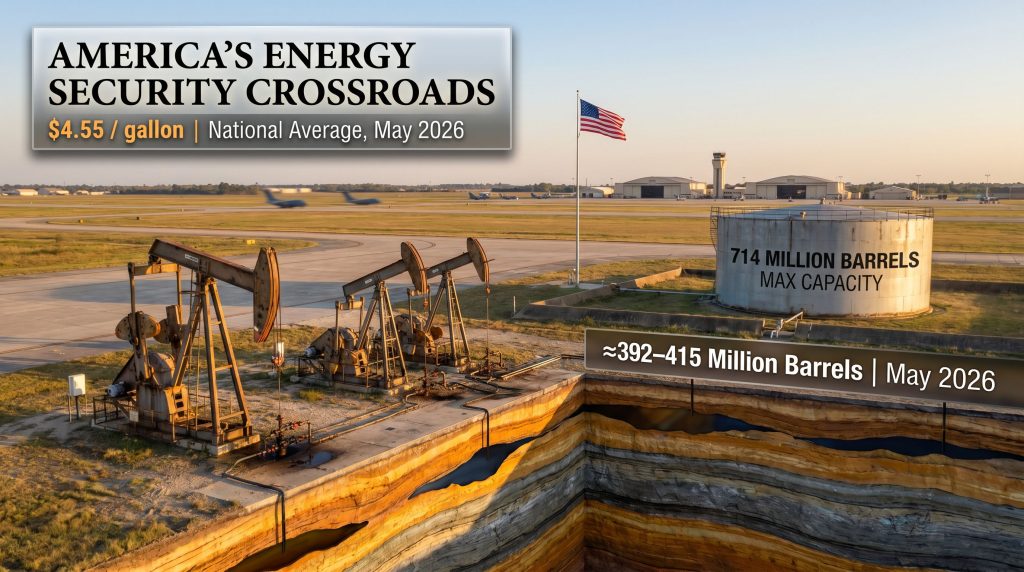
The SPR was not designed as a tool for managing retail gasoline prices. It was conceived in the aftermath of the 1973 Arab oil embargo as a hard national security instrument, a stockpile capable of cushioning supply shocks severe enough to threaten industrial output, military logistics, and economic stability. The reserve's physical infrastructure reflects that original mandate: a network of underground salt caverns along the Gulf Coast capable of holding up to 714 million barrels of crude oil.
Salt caverns are not chosen arbitrarily. Their geology makes them ideal for long-term petroleum storage. Salt is impermeable to hydrocarbons, self-sealing under pressure, and structurally stable over decades. The caverns in Bryan Mound, Big Hill, West Hackberry, and Bayou Choctaw have functioned as the backbone of American energy emergency preparedness since the late 1970s.
Crucially, the crude injected into these facilities must meet specific quality thresholds: API gravity and sulfur content specifications are strictly enforced, meaning not just any crude can be stockpiled. This is a technical detail with significant implications for any proposal involving production from new, untested federal sources. Furthermore, oil's global importance to industrial economies makes these technical standards a matter of strategic consequence.
As of May 2026, the reserve holds approximately 392 million barrels, well above the crisis low of 347 million barrels reached in June 2023, but still near the lowest levels recorded since the mid-1980s. The gap between current holdings and maximum capacity is now over 300 million barrels, and the trajectory of depletion has accelerated significantly through two administrations.
| SPR Milestone | Volume (Million Barrels) | Period |
|---|---|---|
| Maximum Capacity | 714 | Ongoing baseline |
| Biden-Era Low Point | 347 | June 2023 |
| Current Holdings | ~392 | May 2026 |
| 2026 Emergency Release Authorised | 172 | March 2026 |
| IEA Coordinated Global Release | 400 | 2026 |
A Reserve Depleted Twice in Four Years
The 2022 Drawdown and Its Political Framing
The first major depletion episode began in early 2022 following Russia's full-scale invasion of Ukraine. The resulting disruption to global crude markets, combined with surging domestic pump prices, prompted the Biden administration to authorise what became one of the largest SPR releases in the reserve's history. From a political standpoint, the drawdown was framed primarily as consumer relief, a tool to soften the impact of energy price spikes on household budgets.
Critics at the time argued this framing fundamentally misrepresented the SPR's intended purpose, converting a strategic national security instrument into a retail price management mechanism. The broader context of crude oil trade geopolitics was effectively subordinated to short-term political messaging.
The reserve fell steadily through 2022 and into mid-2023, reaching that historic low of 347 million barrels before partial replenishment efforts began. The Biden administration did attempt to purchase crude for replenishment at favourable prices when markets softened, though Congressional resistance and budgetary constraints slowed progress.
The 2026 Iran War Release and Exchange Mechanics
The second major depletion is now underway. In March 2026, the Trump administration authorised the release of 172 million barrels from the SPR as part of a broader International Energy Agency coordinated response to supply disruptions associated with the Iran conflict and the closure of the Strait of Hormuz. The IEA's total coordinated global release stands at 400 million barrels, with the United States contributing the largest share.
What distinguishes this release from its predecessor is its structure. Rather than a direct sale from government inventory, the 2026 release is organised as a loan-exchange arrangement. Private companies draw crude from the reserve immediately, but are contractually obligated to return approximately 200 million barrels within 12 months, roughly 20% more than the volume originally withdrawn.
The exchange model is administratively elegant, but it carries a critical assumption: that the geopolitical disruption will resolve within the replenishment window. If Strait of Hormuz tensions persist or escalate, companies may face significant difficulty sourcing and returning the required volumes on schedule.
Trump Oil Under U.S. Military Bases: The Proposal Explained
The Core Fiscal Logic
Against this backdrop, the Trump oil under U.S. military bases for Strategic Petroleum Reserve concept is being explored as a potential solution to an increasingly acute supply problem. The logic is straightforward: the federal government already owns the land. If hydrocarbons exist beneath that land and can be produced within regulatory parameters, the crude would effectively cost the government nothing beyond extraction expenses.
There would be no need to purchase oil at elevated market prices from private sellers, no exchange agreements with deferred repayment obligations, and no Congressional appropriation required for acquisition. U.S. Energy Secretary Chris Wright addressed this concept publicly at a Wall Street Journal event, characterising military installations sitting above oil-bearing formations as underutilised federal assets.
Wright described the absence of development activity as illogical given current supply pressures, and indicated the administration intends to pursue pragmatic approaches to federal energy resources. This rhetorical positioning is notable precisely because it reframes military land from a sensitive dual-use asset into an untapped component of the national energy production portfolio.
Barksdale Air Force Base: The Proof of Concept
The idea of drilling on military land is not theoretical. Barksdale Air Force Base, located east of Bossier City in northwestern Louisiana, has permitted commercial oil extraction on its grounds for decades. The base sits atop productive geological formations that have supported long-running lease arrangements between the federal government and private operators.
In September 2025, the Bureau of Land Management conducted an auction of two parcels totalling 1,922 acres within Barksdale's footprint, indicating that the administrative machinery for this type of arrangement is already functional. Barksdale does not represent an experimental edge case. It is an established precedent that demonstrates the legal and operational compatibility of active military operations and adjacent hydrocarbon production, at least under carefully managed conditions.
Which Agencies Hold Jurisdiction?
Federal mineral rights on military land sit at the intersection of multiple agency authorities:
- The Bureau of Land Management administers federal mineral leasing and auction processes
- The Department of Defense controls surface rights and operational security requirements
- The Department of Energy oversees SPR management and strategic reserve policy
Any expansion of drilling activity across a broader set of military installations would require coordination among all three agencies, along with compliance reviews under existing environmental statutes.
Operational Realities: From Wellhead to Salt Cavern
The Timeline Problem
The most important technical constraint facing this proposal is time. The full cycle of onshore oil production, from geological assessment and permitting through drilling, production ramp-up, processing, and pipeline delivery to SPR storage caverns, typically spans multiple years even in permissive regulatory environments. On federal military land, that timeline extends further due to security reviews, environmental assessments, and inter-agency coordination requirements.
Consequently, even if the administration committed to military base drilling today, no meaningful volume of crude would reach the SPR within the current replenishment window. The proposal is structurally mismatched with the near-term pressure it is being implicitly positioned to address.
Quality and Infrastructure Constraints
An additional technical consideration involves crude quality. As noted earlier, SPR storage caverns accept crude within specific API gravity and sulfur content ranges. Crude produced beneath military bases would need to be characterised, tested, and potentially blended before it could be injected into reserve storage. Pipeline infrastructure connecting any new production site to existing SPR facilities would also need to be assessed for capacity and compatibility.
Comparing SPR Replenishment Strategies
| Strategy | Government Cost | Speed of Impact | Operational Precedent |
|---|---|---|---|
| Market purchase at low prices | Moderate to high | Months | Trump 2020 directive (blocked by Congress) |
| Exchange/loan model | Low (deferred) | Months | Current 2026 arrangement |
| Military base drilling | Very low (own crude) | Years | Barksdale Air Force Base |
| Federal land lease expansion | Low to moderate | Years | BLM ongoing activity |
| IEA coordinated release | None (drawdown) | Immediate | 2022 and 2026 releases |
A notable historical data point: in 2020, the Trump administration directed SPR purchases at approximately $24 per barrel during the COVID-era price collapse. Congress blocked the appropriation, illustrating a persistent tension between executive-branch energy security strategy and legislative budgetary control, a tension that the military base drilling concept may also encounter.
The next major ASX story will hit our subscribers first
The Consumer Pressure Point: Gasoline at a Four-Year High
What Drivers Are Paying Right Now
While longer-term policy debates unfold in Washington, American motorists are absorbing the immediate impact of global supply disruption at the pump. The national average gasoline price crossed $4.50 per gallon in May 2026 for the first time since July 2022, and has continued climbing. AAA data confirms a 25-cent per-gallon increase for two consecutive weeks, bringing the national average to $4.55 per gallon. Year-over-year, drivers are paying $1.40 more per gallon than they were in May 2025.
| Consumer Metric | Value | Reference Point |
|---|---|---|
| Current National Average | $4.55/gallon | May 2026 |
| Weekly Price Increase | +$0.25 | Two consecutive weeks |
| Year-Over-Year Increase | +$1.40 | vs. May 2025 |
| Last Comparable Level | July 2022 | Post-Ukraine invasion |
| Recent All-Time High | $5.01/gallon | June 2022 |
The Crude-Gasoline Decoupling
One of the more analytically significant features of the current price environment is the partial decoupling between crude oil spot prices and retail gasoline costs. Even as crude oil briefly fell below $100 per barrel amid signals of progress in Strait of Hormuz negotiations, gasoline prices continued rising. AAA's assessment attributed this dynamic to persistent global supply concerns embedded in the refining and distribution chain rather than spot crude price movements alone.
This decoupling matters for policy analysis. It suggests that even a meaningful reduction in crude prices, driven by diplomatic resolution or additional SPR releases, may not immediately translate into relief at the pump. Furthermore, the trade war oil markets dynamic adds another layer of complexity to this already fraught pricing environment.
The Strait of Hormuz as the Central Variable
The Strait of Hormuz connects the Persian Gulf to the Gulf of Oman and handles an estimated 20% of globally traded oil. Its effective closure or disruption does not merely reduce supply volumes. It forces rerouting of tankers around the Arabian Peninsula via the Strait of Bab el-Mandeb and the Cape of Good Hope, adding weeks to transit times, increasing insurance and war risk premiums, and compressing effective global tanker fleet capacity. These secondary effects propagate through refinery input costs and ultimately retail pricing, well beyond what spot crude market movements alone would imply.
National Security Tensions and Environmental Considerations
Operational Conflicts
Introducing civilian drilling contractors, surface equipment, and associated vehicle traffic onto active military installations creates a set of security perimeter challenges that have no simple resolution. Noise and vibration from drilling activity can interfere with sensitive military instrumentation and operations. Access control requirements for a working drill site are fundamentally incompatible with those of a restricted military zone unless carefully compartmentalised.
The Barksdale precedent suggests these conflicts are manageable under specific conditions. However, scaling the concept to bases with different operational profiles, mission types, and geographic configurations would require case-by-case assessment rather than a blanket policy.
Environmental Review Obligations
Military land currently benefits from certain regulatory exemptions that do not apply to equivalent civilian or private land. Whether expanded drilling activity on DoD property would trigger National Environmental Policy Act review obligations, particularly where such activity occurs on previously undisturbed land or near sensitive water resources, remains an open legal question. Community impacts near installations in populated areas would also attract scrutiny, as demonstrated by the proximity of Barksdale to Bossier City.
The Bigger Picture: What Federal Land Drilling Signals About U.S. Energy Strategy
From Emergency Tool to Production Platform
The SPR was never intended to function as a supply source of first resort. Repeated emergency drawdowns across two administrations have gradually eroded the conceptual firewall between the reserve as a national security buffer and the reserve as a reactive price management tool. The Trump oil under U.S. military bases for Strategic Petroleum Reserve proposal, whatever its ultimate operational fate, represents a logical extension of this drift.
This question, once asked openly by a cabinet-level official, is not easily unasked. It implicitly opens a broader conversation about which categories of federal land should be considered part of the national energy production portfolio, and on what terms.
Federal Land as an Energy Asset Class
If military base drilling gains traction as policy, its implications extend well beyond the SPR. It positions the Bureau of Land Management as an increasingly active participant in national energy security strategy, potentially alongside its existing conservation and multiple-use mandates. It also raises questions about other categories of federal land currently subject to extraction moratoriums, and whether energy security arguments could be used to revisit those restrictions.
In addition, OPEC market influence over global pricing dynamics means that any increase in domestic U.S. production must be weighed against the cartel's capacity to adjust output in response. The administration's broader domestic production posture provides the ideological architecture within which the military base drilling concept sits. Whether that architecture produces durable results depends entirely on geological reality, infrastructure capacity, regulatory timelines, and the pace at which global supply disruptions either worsen or abate.
Furthermore, US oil production decline trends in recent years lend additional urgency to these unconventional proposals, as the administration seeks to reverse output trajectories through every available federal mechanism.
Key Developments to Monitor
For those tracking how this policy evolves, several indicators will signal the direction and pace of movement:
- Formal announcements from the Department of Energy or Department of Defense regarding feasibility studies, geological assessments, or environmental review initiation
- BLM lease auction activity in the vicinity of or within military installation boundaries, following the Barksdale September 2025 precedent
- Gasoline price movement relative to crude oil spot prices, as sustained decoupling indicates embedded supply chain disruptions that SPR releases alone cannot address
- IEA coordination signals on whether additional global emergency releases are being considered, which would directly affect U.S. replenishment timelines and obligations
- Congressional responses to executive branch energy security proposals, particularly any attempts to appropriate funding or authorise new drilling activity on DoD land
This article is intended for informational purposes only and does not constitute financial, investment, or energy policy advice. Data and figures cited reflect conditions as reported in May 2026 and are subject to change as geopolitical and market conditions evolve. Readers should consult primary sources including the U.S. Department of Energy, AAA, and the International Energy Agency for the most current figures.
Want to Stay Ahead of the Next Major Energy-Driven Market Move?
Global supply disruptions and shifting energy security strategies create significant ripple effects across commodity markets — and Discovery Alert's proprietary Discovery IQ model delivers real-time alerts on significant ASX mineral discoveries, instantly turning complex data into actionable opportunities for investors at every level. Explore how historic discoveries have generated substantial returns and begin your 14-day free trial today to position yourself ahead of the market.