July 16, 2026
The Architecture of Energy Sovereignty: How China Rebuilt Its Position in Global Oil Markets
Most assumptions about energy vulnerability rest on a straightforward premise: nations that import the majority of their fuel are structurally exposed to the decisions of producers, the stability of transit routes, and the pricing power of markets they cannot control. For much of the twentieth century, this logic defined the strategic calculus of every major oil-importing economy. What has changed in the past decade, and with particular force since 2025, is that China has systematically dismantled this vulnerability from the inside out, constructing a petroleum reserve architecture so large and operationally sophisticated that it no longer fits neatly into the category of an import-dependent nation.
Understanding the China oil stockpile strategy requires more than cataloguing storage volumes. It demands an examination of how reserve architecture functions as geopolitical leverage, how procurement timing converts sanctioned-supplier discounts into strategic assets, and why Beijing's deliberate opacity around inventory data is itself a form of market power. Furthermore, China oil market dynamics are increasingly shaped by this reserve-building posture rather than by simple consumption trends.
When big ASX news breaks, our subscribers know first
A Two-Tier System Built for Flexibility and Scale
China's petroleum reserve framework is structurally distinct from the emergency stockpiles maintained by most other major economies. Rather than relying on a single government-controlled facility, Beijing operates across two integrated layers that together create a reserve pool far larger than any comparable national program.
The first tier consists of dedicated state-owned Strategic Petroleum Reserve facilities, comparable in conceptual design to the U.S. Strategic Petroleum Reserve but increasingly surpassing it in absolute volume. The second tier is composed of mandated commercial inventories held by the major state energy companies, including Sinopec, PetroChina, and CNOOC, which are legally required to maintain minimum inventory levels under what Beijing terms social responsibility reserve obligations.
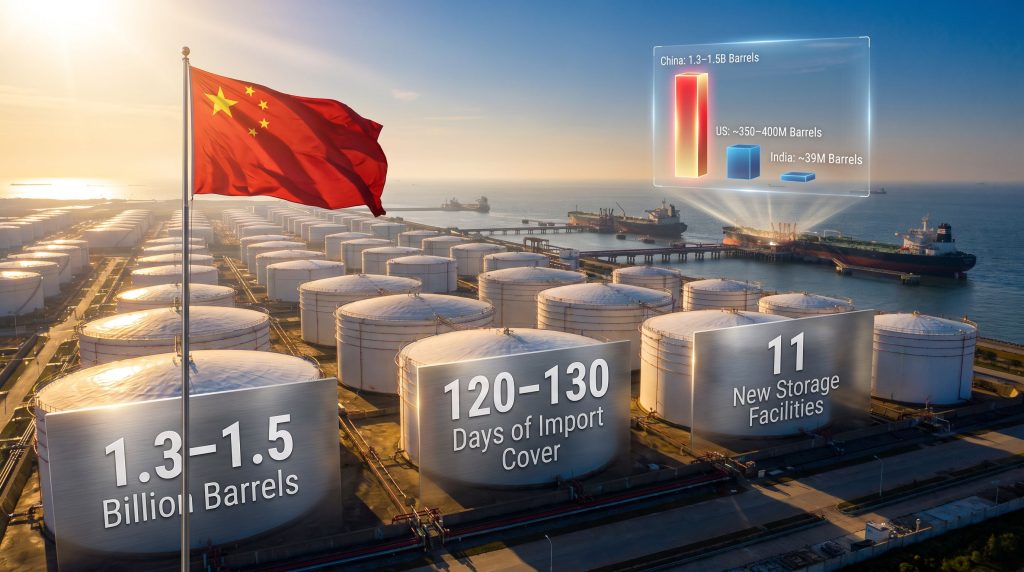
A landmark piece of legislation passed in January 2025 formally unified these two tiers under a single national reserve governance framework, eliminating the operational ambiguity that had previously existed between state holdings and commercial inventories. This regulatory consolidation was not merely administrative. It gave Beijing a unified command structure over an inventory pool estimated at 1.3 to 1.5 billion barrels as of late 2025, representing more than 120 days of average import coverage and substantially exceeding the International Energy Agency's recommended minimum of 90 days.
China's reserve system is not a passive buffer against supply shocks. It is an actively managed instrument of energy sovereignty, combining the scale of a government emergency stockpile with the operational flexibility of commercial inventory management across multiple state enterprises.
The Numbers Behind the Fortress: Scale, Expansion, and Targets
The raw scale of China's petroleum reserve program places it in an entirely different category from any comparable national initiative. The figures, drawn from indirect estimation methods given Beijing's deliberate lack of official disclosure, are striking in their magnitude.
| Metric | Estimated Figure | Benchmark Context |
|---|---|---|
| Total petroleum reserves (late 2025) | 1.3–1.5 billion barrels | Exceeds 120 days of average import cover |
| Government-held SPR (Dec 2025) | ~360 million barrels | Broadly comparable to U.S. SPR capacity |
| Daily stockpiling rate (2025) | ~1.1 million barrels/day | Equivalent to the full output of a mid-sized OPEC producer |
| IEA recommended minimum | 90 days of net imports | China's holdings exceed this threshold by 30–40 days |
| Long-term storage ambition | Up to 2 billion barrels | Approximately six months of import coverage |
Between 2025 and 2026, China is actively developing 11 new storage facilities designed to add approximately 169 million barrels of incremental capacity to the existing network. The long-term strategic ceiling of 2 billion barrels would represent roughly six months of total import coverage, a figure with no meaningful precedent in the history of national petroleum reserve programs.
An intermediate benchmark of 1 billion barrels, broadly equivalent to three months of imports, has already been surpassed. This pace of accumulation is not incidental. China imported a record 11.55 million barrels per day in 2025, representing approximately 16% of total global oil demand. According to recent EIA analysis, a meaningful portion of this import surge reflected deliberate stockpiling rather than consumption-driven demand growth, with the daily accumulation rate of roughly 1.1 million barrels per day effectively functioning as an ongoing strategic purchasing campaign disguised within the broader import data.
Counter-Cyclical Procurement: The Hidden Financial Logic of Stockpiling
One of the least widely understood dimensions of China oil stockpile strategy is its financial architecture. Beijing has developed a systematic approach to procurement timing that converts global price volatility and geopolitical isolation of sanctioned producers into a direct cost advantage for reserve-building.
How Does the Procurement Logic Work?
The operational logic works as follows: when global crude prices fall due to demand weakness, supply gluts, or market uncertainty, Chinese state buyers accelerate purchasing and divert excess volumes into reserve storage. When prices are elevated, purchasing slows or pauses entirely. This counter-cyclical discipline means that the average per-barrel acquisition cost of China's strategic inventory is structurally lower than spot market prices at any given moment of crisis.
A second, equally significant dimension involves sanctioned suppliers. Russia, Iran, and Venezuela, all of which face restrictions on their ability to sell crude into Western-aligned markets, routinely offer discounts of $5 to $20 per barrel below benchmark prices to access Chinese buyers. China's willingness to absorb these volumes serves a dual purpose: it deepens supply relationships with producers outside Western energy networks while simultaneously reducing the per-barrel cost of building the world's largest petroleum stockpile.
This procurement approach explains why China's 4.4% increase in crude imports in 2024 to 2025 was not simply a reflection of economic growth. It was, in substantial part, a deliberate and financially optimised reserve accumulation campaign executed at scale. These dynamics are further complicated by the ongoing US-China trade war, which has added additional incentive for Beijing to accelerate energy self-sufficiency measures.
The Hormuz Test: How China's Reserve Architecture Performed Under Real Crisis Conditions
The theoretical value of a petroleum reserve is always subject to the question of whether it performs as intended when genuinely tested. The effective closure of the Strait of Hormuz, through which approximately 20% of global energy supplies previously transited, provided the most significant real-world stress test of China's reserve architecture in its history.
The crisis sent Brent crude surging from approximately $72 per barrel to a peak of $118 per barrel in late March, representing a 64% price spike within weeks. Global markets faced the loss of more than 13 million barrels per day of Middle Eastern export volumes, a disruption of a scale that most analysts had modelled as a theoretical extreme scenario.
How Did China Respond to the Disruption?
China's response confounded market expectations. Rather than competing aggressively for alternative supplies at crisis-elevated prices, Beijing deployed a three-lever response that drew on the full operational breadth of its energy management toolkit:
- Import compression at scale: June crude deliveries fell more than 41% year-on-year to just 7.12 million barrels per day, the lowest level recorded since October 2016, extending a sharp decline first visible in May customs data.
- Refinery throughput reduction: Processing activity was cut to approximately 12.5 million barrels per day in June, down 18% year-on-year and the lowest throughput figure since the height of the COVID-19 pandemic in March 2020.
- Refined product export suspension: China suspended exports of gasoline, diesel, and jet fuel entirely in March, prioritising domestic supply adequacy over regional market commitments.
What makes this response analytically remarkable is the restraint it demonstrated. Despite the severity of the disruption, inventory drawdowns between April and June were estimated at a relatively contained 500,000 to 1 million barrels per day. Beijing chose to absorb the supply shock primarily by reducing refining activity rather than deploying its full reserve capacity, which means the strategic depth of the Chinese petroleum stockpile remains, in the words of analysts tracking the situation, largely untested.
The deliberate restraint in reserve deployment during the Hormuz crisis carries a significant strategic implication: if China can absorb a loss of over 13 million barrels per day of Middle Eastern exports while barely drawing on its strategic reserves, the full capability of that stockpile represents a form of untapped energy power that no other importing nation can match.
Regional Fallout: The Consequences of China's Refined Product Suspension
China's decision to suspend refined product exports in March was framed domestically as a supply security measure, but its consequences rippled across Asian energy markets with immediate severity. In 2025, China exported approximately 800,000 barrels per day of refined petroleum products, representing roughly 12% of total Asian refined fuel imports. The abrupt removal of this supply from regional markets triggered acute fuel shortages across multiple economies.
Australia, Bangladesh, and the Philippines were among the most immediately and severely affected, exposing a structural dependency that had developed gradually as Chinese refining overcapacity emerged as a reliable regional supply backstop. The episode revealed that the integration of Chinese refined fuel exports into Asian supply chains had proceeded faster than the development of alternative supply infrastructure.
Beijing partially reinstated refined product exports in July, providing some relief to regional markets. However, the episode permanently altered the risk calculus for energy planners across Southeast Asia and the broader Indo-Pacific. Nations whose domestic fuel supply chains have become structurally dependent on Chinese refining output now face a category of supply risk that is distinct from traditional producer-side disruptions: it is policy-driven, opaque in its advance signals, and potentially deployable with minimal warning.
The next major ASX story will hit our subscribers first
From Price Taker to Price Maker: A Structural Shift in Market Hierarchy
For the better part of three decades, China occupied a clearly defined role in global oil markets. It was the world's most consequential source of incremental demand growth, a buyer whose purchasing volumes responded to global conditions rather than shaping them. This characterisation was not merely analytical. It was structural: without the reserve depth to absorb supply shocks independently, China's import behaviour during crises was necessarily reactive.
The Hormuz disruption altered this characterisation fundamentally. By compressing imports at the scale of millions of barrels per day during a global supply shock, China's purchasing decisions became a primary variable in determining whether the global economy could absorb the disruption at all. Consequently, the capacity to adjust import volumes rapidly at this scale confers a form of market influence that economists typically associate with major producers rather than major consumers.
The oil market trade war impact has further accelerated this transition, incentivising Beijing to weaponise its reserve depth as a buffer against externally imposed economic pressure. Several structural enablers underpin this transition:
| Enabler | Detail | Strategic Impact |
|---|---|---|
| Pre-built inventory depth | 1.3–1.5 billion barrels in storage | Eliminates urgency to buy at crisis-elevated prices |
| Record domestic production | 4.3 million bpd in 2025 | Reduces import dependency at the margin |
| Accelerating EV adoption | Rapid electrification of passenger transport fleet | Structurally suppresses long-term crude demand growth |
| Refining overcapacity | Ability to curtail throughput without triggering supply crisis | Provides operational buffer during disruptions |
| Sanctioned supplier access | Discounted crude from Russia, Iran, Venezuela | Maintains procurement optionality outside Western-aligned markets |
The combination of these factors means that China's import behaviour is no longer a straightforward function of domestic consumption needs. It is a managed variable that Beijing can deploy as an instrument of market influence in either direction, buying aggressively to support price floors during downturns or withdrawing from markets to avoid fuelling price spikes during crises.
The Paradox of the Electrostate: Building a Fortress for a Fuel It Will Need Less
One of the most intellectually striking features of China's energy strategy is the simultaneous pursuit of two apparently contradictory objectives. On one hand, Beijing is constructing the world's largest petroleum reserve, with ambitions to reach 2 billion barrels of total storage capacity. On the other hand, China's domestic electric vehicle transition is proceeding at a pace that will structurally suppress long-term crude import growth.
Domestic crude production reached a record 4.3 million barrels per day in 2025, reducing the gap between consumption and imports. EV fleet expansion is accelerating across passenger vehicle segments, and government targets for electrification are among the most ambitious of any major economy. As this transition deepens, the long-term trajectory of Chinese crude import demand flattens, gradually reducing the strategic imperative for maintaining the enormous petroleum fortress Beijing has spent decades assembling.
This creates what analysts have begun to describe as the electrostate paradox: China is reaching peak petroleum fortress capacity at precisely the moment when the long-term case for petroleum dependency is weakening. The reserve program's strategic logic remains sound for the medium term, but its eventual obsolescence is being engineered in parallel by the same government that is funding its expansion.
How China's SPR Compares to Other Major Reserve Programs
The scale of China's petroleum reserve achievement is best understood in comparative context. Against established national reserve programs, the Chinese system stands apart on virtually every dimension of size, flexibility, and governance complexity.
| Country/Bloc | Estimated Reserve Volume | Days of Import Cover | Governance Model |
|---|---|---|---|
| China | 1.3–1.5 billion barrels | 120–130 days | Hybrid: state SPR and mandated commercial reserves |
| United States | ~350–400 million barrels | ~25 days of consumption | Government-controlled federal SPR |
| Japan | ~300 million barrels | 150+ days (smaller economy) | Government plus industry combined |
| IEA Member Average | Varies by country | 90-day minimum requirement | National government mandates |
| India | ~39 million barrels (SPR) | ~9–10 days | Government-controlled, actively expanding |
China's reserve architecture differs from the U.S. model in one particularly consequential way: by integrating mandated commercial inventories with state reserves, the combined pool is substantially larger and more operationally flexible than a purely government-held facility. As detailed on China's strategic petroleum reserve documentation, the U.S. Strategic Petroleum Reserve requires congressional and executive approval processes before release, operating within a slower decision cycle than China's unified system.
Perhaps most strategically significant is Beijing's deliberate opacity around inventory data. No official figures on reserve levels, drawdown rates, or geographic distribution of storage facilities are publicly disclosed. This informational asymmetry is not an accidental feature of Chinese energy governance. It is a calculated strategic asset: uncertainty about the true scale and deployment readiness of Chinese reserves complicates the ability of competing governments, OPEC members, and market participants to anticipate or counter Beijing's moves.
Geopolitical Consequences: Energy Interdependence as a Declining Constraint
The post-Cold War global energy order rested on a premise of mutual vulnerability. Major consumers and producers were bound together by supply chains that neither could sever without inflicting severe economic damage on themselves. This mutual exposure created a form of enforced interdependence that moderated the most aggressive impulses of energy geopolitics.
China's reserve architecture systematically erodes this constraint from Beijing's side of the equation. As the depth of Chinese petroleum reserves grows, the leverage that supply disruptions, sanctions threats, and market pricing pressures can exert on Chinese policy behaviour diminishes correspondingly. This shift has profound implications for how the international community can respond to Chinese foreign policy actions that might otherwise invite energy-sector pressure.
The asymmetry this creates between China and other large importing economies is equally significant. Nations including India, Japan, South Korea, and the European economies remain structurally exposed to supply disruptions in ways that China, increasingly, does not. This divergence in vulnerability, shaped further by broader geopolitical trade tensions, could reshape energy diplomacy across the Indo-Pacific and beyond.
The United States, with its own strategic reserve capacity and domestic production flexibility following the shale revolution, represents the most direct counterpart to China's energy autonomy. The tension between two reserve-holding giants, each capable of influencing global oil market balances through inventory management, represents an emerging axis of energy geopolitics that will define market dynamics for the decade ahead. Furthermore, crude oil price geopolitics suggest this rivalry will only intensify as both nations refine their respective reserve strategies.
Frequently Asked Questions: China Oil Stockpile Strategy
How much oil does China have in strategic reserves?
China's total petroleum inventory, combining government-controlled SPR facilities with mandated commercial reserves held by state energy companies, is estimated at approximately 1.3 to 1.5 billion barrels as of late 2025. Government-held reserves alone are estimated at around 360 million barrels. Combined holdings represent more than 120 days of average import coverage, substantially exceeding the IEA's 90-day minimum recommendation.
Why is China building such large oil reserves?
China's reserve program is driven by overlapping energy security imperatives, geopolitical hedging objectives, and market strategy considerations. As the world's largest crude oil importer, accounting for approximately 16% of global demand, China is structurally exposed to supply route disruptions, sanctions risks on its primary discounted suppliers, and price volatility. The reserve program reduces this vulnerability while simultaneously enabling Beijing to influence global oil prices through managed import volume adjustments.
Does China publish official data on its strategic petroleum reserves?
No. Beijing does not disclose official inventory levels, reserve movements, drawdown rates, or geographic storage distribution. Analysts estimate Chinese inventory positions using indirect calculation methods, primarily by subtracting refinery throughput figures from the combined total of crude imports and domestic production. This opacity is widely regarded as a deliberate and strategically valuable feature of China's energy governance framework.
How does China's oil stockpile strategy affect global oil prices?
The reserve program influences global prices through two primary mechanisms. Counter-cyclical stockpiling during price downturns absorbs excess supply and supports price floors. Import compression during supply shocks, as demonstrated during the Hormuz disruption when June imports fell more than 41% year-on-year, reduces demand pressure precisely when prices would otherwise spike most severely, effectively functioning as a demand-side stabiliser in global markets.
What is the long-term storage target for China's petroleum reserve program?
China's long-term strategic storage ambition is estimated at up to 2 billion barrels, representing approximately six months of import coverage. An intermediate target of 1 billion barrels has already been surpassed. Between 2025 and 2026, 11 new storage facilities are under development, designed to add approximately 169 million barrels of additional capacity to the existing network.
How does China's reserve strategy affect Asian fuel markets?
China's position as a major exporter of approximately 800,000 barrels per day of refined petroleum products in 2025, representing roughly 12% of Asian refined fuel imports, means that Beijing's domestic energy management decisions have direct and immediate consequences for fuel availability across the region. The temporary suspension of refined product exports during the Hormuz crisis triggered acute supply shortages in Australia, Bangladesh, and the Philippines, establishing a precedent for policy-driven supply interruptions with limited advance warning to dependent markets.
Want to Know Which ASX Companies Are Positioned to Benefit From the Next Major Commodity Discovery?
Discovery Alert's proprietary Discovery IQ model delivers real-time alerts on significant ASX mineral discoveries, transforming complex geological and market data into actionable investment insights — so subscribers can identify opportunities ahead of the broader market. Explore historic examples of exceptional discovery returns and start your 14-day free trial at Discovery Alert to position yourself at the forefront of the next major find.