August 25, 2026
The Chokepoint That Is Choking Itself: How Strait of Hormuz Oil Bypass Pipelines Are Reshaping Middle East Energy
Picture a weapon that becomes less effective every time it is used. That is the strategic paradox now confronting Iran as it leverages the Strait of Hormuz amid an escalating confrontation with the United States. The more pressure Tehran applies to the world's most critical oil transit corridor, the faster capital flows into the infrastructure designed to make that corridor irrelevant. By the time the current conflict resolves, the geopolitical chessboard will have shifted in ways that cannot be undone, regardless of who claims a diplomatic victory.
This is not a distant theoretical outcome. It is a pipeline buildout already underway, financed by nations with both the resources and the urgency to see it through. Furthermore, the geopolitical trade tensions driving this acceleration show no signs of easing in the near term.
When big ASX news breaks, our subscribers know first
The Scale of Hormuz and Why It Cannot Simply Be Replaced Overnight
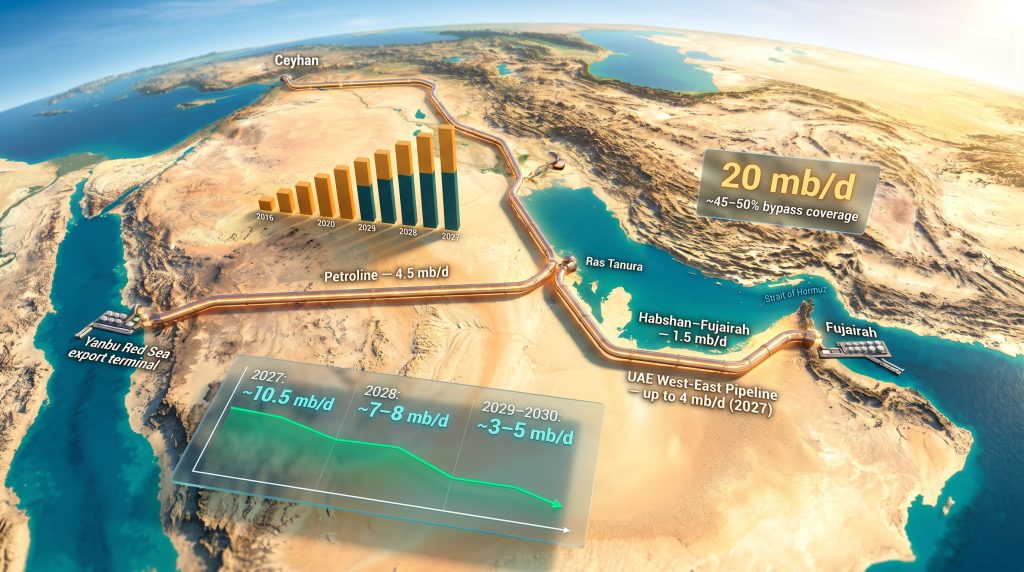
Understanding the challenge requires appreciating just how dominant the Strait of Hormuz has been as an oil transit corridor. Before the current conflict, the strait carried approximately 20 million barrels per day (mb/d) of hydrocarbons, representing roughly 20% of total global oil supply. That volume breaks down into an estimated 15 mb/d of crude oil and a further 5 mb/d of refined petroleum products.
Critically, Iran itself contributed around 3 mb/d to that total. The remaining 17 mb/d originated from neighbouring Gulf states, meaning Hormuz has always been a collective vulnerability for the entire region, not merely a bilateral pressure point between Tehran and Washington.
Of that 17 mb/d, Saudi Arabia and the UAE have already redirected approximately 5 mb/d through existing pipeline infrastructure. That leaves a residual 12 mb/d requiring new routing solutions, which is precisely what is now being pursued at an accelerating pace through a combination of Strait of Hormuz oil bypass pipelines, export terminal upgrades, and cross-border diplomatic arrangements that would have seemed implausible just a few years ago.
Existing Bypass Infrastructure: The Inventory of What Already Works
Several operational pipeline systems already provide partial alternatives to Hormuz transit. Their combined capacity falls well short of what is needed, but they represent the foundation on which expanded bypass architecture is being built.
| Pipeline | Country | Capacity (mb/d) | Export Terminal | Status |
|---|---|---|---|---|
| East-West Pipeline (Petroline) | Saudi Arabia | 5.0-7.0 (effective ~4.5) | Yanbu, Red Sea | Fully operational |
| Habshan-Fujairah Pipeline | UAE | 1.5-1.8 | Fujairah, Gulf of Oman | Operational |
| Kirkuk-Ceyhan Pipeline | Iraq | ~1.6 | Ceyhan, Turkey | Largely dormant |
| Goreh-Jask Pipeline | Iran | 1.0 | Jask, Gulf of Oman | Operational |
| Saudi-Bahrain Pipeline | Saudi Arabia/Bahrain | Minor | Bahrain refineries | Regional function only |
The aggregate effective bypass capacity across these systems totals roughly 9 to 10 mb/d, representing a coverage ratio of approximately 45 to 50% of pre-conflict Hormuz throughput. That gap of 10 to 11 mb/d is the strategic deficit now driving an infrastructure investment cycle of historic regional significance. Monitoring crude oil price trends during this period reveals just how sensitively markets are responding to every development in bypass capacity planning.
A chokepoint retains leverage only as long as it carries traffic that cannot be rerouted. Every disruption event compresses the investment timeline for alternatives, directly eroding the very leverage the disruption was designed to project.
Why Pipelines Can Be Built Faster Than Most People Assume
One of the less appreciated dimensions of this story is that the engineering challenge of constructing major oil pipelines is far less daunting than the political one. Historical precedents from the region itself confirm this.
The Trans-Arabian Pipeline (Tapline), a 1,640-kilometre conduit running from eastern Saudi Arabia through Jordan and Syria to the Lebanese coast, was completed in just 3.5 years and entered service in 1950. During the 1980s, both construction phases of the Iraq-Saudi Arabia Pipeline (IPSA) were each completed in under four years, despite the regional instability of that era.
These timelines demonstrate that when political conditions allow, large-scale pipeline infrastructure can be delivered within a single US presidential term. The constraint has never been the steel or the pumping stations. It has always been the diplomatic architecture required when a pipeline crosses an international border.
This is a crucial distinction. Saudi Arabia and the UAE enjoy the singular advantage of being able to build new bypass capacity entirely within their own sovereign territory, with no need for cross-border agreements. Every other regional player, including Iraq, Kuwait, and any future entrants, must navigate the region's complex web of bilateral relationships to reach a coastline.
What has changed, however, is that the regional diplomatic environment has shifted materially. The normalisation of relations between Damascus and Riyadh, and the improving relationship between Baghdad and Ankara, have opened routing possibilities that would have been dismissed as unrealistic as recently as 2023. The rusting remnants of abandoned pipelines built between the 1950s and the 1990s stand as monuments to previous failed attempts, but the geopolitical conditions that doomed those projects no longer fully apply.
The New Pipeline Projects: Who Is Building What and When
UAE: The Most Advanced Near-Term Capacity Addition
Abu Dhabi is the furthest advanced in terms of shovel-in-ground progress. A new West-East pipeline was approximately 50% complete as of mid-2026, with operational status targeted for end of 2027. The project is designed to carry up to 1.5 mb/d, and when combined with the existing Habshan-Fujairah system, would bring total UAE bypass capacity to over 5.5 mb/d.
Beyond that, the UAE is actively evaluating a third pipeline that could further reduce Hormuz-dependent volumes to approximately 9 mb/d. The significance of the UAE's position cannot be understated: it sits at the southern end of the Persian Gulf with direct access to the Gulf of Oman via Fujairah, allowing export routing that completely circumvents the strait's narrow 33-kilometre navigable channel.
Saudi Arabia: The Largest Potential Capacity Expansion
Saudi Arabia holds the most significant expansion potential of any single actor in this buildout. Internal planning for expansions to the East-West Petroline and capacity upgrades at its twin Red Sea terminals at Yanbu and Al Muajjiz are in advanced stages, though final investment decisions have not yet been publicly announced.
Conservative estimates suggest the kingdom could add 2 to 4 mb/d of additional bypass capacity before 2030 if those investment decisions are made promptly. Saudi Arabia is also in active discussions with Kuwait regarding shared bypass arrangements, a development with considerable strategic weight given Kuwait's geographic position at the northern end of the Persian Gulf, where it has the least favourable access to alternative routing.
Iraq: The Mediterranean Routing Challenge
Baghdad is evaluating two primary corridors. The first is a northern route via Turkey, leveraging the largely dormant Kirkuk-Ceyhan pipeline system to access Mediterranean export terminals. The second is a western route through Syria, which has become more viable following the end of the Syrian civil conflict and the broader diplomatic rehabilitation of Damascus.
Two additional proposals are at earlier conceptual stages: a projected Iraq-Jordan pipeline targeting 1 mb/d to the Red Sea port of Aqaba, and a more ambitious Iraq-Oman pipeline with a projected capacity of 2.5 mb/d to the port of Duqm on Oman's southern coast.
A significant complication for the Iraqi routing options is that Mediterranean terminals primarily serve European import markets, which are in structural long-term demand decline. The major growth markets for Gulf crude, including China, India, Japan, and South Korea, are all in Asia, which requires either Red Sea access or Gulf of Oman routing to service efficiently.
A Phased Outlook for Bypass Capacity Growth Through 2030
| Phase | Key Infrastructure Addition | New Capacity (mb/d) | Cumulative Bypass (mb/d) | Hormuz Residual (mb/d) |
|---|---|---|---|---|
| Baseline 2026 | Existing operational pipelines | 9-10 | 9-10 | ~10-11 |
| Near-term 2027 | UAE West-East pipeline Phase 1 | +1.5 | ~11 | ~10.5 |
| Mid-term 2028 | UAE third pipeline + Saudi Petroline expansion | +2-3 | ~13-14 | ~7-8 |
| Longer-term 2029-2030 | Saudi Red Sea terminal upgrades + Kuwait arrangements | +2-4 | ~16-17 | ~3-5 |
These figures represent estimated scenarios based on reported planning activity. Actual outcomes depend on geopolitical conditions, final investment decisions, and construction execution timelines.
Iranian parliamentary speaker Mohammad Bagher Ghalibaf publicly acknowledged the self-defeating nature of restricting Hormuz traffic, stating that the strait's value is tied directly to increasing throughput, not decreasing it. His warning went largely unheeded by hardliners within Iran's security establishment.
The next major ASX story will hit our subscribers first
The Resilience Question: Are Pipelines Actually Safer Than Tankers?
A sceptical reading of the bypass pipeline thesis focuses on terminal vulnerability. Unlike dispersed tanker fleets that can be rerouted, export terminals represent fixed, concentrated infrastructure that can themselves become targets. Yanbu on the Red Sea, Fujairah on the Gulf of Oman, and Ceyhan on the Turkish Mediterranean coast each carry their own security risk profiles.
The current conflict has, however, provided a real-world stress test that has partially answered this question. Iranian efforts to disrupt Saudi and UAE pipeline operations have thus far failed to achieve meaningful interruption. The infrastructure has proven more resilient in practice than pre-conflict threat assessments suggested.
What pipelines categorically eliminate is exposure to:
- Naval interdiction in congested maritime chokepoints
- Escalating war-risk insurance premiums that can make voyages commercially unviable
- Tanker availability constraints that develop when ship operators reroute fleets away from conflict zones
- The physical vulnerability of slow-moving vessels in narrow, easily monitored waterways
These advantages are structural, not circumstantial. They persist regardless of whether the current conflict resolves quickly or drags on. Consequently, the trade war oil impact on shipping economics has only reinforced the investment case for fixed bypass infrastructure.
Three Scenarios for How This Unfolds
The trajectory of global oil markets over the next three to five years depends heavily on how long Hormuz disruption persists. Three distinct scenarios frame the range of plausible outcomes:
Scenario A: Prolonged Disruption (12 to 24 months)
Oil prices spike substantially. US Strategic Petroleum Reserve releases and demand destruction in price-sensitive economies provide partial offsetting pressure. Pipeline construction programmes shift to emergency timelines, compressing delivery schedules. Asian importers accelerate long-term offtake agreements for bypass capacity that does not yet exist.
Scenario B: Intermittent Disruption (recurring 3 to 6 month cycles)
War-risk insurance and freight premiums become structurally elevated even during quiet periods, permanently altering the economics of seaborne Hormuz transit. Investment in bypass infrastructure reaches peak velocity as Gulf states and Asian importers jointly fund acceleration. The pipeline buildout proceeds on a commercially driven timeline rather than a crisis timeline.
Scenario C: Resolution Before 2028
Diplomatic settlement reduces acute pressure on Hormuz. However, pipeline programmes already past their final investment decision points continue to completion. The structural reduction in Hormuz dependency proceeds regardless, simply at a slightly slower pace.
In every scenario, the long-run outcome is the same: Hormuz carries a progressively smaller share of global oil supply by 2030. The difference between scenarios is only speed, not direction.
The Asymmetric Endgame: Why Iran Faces a Structural Disadvantage Over Time
The deepest strategic miscalculation embedded in Iran's Hormuz leverage strategy is that it treats a static infrastructure map as though it were permanent. In reality, the map is being redrawn in real time, and the redrawn version contains significantly less Iranian leverage. The OPEC market influence on production decisions adds yet another layer of complexity to how these dynamics ultimately play out for global supply.
By 2030, even conservative modelling of the pipeline buildout suggests Hormuz-dependent volumes could fall to 5 mb/d or below, down from approximately 20 mb/d before the conflict began. That represents a reduction of roughly 75% in the strait's strategic throughput weight within a single decade.
The leverage that makes Hormuz valuable as a pressure instrument is directly proportional to the volume of traffic it carries. As bypass infrastructure comes online, that leverage curve bends downward, and it does not bend back. Even a comprehensive diplomatic resolution of the current conflict would leave the pipeline programmes already underway running to completion, permanently altering the energy transit architecture of the Middle East.
For energy market participants, infrastructure investors, and policymakers tracking Asian import security, this structural shift carries implications that extend well beyond the current conflict. Nations that lock in long-term offtake agreements from Red Sea and Gulf of Oman bypass terminals over the next two to three years will be securing supply chains that are materially more resilient than anything Hormuz-dependent routing can offer. The oil price rally observed in recent months has only sharpened this calculus for import-dependent nations seeking alternatives.
Indeed, analysts tracking Gulf energy alternatives have noted that the financial case for bypass investment has never been stronger, with the cost of inaction now clearly exceeding the cost of construction across virtually every modelled scenario.
The chokepoint is choking itself. And the infrastructure being built to replace it will outlast whatever political resolution eventually emerges.
Readers seeking further context on Middle East oil transit infrastructure and the geopolitics of global energy routing may find additional reporting through ET EnergyWorld's Oil & Gas coverage a useful supplement to this analysis. This article contains forward-looking assessments and scenario projections that involve material uncertainty. Actual infrastructure timelines, capacity figures, and geopolitical outcomes may differ significantly from estimates presented here.
Want to Stay Ahead of the Next Major Resource Discovery?
Whilst global energy infrastructure undergoes this structural transformation, significant commodity discoveries continue to emerge on the ASX — and Discovery Alert's proprietary Discovery IQ model ensures subscribers receive real-time alerts the moment they are announced, turning complex data across 30+ commodities into clear, actionable opportunities. Explore historic discoveries and their remarkable returns, then begin your 14-day free trial at Discovery Alert to position yourself ahead of the broader market.