August 8, 2026
Strategic Energy Infrastructure Evolution
Global energy security frameworks undergo constant transformation as nations adapt to shifting geopolitical landscapes and supply chain vulnerabilities. Modern economies increasingly recognise that energy independence extends beyond domestic production capabilities to encompass sophisticated storage and distribution networks. China oil stockpiling has emerged as a critical component of national resilience strategies, enabling countries to weather market volatility while maintaining economic stability during potential disruptions.
The architecture of strategic energy reserves reflects broader economic philosophies about state intervention in commodity markets. Nations implementing comprehensive stockpiling programmes demonstrate sophisticated understanding of how inventory management can influence global pricing dynamics while providing domestic policy flexibility. These systems operate through complex interactions between government oversight, commercial participation, and technological innovation that reshape traditional supply-demand relationships.
When big ASX news breaks, our subscribers know first
Understanding China's Strategic Petroleum Reserve Framework
China's systematic approach to energy security represents a fundamental evolution in strategic reserve management. The nation has implemented a comprehensive framework that integrates government strategic petroleum reserves with mandated commercial stockpiles under centralised oversight. This dual-tier system combines traditional strategic reserves maintained by government entities with requirements for commercial operators to maintain specified inventory levels.
Current Storage Infrastructure Scale
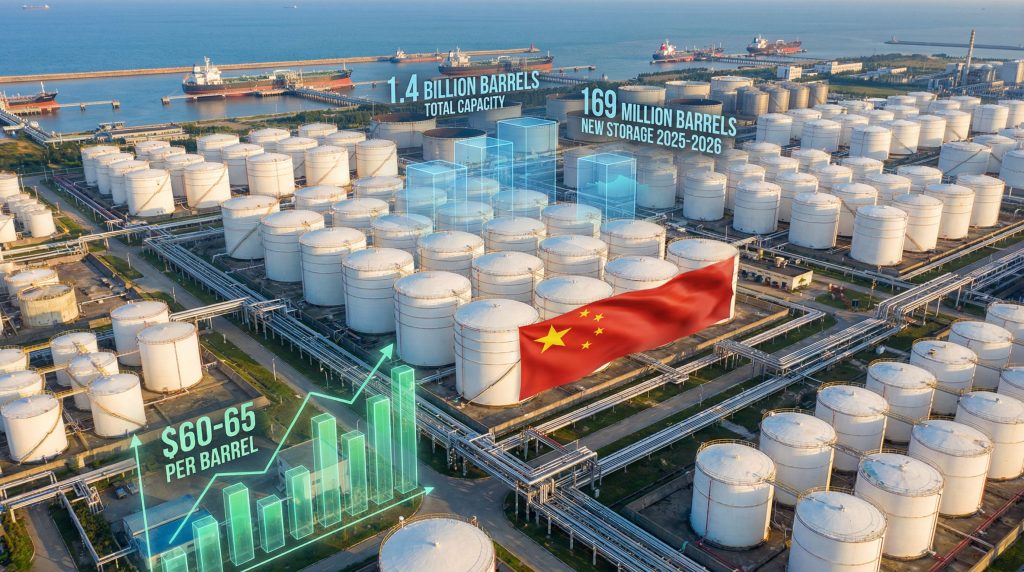
According to December 2025 data from Oilprice.com, China's total oil storage currently exceeds 1.5 billion barrels as measured by Kpler monitoring systems. Energy Aspects analysis indicates total storage capacity reaches 2 billion barrels, providing substantial room for continued accumulation. The nation maintains approximately 121 days of import coverage at current consumption rates, significantly exceeding the International Energy Agency's 90-day benchmark standard.
Expansion Timeline and Capacity Development
China has initiated construction of 11 new storage facilities with combined capacity of 169 million barrels scheduled for completion during 2025-2026. OilX data reveals that current storage caverns operate at only 50 percent capacity, indicating substantial unutilised space even before new facilities come online. This suggests the nation possesses significant headroom to continue accumulation through 2026 and beyond without approaching practical storage limitations.
Furthermore, this massive expansion programme demonstrates how energy transition challenges affect global infrastructure planning. The scale of China's investment reflects broader recognition that traditional supply chain vulnerabilities require comprehensive strategic responses.
Legislative Framework Integration
The 2025 legislative framework requires companies to maintain social responsibility stocks under government supervision, creating unified oversight of both strategic and commercial inventories. This integration enables coordinated response to market disruptions while distributing storage costs across public and private sectors.
The Economics of China's Reserve Accumulation
Quantitative Analysis of Current Holdings
China oil stockpiling velocity has averaged between 900,000 to 1 million barrels daily throughout 2025, representing approximately 0.9 percent of global oil production. November 2025 import data shows China's crude oil imports increased 5 percent year-on-year, with daily averages reaching 12.38 million barrels. This persistent accumulation removes substantial volumes from global spot markets, creating material demand factors for price support.
| Storage Metrics | Current Status | 2026 Projections |
|---|---|---|
| Total Storage Capacity | 1.5-2.0 billion barrels | 2.2-2.4 billion barrels |
| Strategic Government Reserves | 400-500 million barrels | 550-650 million barrels |
| Commercial Stocks | 1.0-1.5 billion barrels | 1.4-1.8 billion barrels |
| Import Coverage Days | 121+ days | 140+ days |
| Utilization Rate | 50-75% | 70-85% |
Investment Capital and Infrastructure Costs
The current construction phase represents approximately $8-12 billion in storage infrastructure investment. This translates to roughly $47-71 per barrel of installed capacity across the 169 million barrel expansion programme. These costs encompass engineering, construction, and specialised equipment for both underground cavern systems and surface tank farm configurations.
Forecasting Methodology Variations
Different forecasting firms employ varying methodologies to estimate China oil stockpiling rates, creating substantial variance in projections. Reuters calculates storage accumulation by subtracting imports from refinery run rates, yielding a 990,000 barrels daily average. FGE forecasts 600,000 barrels daily for 2026, while Citigroup projects 900,000 barrels daily continuing into 2026. These variations reflect the absence of official Chinese government data on oil storage levels.
Market Impact and Price Dynamics
Price Support Mechanisms and Threshold Analysis
China's counter-cyclical purchasing strategy appears to activate when oil prices approach the $60-65 per barrel range. This mechanism operates through state-owned enterprise guidance rather than explicit government decrees, providing flexibility to respond to market conditions. The system functions as an automated price stabiliser, increasing purchases during market downturns and reducing acquisition rates when prices rise above threshold levels.
However, recent oil-price trade war dynamics and evolving US-China trade war tensions have created additional complexity in these threshold mechanisms.
Supply Absorption and Market Balance Effects
The International Energy Agency revised its supply surplus projection from 4.09 million barrels daily to 3.84 million barrels daily, a reduction of 250,000 barrels daily based on stronger-than-expected demand. Global oil supply decreased 610,000 barrels daily in November compared to October, and fell 1.5 million barrels daily from September's peak. China oil stockpiling alone exceeds these supply variations, indicating the magnitude of its market impact.
Current Price Environment Analysis
As of December 2025, crude benchmarks reflected the stabilising influence of Chinese accumulation:
- WTI Crude: $57.44
- Brent Crude: $61.12
- Murban Crude: $62.18
These price levels demonstrate how systematic Chinese purchasing has created stability within the anticipated support range, reducing volatility typically associated with supply-constrained markets. For instance, the current pricing environment contrasts sharply with previous scenarios outlined in comprehensive oil-price crash analysis.
Geopolitical and Strategic Implications
Energy Security and Diplomatic Leverage
China's reserve accumulation provides substantial geopolitical advantages beyond basic energy security. With 120+ days of import coverage, China has positioned itself among the world's most energy-secure major economies. This enhanced security provides diplomatic flexibility in international negotiations and reduces vulnerability to supply disruption threats.
Strategic Response Capabilities
The integrated commercial-strategic framework enables Beijing to implement coordinated market responses during geopolitical tensions. Large reserves provide buffering capacity against sanctions or supply restrictions while maintaining economic continuity during potential disruptions. This capability enhances China's negotiating position in energy-related diplomatic discussions.
Regional Influence and Partnership Development
Substantial reserve holdings enable China to develop enhanced bilateral energy partnerships with major producers. Suppliers increasingly focus on long-term Chinese contracts due to the predictable nature of strategic buying, creating shifted trading patterns that concentrate significant volumes within China's national system.
Infrastructure Development and Investment Flows
Regional Distribution of New Capacity
The 169 million barrel expansion across 11 facilities reflects strategic geographic distribution considerations:
| Region | New Capacity (Million Barrels) | Primary Operators | Strategic Significance |
|---|---|---|---|
| Eastern Coastal | 85 | Sinopec, CNOOC | Import hub proximity |
| Southern Provinces | 45 | CNPC, Sinopec | Refinery integration |
| Western Interior | 39 | CNPC | Pipeline terminus storage |
Technology and Engineering Specifications
Storage facilities utilise both underground cavern systems and surface tank farm configurations. Underground caverns provide enhanced security and environmental protection, while surface facilities offer operational flexibility and faster construction timelines. The mixed approach optimises both strategic protection and operational efficiency.
State-Owned Enterprise Coordination
Sinopec, CNOOC, and CNPC lead infrastructure development through coordinated planning that integrates storage expansion with existing refining and distribution networks. This coordination ensures optimal utilisation of transportation infrastructure while maintaining strategic distribution across multiple regions.
The next major ASX story will hit our subscribers first
Global Supply Chain Implications
Structural Changes in Oil Flow Patterns
China oil stockpiling creates fundamental changes in global oil distribution networks. The predictable nature of Chinese strategic buying provides market stability but concentrates significant volumes within a single national system. This concentration affects global price discovery mechanisms and trading pattern development.
Transportation and Logistics Impact
Continuous Chinese stockpiling affects global tanker demand and shipping rates. The massive scale of China's accumulation programme influences transportation patterns significantly, particularly when combined with factors such as US oil production decline, which affects global supply chain dynamics.
Enhanced demand for crude oil shipping capacity reflects the scale of China's accumulation programme. The Japan Times analysis highlights how this persistent demand creates structural shifts in global shipping patterns.
Supplier Relationship Evolution
Major oil producers increasingly prioritise long-term contracts with Chinese entities due to reliable demand patterns. This shift affects spot market liquidity and creates stronger bilateral relationships between producing nations and China. Traditional trading patterns adapt to accommodate China's strategic purchasing priorities.
Economic Security and Risk Management
Vulnerability Assessment and Mitigation
China's accelerated reserve programme responds to multiple risk factors identified by economic planners. Supply chain vulnerabilities exposed during recent geopolitical tensions highlight the importance of substantial domestic inventories. The reserve system provides economic continuity insurance against various disruption scenarios.
Risk Framework Categories
The comprehensive approach addresses several risk categories:
- Sanctions resilience: Large reserves reduce vulnerability to supply restrictions
- Price volatility buffer: Strategic timing capabilities for market entry and exit
- Economic continuity: Industrial operation maintenance during supply disruptions
- Geopolitical leverage: Enhanced negotiating position through energy security
Market Psychology and Confidence Effects
Substantial Chinese reserves create psychological market effects that extend beyond physical supply considerations. Energy traders and policymakers anticipate reduced vulnerability to supply shocks, which dampens speculative price increases. This confidence mechanism contributes to overall market stability.
Future Market Scenarios and Projections
Capacity Saturation Timeline Analysis
As China approaches optimal reserve levels, global oil markets may experience structural shifts. The transition from accumulation to maintenance phases could alter demand patterns and price dynamics significantly. Current projections suggest capacity constraints may begin influencing purchasing patterns by 2027-2028.
Scenario-Based Market Projections
| Scenario | Timeline | Market Impact | Price Range |
|---|---|---|---|
| Continued Building Phase | 2025-2027 | Sustained demand support | $60-70/barrel |
| Capacity Saturation Phase | 2027-2028 | Reduced strategic buying | Potential softening |
| Strategic Rotation Phase | 2028+ | Cyclical demand patterns | Increased volatility |
Demand Forecasting Complexity
FGE NexantECA's analysis creates analytical challenges by revising October apparent demand downward to 14.6 million barrels daily while expecting 2026 imports to rise due to strategic reserve building. This reflects recognition that reserve accumulation demand differs fundamentally from consumption demand, complicating traditional forecasting methodologies.
Technology and Monitoring Systems
Advanced Inventory Management Systems
China employs sophisticated monitoring technologies including satellite surveillance and automated inventory management systems. These capabilities enable precise reserve management while optimising storage utilisation across multiple facilities. Integration with supply chain tracking systems enhances both operational efficiency and strategic flexibility.
Data Collection and Analysis Framework
The absence of official Chinese government storage data necessitates reliance on satellite monitoring and indirect calculation methods. Private firms like Kpler, OilX, and Energy Aspects utilise various technologies to estimate inventory levels and storage utilisation rates. These systems provide market transparency despite limited official disclosure.
Operational Optimisation Technologies
AI-driven optimisation systems manage storage distribution and utilisation patterns across the national network. These technologies coordinate purchasing decisions with storage capacity availability while optimising transportation and logistics efficiency.
Investment and Financial Market Implications
Energy Sector Investment Opportunities
China's systematic reserve strategy creates investment opportunities across multiple energy sector segments. Storage infrastructure development requires specialised engineering and construction services. Transportation assets experience increased demand for crude oil shipping and pipeline capacity. Market timing strategies can benefit from understanding Chinese buying patterns.
Financial Market Considerations
Investment considerations for energy sector exposure include:
- Storage infrastructure: Opportunities in tank construction and management technology
- Transportation assets: Enhanced demand for shipping and pipeline capacity
- Market timing: Understanding Chinese purchasing patterns for trading strategies
- Technology providers: Systems for inventory management and monitoring
Risk Assessment for Portfolio Management
Understanding China oil stockpiling patterns becomes crucial for energy-related investment positioning. The systematic nature of accumulation affects volatility patterns and long-term demand projections. Portfolio managers must consider how Chinese reserve strategy influences sector risk profiles.
Policy Framework and Regulatory Environment
Legislative Innovation and Integration
Beijing's approach integrates strategic and commercial reserves through unified regulatory oversight. The 2025 legislative framework requiring commercial entities to maintain social responsibility stocks represents policy innovation in national energy security management. This model may influence international energy policy discussions and regulatory development.
Regulatory Coordination Mechanisms
Centralised oversight coordinates national energy security objectives with private sector capabilities. State-owned enterprises operate under government guidance while private companies comply with mandatory storage requirements. This hybrid approach distributes costs while maintaining strategic control.
International Policy Influence
China's comprehensive reserve framework may inspire similar approaches in other major economies. The scale and sophistication of the programme establishes new benchmarks for national energy security that could influence global strategic reserve standards and international energy policies.
Long-term Economic Implications
Global Energy Security Architecture
China's reserve programme establishes new benchmarks for national energy security that extend beyond traditional strategic petroleum reserve concepts. The integration of commercial and strategic storage under centralised oversight represents an evolution in energy security frameworks that may influence international standards and approaches.
Market Structure Evolution
The concentration of substantial oil volumes within China's reserve system creates structural changes in global energy markets. Reduced spot market volatility results from predictable Chinese demand, but this concentration also creates new forms of market risk related to Chinese policy decisions and strategic objectives.
Economic Modelling and Forecasting Challenges
Traditional oil demand forecasting models struggle to incorporate China oil stockpiling effects accurately. The distinction between consumption demand and strategic accumulation demand requires new analytical frameworks. This complexity affects both short-term trading decisions and long-term investment planning across the energy sector.
Systemic Risk and Resilience Factors
While China's reserve accumulation enhances domestic energy security, it creates potential systemic risks related to the concentration of global oil stocks within a single national system. The interplay between enhanced Chinese energy security and global market dependencies requires continued monitoring and analysis as the reserve system reaches maturity.
Disclaimer: This analysis is based on publicly available information and industry reports. Oil market projections involve substantial uncertainty, and actual outcomes may differ significantly from forecasted scenarios. Investment decisions should incorporate comprehensive risk assessment and professional financial advice.
Ready to Capitalise on the Next Major Energy Discovery?
Discovery Alert instantly alerts investors to significant ASX mineral discoveries using its proprietary Discovery IQ model, turning complex mineral data into actionable insights for the energy transition era. Understand why historic discoveries can generate substantial returns by visiting Discovery Alert's dedicated discoveries page, showcasing exceptional outcomes, and begin your 30-day free trial today to position yourself ahead of the market.