August 6, 2026
The Arbitrage Engine Reshaping Global Palladium Supply Routes
Commodity markets have always been shaped by the flow of capital chasing price differentials across geographic and structural boundaries. When a new futures exchange emerges in the world's largest commodity-consuming nation, and domestic contract prices begin to diverge meaningfully from established international benchmarks, the ripple effects can be felt across global supply chains within months. That is precisely the dynamic now unfolding in the platinum group metals market, where China palladium imports surge on Guangzhou futures premium activity has redrawn physical delivery patterns in ways that challenge conventional assumptions about who sets the price and who simply follows it.
When big ASX news breaks, our subscribers know first
How the Guangzhou Futures Exchange Premium Creates a Physical Delivery Incentive
The mechanics behind China's April 2026 palladium import spike begin with a straightforward but powerful arbitrage logic. When the price of a futures contract on a domestic Chinese exchange consistently trades above the equivalent price on an international benchmark such as COMEX or the London spot market, it becomes financially rational to purchase metal at the lower international price, arrange physical shipment into China, and deliver that metal against the higher-priced domestic contract.
This is not speculation in the conventional sense. It is a structured trade with a defined entry point, a defined exit price, and a relatively predictable cost of carry. The risk lies primarily in logistics, foreign exchange movement, and the possibility that the premium compresses before the physical delivery is completed.
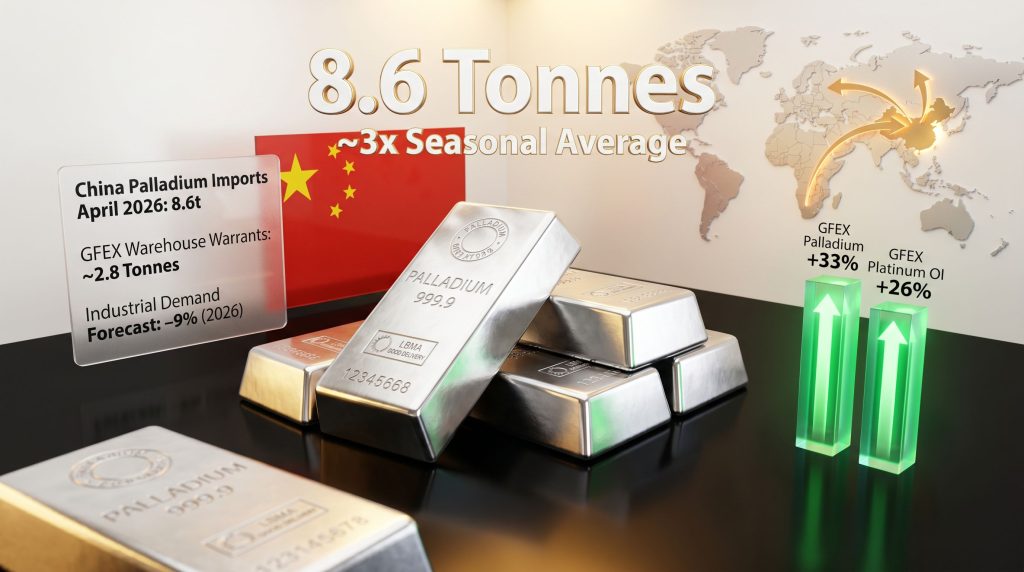
The Guangzhou Futures Exchange, known as GFEX, launched platinum and palladium futures contracts in late November 2024. Within months, these contracts attracted substantial speculative and hedging interest, with open interest in palladium growing by 33% and platinum rising by 26%. As positions accumulated and buying pressure pushed domestic contract prices toward their daily limit ceilings, a meaningful spread opened between GFEX-quoted palladium and prices on Western exchanges.
When a domestic futures price consistently exceeds the international equivalent by more than the cost of physical delivery, the market is essentially issuing a standing purchase order for imported metal. The only variable is how long traders can source and ship supply before the spread compresses under its own weight.
Breaking Down China's April 2026 Palladium Import Figures
Chinese customs data released in May 2026 confirmed that palladium shipments into the country reached 8.6 tonnes in April, a figure that represents approximately three times the seasonal average for that period. To contextualise the scale of this deviation, consider that seasonal palladium import volumes into China typically reflect genuine industrial consumption patterns tied to automotive manufacturing cycles. A near-triple deviation of that baseline is not the result of a sudden surge in factory demand. It is, almost by definition, financially motivated.
The data tells a more complete story when viewed alongside warehouse inventory figures from GFEX itself. As of late May 2026, approximately 2.8 tonnes of palladium were held on warrant in GFEX-linked warehouses. That figure represents more than one-third of the palladium volumes held in warehouses linked to the New York Mercantile Exchange, a striking comparison given how recently the GFEX contracts were introduced.
| Metric | Data Point | Context |
|---|---|---|
| China palladium imports (April 2026) | 8.6 tonnes | ~3x seasonal average |
| GFEX warehouse palladium warrants | ~2.8 tonnes | >33% of NYMEX-linked warehouse volumes |
| GFEX open interest growth (palladium) | +33% | Reflects speculative and hedging demand surge |
| GFEX open interest growth (platinum) | +26% | Parallel PGM momentum across both metals |
| China's prior-year PGM import dependency | ~71% of domestic supply | Based on 91.1 tonnes of Pt+Pd imports |
| Palladium industrial demand forecast change | -9% (2026) | Driven by declining combustion engine vehicle demand |
The June palladium futures contract on GFEX was approaching expiry at the time of these inventory readings, which explains the concentration of physical delivery activity during this window. Traders holding long positions in expiring contracts who wish to capture the premium must arrange physical delivery, and the accumulation of warranted metal in GFEX warehouses is the direct output of that process.
China's Structural Import Dependency: The Supply Gap That Sustains the Premium
Understanding why this arbitrage mechanism has such pronounced effects requires an appreciation of China's position as a structurally import-dependent consumer of platinum group metals. Unlike its dominance in rare earth element production or its significant lithium refining capacity, China produces only negligible quantities of PGMs domestically. The country's geological profile simply does not contain the layered igneous intrusions that host the world's major PGM deposits, which are concentrated overwhelmingly in South Africa's Bushveld Igneous Complex and Russia's Norilsk region.
This geological reality means China must source the vast majority of its palladium and platinum from international markets. In the year prior to the April 2026 surge, China imported approximately 91.1 tonnes of combined platinum and palladium, with roughly 71% of its domestic PGM supply sourced from abroad. That level of structural dependency means that any premium emerging in domestic prices has an almost automatic transmission mechanism into international physical flows. Furthermore, understanding the broader platinum and palladium market dynamics helps to contextualise why China's import dependency creates such powerful arbitrage conditions.
Domestic recycling of PGMs from spent catalytic converters and industrial equipment does provide a partial offset, and China's secondary recovery sector has been growing. However, the rate of scrap collection and refining capacity has not reached a scale sufficient to materially narrow the gap between domestic consumption and domestic production. This ensures that when GFEX prices rise above international benchmarks, the arbitrage window is accessible to international traders and refiners who control the physical supply chain.
The Industrial Demand Paradox: Financial Flows Versus Declining End-Use
Perhaps the most analytically interesting dimension of this episode is that China palladium imports surge on Guangzhou futures premium activity is occurring precisely as the long-term industrial demand outlook for palladium deteriorates. This is not a contradiction so much as a demonstration of how financial markets can decouple from fundamental consumption dynamics over medium-term horizons.
Palladium's dominant industrial application is as a catalytic converter component in petrol-powered internal combustion engine vehicles. These converters use palladium to oxidise harmful hydrocarbons and carbon monoxide in exhaust gases. As global EV adoption accelerates, the number of new ICE vehicles being produced is declining, and with it, the volume of palladium required for autocatalyst manufacturing.
Johnson Matthey, one of the world's leading PGM refiners and the producer of the most widely cited annual PGM market review, projected a 9% decline in palladium industrial consumption in 2026, attributing this directly to weakening demand for conventional vehicles. This is not a short-term cyclical dip. It represents a structural erosion of palladium's primary demand source that is expected to continue as fleet electrification progresses across major automotive markets. In addition, the broader precious metals market analysis confirms that investment demand has become the dominant swing factor across multiple metals during this period.
The April import surge appears primarily financially motivated rather than industrially driven. When physical delivery is used to capture a futures price spread rather than to satisfy manufacturing demand, it represents a form of financial arbitrage that can temporarily inflate import statistics without reflecting genuine end-use consumption growth.
The key swing variable identified by Johnson Matthey is investment demand, which has the capacity to absorb or amplify supply-demand imbalances in ways that industrial consumption alone cannot predict. The GFEX premium episode is a live demonstration of that swing factor in action.
GFEX's Market Regulation Signal: What Trading Limit Tightening Reveals
One of the more telling regulatory signals embedded in this story is the GFEX's decision to tighten daily trading limits on both platinum and palladium contracts, a measure implemented in late December 2025. This kind of intervention is not taken lightly by exchange operators. Daily price movement limits on commodity futures serve as circuit breakers designed to prevent runaway volatility and disorderly market conditions.
When an exchange introduces or tightens such limits shortly after a new contract's launch, it is signalling that speculative positioning has grown faster than the regulator is comfortable with. The speed at which GFEX palladium contracts attracted capital, as evidenced by the 33% open interest increase, appears to have prompted precisely this kind of regulatory response.
This is a pattern with precedent. The Shanghai Gold Exchange and Shanghai Futures Exchange have both used trading limit adjustments as tools to manage periods of elevated speculative activity in gold and silver contracts, sometimes successfully cooling momentum and sometimes merely delaying price discovery. The GFEX's intervention in the PGM space suggests it is navigating the tension between wanting to establish itself as a credible and liquid pricing venue while also preventing the kind of volatility that can undermine market integrity in the contract's early stages. Consequently, commodity volatility and hedging strategies have become increasingly relevant for participants exposed to GFEX-linked price movements.
The next major ASX story will hit our subscribers first
Comparing PGM Premium Dynamics: Palladium vs. Platinum on GFEX
While palladium has attracted the most attention given the scale of the April import surge, platinum has followed a broadly parallel trajectory on the Guangzhou exchange. Both metals hit their daily price ceilings as buying pressure mounted, and both saw open interest expand significantly.
| Metal | GFEX Price Behaviour | Open Interest Change | Import Implication |
|---|---|---|---|
| Palladium | Hit price ceiling; premium over COMEX | +33% | Physical inflows accelerating |
| Platinum | Hit price ceiling; premium over London | +26% | Parallel import incentive building |
| Gold | Strong rally; investor rotation catalyst | N/A (separate exchange) | Momentum spillover into PGMs |
The parallel behaviour of platinum and palladium on GFEX is consistent with a broader pattern of precious metals momentum rotation. When gold rallies strongly, as it did through early 2026, it tends to draw investor attention toward adjacent metals. Platinum and palladium, which share many of gold's characteristics as hard assets with finite supply and dual industrial and investment applications, often benefit from this spillover effect as capital rotates through the precious metals complex.
Palladium's roughly 33% price decline from its January 2026 peak by the time the GFEX premium emerged created a particularly attractive entry point for traders who believed the metal was oversold relative to its domestic futures price. That spread between a depressed international spot price and a firm domestic futures price formed the foundation of the entire arbitrage trade.
Strategic Scenarios for China's Palladium Market
Several credible pathways exist for how this dynamic evolves from here, each with different implications for global palladium pricing and supply routing. Understanding commodity price impacts on producers and refiners will be essential as these scenarios play out.
-
Premium normalisation: As physical imports increase the volume of palladium available in GFEX-linked warehouses, the domestic premium compresses. Arbitrage profits shrink, import incentives diminish, and volumes return toward seasonal norms. This is the most mechanically intuitive outcome and likely describes the near-term trajectory.
-
Structural premium persistence: If GFEX establishes itself as a deep and liquid enough market to attract sustained domestic investor interest, a modest structural premium over Western benchmarks could persist indefinitely, similar to the premiums that have historically characterised Shanghai gold prices versus international equivalents.
-
Regulatory dampening: Continued tightening of trading limits or the introduction of position limits could reduce speculative participation, lowering domestic prices toward international levels and eliminating the import incentive without requiring a physical supply correction.
-
Accelerated EV transition: If China's electric vehicle penetration continues to outpace expectations, the long-term decline in palladium autocatalyst demand could accelerate, eventually reducing both industrial and financial interest in the metal and causing premiums to dissipate.
The most probable near-term trajectory involves partial premium compression as physical imports increase the domestic supply available for delivery, followed by a medium-term equilibrium where GFEX establishes itself as a credible price-discovery venue capable of maintaining a modest structural premium relative to Western benchmarks.
Frequently Asked Questions: China Palladium Imports and the GFEX Premium
Why did China's palladium imports spike so sharply in April 2026?
The primary driver was financial arbitrage. Palladium futures prices on the Guangzhou Futures Exchange were trading at a premium to international benchmarks, making it profitable for traders to purchase metal internationally and deliver it against GFEX contracts.
What is the Guangzhou Futures Exchange and when did it launch palladium contracts?
GFEX is a commodity futures exchange based in Guangzhou, China. It launched platinum and palladium futures contracts in late November 2024, making it one of the newer major PGM futures venues globally.
How does a futures premium drive physical metal imports into China?
When domestic contract prices exceed international spot prices by more than the cost of shipping and delivering physical metal, traders can lock in risk-adjusted profits by importing metal and delivering it against the higher-priced domestic futures position.
Is the palladium import surge a sign of growing industrial demand in China?
No. Industrial demand for palladium in China has been described as flat, and Johnson Matthey projects a 9% decline in global palladium industrial consumption in 2026 due to declining combustion engine vehicle production.
What is the relationship between EV adoption and palladium consumption?
Palladium is primarily used in catalytic converters fitted to petrol-powered vehicles. As electric vehicle adoption increases, fewer ICE vehicles are produced, reducing autocatalyst demand and creating a long-term structural headwind for palladium consumption.
Could China's palladium buying influence global prices?
China's import scale and the concentration of GFEX warehouse stocks relative to NYMEX volumes suggest China is increasingly capable of influencing the marginal price of palladium, particularly during periods when GFEX premiums attract significant physical inflows. Furthermore, central bank metals demand patterns suggest institutional appetite for hard assets continues to underpin broader PGM market sentiment.
Key Takeaways
-
China's April 2026 palladium imports reached 8.6 tonnes, approximately three times the seasonal average, driven primarily by financial arbitrage rather than industrial demand growth
-
The Guangzhou Futures Exchange premium over international benchmarks created a structural incentive for physical delivery, with approximately 2.8 tonnes accumulating in GFEX-linked warehouses by late May 2026
-
Open interest on GFEX palladium contracts rose 33%, signalling rapid capital accumulation in a relatively young market infrastructure
-
China's approximately 71% import dependency for PGMs means domestic price premiums consistently translate into measurable adjustments to international physical supply flows
-
Industrial palladium demand is projected to fall approximately 9% in 2026 due to declining combustion engine vehicle production, making investment and arbitrage demand the dominant near-term price drivers
-
GFEX's decision to tighten trading limits in late December 2025 reflects the exchange's recognition of elevated speculative activity and its intent to manage volatility in these contracts during their formative period
-
The episode ultimately represents something larger than a single month's import figure: it signals China palladium imports surge on Guangzhou futures premium dynamics as part of a transition from passive price-taker to active price-setter in the global PGM market, a shift with lasting structural implications for supply routing, benchmark pricing, and the geographic centre of gravity for physical palladium
This article contains forward-looking assessments, market scenario analysis, and projections sourced from publicly available industry data including Johnson Matthey's PGM market review. These do not constitute financial advice. Commodity markets carry significant risk and past import patterns are not indicative of future price movements or supply dynamics.
Want To Track The Next Major ASX Mineral Discovery Before The Broader Market?
Discovery Alert's proprietary Discovery IQ model delivers real-time alerts on significant ASX mineral discoveries, transforming complex commodity data across more than 30 minerals into clear, actionable insights for both short-term traders and long-term investors — begin your 14-day free trial today and position yourself ahead of the market, or explore how historic discoveries have generated extraordinary returns on the Discovery Alert discoveries page.