May 14, 2026
Global manufacturing networks face mounting pressure as strategic materials become instruments of geopolitical influence. The intersection of industrial dependency and diplomatic tensions creates vulnerabilities that extend far beyond traditional trade disputes. When essential elements for modern technology become subject to export control strategies, the consequences ripple through automotive assembly lines, electronics production facilities, and defense contractors worldwide.
The current landscape reveals how concentrated control over critical material processing can transform obscure chemical elements into powerful leverage points. Understanding these dynamics requires examining both the technical requirements that create dependency and the strategic calculations that weaponise scarcity.
Understanding China's Rare Earth Export Control Architecture
Current Regulatory Framework and Licensing Requirements
China rare earth export restrictions operate through a sophisticated licensing system that targets seven critical heavy rare earth elements. This framework establishes non-automatic approval processes, creating deliberate uncertainty within global supply chains. The distinction between complete export bans and licensing restrictions allows for calibrated pressure while maintaining plausible deniability.
The regulatory architecture encompasses dysprosium, terbium, holmium, erbium, thulium, ytterbium, and lutetium. These elements undergo rigorous export approval processes that can introduce delays ranging from weeks to months. Manufacturing companies dependent on these materials face inventory planning challenges when approval timelines remain unpredictable.
Recent policy adjustments have expanded the scope of oversight to include downstream products containing these elements. This broader interpretation affects not just raw materials but also processed components and finished goods incorporating rare earth content above specified thresholds.
Extraterritorial Reach and Global Supply Chain Impact
The implementation of a 0.1% threshold rule demonstrates how export controls extend beyond direct bilateral trade relationships. Foreign products containing Chinese rare earths above this concentration face potential restrictions, creating compliance challenges for manufacturers across multiple jurisdictions.
Technology transfer restrictions compound these challenges by limiting the development of alternative processing capabilities outside China. Companies seeking to establish separation and refining facilities encounter barriers to accessing essential expertise and specialised equipment designs.
Enforcement mechanisms operate through multiple channels, including customs inspections, end-use verification requirements, and ongoing monitoring of approved shipments. This comprehensive approach ensures that circumvention attempts face significant detection risks and potential penalties.
When big ASX news breaks, our subscribers know first
Why Are Heavy Rare Earth Elements Critical to Global Industry?
Industrial Applications Driving Strategic Importance
Heavy rare earth elements serve as indispensable components in permanent magnet manufacturing, particularly for electric vehicle motors and wind turbine generators. Dysprosium enhances thermal stability in neodymium-iron-boron magnets, enabling operation at the elevated temperatures common in automotive applications.
Electronics miniaturisation depends heavily on terbium and other heavy rare earths for their unique magnetic and optical properties. Smartphone cameras, hard disk drives, and precision instruments require these elements to achieve the performance densities demanded by modern consumer expectations.
Defence applications represent another critical dependency area, with guidance systems, communications equipment, and advanced radar installations incorporating heavy rare earth components. Furthermore, the specialised performance characteristics of these elements often lack viable substitutes in high-precision military applications.
China's Dominance Across the Value Chain
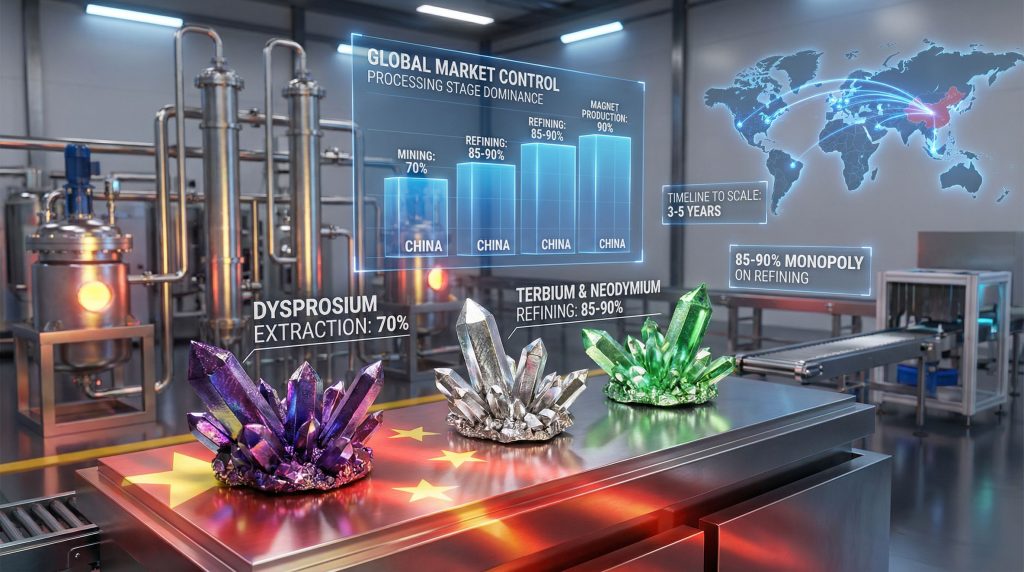
China maintains approximately 70% control of global rare earth mining operations, but this figure understates the true extent of dependency. The nation commands an estimated 85-90% monopoly on refining and separation processes, which represent the actual chokepoints in the supply chain.
This processing dominance reflects decades of industrial development and accumulated expertise in rare earth chemistry. The separation of heavy rare earths from mixed concentrates requires sophisticated ion-exchange processes and specialised facilities that remain concentrated in Chinese industrial zones.
China's Rare Earth Market Control by Processing Stage
| Processing Stage | Chinese Market Share | Alternative Capacity | Timeline to Scale |
|---|---|---|---|
| Mining | 70% | 30% (US, Australia) | 3-5 years |
| Refining | 85-90% | 10-15% | 5-8 years |
| Magnet Production | 80% | 20% | 2-4 years |
Limited alternative sources for heavy rare earth elements compound the vulnerability. While light rare earth mining has expanded in Australia, Canada, and the United States, heavy rare earth deposits remain geographically concentrated and technically challenging to develop economically.
How Do Export Restrictions Function as Economic Leverage?
Calibrated Escalation Strategy
The timing of export restrictions with geopolitical tensions reveals a deliberate strategy of graduated pressure. Rather than implementing immediate comprehensive bans, Chinese policymakers employ selective targeting that allows for face-saving retreats whilst demonstrating capabilities for future escalation.
This approach involves graduated response mechanisms that avoid complete weaponisation of rare earth exports while maintaining economic pressure. Administrative delays, enhanced documentation requirements, and selective approval processes create uncertainty without crossing thresholds that might trigger immediate retaliation.
The strategy balances coercion objectives with continued market access, recognising that China's rare earth sector benefits significantly from export revenues. In addition, complete export cessation would damage Chinese producers while potentially accelerating alternative supply source development.
Historical Precedents and Pattern Recognition
The 2010 maritime dispute between China and Japan provided a crucial learning experience for both sides. During this confrontation, rare earth shipments to Japan slowed dramatically, creating immediate supply pressures across Japanese manufacturing sectors.
Industry reports from this period documented billion-dollar economic exposure estimates for the affected Japanese economy. The Nomura Research Institute calculated that even short-term export disruptions could generate cascading effects throughout electronics and automotive supply chains.
Lessons learned from this restriction cycle informed subsequent policy development on both sides. China refined its approach to maintain plausible deniability while maximising economic impact, whilst Japan accelerated diversification efforts and strategic stockpiling programmes.
What Are the Economic Consequences of Supply Disruptions?
Immediate Market Impact Assessment
Supply chain brittleness in automotive and electronics sectors amplifies the impact of rare earth restrictions beyond the direct material costs. Manufacturing networks optimised for just-in-time delivery lack resilience when critical components face availability uncertainty.
Price volatility emerges rapidly during supply disruption periods, with heavy rare earth oxides experiencing price increases of 200-300% during previous restriction episodes. These price spikes reflect both actual scarcity and speculative inventory stockpiling behaviours across affected industries.
The concentrated nature of heavy rare earth applications means that shortages cannot be easily absorbed through demand destruction. Electric vehicle production, wind turbine manufacturing, and defence contractor operations face binary choices between securing alternative supplies or accepting production delays.
Long-term Strategic Vulnerabilities
Manufacturing capacity relocations represent one of the most significant long-term consequences of supply uncertainty. Automotive companies have begun evaluating production site decisions based partially on proximity to reliable magnet suppliers and rare earth processing facilities.
"Even short-term export disruptions can cascade through manufacturing networks, affecting everything from smartphone production to wind turbine installations, demonstrating the concentrated risk of rare earth dependency."
Investment delays in green energy transition projects compound these vulnerabilities. Wind farm developers face extended project timelines when turbine manufacturers cannot guarantee magnet supply security, potentially slowing renewable energy deployment schedules.
However, national security implications extend beyond immediate defence contractor exposure. Dependence on foreign-controlled materials for critical infrastructure systems creates strategic vulnerabilities that persist across multiple technological generations.
How Are Nations Responding to Supply Chain Vulnerabilities?
Diversification Strategies and Their Limitations
Mining capacity expansion efforts in Australia, Canada, and the United States focus primarily on light rare earth production, addressing only part of the dependency challenge. Heavy rare earth deposits outside China remain limited and often require extensive development timelines.
Processing facility development faces more significant obstacles than mining expansion. The construction of rare earth separation plants requires specialised expertise, environmental permitting, and substantial capital investment. Typical development timelines extend 5-8 years from initial planning to operational status.
Workforce development requirements for specialised separation chemistry represent an often-overlooked constraint. The number of trained chemists and engineers familiar with rare earth processing remains small globally, creating human capital bottlenecks for alternative facility development.
Alternative Material Research and Substitution Efforts
Recycling technology advancement offers potential for reducing primary rare earth demand, particularly for heavy elements. Research into magnet recycling processes has demonstrated technical feasibility, though economic viability depends on collection infrastructure development and processing scale economies.
Magnet chemistry innovations focus on reducing heavy rare earth content whilst maintaining performance characteristics. Grain boundary diffusion techniques and alternative alloy compositions show promise for decreasing dysprosium requirements in high-temperature applications.
Strategic stockpiling programmes have emerged across multiple countries as interim measures while alternative supplies develop. The United States National Defense Stockpile and similar European initiatives aim to provide buffer inventory during potential supply disruptions.
What Factors Will Shape Future Export Control Policies?
Geopolitical Pressure Points and Negotiation Dynamics
Taiwan Strait tensions remain a primary factor influencing the severity of potential restrictions. Escalating military activities and diplomatic confrontations create conditions where economic leverage tools become more likely deployment options.
Trade relationship management with key partners involves balancing coercive pressure against long-term economic interests. China's approach must consider the risk that aggressive export controls could accelerate alternative supply development and reduce future market share.
Consequently, multilateral coordination among affected economies has strengthened since 2010, with Japan, the United States, and European Union developing information sharing mechanisms and joint response protocols for supply disruption scenarios.
Market Forces and Industry Adaptation
Chinese domestic demand growth affects export availability independent of policy decisions. The expansion of China's electric vehicle industry and renewable energy sector increases internal rare earth consumption, naturally reducing export volumes.
Technology transfer restrictions limit the ability of foreign companies to develop processing capabilities through licensing agreements or joint ventures. This constraint extends development timelines for alternative facilities while protecting Chinese competitive advantages.
Investment flows toward non-Chinese rare earth projects have accelerated following recent geopolitical tensions. Private and government funding for alternative supply development has increased substantially, though project completion timelines remain extended.
For instance, considering the broader implications of these dynamics, the US–China trade war impacts continue to reshape global supply chains across multiple sectors.
The next major ASX story will hit our subscribers first
Investment Implications and Risk Assessment Framework
Evaluating Rare Earth Mining Investment Opportunities
Heavy rare earth projects command premium valuations compared to light rare earth deposits due to supply concentration and strategic importance. However, the technical complexity of heavy rare earth extraction and processing creates elevated execution risks for development companies.
Processing capability development represents the primary value creation driver rather than simple resource ownership. Companies that can demonstrate progress toward operational separation facilities attract greater investor interest and partnership opportunities.
Risk Mitigation Strategies by Industry Sector
| Sector | Primary Risk | Mitigation Approach | Implementation Timeline |
|---|---|---|---|
| Automotive | EV motor magnets | Alternative suppliers + recycling | 2-3 years |
| Electronics | Miniaturisation components | Design optimisation + stockpiling | 1-2 years |
| Defence | Guidance systems | Domestic processing + substitution | 3-5 years |
Regulatory and permitting risk factors vary significantly by jurisdiction. Environmental regulations governing rare earth processing affect project timelines and operating costs, with some regions offering more streamlined approval processes for strategic material projects.
The development of a comprehensive critical minerals strategy becomes essential as governments recognise the strategic importance of supply chain security.
Supply Chain Resilience Planning for Manufacturers
Dual-sourcing strategies require careful evaluation of supplier geographic and technological diversification. Simply contracting with multiple Chinese suppliers provides limited protection against export restrictions, whilst developing truly independent alternatives requires substantial lead times.
Inventory management approaches for critical materials must balance carrying costs against supply disruption risks. Companies in affected industries have increased working capital allocation to rare earth inventory following recent geopolitical developments.
Technology roadmaps that reduce rare earth intensity offer long-term protection against supply vulnerabilities. Research and development investments in alternative magnet technologies and recycling processes can provide competitive advantages whilst reducing dependency.
Frequently Asked Questions About China's Rare Earth Export Controls
Are these restrictions permanent or temporary measures?
Current suspension status extends through November 2026 based on announced timelines, though underlying regulatory frameworks remain in place for potential rapid reimplementation. The temporary nature of suspensions provides flexibility for policy adjustment based on evolving geopolitical conditions.
Export control mechanisms can be activated with minimal notice periods, creating ongoing uncertainty for supply chain planning. Manufacturing companies must maintain contingency plans even during periods when restrictions are not actively enforced.
Which countries are most vulnerable to supply disruptions?
Japan faces concentrated exposure through its substantial automotive and electronics manufacturing base, which relies heavily on permanent magnet applications. The country's industrial structure creates particular vulnerability to heavy rare earth supply interruptions.
The European Union's green energy transition dependencies have grown substantially with expanding wind power installations and electric vehicle adoption. German automotive manufacturers represent especially significant exposure points within European supply chains.
United States defence and technology sector vulnerabilities span multiple critical applications, from military guidance systems to commercial electronics manufacturing. The concentration of these industries in specific geographic regions amplifies potential economic impacts.
How quickly can alternative supply sources be developed?
Mining project development requires minimum timelines of 3-5 years for most rare earth deposits, assuming successful permitting and financing completion. Heavy rare earth projects often face extended development periods due to technical complexity and environmental considerations.
Processing facility construction typically requires 5-8 years from initial planning to operational status. The specialised nature of rare earth separation chemistry creates unique engineering and regulatory challenges that extend standard industrial project timelines.
Workforce training and technology transfer needs add 2-4 years to facility development schedules. The limited pool of experienced rare earth processing professionals globally constrains the pace of alternative capacity development.
Strategic Outlook and Policy Recommendations
Scenario Planning for Different Restriction Levels
Minimal disruption scenarios involve licensing delays and administrative friction that increase costs and uncertainty without creating acute shortages. These measures allow for diplomatic pressure whilst maintaining commercial relationships.
Moderate escalation might include selective targeting of specific elements or countries based on diplomatic priorities. This approach enables graduated pressure escalation whilst preserving options for de-escalation and relationship repair.
Maximum pressure scenarios could involve comprehensive export bans with extraterritorial enforcement mechanisms. Such measures would likely trigger immediate retaliation and accelerate alternative supply development, potentially damaging long-term Chinese market position.
Building Resilient Supply Chain Architecture
Public-private partnerships for critical material security offer frameworks for coordinating government strategic interests with private sector expertise and capital. These collaborations can accelerate alternative supply development whilst sharing financial risks.
International cooperation frameworks for resource sharing and joint development can reduce individual country vulnerabilities whilst distributing development costs. Furthermore, allied coordination on strategic material projects strengthens collective supply security.
Technology development incentives for substitution research and recycling advancement provide long-term solutions to supply concentration risks. Government funding for alternative material research can reduce private sector dependency on foreign-controlled supplies.
The broader context of critical minerals energy security demonstrates how these materials have become central to national security planning. Additionally, recent developments show how policymakers are considering broader measures, including an executive order on minerals to address these strategic vulnerabilities.
The intersection of industrial dependency and geopolitical strategy will likely intensify as technological competition continues. Understanding these dynamics becomes essential for investors, manufacturers, and policymakers navigating an increasingly complex global supply landscape. The new non-tariff battlefield that China rare earth export restrictions represent marks a significant shift in global trade dynamics.
However, as the IEA highlights, these supply concentration risks have now become reality rather than theoretical concerns.
Searching for Your Next Strategic Investment Opportunity?
Discovery Alert's proprietary Discovery IQ model delivers real-time alerts on significant ASX mineral discoveries, empowering subscribers to identify actionable opportunities in critical minerals and rare earth exploration companies ahead of broader market recognition. Position yourself at the forefront of Australia's strategic materials sector by beginning your 30-day free trial today and gain immediate access to the intelligence that drives informed investment decisions.