August 5, 2026
## China rare earth export controls are really about control over the whole supply chain
China rare earth export controls are less about a single border measure and more about influence over the entire industrial system. Critical mineral markets can appear open until a chokepoint matters. Rare earths show this clearly, because market power depends on who can legally mine, process, separate, refine, and deliver usable material at scale.
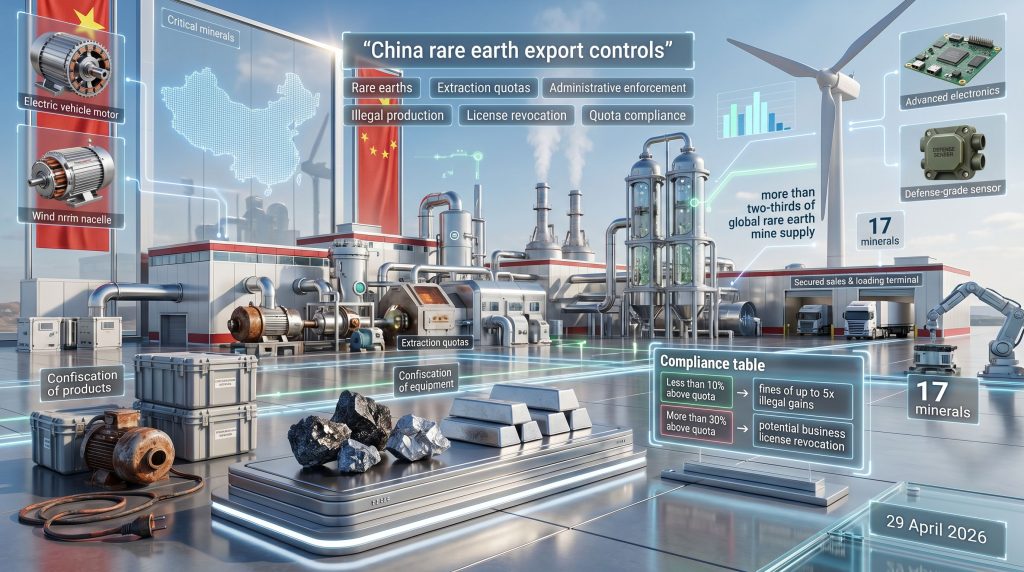
That is why these measures are better understood as part of a broader compliance and industrial governance model, not just a trade headline. As of 29 April 2026, China had moved to tighten enforcement across rare earth production and processing through a draft framework published by the Ministry of Industry and Information Technology.
The framework includes penalties covering mining, smelting, separation, and sales of illegally produced material. Consequently, manufacturers, policymakers, and investors are focused less on where ore exists and more on whether inputs can move through the full chain on time, under quota, under licence, and in a usable form.
“The core vulnerability in the rare earth market is not geology alone. It is the concentration of legally authorised processing and separation capacity.”
## What do China rare earth export controls actually mean in practice?
China rare earth export controls do not automatically mean a total export ban. In practice, the system is broader. It can include export licensing, domestic quota enforcement, refining oversight, inspections, and penalties for unauthorised production or sales.
The 2026 policy discussion matters because it expands attention beyond customs measures. In addition, it brings upstream and downstream stages into one enforcement logic, covering:
- Mining and extraction
- Smelting
- Separation
- Sales and commercialisation
This matters because supply disruptions do not need to begin at a port. For instance, they can start at the mine gate, inside a processing facility, or when non-compliant material is removed from legal circulation.
Why this is a regulatory escalation, not just a trade story
The latest move looks more like stronger administrative enforcement across the value chain. Rather than relying only on blunt restrictions, authorities can use quotas, licensing rules, confiscation powers, and business penalties to shape supply.
That creates a more flexible system. However, it also raises compliance risk for producers and buyers without requiring an outright halt in exports. This is why the broader China rare earth trade strategy matters as much as any individual customs announcement.
China rare earth control measures at a glance
| Policy tool | What it regulates | Who is affected | Likely market impact | Enforcement mechanism |
|---|---|---|---|---|
| Extraction quotas | Mine output volumes | Mining producers | Limits raw material availability | Administrative enforcement |
| Smelting quotas | Processing volumes | Smelters and processors | Can constrain intermediate supply | Fines, sanctions |
| Separation oversight | Refining into individual rare earth products | Separation plants | Tightens usable material supply | Inspections, confiscation |
| Sales restrictions | Commercialisation of illegal output | Traders, processors, downstream buyers | Reduces grey-market liquidity | Product seizure, penalties |
| Licensing actions | Legal right to operate | Producers and processors | Raises operational risk sharply | Licence suspension or revocation |
## Why does China have outsized power in the rare earth supply chain?
China is described in the source material as producing more than two-thirds of global rare earth mine supply. That alone is significant. Yet mining share is only one layer of the advantage.
The more important factor is downstream refining and separation dominance. Rare earth ore is not a finished industrial input. It must undergo complex chemical processing before manufacturers can use it in magnets, motors, sensors, and advanced electronics.
The two-layer advantage: mining plus processing
China’s influence comes from a combination of:
- Large upstream mine output
- Extensive smelting capability
- Deep separation capacity
- Established chemical know-how
- Strong links to magnet manufacturing and industrial end users
This is why resilience is hard to build quickly. A new mine outside China does not fully solve the problem if the material still depends on Chinese processing. That wider rare earth supply chain remains the central issue.
Why processing is harder to replace than deposits
Rare earth processing is difficult for several reasons:
- Chemistry is complex
- Capital intensity is high
- Environmental permitting is difficult
- Industrial learning curves matter
Furthermore, these rare earth processing challenges help explain why alternative supply routes take years, not months, to establish.
“Even where mine supply exists outside China, a refining bottleneck can still leave downstream manufacturers exposed.”
## How do China’s quota and enforcement rules work?
The quota system is designed to manage production volumes, processing discipline, and legal traceability. In practice, quotas control not only total output, but also who produces it and under what conditions.
What kinds of violations can trigger penalties?
The framework described in the source covers several non-compliance categories:
- Exceeding extraction quotas
- Exceeding smelting quotas
- Carrying out unauthorised separation
- Selling illegally mined or processed material
Penalty thresholds that matter
Two thresholds stand out:
- Less than 10% above quota can lead to fines of up to 5 times illegal gains
- More than 30% above quota can expose a company to business licence revocation
Authorities may also use:
- Administrative sanctions
- Confiscation of products
- Confiscation of equipment
Those penalties matter because they go far beyond a routine fine. For operators, licence revocation can become an existential risk. The broader logic is also reflected in the China rare earth export restrictions debate, where supply pressure can emerge well before cargo reaches the border.
## Are China rare earth export controls about trade or industrial policy?
The most useful answer is both, although industrial policy sits deeper underneath. Rare earths are essential to advanced manufacturing, renewable energy, electric vehicles, electronics, and defence systems.
A country that governs extraction quotas, separation capacity, and legal commercialisation holds more than market share. It holds a form of state capacity over strategic mineral flows. Consequently, administrative tools can be more attractive than blunt bans because they are easier to calibrate.
The market also interprets these actions through a geopolitical lens. According to the IEA’s assessment of critical mineral supply concentration risks, tighter controls make concentration risks much more visible in already narrow supply chains.
This is where the broader rare earth geopolitical impact becomes clear. A stricter compliance system can influence trade outcomes without looking like a classic export ban.
## What could this mean for global prices, supply risk, and procurement strategy?
When enforcement tightens in a concentrated market, companies often react before shortages are obvious. They build inventories, seek alternative suppliers, and review contract terms more closely.
In the near term, China rare earth export controls and quota discipline could contribute to:
- Shipment delays
- Higher compliance costs
- Tighter inventory buffers
- Greater input volatility
- More cautious procurement behaviour
Medium-term effects on manufacturers
Over a longer horizon, likely responses include:
- Stockpiling critical inputs
- Supplier diversification
- Regional processing investment
- Longer-term offtake contracts
- Product redesign
For example, Mining.com’s coverage of stricter enforcement rules suggests that enforcement itself can move markets by increasing uncertainty, even before any physical shortage becomes visible.
“This is not financial advice. Commodity prices can react to policy, inventory cycles, substitution, and macroeconomic demand shifts in unpredictable ways.”
## Which countries and companies are trying to reduce dependence on China?
Diversification is possible, but it requires more than new mines. A workable alternative chain needs ore supply, separation plants, metallisation capacity, magnet manufacturing, permitting certainty, and long-term financing.
Where alternative supply chains may emerge
Several regions are often discussed as future building blocks:
- Australia for upstream resource development
- United States for processing and defence-linked priorities
- Canada for project development potential
- Southeast Asia for intermediate processing roles
- Japan, South Korea, and Europe for downstream manufacturing hubs
Large miners such as BHP, Rio Tinto, Mineral Resources, and South32 are sometimes mentioned in the wider critical minerals discussion. However, that does not make them direct rare earth solutions today.
## What are the main policy risks for automakers, wind manufacturers, and defence suppliers?
Rare earth demand is not evenly spread across industries. Some sectors can redesign products more easily than others.
Electric vehicles and permanent magnet exposure
Many EV drivetrains use high-performance permanent magnets linked to NdPr demand. Some automakers can explore alternative motor designs, but there may be trade-offs in efficiency, size, cost, or performance.
Wind turbines and energy transition vulnerability
Large turbine applications, especially some offshore designs, can be highly sensitive to magnet supply. Therefore, disruption may not stop deployment outright, but it can raise costs and extend lead times.
Defence and advanced electronics
Defence suppliers face a different kind of risk. The issue is not only cost, but also reliability, certification, and strict timing. Precision systems often have less room for easy substitution.
## Can the rest of the world build a rare earth supply chain without China?
Yes, but not quickly and not cheaply. The biggest constraints are time, chemistry, permitting, and economics.
A realistic timeline for diversification
- Short term: Limited relief with continued dependence on existing hubs
- Medium term: Partial resilience through regional separation and magnet facilities
- Long term: A more balanced network is possible with sustained investment
A practical de-risking framework for manufacturers
A manufacturer trying to reduce exposure might:
- Map direct and indirect exposure
- Identify Chinese processing dependence
- Secure multi-source contracts
- Build inventory buffers
- Assess redesign options
This is practical operational work rather than political messaging.
## FAQ: China rare earth export controls explained
Is China banning rare earth exports?
Not necessarily. China rare earth export controls can involve licensing, quotas, inspections, and stricter enforcement rather than a total ban.
Why are rare earths so important?
Rare earths are a group of 17 minerals used in permanent magnets, electronics, renewable energy systems, and defence technologies.
How much of global rare earth supply does China control?
The source material states that China accounts for more than two-thirds of global mine production, while also holding a stronger position in processing and separation.
What happens if producers exceed quotas in China?
According to the framework described:
- Below 10% above quota: fines of up to 5 times illegal gains
- More than 30% above quota: possible licence revocation
- Related products and equipment can also be confiscated
## The bottom line for the rare earth market in 2026 and beyond
The biggest takeaway is that China’s power in rare earths comes from both volume and processing control. The latest policy direction reinforces that influence through layered regulation across mining, smelting, separation, and commercialisation.
For global industry, the lesson is straightforward. Supply risk is no longer just about access to deposits. Instead, it is about access to compliant processing capacity, legal shipments, and usable downstream materials.
Diversification can happen, but it will likely be slow, capital-heavy, and operationally difficult. That means governments and manufacturers need practical resilience strategies, not just rhetoric.
Want Earlier Signals on the Next Critical Mineral Discovery?
Discovery Alert’s proprietary Discovery IQ model delivers real-time ASX discovery alerts that help investors track emerging opportunities across strategic minerals before the broader market reacts. See how major discoveries have historically driven exceptional returns on Discovery Alert’s discoveries page and start a 14-day free trial to stay ahead of the market.