June 23, 2026
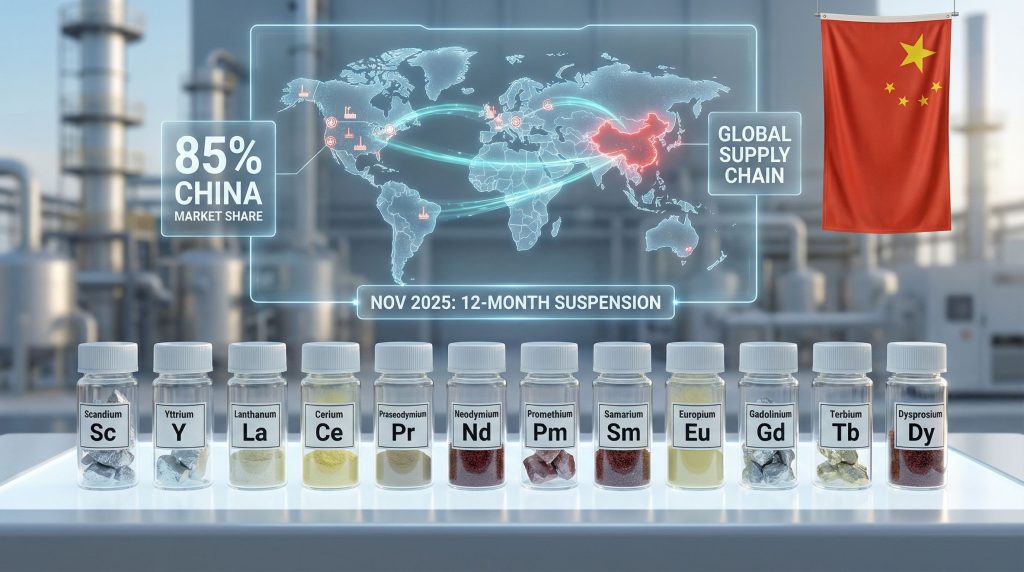
China's global dominance in rare earth production has taken on new strategic dimensions as Beijing implements sophisticated licensing controls that transform critical materials into tools of economic statecraft. The critical minerals energy transition has heightened the importance of these elements, making China rare earth export licenses a critical factor in international manufacturing operations. This regulatory framework demonstrates how administrative mechanisms can achieve strategic objectives traditionally pursued through conventional trade policies.
Furthermore, the intersection of resource control and technological dependence has created unprecedented vulnerabilities for industries ranging from automotive manufacturing to advanced defence systems, forcing companies to completely reassess their supply chain strategies.
What Are China's New Rare Earth Export Controls?
Beijing's April 2025 implementation of comprehensive rare earth export controls marked a fundamental shift in global critical mineral governance. The initial framework required individual licensing approval for every shipment, creating immediate bottlenecks that disrupted automotive supply chains and forced manufacturers to halt production lines.
The licensing system operates through two distinct pathways that determine market access and operational efficiency. General licenses provide year-long validity periods with streamlined shipping procedures, significantly reducing administrative burden for approved customers. Standard export permits maintain the original shipment-by-shipment approval requirements, extending processing times and increasing compliance costs for manufacturers.
This dual-track approach creates strategic differentiation in market access, with Beijing maintaining discretionary control over which companies and sectors receive preferential treatment. The system encompasses technology transfer restrictions and extraterritorial applications, extending Chinese regulatory reach beyond traditional export boundaries.
Timeline and Implementation Framework
The regulatory evolution from April through November 2025 demonstrates Beijing's calibrated approach to resource diplomacy:
- April 2025: Initial export controls implemented requiring individual shipment approvals
- April-November 2025: Supply chain disruptions across automotive sector intensify
- November 2025: General license system introduced following high-level diplomatic engagement
- December 2025: First batch of general licenses approved for select suppliers
Export volumes increased significantly in November 2025, indicating Beijing's willingness to adjust supply flows based on diplomatic progress and strategic relationships with trading partners.
When big ASX news breaks, our subscribers know first
Why Did China Implement These Export Restrictions?
Beijing's motivation for rare earth export controls stems from recognising the strategic value of controlling materials essential to modern technological infrastructure. With China dominating global production capacity, these controls transform geological advantages into diplomatic leverage across multiple sectors simultaneously.
The timing of implementation coincided with broader trade tensions, positioning rare earth access as a negotiating tool in international economic discussions. Export restrictions create immediate pressure on manufacturing supply chains while demonstrating China's ability to influence global production capacity through regulatory mechanisms.
Moreover, the implementation directly relates to the supply chain crisis in critical minerals that has highlighted vulnerabilities in Western defence and technological capabilities.
Economic Leverage Mechanisms
The export licensing system provides Beijing with several strategic advantages:
- Supply chain dependency: Manufacturing sectors become reliant on Chinese regulatory approval for critical inputs
- Diplomatic pressure: License approvals can be tied to broader bilateral relationship objectives
- Market segmentation: Differential approval patterns reward allies while pressuring competitors
- Technology transfer leverage: Export approvals can be conditioned on technology sharing agreements
"The introduction of rare earth export controls in April forced companies to apply for licenses for every shipment, creating shortages that brought parts of the auto supply chain to a halt and handed Beijing enormous leverage in trade talks," according to Reuters analysis of the market disruption.
This strategic approach reflects China's broader economic statecraft philosophy, where control over critical materials becomes a tool for advancing national interests through market mechanisms rather than traditional diplomatic channels.
How Do Export Licenses Work in Practice?
The practical implementation of China rare earth export licenses creates multiple layers of administrative complexity that directly impact global supply chain operations. Companies must navigate approval processes that can determine production schedules, inventory management, and long-term strategic planning across entire industrial sectors.
General license recipients benefit from streamlined procedures that allow multiple shipments under single approvals, reducing transaction costs and enabling more predictable supply planning. The year-long validity periods provide operational certainty that supports investment decisions and production scheduling.
Standard permit applicants face extended approval timelines for individual transactions, creating inventory management challenges and forcing companies to maintain larger safety stocks to buffer against regulatory delays. This system increases working capital requirements and reduces operational efficiency.
Case-by-Case Evaluation Criteria
Beijing's approval process demonstrates strategic discrimination based on multiple factors:
| Evaluation Factor | Impact on Approval | Strategic Purpose |
|---|---|---|
| Customer nationality | US companies received priority access | Reward diplomatic engagement |
| Sector application | Automotive approved before aerospace | Manage technology transfer risk |
| Historical relationships | Long-term partnerships don't guarantee approval | Reset relationship dynamics |
| End-use verification | Military vs. civilian applications scrutinised | Control strategic technology access |
The approval process reveals Beijing's sophisticated approach to using administrative mechanisms for strategic objectives, with technical licensing decisions reflecting broader geopolitical calculations.
Which Industries Are Most Affected by These Controls?
The automotive sector experienced the most immediate and severe disruption from China rare earth export licenses requirements. Manufacturing operations that rely on permanent magnets for electric motors, battery systems, and hybrid powertrains faced critical shortages that forced production line shutdowns and supply chain restructuring.
Ford Motor emerged as the first major foreign automaker to successfully navigate the new licensing framework, with three Chinese magnet suppliers receiving general license approvals. This breakthrough followed high-level diplomatic engagement and demonstrates the intersection of corporate supply chains with international relations.
European automotive manufacturers faced different treatment despite long-standing Chinese market relationships. Volkswagen and BMW remained excluded from initial general license approvals, highlighting how regulatory decisions reflect strategic political considerations rather than purely commercial factors.
Additionally, the broader context of US‑China trade impact has influenced how these licensing decisions are made and implemented.
Sector-Specific Impact Analysis
Automotive Manufacturing:
- Production line disruptions due to permanent magnet shortages
- Electric vehicle programme delays affecting transition timelines
- Hybrid system component availability constraints
- Battery technology supply chain vulnerabilities
Technology Sectors:
- Semiconductor production bottlenecks in specialised applications
- Consumer electronics component sourcing challenges
- Telecommunications equipment supply disruptions
- Data centre infrastructure delays
Defence and Aerospace:
- Military contractor supply chain vulnerabilities exposed
- Advanced materials access restricted for sensitive applications
- Aerospace manufacturing programmes face component shortages
- Strategic stockpiling requirements reassessed
The differential impact across sectors reveals Beijing's strategic prioritisation, with civilian automotive applications receiving approval preference over aerospace and semiconductor sectors that have greater national security implications.
What Are the Current Licensing Categories?
China rare earth export licenses operate through two primary categories that create fundamentally different operational experiences for global manufacturers. Understanding these categories is essential for companies developing supply chain strategies and risk management frameworks.
General Licenses represent the streamlined pathway that provides significant operational advantages. These approvals offer 12-month validity periods, allowing multiple shipments under single permits and reducing administrative overhead. The year-long timeframe enables better production planning and inventory management, supporting more efficient supply chain operations.
Standard Export Permits maintain the original transaction-by-transaction approval requirements that created widespread supply disruptions from April through November 2025. Each shipment requires individual processing, extending approval timelines and increasing compliance costs throughout the supply chain.
Operational Implications by License Type
| License Category | Validity Period | Administrative Burden | Planning Certainty |
|---|---|---|---|
| General License | 12 months | Low – single approval covers multiple shipments | High – enables annual planning cycles |
| Standard Permit | Per shipment | High – individual transaction processing | Low – uncertain approval timing |
The licensing structure creates competitive advantages for approved companies whilst imposing significant operational constraints on those limited to standard permits. This differentiation effectively segments the market based on regulatory access rather than purely commercial factors.
How Are Different Countries Responding?
International responses to China rare earth export licenses reveal the complex interplay between diplomatic relationships and industrial supply chain security. Countries are adapting their strategies based on their current approval status and broader bilateral relationships with Beijing.
United States Trade Position: Following Xi-Trump meetings in South Korea, American companies gained preferential access to general licenses. Ford Motor's suppliers received approvals in the first batch, demonstrating how high-level diplomatic engagement translates into tangible supply chain benefits for domestic companies.
The US approach combines diplomatic negotiation with corporate advocacy, as evidenced by Ford's statement encouraging continued collaboration between governments to resolve supply chain issues comprehensively. The influence of Trump's mining permits executive order demonstrates the intersection of domestic resource policy with international supply security.
European Union Challenges
Germany faces particular difficulties in securing licensing access for its automotive sector. Foreign Minister Johann Wadephul's acknowledgment that German automakers were excluded from initial general license approvals highlights the diplomatic challenges facing European manufacturers.
Volkswagen and BMW represent different adaptation strategies:
- VW Approach: Maintains that supply remains stable with no current shortages, whilst suppliers work continuously to obtain necessary approvals
- BMW Strategy: Adopts monitoring stance, tracking general license developments alongside supplier relationships
The exclusion of established German automotive manufacturers despite decades of Chinese market presence demonstrates Beijing's willingness to reset commercial relationships through regulatory mechanisms.
Diplomatic Response Patterns
Non-US diplomats express concerns about preferential treatment for American companies, fearing the licensing system primarily benefits US customers. This anxiety reflects broader questions about whether China's export controls serve economic or political objectives.
European diplomatic efforts focus on persuading Beijing to extend general license access, with Wadephul indicating that substantial work remains to achieve parity with US companies in licensing treatment.
The next major ASX story will hit our subscribers first
Strategic Supply Chain Adaptation Methods
Global manufacturers are implementing comprehensive risk management strategies to navigate China rare earth export licenses uncertainties. These approaches combine supply diversification, inventory optimisation, and regulatory compliance frameworks designed to maintain operational continuity regardless of licensing status changes.
Supply Chain Diversification has emerged as the primary long-term strategy for reducing dependence on Chinese rare earth supplies. Companies are evaluating alternative sources including Australian, Canadian, and African mining projects, though these typically require years of development and significant capital investment.
Strategic Stockpiling provides short-term buffer capacity against regulatory disruptions. Manufacturers are reassessing inventory levels to account for potential licensing delays, balancing carrying costs against supply security objectives.
The broader context of China's bismuth controls indicates that rare earth licensing may be part of a comprehensive strategy affecting multiple critical materials.
Compliance Framework Development
Companies operating under the licensing system must develop sophisticated compliance capabilities:
- End-use documentation: Comprehensive tracking of rare earth applications and destinations
- Supplier relationship management: Maintaining approved supplier networks and backup options
- Regulatory monitoring: Continuous assessment of licensing policy changes and their implications
- Risk assessment protocols: Quantifying exposure to supply disruptions across product lines
Recycling and Recovery Programmes represent emerging strategies for reducing primary material dependence. Advanced recycling technologies can recover rare earth elements from end-of-life products, though current capacity remains limited relative to primary supply requirements.
Market Implications and Future Outlook
The China rare earth export licenses system is fundamentally reshaping global critical mineral markets by introducing regulatory uncertainty as a permanent factor in supply chain planning. The system demonstrates how administrative controls can achieve strategic objectives traditionally pursued through tariffs or trade agreements.
Price Volatility has increased significantly as markets adjust to supply uncertainty driven by regulatory rather than geological factors. The licensing system creates artificial scarcity that can persist regardless of underlying production capacity, forcing manufacturers to build premium pricing into long-term contracts.
Investment Patterns are shifting toward non-Chinese rare earth projects despite higher development costs and longer timelines. The regulatory risk associated with Chinese supply is driving capital allocation toward more geographically diverse sources, even when they offer less favourable economics.
According to China Brief analysis, businesses are experiencing cascading effects throughout their operations as they adapt to these new regulatory realities.
Long-Term Strategic Implications
The licensing system represents a new model for resource diplomacy that other countries may adopt for their own strategic materials. This approach could fragment global supply chains into regional blocs based on regulatory access rather than economic efficiency.
Technology Development is accelerating in two critical areas:
- Material substitution: Research into alternatives to rare earth elements in key applications
- Recycling efficiency: Advanced recovery technologies to reduce primary material dependence
Regional Supply Security initiatives are gaining momentum as countries recognise the strategic vulnerability of depending on single-source suppliers for critical materials. Government-backed financing for domestic mining projects and processing capabilities is increasing globally.
The emergence of rare earth export licensing as a tool of statecraft signals a broader shift toward weaponising control over critical materials, with implications extending far beyond the specific elements currently regulated by China.
Navigating Regulatory Complexity in Global Supply Chains
The evolution of China rare earth export licenses from April 2025 through the current period illustrates how regulatory frameworks can rapidly transform global industrial relationships. Manufacturing companies worldwide must now incorporate diplomatic considerations into supply chain strategies that previously focused solely on cost optimisation and operational efficiency.
The differential treatment of American versus European companies demonstrates the strategic nature of licensing decisions, where approval patterns reflect broader bilateral relationships rather than purely commercial factors. This approach fundamentally alters the risk profile of international manufacturing, requiring companies to diversify not only suppliers but also regulatory exposure.
As the licensing system continues evolving, manufacturers face the challenge of balancing short-term operational needs with long-term strategic independence. The success of early adaptive strategies will likely influence how industries approach similar regulatory challenges in other critical material sectors, establishing new precedents for managing geopolitical risk in global supply chains.
The implementation has highlighted the critical importance of understanding how Mining.com reports on the evolving nature of these controls and their impact on global markets.
Are You Exploring Investment Opportunities in Critical Materials?
Discovery Alert provides instant notifications on significant ASX mineral discoveries, including critical materials and rare earth elements, powered by its proprietary Discovery IQ model. Subscribers receive rapid insights into actionable trading and investment opportunities, ensuring quick and informed decisions in the rapidly evolving critical minerals sector. Begin your 30-day free trial today to gain a market-leading edge.