
June 27, 2026
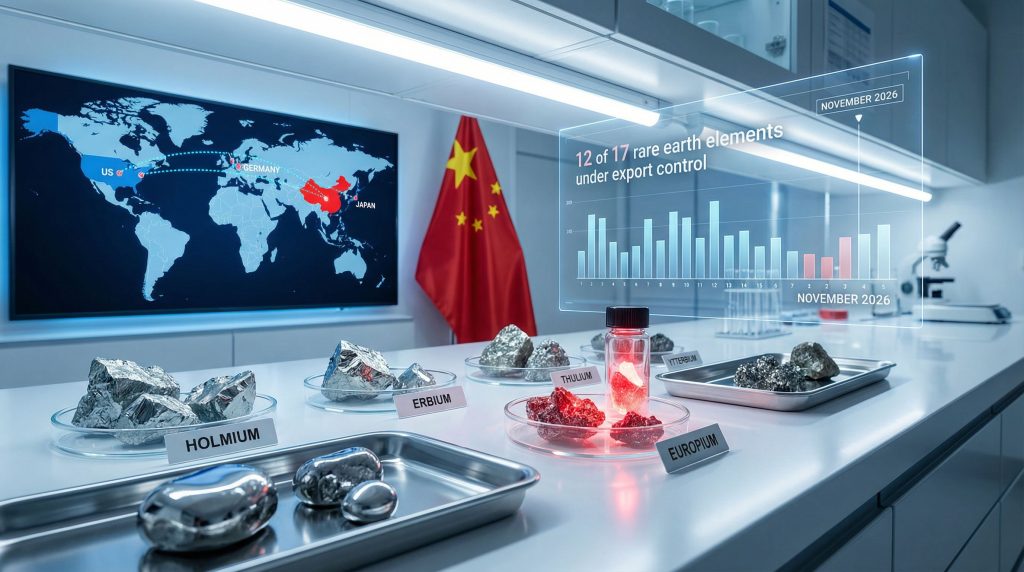
The global economy faces unprecedented challenges as China rare earth export restrictions reshape critical material markets and expose vulnerabilities in international supply chains. These strategic controls, affecting essential elements used in defense systems, renewable energy technologies, and consumer electronics, demonstrate how resource dependencies become tools of geopolitical influence. Furthermore, the timing coincides with broader tensions including the US‑China trade war impact on global markets and emerging China export controls across multiple strategic materials.
Strategic Resource Control Mechanisms in Modern Trade Policy
China's approach to rare earth export management represents a sophisticated evolution in strategic resource diplomacy. Beginning with targeted restrictions on seven heavy rare earth elements in August 2023, Beijing has systematically expanded control mechanisms across critical material supply chains. These measures encompass not only raw materials but extend to processing technologies and downstream manufacturing capabilities.
The licensing framework operates through China's Ministry of Commerce (MOFCOM), requiring exporters to obtain approval for shipments of controlled materials. This system enables Chinese authorities to evaluate end-use applications, screen for military purposes, and maintain oversight of global supply chain flows. Processing delays averaging 45-90 days create operational uncertainties for international buyers, encouraging diversification away from Chinese sources.
China's dominance in rare earth processing creates unique leverage points. Despite representing 60-70% of global mining production, China controls approximately 99% of rare earth element refining capacity. This processing monopoly means that even rare earths mined in other countries typically require Chinese facilities for separation and purification before reaching final applications.
Key elements under enhanced scrutiny include:
• Dysprosium and terbium for high-temperature permanent magnets
• Europium for advanced electronics and display technologies
• Erbium, holmium, and thulium for specialised industrial applications
• Lutetium for medical imaging and research applications
The extraterritorial implications of these controls extend beyond direct rare earth exports. Products containing even minimal percentages of Chinese-origin rare earths may fall under licensing requirements, capturing downstream manufactured goods in the regulatory framework.
When big ASX news breaks, our subscribers know first
Industrial Sector Vulnerabilities and Dependencies
Defense manufacturing faces particularly acute exposure to China rare earth export restrictions. Modern military systems rely heavily on rare earth permanent magnets for precision guidance, radar arrays, and communication equipment. The F-35 fighter program alone requires rare earth magnets across multiple subsystems, with total program production exceeding 3,000 aircraft globally.
Neodymium-iron-boron (NdFeB) magnets enhanced with dysprosium provide essential high-temperature stability for military applications. These materials operate reliably in temperature ranges exceeding 150°C, critical for hypersonic weapons systems and advanced propulsion technologies. Defense contractors historically sourced 80% of rare earth magnet requirements through Chinese processing chains.
Critical defense applications include:
• Missile guidance servo motors and positioning systems
• Phased-array radar frequency components
• Submarine propulsion and navigation systems
• Advanced communications infrastructure
Clean energy technology manufacturing demonstrates similar dependency patterns. Modern direct-drive wind turbines require 400-600 kilograms of rare earth magnets per unit, with global offshore wind deployment targeting over 1,000 GW by 2050. This expansion necessitates approximately 4-6 million metric tons of rare earth magnets through mid-century, highlighting the importance of critical minerals energy security for future energy systems.
Electric vehicle production compounds these requirements. Permanent magnet motors in EVs consume significant quantities of neodymium and dysprosium, with market penetration expanding rapidly across global automotive sectors. Tesla, BYD, and traditional automakers increasingly rely on rare earth magnet technologies for efficiency improvements.
Consumer electronics represent another vulnerable sector. Smartphones, laptops, and data centre equipment incorporate rare earth elements in speakers, hard drives, and power management systems. The miniaturisation trends in consumer technology increase reliance on high-performance rare earth magnets and phosphors.
Supply Chain Adaptation Strategies and Market Response
Alternative Supply Development
Global supply chains are implementing diversification strategies to reduce Chinese dependency. Alternative rare earth sources in Australia, Canada, and Africa receive increased investment, though developing competitive processing capacity requires substantial capital and technical expertise.
Notable diversification initiatives include:
• Lynas Rare Earths expanding Australian processing capabilities
• MP Materials developing domestic U.S. separation facilities
• Canadian rare earth projects advancing through permitting processes
• African mining ventures attracting international partnership capital
Technology Substitution and Innovation
Technology substitution research accelerates as companies seek rare earth-reduced alternatives. Samarium-cobalt magnets offer high-temperature performance without dysprosium requirements, though at higher material costs. Ferrite magnets provide lower-performance options for applications where rare earth specifications exceed functional needs.
Urban mining and recycling initiatives gain prominence as supply constraints tighten. Permanent magnet recycling from end-of-life wind turbines and electric vehicles could provide significant secondary supply sources. However, current recycling infrastructure remains limited and economically marginal at current price levels.
Strategic stockpiling programs expand across Western governments and critical industries. The U.S. Defense Logistics Agency maintains strategic material reserves, while private companies increase inventory buffers to manage supply disruption risks. These stockpiles provide temporary cushions but cannot address long-term structural dependencies.
Geopolitical Implications and Resource Diplomacy
China's rare earth export restrictions function as components of broader strategic competition with the United States and Western allies. The timing of control expansions correlates with U.S. technology export restrictions targeting Chinese semiconductor and advanced manufacturing sectors. This tit-for-tat escalation demonstrates how critical material dependencies become tools of statecraft.
Resource diplomacy extends beyond bilateral U.S.-China relations. European Union critical raw materials legislation acknowledges supply chain vulnerabilities and promotes domestic processing capabilities. Japan's resource security strategy emphasises diversified sourcing and technology partnerships with resource-rich nations.
International cooperation frameworks emerging include:
• Minerals Security Partnership linking democratic nations
• Critical materials alliance structures within NATO
• Technology sharing agreements for processing development
• Joint stockpiling arrangements among allied countries
The interconnection between energy and mineral geopolitics becomes increasingly apparent. Moreover, recent developments show a significant pivot in critical minerals strategy as nations recognise the importance of securing domestic supply chains. Additionally, the new critical minerals order demonstrates how policy makers are responding to these challenges.
Ship-to-ship transfers, re-flagging operations, and commodity re-branding techniques perfected in sanctioned oil markets could easily apply to rare earth trade. The opacity inherent in critical mineral supply chains facilitates such workarounds, complicating enforcement of export restrictions.
Market Dynamics and Price Formation Mechanisms
Rare earth pricing structures reflect both fundamental supply-demand dynamics and geopolitical risk premiums. The 2010 rare earth crisis, when China reduced export quotas by 72%, created price increases of 400-1000% for speciality elements like dysprosium and terbium. Current restrictions generate similar volatility, though market participants maintain larger inventory buffers than in 2010.
Price formation factors include:
• Physical supply availability through licensed channels
• Inventory speculation and strategic stockpiling demand
• Technology substitution reducing specific element requirements
• Alternative supply source development timelines
Contract structures adapt to supply uncertainty through longer-term agreements and price adjustment mechanisms. Buyers increasingly negotiate supply security provisions rather than optimising purely for cost. Force majeure clauses specifically address export restriction scenarios.
Market segmentation develops between Chinese-origin and alternative-source materials. Premium pricing for non-Chinese rare earths reflects supply security value, creating dual-market structures similar to conflict mineral certification systems.
Secondary market development for rare earth materials remains limited compared to other commodity sectors. The technical complexity of rare earth specifications and quality requirements constrains spot market liquidity, maintaining dependence on direct producer relationships.
Business Adaptation and Compliance Frameworks
How Should Companies Navigate Export Control Complexity?
Companies exposed to China rare earth export restrictions must implement comprehensive supply chain auditing systems. Traceability requirements extend beyond immediate suppliers to encompass upstream processing and mining origins. Documentation standards mirror those developed for conflict minerals compliance.
Essential compliance elements include:
• Origin certification for all rare earth inputs
• Technology licensing review for export control implications
• Supplier diversification timeline development
• Force majeure and supply disruption contingency planning
Legal frameworks governing export controls create complex compliance obligations. Companies must navigate Chinese export licensing requirements, U.S. sanctions regulations, and European Union dual-use goods controls simultaneously. Professional legal counsel specialising in trade controls becomes essential for multinational operations.
Risk assessment methodologies incorporate geopolitical scenarios alongside traditional business risks. Supply chain stress testing evaluates performance under various restriction scenarios, informing inventory strategies and supplier relationship investments.
Technology development priorities shift toward reducing rare earth intensity or eliminating dependencies entirely. Research and development budgets increasingly target material substitution alongside traditional performance improvements.
The next major ASX story will hit our subscribers first
Comparative Analysis of Strategic Material Controls
China's rare earth restrictions operate within a broader framework of strategic material export controls. Gallium and germanium restrictions implemented in August 2023 preceded rare earth measures, establishing precedents for scope and enforcement mechanisms. Tungsten and antimony controls add additional dimensions to China's critical material leverage.
Parallel control mechanisms include:
• Gallium restrictions affecting semiconductor manufacturing
• Germanium controls impacting fiber optic and solar applications
• Tungsten limitations affecting aerospace and defence sectors
• Antimony restrictions targeting flame retardants and battery applications
International responses vary across jurisdictions and sectors. The United States implements reciprocal restrictions on advanced technology exports to China, while European nations pursue strategic autonomy through domestic capacity building. Japan emphasises diplomatic engagement and alternative partnership development.
The cumulative effect of multiple material restrictions creates systemic supply chain pressures. Companies face simultaneous constraints across multiple input categories, requiring integrated rather than element-specific adaptation strategies. According to the International Energy Agency, "these new export controls on critical minerals make supply concentration risks a reality for many industries."
Future Scenarios and Strategic Planning Horizons
What Are the Potential Outcomes for Global Markets?
Multiple scenarios govern potential developments in China's rare earth export policy through 2030. Full implementation of expanded controls after temporary suspension periods would significantly constrain global supply chains. However, diplomatic resolution possibilities exist through technology cooperation or trade agreement modifications.
Critical monitoring indicators include:
• Chinese rare earth production and export volume statistics
• Alternative supply source development milestones
• Technology substitution breakthrough timelines
• Geopolitical relationship evolution between major powers
Market rebalancing timelines depend on alternative supply chain development speeds. New mining and processing projects typically require 7-10 years from discovery to production, creating extended transition periods. Technology substitution may accelerate this rebalancing through demand reduction rather than supply expansion.
Investment patterns increasingly favour supply chain resilience over cost optimisation. Private equity and government funding target critical material processing capabilities, rare earth recycling technologies, and material substitution research. These investments create long-term structural changes in global supply networks.
The interconnection between resource geopolitics and global economic relationships continues deepening. Energy sanctions, critical material restrictions, and technology export controls operate as integrated policy tools rather than isolated measures. Understanding these linkages becomes essential for strategic planning across multiple industrial sectors.
Disclaimer: This analysis contains forward-looking statements and scenarios based on current information and historical patterns. Actual policy developments may differ significantly from projections. Readers should conduct independent research and consult professional advisors for specific business decisions involving critical material supply chains and geopolitical risk assessment.
Are You Tracking Critical Minerals Investment Opportunities Amidst Global Supply Chain Disruptions?
As China's rare earth export restrictions reshape global markets and create unprecedented opportunities in alternative supply chains, Discovery Alert's proprietary Discovery IQ model delivers instant notifications on significant ASX mineral discoveries across critical materials sectors. Begin your 30-day free trial today and position yourself ahead of the market as major mineral discoveries demonstrate the potential for substantial returns when supply chain vulnerabilities create new investment landscapes.