July 8, 2026
The Hidden Architecture of Critical Mineral Coercion
Most commodity disruptions unfold through market forces: price spikes, shipping delays, or unexpected demand surges. What is happening between China and Japan right now is structurally different. It is a deliberate, calibrated withdrawal of material supply tied directly to geopolitical signalling, and it exposes a vulnerability that decades of industrial planning failed to adequately address.
The materials at the centre of this dispute are not bulk commodities. They are heavy rare earth elements and specialist metals whose physical properties are irreplaceable in the technologies that define modern industrial economies. Understanding why China rare earth exports to Japan have effectively stopped, what it means for manufacturers, and what alternatives realistically exist requires moving beyond headlines and into the mechanics of the supply chain itself.
When big ASX news breaks, our subscribers know first
What Makes Heavy Rare Earths Strategically Unique
The rare earth category encompasses 17 elements, but not all carry equal strategic weight. The distinction between light rare earths, such as cerium and lanthanum, and heavy rare earths, including dysprosium, terbium, and yttrium, is critical to understanding the current crisis.
Heavy rare earths are present in far lower concentrations in the Earth's crust and are disproportionately concentrated in Chinese ionic clay deposits, particularly in southern China's Jiangxi Province. These deposits are not merely dominant in market share terms; they represent a geological reality that no amount of capital investment can quickly replicate elsewhere. Unlike light rare earths, which are found in carbonatite and other deposit types distributed more widely across Australia, Africa, and North America, the ionic clay deposits that host heavy rare earths require a specific lateritic weathering environment that took millions of years to form.
This geological asymmetry is the foundation of China's leverage. It is not a policy choice that can be undone by shifting trade relationships. It is a physical reality embedded in the planet's crust. Furthermore, rare earth supply chains globally have long been shaped by this geographic concentration, leaving importing nations structurally exposed.
The Four Materials Driving the Current Disruption
Since December 2025, Chinese customs data shows that exports of four specific materials to Japan have effectively ceased, with only minor residual shipments of yttrium recorded:
| Material | Primary Application | Strategic Sector |
|---|---|---|
| Dysprosium | High-coercivity permanent magnets | EVs, defence, robotics |
| Terbium | Magnet performance enhancement | Aerospace, industrial motors |
| Yttrium oxide | Phosphors, ceramics, electronics | Semiconductors, displays |
| Gallium | Compound semiconductor wafers | Chip fabrication, radar systems |
Each of these materials sits at a chokepoint within a manufacturing chain that feeds directly into the technologies considered most critical to Japan's economic and national security interests. In addition, gallium in semiconductors represents one of the most acute single-material vulnerabilities Japan now faces.
How Deep Is Japan's Dependence on Chinese Rare Earths?
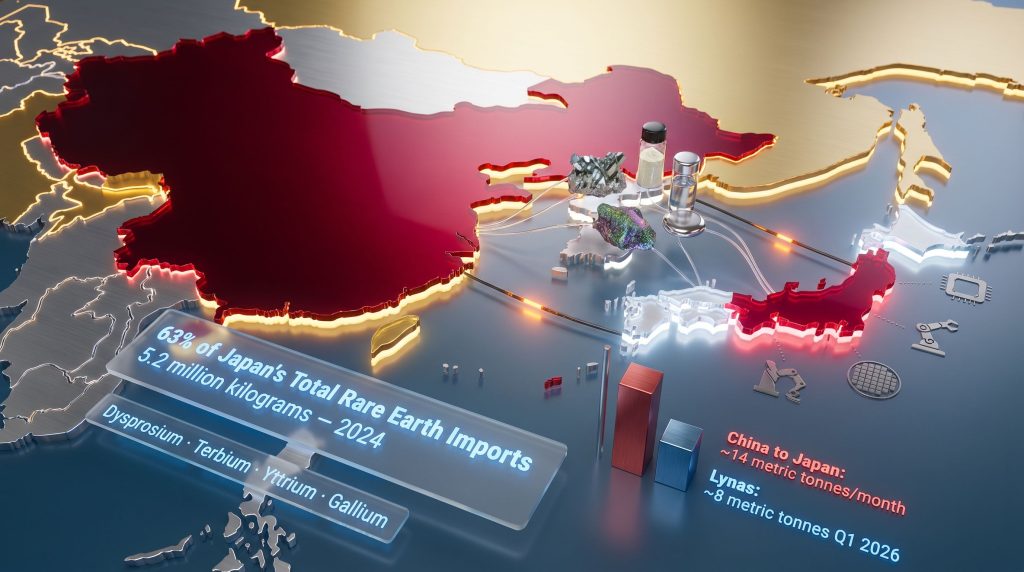
Japan imported over 5.2 million kilograms of rare earth metals from China in 2024, representing approximately 63% of its total rare earth imports. That figure alone understates the vulnerability because the remaining 37% covers predominantly light rare earths sourced from countries like Australia and Malaysia. For the heavy rare earth fraction, Chinese dominance approaches totality.
Japan holds a paradoxical position in the global rare earth ecosystem. It is the world's largest producer of rare earth permanent magnets outside of China, with companies like Shin-Etsu Chemical, TDK, and Hitachi Metals operating globally significant manufacturing operations. Yet the feedstock for those magnets flows overwhelmingly through Chinese supply chains.
This paradox was not accidental. For decades, the economics of sourcing from China were so compelling that building alternative supply chains carried no commercial justification. The result is a high-value downstream manufacturing capability built atop a single-origin upstream dependency.
The Magnet Manufacturing Bottleneck
Neodymium-iron-boron (NdFeB) permanent magnets are the workhorses of modern electrification. They are found in every electric vehicle motor, every wind turbine generator, and a vast range of industrial and consumer electronics. The performance ceiling of these magnets, particularly their ability to retain magnetic properties at elevated temperatures, is determined almost entirely by dysprosium and terbium additions.
Without dysprosium, NdFeB magnets experience significant demagnetisation at the operating temperatures found inside EV motors and industrial equipment. There is no substitute material that replicates this function at commercial scale. This is why Shin-Etsu's decision to halt new order acceptance for dysprosium-containing magnets carries such significant downstream implications for the automotive and industrial sectors that depend on Japanese magnet supply.
China's Calibrated Strategy: Asymmetric Restriction
One of the most analytically important features of the current disruption is what China has not restricted. Finished rare earth permanent magnets continue to flow from China to Japan at relatively normal volumes. Only the upstream raw inputs, the separated heavy rare earth oxides and metals, have been cut off.
This asymmetry points to a deliberate industrial strategy rather than a blanket embargo. By restricting raw inputs while continuing to supply finished components, China preserves its competitive advantage in downstream magnet manufacturing while simultaneously constraining Japan's ability to independently process and refine heavy rare earths.
The implication for Japanese manufacturers is stark. Companies that rely on processing their own rare earth feedstock into specialist magnet alloys face the sharpest pressure. Those purchasing finished magnets from Chinese suppliers remain operational for now, but at the cost of deepening dependency on Chinese finished goods rather than building independent capability.
This pattern is consistent with a broader industrial policy logic: China has spent the past two decades building processing and manufacturing capacity along the entire rare earth value chain, and the current restrictions serve to reinforce that advantage. Consequently, rare earth processing challenges outside China remain a fundamental barrier to meaningful diversification.
2010 and 2025: Two Eras of Rare Earth Coercion Compared
The current situation inevitably draws comparisons to China's 2010 rare earth export slowdown, which followed a territorial dispute involving a Chinese fishing vessel near the Senkaku Islands. That episode triggered a global reassessment of rare earth supply chain risk and catalysed a wave of investment in alternative sources. According to analysis of the 2010 rare earths dispute, the episode fundamentally reshaped how resource-dependent nations viewed concentrated mineral supply.
| Dimension | 2010 Dispute | 2025-2026 Dispute |
|---|---|---|
| Primary trigger | Territorial/diplomatic friction | Taiwan-linked diplomatic tensions |
| Materials targeted | Broad rare earth export reduction | Heavy rare earths and gallium specifically |
| Japan's preparedness | Low stockpiles, high exposure | Improved stockpiles, partial diversification |
| Alternative supply | Minimal | Lynas, emerging Australian and French projects |
| Diplomatic response | Multilateral WTO challenge | Bilateral ministerial engagement |
| Downstream impact | Severe price spikes globally | Contained but operationally significant |
Japan's industrial sector is meaningfully better positioned than in 2010. Stockpile programmes were strengthened, heavy rare earth usage in magnets was partially reduced through engineering innovation, and investments in alternative producers like Lynas Rare Earths have created at least a marginal non-Chinese supply base. Research director David Merriman of Project Blue has noted that Japanese companies have pursued stockpiling, usage reduction, and supply diversification since the 2010 episode, which provides some buffer against the current pressure.
However, the 2025 campaign is more precisely targeted. The focus on heavy rare earths and gallium specifically, rather than a broad reduction in all rare earth exports, reflects a more sophisticated understanding of where Japan's substitution options are weakest.
Japan's Response: Reserves, Diplomacy, and the Limits of Diversification
Japan's government has confirmed it is releasing stockpiled supplies where required, though specific volumes and timelines are not publicly disclosed. The industrial ministry has acknowledged awareness of supply tightening and price pressure, indicating that the impact is real enough to warrant policy attention without yet reaching crisis levels.
At the corporate level, responses have varied:
- TDK has stated it does not currently anticipate major operational disruption and is broadening its sourcing strategy across multiple geographies.
- Mitsubishi Motors confirmed in early 2026 that it had secured rare earth supply through mid-year, a statement that implicitly signals the urgency of securing post-mid-year supply.
- Shin-Etsu Chemical has stopped accepting new orders for dysprosium-containing magnets, a significant signal from the world's largest rare earth magnet producer outside China.
Japan's Trade Minister Ryosei Akazawa travelled to China in May 2026, representing the most senior Japanese diplomatic engagement with Beijing since the dispute began. Whether this constitutes substantive negotiation or primarily diplomatic signalling remains unclear, but the visit itself reflects the seriousness with which Tokyo views the situation.
The next major ASX story will hit our subscribers first
The Lynas Reality Check: What Alternative Supply Actually Exists
Lynas Rare Earths, the Australian producer in which Japan has invested, represents the only commercial-scale source of separated terbium and dysprosium outside Chinese jurisdiction. Its significance to Japan's supply diversification strategy cannot be overstated, but neither can its current limitations.
In the first quarter of 2026, Lynas produced approximately 8 metric tonnes of combined dysprosium and terbium. In 2024, China was exporting roughly 14 metric tonnes per month of those same two elements to Japan alone.
The arithmetic is unambiguous: even if Lynas directed its entire heavy rare earth output exclusively toward Japan, it would cover less than two months of Japan's pre-disruption monthly requirement.
Beyond Lynas, Japan has supported rare earth development projects in Australia and France, and a gallium recovery project in Australia. Gallium presents a particularly difficult diversification challenge because it is primarily recovered as a byproduct of aluminium smelting, and its production geography is even more concentrated than rare earths. China accounts for an estimated 80% or more of global gallium production, and the processing infrastructure to recover gallium economically at scale outside China does not yet exist in commercially viable form.
The broader message is that supply chain diversification in heavy rare earths and gallium is a decade-long structural project, not a near-term solution. Projects take years to move from discovery through feasibility, permitting, construction, and commercial production. Even the most optimistic development timelines for new non-Chinese heavy rare earth processing capacity push meaningful supply contributions into the early 2030s at the earliest.
Industries Facing the Highest Disruption Risk
The sectors most exposed to a prolonged restriction of China rare earth exports to Japan span both civilian and defence applications. Furthermore, growing critical minerals demand across the energy transition is making these bottlenecks increasingly consequential:
- Electric vehicle manufacturing: Every EV motor relies on high-performance NdFeB magnets. Dysprosium and terbium additions are essential for thermal stability in traction motor applications.
- Aerospace and defence: Heavy rare earths are classified as critical to national security in both Japan and allied nations, underpinning guidance systems, radar components, and aerospace actuation systems.
- Semiconductor fabrication: Gallium is integral to gallium arsenide and gallium nitride compound semiconductors used in high-frequency and high-power chips. Japan's chip sector faces a distinct and acute exposure.
- Industrial automation and robotics: A largely underappreciated demand vector, factory automation relies heavily on permanent magnet servo motors that require the same heavy rare earth inputs as EV drivetrains.
A Global Pattern: Japan Is Not Alone
The pressure campaign against Japan is structurally parallel to restrictions applied toward the United States during the broader trade conflict of 2025. China's export restrictions have targeted heavy rare earths and gallium across multiple jurisdictions, though the specific designations and timing have varied.
The European Union and South Korea are watching Japan's situation with considerable institutional interest. Both economies carry meaningful rare earth dependencies, and the Japan case study is effectively a live demonstration of the maximum leverage China can extract from mineral dominance in the absence of diversified supply chains.
For policymakers in Brussels and Seoul, the lesson is the same as it was after 2010, though now rendered with sharper urgency: strategic dependency in critical minerals is not merely an economic risk category. It is a foreign policy vulnerability that adversaries can activate at a time of their choosing. As Japan's rare earth strategy analysts at the East Asia Forum have observed, China continues to hold most of the structural cards in this contest.
Frequently Asked Questions: China Rare Earth Exports to Japan
What rare earth materials has China restricted from export to Japan?
Chinese customs data shows that exports of dysprosium, terbium, yttrium oxide, and gallium to Japan have effectively ceased since December 2025, with only minor yttrium shipments recorded in the intervening period.
How long has the export slowdown been in effect?
The disruption has been underway for at least four months as of mid-2026, with Beijing formally tightening export controls in January 2026 and expanding restrictions in February 2026.
Is Japan at risk of a manufacturing crisis due to rare earth shortages?
The near-term risk is managed by stockpiles and existing contracts, but the medium-term outlook, particularly beyond mid-2026, presents genuine operational uncertainty for manufacturers dependent on heavy rare earth inputs.
What is Lynas Rare Earths' role in replacing Chinese supply?
Lynas is the only commercial non-Chinese producer of separated terbium and dysprosium, but its current output covers a fraction of Japan's prior monthly import volume from China.
Has China officially acknowledged using rare earths as diplomatic leverage?
China has not made explicit public statements linking the export restrictions to diplomatic objectives, but the timing correlation with the Taiwan-related diplomatic dispute and the selective targeting of Japanese entities is widely interpreted by analysts as intentional coercion.
What can Japan realistically do to reduce its dependence on Chinese rare earths?
Short-term measures include stockpile releases and magnet recycling. Medium-term options include expanding Lynas capacity and developing Australian and French projects. Long-term structural reduction requires new mining and processing infrastructure, a process realistically spanning a decade or more.
The Three Scenarios Ahead
Analysts tracking the China-Japan rare earth dispute broadly frame the forward outlook around three possible trajectories:
- Diplomatic resolution: Ministerial-level engagement produces a framework that gradually restores export flows, likely tied to broader bilateral agreements on Taiwan-related frictions. This scenario would relieve immediate pressure but leave the structural dependency intact.
- Prolonged restricted access: The current partial embargo continues for an extended period, accelerating Japanese investment in alternative supply but causing measurable industrial disruption in the interim. This scenario is consistent with China's observed behaviour pattern.
- Escalation: Restrictions expand to cover finished rare earth magnets in addition to raw inputs, or are extended to additional materials. This scenario would cause severe near-term manufacturing disruption and likely trigger emergency multilateral responses.
What the Japan case study ultimately reveals is a structural truth about the global critical mineral landscape: the transition to clean energy, advanced defence systems, and digital infrastructure requires materials whose production geography was allowed to concentrate into a single jurisdiction over several decades of cost-driven procurement decisions. Reversing that concentration will require sustained, coordinated investment across mining, processing, and manufacturing infrastructure at a scale and timeline that neither the private sector nor individual governments have yet fully committed to.
This article is provided for informational purposes only and does not constitute financial or investment advice. Forecasts, timelines, and market projections involve inherent uncertainty and should not be relied upon as the basis for investment decisions.
Want to Track the Next Critical Mineral Discovery Before the Market Does?
Discovery Alert's proprietary Discovery IQ model delivers real-time alerts on significant ASX mineral discoveries across rare earths, gallium, and more than 30 other commodities — instantly converting complex geological data into actionable investment insights for both short-term traders and long-term investors. Explore historic discoveries and their extraordinary returns, then begin your 14-day free trial at Discovery Alert to position yourself ahead of the next major find.