May 22, 2026
The Strategic Chokepoint America Is Finally Addressing
For decades, the rare earth supply chain operated like an invisible backbone beneath modern civilisation. The magnets in electric vehicle motors, the guidance systems in precision munitions, the screens in smartphones, the generators in offshore wind turbines — all of them trace back to a handful of elements that require extraordinarily complex chemistry to refine. Mining these materials is only the beginning. The real strategic leverage sits in the separation and processing stages, where raw ore is transformed into high-purity oxides and metal alloys that industry can actually use.
That processing capability, once partially held by the United States, shifted steadily offshore across the 1980s and 1990s, leaving America dependent on foreign refining capacity for some of its most critical industrial inputs. Understanding the strategic importance of rare earths helps explain why the urgency to rebuild domestic capacity has intensified so dramatically in recent years.
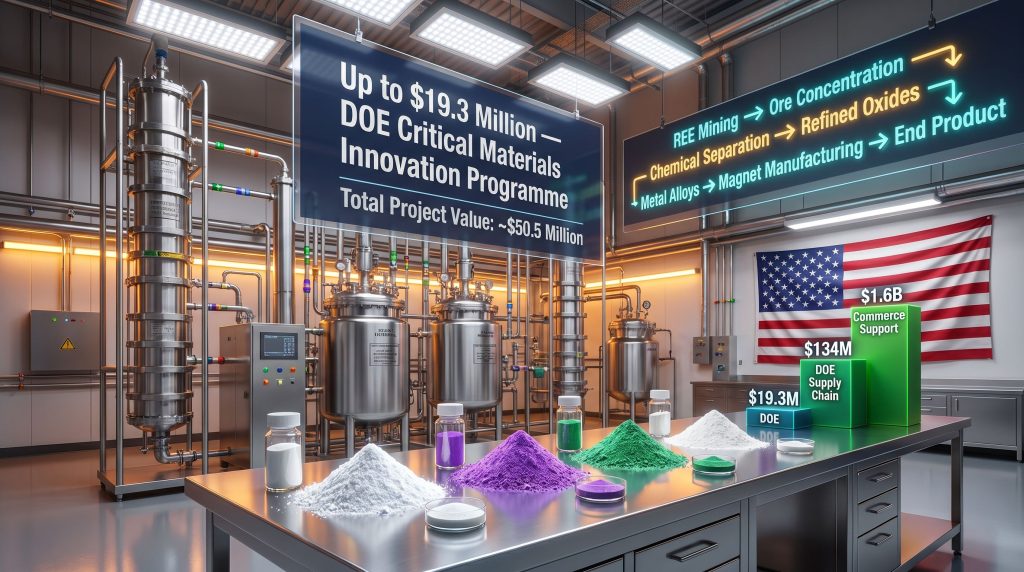
The USA Rare Earth DOE funding announcement, which involves a potential award of up to $19.3 million under the Department of Energy's Critical Materials Innovation, Efficiency and Alternatives programme, is best understood against this decades-long backdrop of capacity erosion and the accelerating federal effort to rebuild it.
When big ASX news breaks, our subscribers know first
Understanding the DOE CMI Programme and How It Works
The Critical Materials Innovation, Efficiency and Alternatives programme is one of the federal government's primary instruments for de-risking domestic rare earth element supply chains. Its mandate goes beyond research funding. The programme is designed to move projects from laboratory concept through to pilot-scale and eventually commercial-scale processing capability, with a particular focus on the mid-stream separation and refining stages where the U.S. has historically been most exposed.
It is important to understand exactly what stage this funding represents. The DOE funding pipeline follows a structured sequence:
- Programme announcement and open application window
- Technical and strategic merit review by DOE evaluators
- Selection of preferred applicants for award negotiations
- Execution of a formal funding agreement confirming final commitment
USA Rare Earth has reached step three. This is a meaningful milestone, but it is not the finish line.
Important Distinction: Selection for award negotiations under a DOE programme is categorically different from receiving a confirmed grant. The final disbursement amount, project scope, milestone structure, and timeline all remain subject to negotiation and can change before any formal agreement is signed.
This distinction matters to investors. A selection signals that the project has passed substantive technical and strategic scrutiny, but it does not guarantee the full amount, the timeline, or the scope outlined in the initial announcement.
Breaking Down the $50.5 Million Project Structure
The proposed project is structured as a public-private partnership, a model the DOE has consistently favoured in critical minerals development because it aligns federal risk tolerance with commercial accountability.
| Funding Component | Amount |
|---|---|
| DOE Potential Contribution | Up to $19.3 million |
| Non-DOE (Private/Company) Contribution | Approximately $31.2 million |
| Total Estimated Project Value | Approximately $50.5 million |
The private co-investment figure of roughly $31.2 million deserves attention. In critical minerals development, the willingness of private capital to match or exceed federal contributions at the pilot stage is often read as a signal of commercial conviction. Pilot-scale facilities are expensive and technically demanding, and investors backing them at this stage are typically betting on the project's ability to generate proprietary processing know-how, technical data, and qualified workforce capability that can underpin a future commercial-scale build-out.
Why Rare Earth Separation Is the True Strategic Vulnerability
A common misconception in public discourse about critical minerals is that mine ownership equals supply chain security. In practice, the separation and refining stages represent far greater strategic leverage than the mining stage. Consider the processing chain:
REE Mining → Ore Concentration → Chemical Separation →
Refined Oxides → Metal Alloys → Magnet Manufacturing → End Product
Each step in this chain requires distinct technical expertise, specialised equipment, and significant capital investment. The United States has retained some capacity at the mining stage but has historically lacked competitive domestic infrastructure across the separation, refining, and alloying stages. Furthermore, this gap means that even domestically mined rare earth ore has often been shipped overseas for processing before returning as refined material or finished components.
The separation stage is particularly complex. Rare earth elements are chemically very similar to one another, which makes separating them into individual high-purity compounds technically demanding. Solvent extraction, the dominant commercial separation technology, requires carefully engineered multi-stage circuits and significant process chemistry expertise. The processing challenges facing rare earths in 2025 make building this capability domestically at pilot scale the essential precursor to any credible commercial-scale processing industry.
Key End-Use Sectors Dependent on Domestic REE Separation
- Electric Vehicles: Neodymium-iron-boron permanent magnets, which are essential in EV traction motors, require high-purity separated neodymium, praseodymium, and dysprosium. As EV adoption accelerates, demand for these separated oxides is forecast to grow substantially through the 2030s.
- Defence Systems: Precision-guided munitions, radar arrays, sonar systems, jet engine components, and advanced communications hardware all incorporate REE-derived materials. Supply chain disruptions at the separation stage create direct exposure for defence procurement.
- Renewable Energy: Direct-drive offshore wind turbines use large quantities of REE-based permanent magnets. A single large offshore turbine can require several hundred kilograms of rare earth magnet material.
- Semiconductors and Electronics: REEs including cerium, lanthanum, and europium are embedded across chip polishing processes, phosphors, and optical components. Indeed, the role of critical minerals in semiconductors has become one of the most closely watched supply chain issues of this decade.
- Advanced Manufacturing and Robotics: Industrial servo motors, automation systems, and precision manufacturing equipment increasingly rely on REE-based components as efficiency standards rise.
The Broader Federal Investment Architecture
The USA Rare Earth DOE funding selection does not exist in isolation. It sits within a substantially larger federal investment framework targeting rare earth supply chain reconstruction. In addition, efforts to rebuild America's rare earth supply chain have gathered considerable momentum across multiple government departments simultaneously.
| Programme or Initiative | Approximate Scale | Focus Area |
|---|---|---|
| DOE CMI Pilot Funding (this selection) | Up to $19.3 million | REE separation, pilot-scale |
| DOE Rare Earth Supply Chain Programme | Up to $134 million | Broad REE supply chain |
| U.S. Department of Commerce Support (reported, milestone-contingent) | Up to $1.6 billion | Full project development |
The DOE has separately committed up to $134 million across multiple participants in its rare earth supply chain programme, of which this selection forms one component. The reported Department of Commerce support figure of up to $1.6 billion, noted as milestone-contingent, suggests that federal interest in USA Rare Earth extends well beyond a single pilot project. However, it is critical to note that milestone-contingent commitments are not guaranteed disbursements. They are structured to release funding only upon the achievement of defined operational or commercial benchmarks.
The Historical Context Behind the Policy Urgency
The United States was once a global leader in rare earth production and processing. Mountain Pass in California was the world's dominant rare earth mine through much of the second half of the twentieth century. Processing capacity was also held domestically during this period. The erosion of this position was not sudden. It occurred gradually as lower-cost overseas producers, operating under different environmental and labour cost structures, undercut domestic economics across both mining and processing.
By the early 2000s, the U.S. had effectively ceded mid-stream and downstream processing capability. Consequently, China's rare earth export restrictions have converted what was a structural vulnerability into an acute geopolitical pressure point. Legislative frameworks including the Inflation Reduction Act, the CHIPS and Science Act, and a series of executive orders on critical mineral security have collectively redirected significant federal capital toward rebuilding domestic processing capacity.
Market Response and Investor Dynamics
The DOE selection announcement coincided with quarterly financial results that came in ahead of analyst expectations. Reported adjusted losses were narrower than forecast, and revenue exceeded market estimates, creating a dual catalyst that amplified the market response to the policy news.
Analyst consensus maintained Buy-equivalent ratings following the announcement, with price targets cited at approximately USD $34 per share. The convergence of improving financial performance and a high-profile policy endorsement created a multi-factor sentiment event that drove near-term share price momentum. For further context on government funding for critical minerals companies across recent years, the broader investment picture reinforces the scale of federal commitment to this sector.
Understanding how different catalysts affect critical minerals stocks over different timeframes is useful context for investors:
| Catalyst Type | Typical Market Impact | Duration |
|---|---|---|
| DOE selection announcement (pre-negotiation) | Short-term positive momentum | Days to weeks |
| Executed funding agreement (confirmed award) | Stronger, more sustained re-rating | Weeks to months |
| Commercial milestone achievement | Long-term structural re-rating | Months to years |
| Policy reversal or funding cancellation | Sharp negative correction | Immediate |
Investor Note: Policy-driven catalysts in the critical minerals sector can generate significant short-term price movement. However, sustained valuation re-ratings in this space typically require confirmed funding agreements followed by demonstrable operational progress at the facility level. Investors should distinguish between sentiment-driven momentum and fundamental milestone delivery.
The next major ASX story will hit our subscribers first
From Pilot to Commercial: Why This Stage Matters
Pilot-scale facilities occupy a specific and underappreciated role in the development of processing industries. They are not simply scaled-down versions of commercial plants. They serve as the primary vehicles for generating the process chemistry data, equipment performance benchmarks, product purity validation, and regulatory compliance records that private capital and government procurement offices require before committing to commercial-scale investment.
The development pathway for domestic REE processing follows a structured logic:
- Pilot-scale facility: Validates separation chemistry, process efficiency, and achievable product purity at a manageable capital commitment. Generates the technical dataset required for subsequent investment decisions.
- Demonstration-scale facility: Proves economic viability under near-commercial operating conditions. Refines energy consumption, reagent costs, waste management protocols, and throughput parameters.
- Commercial-scale facility: Full production capacity integrated into domestic supply chains, capable of supporting long-term supply agreements with defence contractors, EV manufacturers, and industrial customers.
Successful pilot operations also generate spillover value beyond the single project. They create trained technical workforces, establish domestic regulatory precedents for REE processing facilities, and produce publicly available data that supports the broader development of the U.S. separation industry.
Frequently Asked Questions: USA Rare Earth DOE Funding
What is the DOE funding amount selected for USA Rare Earth?
The U.S. Department of Energy has selected USA Rare Earth for up to $19.3 million in potential funding under the Critical Materials Innovation, Efficiency and Alternatives programme. This is a selection for award negotiations, not a confirmed or disbursed grant. USA Rare Earth's full selection details have been widely reported across industry and financial media.
What is the total project cost?
The total estimated project value is approximately $50.5 million, comprising up to $19.3 million in potential DOE funding and approximately $31.2 million in non-DOE private contributions.
What will the funding support?
The funding is intended to support development of a pilot-scale rare earth element separation facility aimed at building domestic mid-stream processing capacity for REEs used across energy, defence, and advanced manufacturing applications.
Is the DOE funding confirmed?
No. The DOE has selected USA Rare Earth for award negotiations only. A formal funding agreement must be executed before any funds are committed. Final scope, amount, and timeline remain subject to negotiation.
Why does domestic REE separation matter strategically?
Separation is the critical mid-stream bottleneck. Without it, even domestically mined ore must be processed overseas, maintaining foreign dependency at the most technically sensitive point in the supply chain. Building domestic separation capacity is the foundational step toward genuine supply chain independence across defence, clean energy, and advanced manufacturing.
Disclaimer: This article is intended for informational purposes only and does not constitute financial or investment advice. Information regarding DOE funding selections represents pre-agreement stages and final outcomes remain subject to negotiation. Readers should conduct independent due diligence before making any investment decisions. Reported analyst price targets and financial figures are sourced from publicly available market information and may change.
Want To Stay Ahead Of The Next Major Critical Minerals Discovery?
Discovery Alert's proprietary Discovery IQ model delivers real-time alerts on significant ASX mineral discoveries, instantly translating complex data across 30+ commodities into actionable insights for investors at every level — start your 14-day free trial today and explore historic discoveries that have generated substantial returns.