June 17, 2026
When corporate executives announce supply chain diversification strategies, markets often respond with measured optimism. Yet beneath these reassuring narratives lies a more complex reality where geological constraints, technological barriers, and decades of accumulated expertise create dependencies that cannot be easily unwound through policy declarations or capital investment alone.
The China rare earth magnet supply chain represents perhaps the most concentrated industrial dependency in the global economy. Unlike semiconductor manufacturing, which can theoretically be relocated with sufficient capital and time, rare earth magnet production requires a unique combination of geological resources, chemical processing expertise, and industrial infrastructure that has taken decades to develop and optimise.
This concentration creates systemic vulnerabilities that extend far beyond individual companies or sectors, influencing everything from electric vehicle production to renewable energy deployment and defence manufacturing capabilities.
Understanding China's Rare Earth Magnet Dominance
China's control over global rare earth magnet production stems from strategic investments begun in the 1980s, when Chinese leadership recognised the long-term value of these materials for emerging technologies. Today, this early positioning has crystallised into market dominance that shapes global industrial strategy.
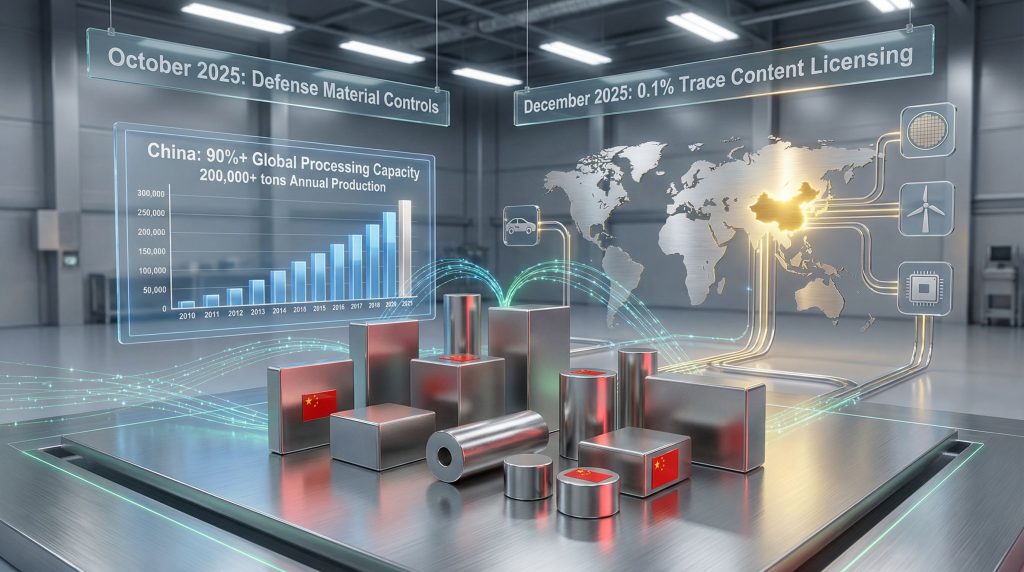
The processing capacity concentration is particularly striking. According to the U.S. Geological Survey's 2023 mineral commodity summaries, China controls approximately 85-90% of global rare earth element separation and processing capacity. This figure represents not just mining output, but the critical downstream processing that transforms raw ore into the purified materials necessary for magnet production.
Historical Development Timeline
China's path to rare earth dominance followed a deliberate strategy:
- 1980s: Initial investment in rare earth processing infrastructure
- 1990s: Deng Xiaoping's declaration that "The Middle East has oil; China has rare earths"
- 2000s: Aggressive pricing strategies that forced Western competitors to close facilities
- 2010s: Consolidation under state-owned enterprises with coordinated production quotas
This systematic approach created a vertically integrated supply chain that extends from mining through final magnet production, with each stage optimised for efficiency and cost competitiveness.
State-Controlled Production Framework
China's rare earth industry operates under centralised coordination through major state-owned enterprises including Baotou Steel Rare-Earth and Technology Co. Ltd., China Northern Rare Earth Group High-Tech Co. Ltd., and Shenghe Resources Holding Co. Ltd. These entities operate under production quotas set by the National Development and Reform Commission, ensuring that supply allocation serves broader strategic objectives rather than purely market dynamics.
This state-directed approach allows for rapid policy implementation and coordinated responses to international trade disputes, creating a level of supply chain control that private market participants in other countries cannot easily replicate or counter.
When big ASX news breaks, our subscribers know first
What Makes Rare Earth Magnets Different from Other Strategic Materials?
The unique characteristics of rare earth magnets create dependencies that resist traditional market solutions. Understanding these technical and geological constraints is essential for realistic policy planning and investment strategy development.
Geological Constraints vs. Manufacturing Capabilities
Unlike semiconductor fabrication, which requires substantial capital investment but can be located anywhere with adequate infrastructure, rare earth magnet production faces fundamental geological limitations:
| Material | Primary Constraint | Replication Timeline | Capital Requirements |
|---|---|---|---|
| Semiconductors | Capital, technical expertise | 3-5 years | $10-20 billion per fab |
| Rare Earth Magnets | Geology, chemistry, process knowledge | 10-15 years | $500M-2B per facility |
| Lithium Batteries | Material access, scale | 2-4 years | $1-5 billion per facility |
The geological constraint is particularly significant for heavy rare earth elements like dysprosium and terbium, which are essential for high-performance magnets operating at elevated temperatures. China controls approximately 95% of global dysprosium and terbium separation capacity, creating a bottleneck that cannot be resolved through alternative sourcing of lighter rare earth elements.
Processing Complexity Beyond Mining
The rare earth value chain involves multiple highly specialised steps:
- Ore Extraction: Mining rare earth-bearing minerals
- Concentration: Physical and chemical separation of rare earth oxides
- Separation: Solvent extraction to isolate individual elements
- Purification: Achieving specification grades (typically 99%+ purity)
- Alloy Production: Creating magnetic alloys with precise compositions
- Magnet Manufacturing: Powder production, pressing, and sintering
China has developed integrated expertise across all these stages, while alternative suppliers typically focus on individual steps. Japan, for example, maintains significant magnet manufacturing capability but relies on Chinese-separated materials for feedstock.
Technical Expertise Accumulation
The tacit knowledge required for rare earth processing has accumulated over decades of operational experience. This includes:
- Process optimisation techniques for maximising separation efficiency
- Quality control protocols for maintaining consistent output specifications
- Troubleshooting expertise for managing complex chemical processes
- Equipment design knowledge for specialised separation and processing machinery
This embedded knowledge cannot be easily transferred or reverse-engineered, creating barriers to entry that persist even when capital and political will align to support alternative capacity development.
How Do China's Export Controls Function as Economic Leverage?
China's rare earth export control mechanisms operate through multiple overlapping policy tools that provide granular control over global supply allocation. Furthermore, these controls have evolved from simple export quotas to sophisticated licensing systems that can target specific applications and end users.
The implementation of Chinese export controls demonstrates increasing sophistication in targeting specific strategic applications, particularly in response to escalating tensions in global trade relationships.
Recent Policy Escalations
The trajectory of Chinese export controls demonstrates increasing sophistication in targeting specific strategic applications:
Policy Evolution Timeline:
- 2010: Initial export quota system implementation
- 2020-2021: Expanded licensing requirements for military applications
- 2024: Enhanced controls on dual-use technologies
- Late 2024/2025: Trace content regulations affecting downstream products
"Unlike traditional trade restrictions, China's rare earth export controls can target minute concentrations of Chinese materials in final products, creating compliance complexity that extends throughout global supply chains."
Export Control Mechanisms
The Chinese system operates through several coordinated policy tools:
Production Quotas: Annual allocation limits set by the National Development and Reform Commission, distributed among state-owned enterprises based on strategic priorities rather than market demand.
Export Licensing: Case-by-case approval requirements for shipments to specific countries or applications, particularly those with defence or dual-use implications.
Technical Standards: Quality and specification requirements that can effectively limit exports to preferred customers or applications.
Content Tracing: Regulations requiring disclosure and licensing of even trace amounts of Chinese rare earth materials in downstream products.
These mechanisms can be deployed individually or in combination, providing policy makers with precise tools for managing supply to achieve strategic objectives.
Which Industries Face the Greatest Strategic Risk?
The concentration of rare earth magnet supply creates asymmetric risks across different industrial sectors, with some facing near-total dependence while others maintain limited alternatives.
Critical Application Sectors
Electric Vehicle Manufacturing: Modern EV motors rely on permanent magnet synchronous designs that require high-performance rare earth magnets containing dysprosium and terbium. Tesla's Model S uses approximately 2 kilograms of rare earth magnets per vehicle, while larger EVs may require up to 5 kilograms.
Wind Energy Generation: Each megawatt of wind generating capacity typically requires 150-200 kilograms of rare earth permanent magnets. The International Energy Agency estimates that achieving net-zero emissions targets will require a six-fold increase in rare earth demand for wind turbines by 2040.
Defence Systems: Military applications including missile guidance systems, radar equipment, and electronic warfare systems rely on rare earth magnets that must operate reliably across extreme temperature ranges and electromagnetic environments.
Consumer Electronics: Smartphones, laptops, and other devices contain multiple rare earth magnets in speakers, vibration motors, and hard drives, though individual unit consumption is relatively small.
Risk Assessment Framework
Different industries face varying degrees of substitution risk:
| Sector | Substitution Difficulty | Volume Sensitivity | Performance Impact |
|---|---|---|---|
| Defence | Extremely High | Low | Critical |
| EVs | High | Very High | Significant |
| Wind Power | High | Very High | Significant |
| Electronics | Medium | High | Moderate |
The automotive sector faces particular vulnerability due to the combination of high volume requirements and performance specifications that currently cannot be met through alternative magnet technologies without significant cost and efficiency penalties.
What Are the Real Alternatives to Chinese Supply?
Developing alternative rare earth magnet supply capacity requires addressing multiple technical, economic, and logistical challenges simultaneously. Current non-Chinese production represents less than 10% of global capacity, highlighting the magnitude of the diversification challenge.
Current Non-Chinese Production Landscape
Global Rare Earth Magnet Production Distribution:
| Region | Annual Capacity (metric tons) | Global Market Share | Primary Limitations |
|---|---|---|---|
| China | >200,000 | 80-93% | Supply control policies |
| Japan | ~15,000 | ~6% | Material sourcing dependency |
| Vietnam | ~8,000 | ~3% | Scale and technology constraints |
| Europe/North America | <2,000 | <1% | Early development stage |
Western Development Projects and Constraints
MP Materials (United States): The Mountain Pass facility in California represents the most significant Western rare earth mining project, with annual production capacity of approximately 37,000 metric tons of rare earth concentrate. However, the facility currently ships concentrate to Malaysia for separation, demonstrating the persistence of processing bottlenecks even with successful mining operations.
Lynas Rare Earths (Australia/Malaysia): Operates the only significant non-Chinese rare earth separation facility, processing ore from Australia at a plant in Kuantan, Malaysia. Annual capacity reaches approximately 22,000 metric tons of separated rare earth products, but heavy rare earth processing remains limited.
Consequently, European critical minerals initiatives aim to address these dependencies, though implementation faces substantial technical and financial challenges.
Technical Development Timelines
Realistic alternative capacity development faces substantial time constraints:
- Mining project development: 3-7 years from discovery to production
- Separation facility construction: 3-5 years with existing technology
- Technology transfer and optimisation: 2-4 years additional
- Workforce development: 5-10 years for specialised expertise
- Full supply chain integration: 10-15 years total timeline
These timelines assume favourable regulatory environments, adequate financing, and successful technology transfer, conditions that rarely align perfectly in practice.
Why Do Market Forces Fail to Drive Diversification?
Traditional market mechanisms that typically promote supply diversification face unique obstacles in the rare earth magnet sector, creating persistent concentration despite obvious strategic risks.
Economic Barriers to Competition
Scale Economics: Chinese rare earth processing benefits from massive scale advantages built over decades. Separation facilities require continuous operation to maintain efficiency, while smaller alternative facilities face higher per-unit costs that make them uncompetitive during periods of normal supply.
Capital Intensity vs. Returns: Building competitive rare earth processing capacity requires $500 million to $2 billion in upfront investment, with uncertain returns given China's demonstrated willingness to use pricing as a competitive weapon.
Environmental Compliance Costs: Rare earth processing generates significant thorium and uranium waste streams requiring specialised disposal. Western facilities face stricter environmental regulations that add substantial ongoing operational costs compared to Chinese facilities.
Technology Transfer Barriers: Much of the process optimisation knowledge required for efficient rare earth separation exists as tacit knowledge within Chinese organisations, making technology transfer difficult even when policy supports such efforts.
Risk Assessment Challenges
Private investors face difficulties in accurately pricing the risks and returns of rare earth diversification projects:
- Demand volatility: Rare earth prices can fluctuate dramatically based on policy decisions rather than market fundamentals
- Regulatory uncertainty: Export control policies can change rapidly, affecting project viability
- Geopolitical risk: Tensions between China and Western nations create additional business risks
- Technology obsolescence: Investment in current processing technology may become obsolete if substitute materials are developed
These factors combine to create a risk profile that exceeds the tolerance of most private capital, requiring government intervention or guarantee programmes to attract investment.
The next major ASX story will hit our subscribers first
How Should Investors and Policymakers Respond?
The structural nature of rare earth supply concentration requires coordinated responses that acknowledge both the severity of the dependency and the realistic timelines for meaningful diversification. In addition, the ongoing US‑China trade war continues to intensify supply chain security concerns across multiple sectors.
Investment Strategy Frameworks
Due Diligence Enhancement: Investors should develop sophisticated supply chain mapping capabilities that trace rare earth content through multiple tiers of suppliers. This includes understanding not just direct suppliers, but the sources of materials used by component manufacturers and their sub-contractors.
Hedging Mechanisms: Financial instruments for hedging rare earth price risk remain underdeveloped, but investors can consider:
- Equity positions in diversified rare earth producers
- Strategic inventory management
- Long-term supply agreements with price escalation clauses
- Investment in alternative technology development
Geographic Diversification: While complete elimination of Chinese supply dependency is unrealistic in the near term, investors can support capacity development in allied countries through:
- Direct investment in mining and processing projects
- Technology development partnerships
- Strategic customer commitments that justify project development
Policy Framework Requirements
Strategic Stockpile Management: Government stockpiles can provide buffer capacity during supply disruptions, but require careful management to avoid market distortion while ensuring adequate reserves for critical applications.
Research and Development Priorities: Public investment should focus on:
- Alternative magnet technologies that reduce rare earth content
- Recycling and recovery processes for rare earth magnets
- Processing technology development to support domestic capacity
- Critical material substitution research
The recent US mineral order demonstrates increasing government focus on supply chain security, though implementation remains challenging.
International Coordination: Allied countries should coordinate policies to:
- Share development costs for alternative capacity
- Prevent beggar-thy-neighbour competition for limited alternative supplies
- Develop common standards for supply chain transparency
- Create mutual defence agreements for supply disruption scenarios
What Does True Supply Chain Independence Require?
Achieving meaningful reduction in rare earth supply dependency requires sustained commitment across multiple dimensions of policy and investment, with realistic timelines that span decades rather than election cycles.
Infrastructure Development Requirements
Processing Facility Networks: True independence requires not just mining capacity, but complete processing infrastructure including:
- Heavy rare earth separation capabilities
- Specialised alloy production facilities
- Magnet manufacturing and recycling operations
- Quality control and testing laboratories
Workforce Development: The specialised expertise required for rare earth processing must be developed through:
- University research programmes and curriculum development
- Industry-academic partnerships for practical training
- International expert exchange programmes
- Long-term career development paths in the sector
Technology Innovation: Reducing dependency requires parallel development of:
- More efficient processing technologies
- Alternative magnet compositions with reduced rare earth content
- Recycling and recovery processes
- Substitute materials for specific applications
Realistic Independence Scenarios
Partial Diversification (2025-2035): More realistic scenarios focus on reducing dependence rather than eliminating it, targeting:
- 30-40% non-Chinese supply for critical applications
- Strategic stockpiles covering 6-12 months of consumption
- Emergency allocation protocols for supply disruptions
- Alternative technology deployment in non-critical applications
Regional Resilience (2035-2050): Longer-term strategies might achieve:
- Allied country supply networks covering 50-60% of demand
- Mature recycling infrastructure reducing primary demand
- Alternative technologies competitive in most applications
- Stable supply chain relationships resistant to political disruption
However, developing a comprehensive critical minerals strategy requires coordinated action across multiple government departments and international partners.
Frequently Asked Questions
How quickly could Western countries reduce dependence on Chinese rare earth magnets?
Meaningful reduction in Chinese rare earth dependence faces fundamental constraints that extend timelines beyond typical policy planning horizons. Based on current project development rates and technical requirements, achieving 30-40% alternative supply would require 7-10 years of sustained investment and policy support.
The critical bottleneck lies in heavy rare earth element processing, where China maintains near-total control over separation capabilities. Even with aggressive investment, developing competitive heavy rare earth processing capacity requires 5-7 years for facility construction plus additional time for process optimisation and workforce development.
Current government commitments fall short of the investment levels required. The U.S. Department of Defense has allocated approximately $2 billion for rare earth supply chain development, while independent analyses suggest $10-15 billion in public and private investment would be required for meaningful diversification.
What triggers China's export policy changes?
Chinese rare earth export policies respond to multiple strategic considerations rather than purely economic factors:
Trade Dispute Escalation: Export restrictions often serve as retaliation for technology restrictions, tariffs, or other trade measures imposed by importing countries.
Domestic Resource Management: China balances export revenues against long-term resource conservation and domestic industrial development priorities.
Strategic Leverage: Export controls can serve broader geopolitical objectives, particularly in disputes over technology transfer, military cooperation, or territorial issues.
Market Manipulation: Policy changes can be timed to maximum disruptive effect on specific industries or countries, particularly during sensitive political periods.
Understanding these triggers requires monitoring not just trade flows, but broader geopolitical developments and Chinese domestic policy priorities.
Which companies are best positioned for supply chain disruptions?
Companies most resilient to rare earth supply disruptions share several characteristics:
Vertical Integration: Firms with equity stakes in upstream suppliers or long-term supply agreements maintain greater control during disruptions. Toyota's investment in rare earth processing and Tesla's materials partnerships exemplify this approach.
Technology Diversification: Companies developing alternative magnet technologies or reducing rare earth content in products face lower exposure to supply volatility. BMW's investment in rare earth-free motor technologies demonstrates this strategy.
Geographic Hedging: Firms with production facilities in multiple regions can shift supply sources more readily than those concentrated in single markets.
Strategic Inventory: Companies maintaining strategic material reserves can weather short-term disruptions, though this requires careful balance between cost and security.
However, even well-positioned companies face constraints when disruptions extend beyond 6-12 months, highlighting the systemic nature of rare earth dependencies.
Strategic Outlook: Navigating Permanent Structural Risk
The China rare earth magnet supply chain represents a fundamentally different challenge than other strategic material dependencies. Unlike semiconductor manufacturing, which has achieved geographic distribution through private investment and technology transfer, rare earth processing requires geological advantages, accumulated expertise, and industrial infrastructure that cannot be easily replicated.
Short-term Market Dynamics (2025-2027)
The immediate outlook remains dominated by Chinese policy discretion rather than market forces. Recent export volume fluctuations demonstrate that supply allocation serves strategic rather than commercial objectives, creating ongoing uncertainty for industrial planning.
Companies should prepare for continued volatility in both pricing and availability, with particular attention to:
- Policy announcements during geopolitical tensions
- Quota adjustments related to domestic Chinese industrial priorities
- Licensing delays affecting specific applications or end users
- Seasonal patterns in export timing and volume
Medium-term Structural Changes (2027-2035)
This period will likely see the emergence of limited alternative capacity, but insufficient to meaningfully alter the fundamental dependency:
Alternative Capacity Development: Projects currently in development may bring 20,000-30,000 metric tons of annual non-Chinese separation capacity online, representing improvement but not transformation of the global supply balance.
Technology Substitution: Alternative magnet technologies may achieve commercial viability in specific applications, particularly where performance requirements are less demanding than current rare earth permanent magnet specifications.
Recycling Infrastructure: Recovery of rare earth materials from end-of-life products could provide 10-15% of demand, reducing but not eliminating primary supply requirements.
Long-term Evolution (2035-2050)
Fundamental transformation of China rare earth magnet supply chain dependencies requires coordinated policy action sustained across multiple political cycles, combined with technological breakthroughs that remain uncertain:
Policy Coordination Success: If allied countries maintain coordinated investment and policy support, meaningful alternative supply networks could emerge, potentially reducing Chinese market share to 60-70%.
Technology Disruption: Breakthrough developments in magnet technology developments could significantly alter demand patterns for traditional rare earth magnets.
Geopolitical Stabilisation: Alternatively, stable long-term relationships between China and major consuming countries could reduce supply uncertainty without addressing underlying concentration.
The most likely outcome involves persistent structural dependency with episodic disruptions, requiring ongoing risk management rather than definitive resolution. Companies and governments must prepare for scenarios where China retains dominant market position indefinitely, making supply relationship management a permanent strategic priority.
This reality demands honest assessment of what diversification can and cannot achieve, balanced against the costs of dependency and the realistic timelines for meaningful alternatives to emerge. Furthermore, understanding the broader implications of supply chain resilience becomes essential for long-term strategic planning.
Looking for Opportunities in Critical Minerals and Supply Chain Disruptions?
Discovery Alert's proprietary Discovery IQ model delivers real-time notifications on significant ASX mineral discoveries, helping you identify actionable investment opportunities before the broader market responds. With China's control over rare earth supply chains creating ongoing market volatility, staying ahead of alternative supply developments and emerging discoveries becomes increasingly valuable. Start your 30-day free trial today to gain a market-leading advantage in navigating these strategic shifts.