
June 17, 2026
The Strategic Logic of Oil Reserves: Why Buffer Size Determines Crisis Outcomes
Energy security is not built in a day. It is constructed across decades through deliberate infrastructure investment, diversified supply agreements, and policy frameworks designed to absorb shocks that markets cannot predict. For most large oil-consuming economies, the calculus is straightforward: hold enough crude in reserve to outlast a supply disruption long enough for markets to rebalance. The difficulty lies not in understanding this principle, but in building the political and financial consensus to act on it before a crisis forces the issue.
India is now confronting that reckoning. The near-closure of the Strait of Hormuz, triggered by escalating conflict involving Iran, has shattered a foundational assumption that had quietly underpinned India's india oil inventory policy for years: that geographic proximity to the Persian Gulf would always provide sufficient buffer time to source alternative crude supplies. That assumption has been exposed as a structural vulnerability, and policymakers are now weighing whether a China-style refiner inventory mandate could rapidly close the gap between India's current reserve posture and the coverage levels held by peer economies.
When big ASX news breaks, our subscribers know first
Understanding India's Existing Oil Inventory Framework
The Two-Tier Architecture Explained
India's oil inventory system operates across two fundamentally different tiers, each serving a distinct function in the country's energy security architecture.
The first tier consists of Strategic Petroleum Reserves (SPR), administered through government-controlled underground rock caverns at three fixed locations. These facilities hold approximately 5.33 million metric tons of crude oil, which translates to roughly 9.5 days of national demand at current consumption rates. The caverns are located at Visakhapatnam in Andhra Pradesh, Mangaluru in Karnataka, and Padur, also in Karnataka. These are purpose-built emergency assets, not operationally traded.
The second tier comprises commercial and refinery operational stocks, which are held by domestic refiners at their own processing facilities. Under current norms, refiners collectively maintain approximately 15 days of consumption in operational crude inventories. According to The Hindu, Indian Oil has reportedly been maintaining crude inventories for more than a month, with LPG sources well diversified. These stocks serve day-to-day processing needs and are not ring-fenced for emergency use in the same way as SPR holdings.
| Storage Category | Volume / Coverage | Location |
|---|---|---|
| Strategic Petroleum Reserves | Visakhapatnam, Mangaluru, Padur | |
| Refinery Operational Stocks | ~15 days of demand | Distributed across refinery sites |
| Combined National Buffer | ~74 days (crude + products) | Multiple facilities nationwide |
| IEA Recommended Minimum | 90 days of net imports | Global benchmark |
| Government Expansion Target | ~87 days (incl. product storage) | Chandikhol, expanded Padur, Rajasthan |
What 74 Days Actually Means
When strategic reserves and commercial stocks are combined with downstream petroleum product inventories, India's total national buffer reaches approximately 74 days as measured in 2023 data. This sounds substantial until it is placed against the International Energy Agency's recommended minimum of 90 days of net import coverage. India falls short of that threshold by a meaningful margin, and the SPR component alone, at 9.5 days, represents the weakest link in the chain.
The 74-day figure includes refined product inventories held across the supply chain. Strip those out and focus only on upstream crude availability, and India's resilience posture looks considerably thinner than the headline number suggests.
How India Compares to Peer Nations on Strategic Crude Holdings
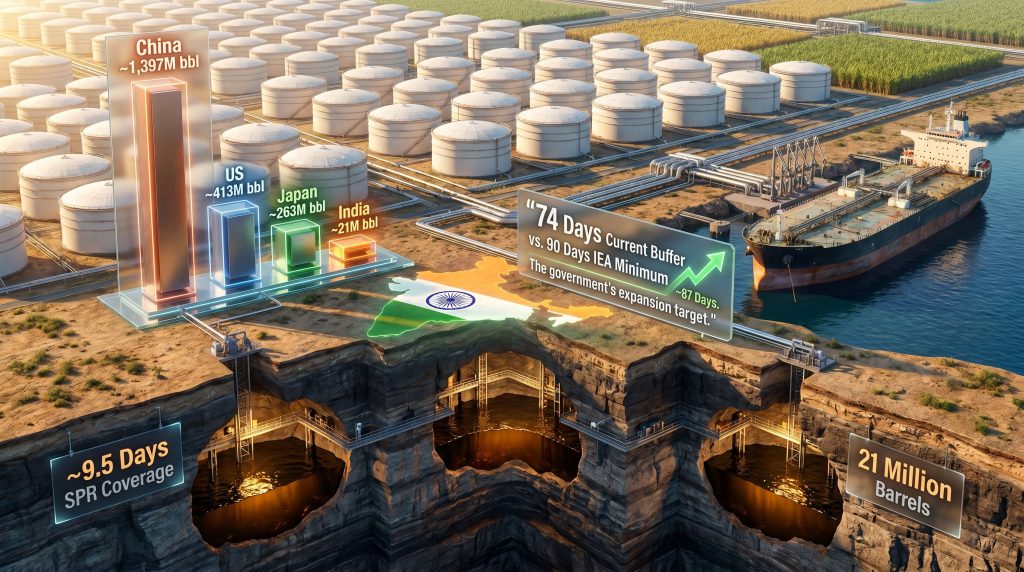
The scale of India's reserve gap becomes most visible in direct international comparison. According to EIA weekly petroleum supply data, at the end of 2025, India held just 21 million barrels of strategic crude stocks. Furthermore, the contrast with other major consuming nations is stark.
| Country | Strategic Crude Reserves (End-2025) | Days of SPR Coverage (Approx.) |
|---|---|---|
| China | ~1,397 million barrels | Highest globally |
| United States | ~413 million barrels | ~25-30 days SPR alone |
| Japan | ~263 million barrels | IEA-compliant |
| India | ~21 million barrels | ~9.5 days (SPR only) |
India's 21 million barrel SPR position represents approximately 1.5% of China's holdings and less than 5% of US strategic reserves, despite India ranking as the world's third-largest oil importer consuming roughly 5 million barrels per day. This disparity is not simply a resource constraint issue. It reflects a long-standing policy assumption that India's relative proximity to Gulf producers reduced the urgency of building large physical buffers.
Broader geopolitical oil price analysis confirms that reserve adequacy is increasingly a function of geopolitical risk, not just market access assumptions.
Why the China Model Is Now Drawing Attention
China's approach to strategic crude management goes beyond government-administered SPR facilities. Beijing has historically required its state-affiliated refiners to maintain elevated operational inventories as an implicit component of the national buffer. This means that refiner stocks function as a de facto second layer of strategic reserves, even when they are technically classified as commercial assets.
The logic is compelling from a policy design standpoint: rather than bearing the full capital cost of new government-funded cavern construction, authorities effectively deputise the refining sector to hold and maintain a portion of the national buffer. The refiner absorbs the inventory carrying cost, and the state benefits from expanded systemic resilience without equivalent upfront expenditure.
The Proposed Refiner Mandate: Mechanics, Costs, and Pushback
Doubling Operational Stocks to 30 Days
The framework currently under consideration in India would require domestic refiners to maintain crude inventories covering approximately 30 days of national demand, doubling the current 15-day operational norm. According to people familiar with the matter, the proposal remains at a preliminary stage and no final implementation decision has been reached.
The physical and financial implications are substantial:
- A combined refiner crude requirement of approximately 150 million barrels, based on 5 million barrels per day of national consumption
- Estimated crude procurement cost of approximately Rs 60,000 crore at prevailing oil prices and exchange rates, covering crude purchases alone
- Additional capital expenditure of several thousand crore rupees for new storage tank construction, with timelines potentially extending across multiple years
- Significant lead times for siting, permitting, and constructing tankage at scale, particularly near port locations
Why Refiners Are Expected to Resist
The refining industry's opposition to such a mandate would likely centre on several interconnected concerns:
- The Rs 60,000 crore crude cost estimate represents a very large upfront capital commitment that directly compresses refinery margins
- Storage tank construction near ports or inland locations involves lengthy environmental and regulatory approval processes
- Capital locked in mandated inventory earns no processing return and is exposed to crude price volatility over its holding period
- Smaller or more leveraged refinery operators may face genuine balance sheet strain from the combined procurement and infrastructure burden
- There is currently no established mechanism for government cost-sharing or compensation that would partially offset these expenses
The Port-Proximate Storage Design: Lessons from Singapore
Industry stakeholders familiar with refiners' thinking have argued that if a mandate does proceed, the policy design must allow flexibility in where storage is built and how mandated crude is managed. Specifically, there is a strong case for requiring new tankage to be located near major ports rather than at inland refinery sites. The practical rationale is that port-adjacent storage allows mandated inventories to remain accessible to international trading markets.
This means refiners could potentially trade or rotate the crude held in mandated tanks rather than treating it as a purely static, locked reserve. Singapore's extensive coastal tankage network is frequently cited as a structural benchmark, demonstrating that large physical storage capacity and active commercial trading are not mutually exclusive objectives. If India's refiner mandate were designed with this flexibility built in, the financial burden on refiners could be partially offset by the trading optionality embedded in their mandated stocks.
India's SPR Expansion: Phase II Infrastructure Targets
New Sites and Salt Cavern Feasibility
Alongside the refiner mandate discussion, India's government has committed to expanding the physical SPR network beyond the three existing underground cavern facilities. Phase II development encompasses:
- Chandikhol, Odisha: A new strategic reserve site currently under development
- Padur, Karnataka: The existing facility earmarked for additional capacity
- Rajasthan: Salt cavern storage under active feasibility evaluation, representing a potentially faster and lower-cost construction approach compared to hard-rock excavation
Salt cavern storage is technically distinct from the hard-rock underground caverns used at India's existing SPR sites. The construction cost differential can be significant, and salt caverns offer faster drawdown speeds in an emergency, making them operationally attractive for a country seeking to improve its crisis-response capabilities quickly.
| Storage Method | Construction Cost | Speed of Build | Operational Flexibility | Current Indian Use |
|---|---|---|---|---|
| Hard-Rock Underground Cavern | High | Slow (5-10 years) | Moderate | Visakhapatnam, Mangaluru, Padur |
| Salt Cavern | Lower | Faster | High (rapid drawdown) | Under evaluation (Rajasthan) |
| Above-Ground Tank Farms | Moderate | Moderate | High | Refinery sites, ports |
The expanded SPR programme targets a combined national buffer of approximately 87 days including product storage, bringing India materially closer to the IEA's 90-day threshold even before any refiner mandate takes effect.
Supply Diversification as India's First Line of Defence
The 40-Country Sourcing Strategy
India's approach to oil supply security has never relied solely on physical reserves. The country simultaneously sources crude from 40 to 41 countries, a deliberate structural hedge designed to ensure that no single supplier disruption or transit chokepoint can paralyse the domestic refining system.
Critically, only approximately 40% of India's crude imports transit the Strait of Hormuz. This figure reflects years of deliberate diversification away from Gulf-only sourcing. Russia has emerged as India's largest single crude supplier in early 2026, a position that reflects both the pricing dynamics that emerged following the Russian oil sanctions impact and India's longstanding policy of source-neutral procurement. However, Venezuela oil policy changes and shifting US sanctions postures are also reshaping India's import options across the Atlantic Basin.
Ethanol Blending as Structural Demand Displacement
India's 20% ethanol blending programme for transport fuels displaces approximately 44 million barrels of crude oil annually, representing a meaningful structural reduction in import dependency. This is not a marginal contribution: 44 million barrels at 5 million barrels per day of national consumption represents roughly 8.8 days of equivalent demand. When viewed alongside the physical reserve build-out strategy, domestic demand displacement through ethanol blending functions as a complementary risk mitigation layer.
India's ethanol blending target effectively contributes a structurally embedded reserve buffer by reducing the gross volume of crude imports required each year, without the capital cost of building or filling new storage infrastructure.
The next major ASX story will hit our subscribers first
Key Implementation Challenges and Unresolved Policy Questions
Regulatory Design Gaps That Must Be Resolved
The refiner mandate proposal, even at its preliminary stage, raises several structural questions that policymakers have not yet publicly answered:
- Who ultimately bears the financial cost of mandated inventory, refiners alone or through a shared mechanism with government contribution?
- Should mandated stocks be tradeable in international markets, as port-proximate storage would enable, or locked as purely strategic and non-tradeable assets?
- How will compliance be monitored across a fragmented sector that includes both large public sector refiners and smaller private operators?
- What specific supply-disruption trigger would authorise the drawdown of mandated refiner stocks, and what governance structure would oversee that decision?
In addition, India's LNG import tax structure adds another dimension to the broader energy security cost calculus, particularly as gas plays a growing role in India's fuel diversification strategy.
Three Possible Policy Outcomes
| Scenario | Policy Design | Refiner Cost Burden | Strategic Benefit | Timeline |
|---|---|---|---|---|
| Full Mandate (30-Day Rule) | Government-imposed, refiner-funded | Very High (~Rs 60,000 Cr+) | Maximum buffer | 5-8 years |
| Hybrid Model (Govt + Refiner Cost-Share) | Subsidised mandate | Moderate | Strong buffer | 3-5 years |
| Voluntary Incentive Framework | Tax/duty incentives for storage build | Low | Gradual improvement | Ongoing |
The hybrid model represents the most politically viable pathway. A pure refiner-funded mandate of this scale carries a very real risk of being delayed or diluted through sustained industry lobbying, while a fully voluntary framework is unlikely to produce the rapid stockpile build-up that the current geopolitical environment demands.
Frequently Asked Questions: India Oil Inventory Policy
What is India's current strategic petroleum reserve capacity?
India holds approximately 5.33 million metric tons of crude in underground caverns at Visakhapatnam, Mangaluru, and Padur, covering roughly 9.5 days of national demand at current consumption rates.
How many days of oil supply does India currently hold in total?
Combining strategic reserves with commercial and refinery operational stocks and downstream product inventories, India's total national buffer stands at approximately 74 days as of 2023 data, below the IEA's 90-day recommended threshold.
What would it cost Indian refiners to double their crude inventories?
Doubling refiner stocks from 15 to 30 days of national demand would require holding approximately 150 million barrels of crude, at an estimated cost of Rs 60,000 crore in crude procurement alone, plus several thousand crore rupees in additional storage tank construction.
Why is only 40% of India's crude exposed to Strait of Hormuz risk?
India's multi-decade policy of sourcing crude from 40 to 41 countries simultaneously means a substantial share of imports arrives via Atlantic Basin, African, and non-Gulf Asian routes that do not pass through the strait, structurally limiting Hormuz-specific exposure.
The Path Toward a Credible 90-Day Buffer
Closing the gap between India's current 74-day combined buffer and the IEA's 90-day benchmark is achievable, but it requires simultaneous progress across multiple policy levers rather than reliance on any single intervention. Consequently, oil price movements in global markets will continue to influence both the urgency and the financial viability of each option.
Key considerations for policymakers, refiners, and energy market participants:
- India's 21 million barrel SPR position is structurally exposed relative to every comparable large consuming nation, and the gap cannot be closed through SPR construction alone given the multi-year timelines involved
- A well-designed refiner inventory mandate, particularly one that incorporates port-proximate storage flexibility and potential cost-sharing mechanisms, could rapidly expand the national buffer while embedding trading optionality into the system
- The Rs 60,000 crore crude cost estimate is a floor figure, not a ceiling. Total implementation costs incorporating new tankage construction will be materially higher, and any honest policy assessment must account for this
- Ethanol blending and supply diversification across 40-plus source nations provide structural risk mitigation that complements but cannot substitute for physical crude reserves
- Salt cavern development in Rajasthan, if technically confirmed viable, could accelerate Phase II SPR expansion at lower cost than the hard-rock cavern approach used at existing sites
India's india oil inventory policy debate is ultimately a question of how much insurance the country is willing to pay for before the next disruption, rather than after it. The Strait of Hormuz episode has made the cost of underinsurance visible in a way that years of peacetime planning never could.
This article contains forward-looking assessments, cost projections, and policy scenario analysis. All figures referenced reflect publicly available data from the US Energy Information Administration and reporting from ET EnergyWorld. Policy proposals described remain at a preliminary stage, and no final implementation decisions have been confirmed. Nothing in this article constitutes financial or investment advice.
Want to Stay Ahead of the Next Major Commodity Discovery?
While India's oil inventory policy debate highlights the critical role of resource security in global markets, investors seeking real-time opportunities in the commodities space can gain an immediate edge through Discovery Alert, where the proprietary Discovery IQ model instantly identifies significant ASX mineral discoveries across 30-plus commodities — explore historic discovery returns to see what major finds have delivered, then begin a 14-day free trial to position yourself ahead of the broader market.