June 17, 2026
The Commodity Supercycle Is Shifting Its Centre of Gravity
For most of the past two decades, a single country determined the trajectory of global iron ore markets. China's extraordinary infrastructure and property boom absorbed roughly half of all steel produced on Earth, reshaping trade flows, shipping economics, and miner capital allocation on a scale never previously witnessed. That era is not ending abruptly, but it is unmistakably transitioning into something different. The question commodity markets are now pricing is not whether China's steel demand has peaked, but whether the next generation of industrial economies can absorb the gravitational pull that China is gradually releasing.
The answer may lie across two of the world's most dynamic growth corridors: South Asia and Southeast Asia. India and ASEAN steel demand offset China slowdown Rio Tinto is rapidly becoming the defining thesis for iron ore market strategy across the next decade.
When big ASX news breaks, our subscribers know first
China's Steel Demand: Structural Plateau, Not Cyclical Dip
What the Data Is Actually Telling Us
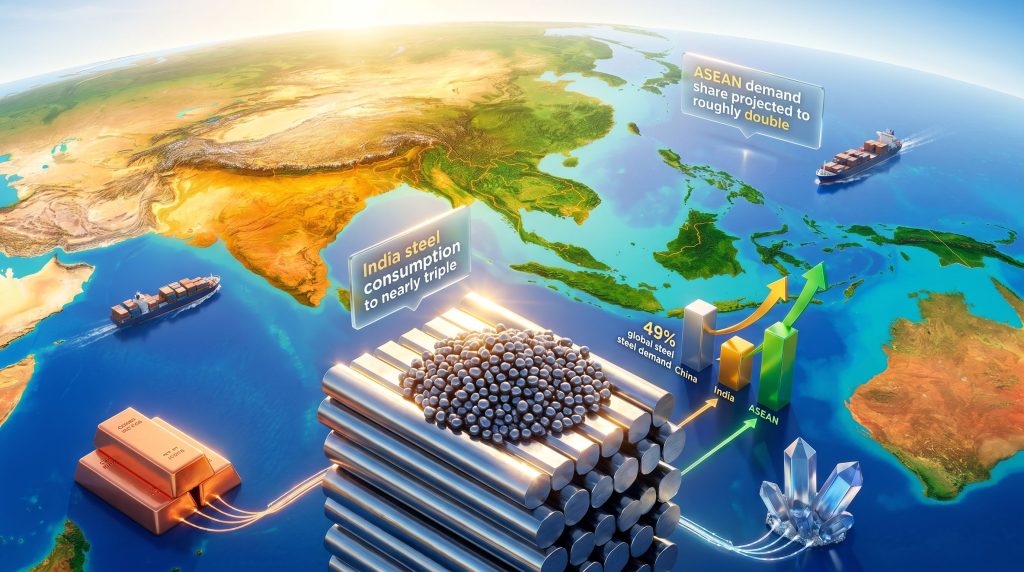
China currently accounts for approximately 49% of global steel demand, a figure that has defined commodity market logic for a generation. However, the forces that drove that dominance — a property-led construction boom, rapid urbanisation, and aggressive industrial expansion — have reached their natural ceiling. Understanding China iron ore demand patterns is essential context for what comes next.
The country's property sector, which historically accounted for an estimated 30 to 40% of domestic steel consumption, is undergoing a structural contraction rather than a cyclical correction. Declining birth rates, a maturing urban population, and an oversupplied residential property stock mean the construction demand that once underpinned iron ore prices above $100 per tonne is unlikely to return at previous intensity.
Industry forecasts project that China's share of global steel demand could compress to around 31% by 2050. Annual domestic steel demand is expected to decline by approximately 5 to 7 million tonnes per year across the next decade. In absolute volume terms, this represents an enormous structural gap that the global raw material supply chain must reorient around.
The convergence of demographic stagnation, a maturing property cycle, and industrial overcapacity in China signals a generational recalibration of steel appetite. This is not a demand dip that recovers in the next infrastructure stimulus cycle. It is a fundamental reset.
Why This Matters Beyond China's Borders
Iron ore mining operations, bulk shipping routes, and port infrastructure across Australia, Brazil, and West Africa were largely engineered around Chinese purchasing patterns. Furthermore, as the China steel outlook softens, every link in that supply chain faces repricing. The critical variable is not whether China's demand erodes, but how quickly alternative markets can absorb the volume.
The iron ore surplus risk becomes particularly acute if alternative demand sources fail to materialise at the pace currently projected by major producers and industry analysts.
India and ASEAN Steel Demand: The Case for a Structural Offset to China's Slowdown
India's Steel Consumption Trajectory
India represents the most compelling structural demand story in global steel markets over the next two to three decades. Steel consumption is forecast to nearly triple from current levels, driven by a combination of infrastructure investment, urbanisation, and an expanding manufacturing base that is attracting global capital at an accelerating pace.
India's per-capita steel consumption remains significantly below the global average, indicating substantial headroom for growth. For context, China's per-capita steel intensity peaked at approximately 600 kilograms per person annually at the height of its construction boom. India currently consumes roughly 90 kilograms per person annually — a gap that investment in railways, highways, urban transit systems, and renewable energy infrastructure is beginning to close.
| Demand Driver | Steel Consumption Implication |
|---|---|
| National highway expansion | High-volume construction-grade steel demand |
| Railway and metro modernisation | Structural and engineering steel requirements |
| Urban residential and commercial construction | Long steel products for housing and commercial builds |
| Renewable energy infrastructure | Steel-intensive wind tower and solar mounting systems |
| Manufacturing capacity expansion | Flat steel for industrial and capital goods production |
Why India's Demand Profile Is More Durable Than China's Was
A critically important but underappreciated distinction between India's emerging steel demand cycle and China's historical one is the diversity of demand drivers. China's steel boom was overwhelmingly property-concentrated, which created both extraordinary growth and extraordinary vulnerability when that single sector corrected.
India's steel demand growth, however, is distributed across infrastructure, manufacturing, and energy transition sectors, making it structurally more resilient to single-sector downturns. According to major miners such as BHP and Rio Tinto, India is increasingly viewed as driving steel's next wave of growth precisely because of this diversified demand base.
India's steel industry is also predominantly blast furnace-based, meaning it consumes iron ore and metallurgical coal as primary feedstocks rather than relying on scrap-fed electric arc furnaces. This is a technically significant point for iron ore exporters: blast furnace steelmaking requires substantial ore inputs per tonne of finished steel, making India a high-quality demand replacement for Australian and Brazilian iron ore producers as Chinese blast furnace utilisation rates soften.
India's blast furnace dominance means that every new tonne of Indian steelmaking capacity added creates genuine seaborne iron ore import demand, not merely electricity consumption. This structural characteristic makes the India demand growth story directly relevant to iron ore trade volumes in a way that some other emerging markets are not.
ASEAN's Distributed Steel Demand Growth
Southeast Asia's collective steel demand is projected to roughly double from current levels across the coming decade, driven by rapid industrialisation across multiple economies simultaneously. Unlike China's concentrated demand, ASEAN's growth is distributed across different jurisdictions with varying demand profiles, reducing concentration risk for iron ore exporters and creating a more diversified customer base.
Key ASEAN economies driving the expansion:
- Vietnam: Export-oriented manufacturing expansion, particularly electronics and textiles, is generating sustained demand for flat steel used in industrial and logistics facilities. Foreign direct investment inflows, largely driven by supply chain diversification away from China, are a key accelerant.
- Indonesia: Domestic infrastructure investment, combined with an emerging nickel-integrated steel industry, creates unique demand dynamics. Indonesia's downstream nickel processing ambitions are intersecting with broader steel capacity expansion.
- Philippines: Urban infrastructure investment and residential construction are underpinning long steel product demand, supported by sustained remittance-driven consumer spending.
- Thailand: Automotive manufacturing and industrial production are supporting flat steel consumption, with the country's position as a regional manufacturing hub attracting continued capital investment.
A factor not widely discussed in mainstream market commentary is the degree to which ASEAN's manufacturing-driven steel demand is directly linked to foreign direct investment flows. Companies diversifying supply chains away from China and into Vietnam, Indonesia, and the Philippines are constructing factories, logistics parks, and industrial zones that require substantial steel inputs. Iron ore miners are consequently highlighting India and ASEAN as their primary growth markets after China, with sustained FDI functioning as a leading indicator for regional steel demand.
Rio Tinto's Strategic Positioning in a Rebalancing Iron Ore World
Reading the Portfolio Signal
At an industry conference in Singapore in June 2026, Rio Tinto's chief commercial officer Bold Baatar articulated the view that India and ASEAN steel demand offset China slowdown Rio Tinto strategies would structurally rebalance the global iron ore market over the coming decade. The statement reflects a strategic posture that Rio Tinto's capital allocation decisions have been signalling for some time.
The company's portfolio is consequently tilted toward copper and lithium growth, with iron ore operations serving as the high-volume cash generation engine that funds this transition. This dual-track approach is strategically coherent: iron ore remains Rio Tinto's largest revenue contributor by volume, but the capital it generates is being redirected toward commodities more directly exposed to the energy transition demand cycle.
How Major Iron Ore Producers Are Repositioning
| Major Producer | China Exposure | India/ASEAN Growth Strategy | Energy Transition Pivot |
|---|---|---|---|
| Rio Tinto | High (Pilbara volumes) | Actively flagged as structural offset | Copper and lithium investment focus |
| BHP | High (iron ore dominant) | Infrastructure growth thesis | Copper prioritised |
| Fortescue | Very High | Emerging market diversification | Green energy integration |
The BHP iron ore pivot similarly reflects this broader industry recalibration, with capital allocation increasingly oriented toward future-facing metals. Iron ore's role in this framework is less as a growth asset and more as a mature, cash-generative platform for funding future-facing metal exposure.
Furthermore, Australia iron ore leadership remains structurally important within this repositioning story, as Pilbara production volumes continue to underpin the cash flows that fund diversification strategies across the sector.
Iron Ore Grade Dynamics: A Less Visible But Consequential Variable
Why Ore Quality Matters as Demand Geography Shifts
One dimension of the India-ASEAN demand transition that receives insufficient analytical attention is the question of iron ore grade preferences. Chinese blast furnace operators, optimising for efficiency in highly sophisticated integrated steel mills, have historically demonstrated preference for high-grade iron ore (typically 62% Fe and above), which improves blast furnace productivity and reduces coke consumption per tonne of hot metal produced.
Indian steel mills are at varying stages of technological development, with a mix of older blast furnace configurations and newer, more efficient plants. As India's steel capacity expands and modernises, its ore grade requirements may evolve, with newer plants increasingly favouring higher-grade feedstocks to maximise productivity. This creates a potential long-term tailwind for high-grade iron ore producers.
Scenario Analysis: Will India and ASEAN Fully Replace Chinese Iron Ore Import Volumes?
The honest answer is that full volume replacement is unlikely in the near term, and the pace of absorption will determine iron ore price trajectories across the late 2020s and into the 2030s. India's expanding domestic iron ore production base will partially satisfy internal steel demand, moderating the growth in seaborne import requirements.
Three scenarios for the India and ASEAN steel demand offset to China's slowdown:
- Bull Case: India and ASEAN collectively absorb 60 to 70% of China's demand gap by 2035, stabilising iron ore benchmark prices above long-run cost support levels and validating current Pilbara production volumes.
- Base Case: Partial absorption of 40 to 50% of China's demand erosion occurs, with iron ore prices facing moderate downward pressure through the late 2020s before stabilising as India's blast furnace capacity matures.
- Bear Case: India and ASEAN demand growth underperforms relative to projections, China's steel demand decline accelerates beyond consensus forecasts, and iron ore markets face sustained oversupply conditions that compress margins for higher-cost producers.
The next major ASX story will hit our subscribers first
Coking Coal and Scrap Steel: The Cascade Effects of the Demand Shift
The raw material implications of this demand geography transition extend beyond iron ore. Metallurgical coal demand is directly linked to blast furnace steelmaking activity. As India and ASEAN expand blast furnace capacity, coking coal demand from these regions will grow even as China accelerates its own transition toward electric arc furnace steelmaking, which uses scrap rather than ore and coal inputs.
This creates a divergence within raw material markets: iron ore and coking coal demand will increasingly migrate toward South and Southeast Asia, while scrap steel markets will deepen in China as its electric arc furnace penetration rises. For Australian metallurgical coal producers, the India and ASEAN growth story is therefore at least as relevant as the iron ore narrative, potentially more so given that domestic Indian coking coal production is limited and heavily dependent on imports.
Disclaimer: Forecasts, scenario projections, and demand estimates referenced in this article represent third-party analytical outputs and industry consensus views. They are subject to material revision based on macroeconomic conditions, policy changes, and commodity market developments. This article does not constitute financial or investment advice.
FAQ: India, ASEAN Steel Demand, and the Global Iron Ore Market Transition
Can India and ASEAN's steel demand growth fully offset China's structural slowdown?
Not immediately, and not necessarily in full volume terms. India's steel consumption is projected to nearly triple over the long term, but China's current demand base is so large that India alone cannot compensate. The combination of India and ASEAN growth across a 10 to 20 year horizon represents the most credible structural offset scenario, with the pace of industrial buildout and domestic ore production growth determining the degree of seaborne import demand generated.
Why does India's blast furnace dominance matter for Australian iron ore producers?
Blast furnace steelmaking requires iron ore and coking coal as primary inputs, unlike electric arc furnace production which uses scrap. India's predominantly blast furnace-based steel industry means its growing production capacity translates directly into seaborne iron ore import demand. This makes India a structurally valuable demand replacement for Chinese blast furnace purchasing as China's own electric arc furnace penetration increases.
How does foreign direct investment into ASEAN relate to steel demand?
Manufacturing facilities, logistics parks, and industrial zones constructed as part of supply chain diversification away from China require substantial steel inputs during construction and ongoing maintenance. FDI inflow volumes into Vietnam, Indonesia, and the Philippines therefore function as a forward indicator for regional construction and industrial steel demand, creating a direct linkage between geopolitical supply chain reshaping and commodity demand forecasting.
What is Rio Tinto's strategic response to the changing iron ore demand landscape?
Rio Tinto is maintaining its Pilbara iron ore production volumes while directing growth capital toward copper and lithium assets, using iron ore cash generation to fund energy transition metal investment. The company's chief commercial officer Bold Baatar publicly articulated at a Singapore conference in June 2026 that India and ASEAN steel demand offset China slowdown Rio Tinto would structurally counterbalance the stagnating Chinese steel market across the coming decade.
Want to Know Which ASX Miners Are Best Positioned for the India and ASEAN Steel Demand Shift?
Discovery Alert's proprietary Discovery IQ model scans ASX announcements in real time, instantly identifying significant mineral discoveries across iron ore, copper, lithium, and over 30 other commodities — converting complex data into actionable investment insights before the broader market reacts. Explore how historic discoveries have generated substantial returns and begin your 14-day free trial at Discovery Alert to position yourself ahead of this generational commodity market rebalancing.