June 17, 2026
The Material Foundation of Modern Industrial Civilisation
Every smartphone, wind turbine, electric vehicle, and skyscraper that defines contemporary life depends on one thing: metals. Yet the dominant model for producing them, digging ore from the ground, processing it through energy-intensive smelting, and discarding the finished product at end of life, is increasingly incompatible with the resource realities of the 21st century. Metal recycling for sustainable economies is no longer a peripheral concern — it is central to how modern industry must evolve.
The UNEP International Resource Panel has documented that global material extraction more than tripled between 1970 and 2017, rising from approximately 27 billion tonnes to over 92 billion tonnes, with metals and minerals forming a growing share of this throughput as industrialisation accelerated across emerging economies. That trajectory has not moderated. The World Bank projects that demand for energy-transition metals including copper, lithium, cobalt, and nickel could increase severalfold by 2050 under Paris Agreement-aligned scenarios.
Graphite, lithium, and cobalt demand for energy storage alone could grow by more than 450 percent relative to 2018 levels in some climate scenarios. Consequently, building robust secondary metal systems is not merely an environmental preference — it is an industrial necessity. The question is not whether secondary metal systems matter, but how quickly they can be scaled.
When big ASX news breaks, our subscribers know first
Why Metals Are the Ideal Circular Material
The Metallurgical Property That Changes Everything
Unlike plastics, which degrade in polymer chain length with each processing cycle, or composite materials that are structurally impossible to separate after manufacture, metals are chemically stable. They can be melted, refined, and re-cast without any fundamental loss of atomic structure or mechanical performance. A steel beam recycled from a demolished building can re-enter a structural application with equivalent performance characteristics.
The International Aluminium Institute notes that roughly 75 percent of all aluminium ever produced remains in active use today, a figure that reflects both the metal's durability and the industry's commitment to recapturing it at end of life. Furthermore, the World Steel Association reports that more than one billion tonnes of steel are recovered and recycled globally each year, with scrap accounting for more than 35 percent of total global steel production.
This indefinite recyclability transforms how economies should think about metal stocks. Rather than treating metal as a consumable extracted from the ground and lost to landfill, mature industrial systems recognise it as a permanent resource circulating through the economy indefinitely — a concept at the heart of urban mining strategies worldwide.
The UNEP International Resource Panel has argued that metals are uniquely positioned for closed-loop systems precisely because their chemical stability permits repeated reprocessing without fundamental performance degradation, provided adequate collection and sorting infrastructure is in place.
How Metal Recycling Actually Works: The End-to-End Value Chain
Stage 1: Collection and Feedstock Aggregation
The recycling process begins with feedstock acquisition. Primary scrap sources include:
- Post-consumer scrap from end-of-life vehicles, household appliances, and construction demolition
- Industrial offcuts and manufacturing residues generated during fabrication
- Electronic waste streams containing high concentrations of gold, silver, palladium, and copper
- Municipal solid waste containing ferrous and non-ferrous components
Feedstock quality has a direct downstream impact. Contaminated or mixed scrap requires more intensive processing and yields lower-purity outputs, increasing per-tonne costs and reducing recovery rates.
Stage 2: Sorting, Separation, and Pre-Processing
Modern sorting operations bear little resemblance to manual scrap yards. Sophisticated mechanical and sensor-based technologies now dominate high-throughput facilities:
- Eddy current separators exploit electromagnetic induction to eject non-ferrous metals from conveyor streams
- Magnetic drum separators extract ferrous fractions from mixed waste at industrial volumes
- Air classifiers separate materials by density and aerodynamic properties
- X-ray fluorescence (XRF) analysers identify alloy composition in real time, enabling grade-specific sorting
- Laser-induced breakdown spectroscopy (LIBS) delivers elemental analysis at conveyor speeds, critical for separating aluminium alloy families
AI-assisted robotic sorting systems are now being deployed in advanced facilities, applying machine vision and deep learning to identify and segregate complex mixed-metal waste streams with accuracy rates that exceed manual sorting by a considerable margin.
Stage 3: Metallurgical Processing
The transformation of sorted scrap into market-ready secondary metal relies on several core processing routes:
| Processing Method | Primary Application | Key Metals Recovered |
|---|---|---|
| Pyrometallurgy | High-temperature smelting and alloying | Steel, copper, aluminium, lead |
| Hydrometallurgy | Chemical leaching and solvent extraction | Lithium, cobalt, nickel, gold |
| Electrometallurgy | Electrolytic refining for high purity | Copper, zinc, precious metals |
| Mechanical Recycling | Physical size reduction and separation | Mixed ferrous and non-ferrous scrap |
| Direct Cathode Recycling | Battery material preservation | Lithium-ion cathode active materials |
Hydrometallurgical routes are particularly significant for battery metal recovery. The battery recycling process is evolving rapidly, with next-generation leaching agents being developed to reduce chemical waste volumes and closed-loop smelting systems increasingly capturing atmospheric emissions that older furnace designs released.
Stage 4: Quality Certification and Market Re-Entry
Recycled metals achieving purity standards equivalent to primary production are certified against internationally recognised frameworks including ISO and ASTM standards. This certification is what allows secondary aluminium or copper to re-enter aerospace, automotive, and electronics manufacturing supply chains without qualification risk.
The Environmental Dividend: Quantifying What Recycling Actually Saves
Energy Reduction: The Strongest Case for Secondary Production
The energy arithmetic of metal recycling is compelling and consistently underestimated in public discourse. The savings versus primary production vary by metal but are substantial across the board:
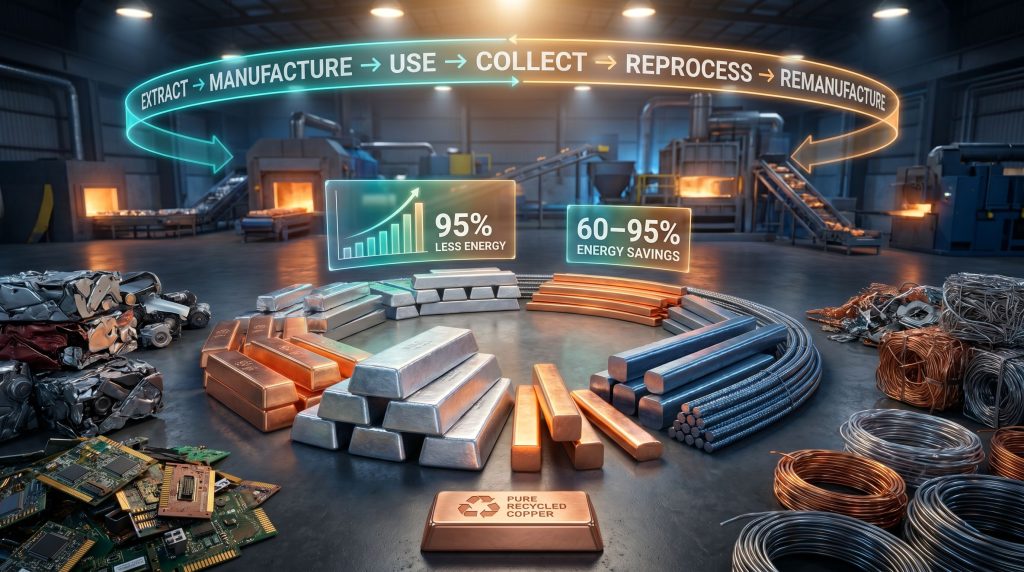
- Aluminium recycling requires approximately 95 percent less energy than primary smelting from bauxite ore
- Copper recycling reduces energy demand by approximately 85 percent versus primary extraction from sulphide ores
- Steel recycling via electric arc furnace consumes roughly 60 to 74 percent less energy than blast furnace production from iron ore
- Lead recycling delivers energy savings of approximately 65 percent compared with primary production
These figures translate directly into greenhouse gas emission reductions. Moreover, as power grids decarbonise, energy transition mining operations and electric arc furnaces running on renewable electricity will approach near-zero emissions performance — a trajectory impossible for blast furnace ironmaking, which requires coking coal as a chemical reductant.
Mining's Environmental Footprint: What Recycling Avoids
Every tonne of metal recovered from secondary sources is a tonne that does not require new mine development. The avoided externalities of primary mining include:
- Land disturbance, habitat fragmentation, and topsoil removal at mine sites
- Acid mine drainage contaminating waterways for decades after mine closure
- Tailings dam construction and the long-term liability of impoundment failure risk
- Deforestation associated with access road construction and site clearing
- Water consumption in processing operations in already water-stressed regions
The biodiversity preservation case for expanding secondary metal supply is therefore not incidental to the economic argument. It is integral to it, particularly as mining increasingly encroaches on ecologically sensitive territories in pursuit of higher-grade ore deposits that are becoming progressively scarcer.
E-Waste: The High-Grade Urban Ore Nobody Talks About
One of the least appreciated facts in the metals industry is the extraordinary metal concentration in electronic waste. A tonne of mobile phones contains more recoverable gold than a tonne of mined ore from many commercial gold deposits. Printed circuit boards, memory chips, and connector components contain gold, silver, palladium, copper, and rare earth processing targets at concentrations that can exceed primary ore grades by orders of magnitude.
Global e-waste volumes run into the tens of millions of tonnes annually, with only a fraction currently processed through formal recycling channels. The metals lost through informal or landfill disposal represent both an environmental liability and a squandered economic opportunity.
Electronic waste is among the highest-value secondary metal sources available to the recycling industry, containing precious and critical metals at concentrations that frequently exceed those found in commercially mined deposits.
The Economic Case: Beyond Cost Savings to Strategic Resilience
Supply Chain Security in a Geopolitically Fractured World
The concentration of primary metal production in a small number of jurisdictions creates systemic vulnerability for import-dependent industrial economies. Cobalt production is heavily concentrated in the Democratic Republic of Congo. Lithium supply is dominated by a small group of South American and Australian producers. Furthermore, critical minerals recycling has consequently become a strategic priority for nations seeking to reduce this exposure.
A nation that captures lithium from spent EV batteries, recovers cobalt from consumer electronics, and reprocesses copper from decommissioned infrastructure is effectively building a domestic secondary ore reserve. This reserve is immune to geopolitical disruption, export restrictions, or commodity price shocks driven by producer-nation policy changes, making metal recycling for sustainable economies a resource security imperative as much as an environmental one.
Industrial Cost Stabilisation Across Manufacturing Sectors
Secondary metal feedstock reduces raw material expenditure across the most metals-intensive industries. In automotive manufacturing, access to recycled aluminium and steel at predictable prices reduces input cost volatility. In electronics, secondary gold and copper procurement reduces exposure to spot market price swings driven by mining supply disruptions.
The European Commission has estimated that improving material efficiency and recycling across metals and other materials could reduce EU industrial material demand by up to 20 percent by 2030 compared with business-as-usual scenarios, with associated cost savings and emissions reductions. In addition, how metal recycling supports the circular economy is increasingly being studied as a model for other material streams to follow.
Employment: The Breadth of the Recycling Jobs Market
The recycling sector generates employment across a wider skills spectrum than primary mining, which is capital-intensive and relatively concentrated geographically.
| Sector | Employment Type Generated |
|---|---|
| Scrap collection and logistics | Drivers, sorters, equipment operators |
| Processing and smelting facilities | Metallurgists, plant technicians, process engineers |
| Quality testing and certification | Laboratory analysts, compliance officers |
| Secondary metal manufacturing | Production workers, materials scientists |
| Technology and automation development | Software engineers, robotics technicians |
| Urban mining operations | E-waste dismantlers, chemical processing specialists |
Collection and sorting roles create accessible employment pathways with lower skills barriers, while processing and technology roles generate well-paid technical positions in regional industrial communities. The wage multiplier effects of recycling facilities recirculate through local economies in ways that offshore primary metal imports do not.
How Technology Is Reshaping the Economics of Metal Recovery
Urban Mining: Treating Cities as Ore Deposits
Urban mining reframes the conceptual geography of metal supply. Rather than looking to remote geological formations, it treats the built environment — the accumulated stock of manufactured goods embedded in buildings, vehicles, electronic devices, and infrastructure — as a distributed ore body awaiting systematic recovery. The three-stage urban mining process works as follows:
- Collection and categorisation — waste streams are aggregated and classified by material composition and resource value, with electronic waste prioritised for its high precious and critical metal concentrations
- Dismantling and chemical processing — mechanical shredding is followed by acid leaching and solvent extraction to liberate target metals from complex multi-material assemblies
- Refining and purification — electrochemical treatment brings recovered metals to market-grade purity, ready for re-entry into manufacturing supply chains
Blockchain technology is being piloted in urban mining operations to establish chain-of-custody transparency, ensuring that recovered materials can be verified as secondary-source and meeting increasingly stringent recycled content requirements in corporate sustainability reporting.
The Convergence of Battery Recycling and the Energy Transition
A compounding dynamic is emerging at the intersection of clean energy deployment and metal recycling. The same transition that is amplifying demand for lithium, cobalt, nickel, and manganese is simultaneously creating vast new recycling feedstock streams as first-generation solar panels, wind turbines, and electric vehicle battery packs reach end of life.
Direct cathode recycling for lithium-ion batteries, a technology still maturing commercially, aims to recover cathode active materials with their crystalline structure intact. If it scales successfully, it could transform the economics of battery metal recovery and significantly close the cost gap between secondary and primary lithium and cobalt supply.
The next major ASX story will hit our subscribers first
Regulatory Drivers and Corporate Commitments Accelerating Adoption
The policy environment is progressively encoding recycled content requirements into law. Key regulatory frameworks shaping demand for secondary metals include:
- The EU Battery Regulation, which mandates minimum recycled content thresholds for cobalt, lithium, and nickel in batteries placed on the European market
- Extended Producer Responsibility (EPR) schemes requiring manufacturers to finance end-of-life collection and recycling of their products
- Carbon border adjustment mechanisms that create cost advantages for low-emission secondary metal production over carbon-intensive primary imports
- National critical minerals strategies incorporating recycling rate targets alongside primary extraction development goals
Corporate commitments are reinforcing regulatory push with market pull. ESG reporting frameworks including the GRI standards, TCFD disclosures, and CDP submissions are driving measurable corporate demand for verified secondary metals. Automotive OEMs have published recycled aluminium and steel content commitments, while electronics sector initiatives are targeting closed-loop recovery of gold, silver, palladium, and rare earths. Guidance on scrap metal and sustainable futures increasingly informs how manufacturers structure their procurement policies.
Frequently Asked Questions: Metal Recycling and Sustainable Economies
What metals are most commonly recycled globally?
Steel and iron account for the highest volumes globally, followed by aluminium, copper, lead, and zinc. Battery metals including lithium and cobalt are among the fastest-growing recycling streams as EV adoption accelerates.
How does metal recycling reduce carbon emissions?
By replacing energy-intensive primary smelting with lower-emission secondary processing, recycling reduces CO₂ output per tonne of metal produced by between 40 and 95 percent depending on the metal. Aluminium delivers the greatest savings at approximately 95 percent.
Is recycled metal the same quality as virgin metal?
For the overwhelming majority of applications, yes. Recycled steel, aluminium, and copper processed through certified operations can achieve purity and mechanical performance standards equivalent to primary metal, enabling direct substitution in demanding manufacturing applications.
What are the biggest structural barriers to scaling metal recycling?
The principal constraints include inconsistent collection infrastructure in high-growth developing economies, alloy contamination challenges in complex mixed-metal waste streams, insufficient design-for-recyclability in current manufactured goods, and price competition from primary production that does not fully internalise its environmental externalities.
Building the Infrastructure for a Recycling-First Industrial Economy
The Investment Priorities That Will Define the Next Decade
Scaling metal recycling for sustainable economies requires targeted capital deployment across several priority areas:
- Expanding urban collection networks in high-consumption emerging economies where informal recycling currently captures only a fraction of available material
- Building advanced processing capacity specifically for battery metals and electronic waste, the highest-value and fastest-growing secondary streams
- Developing regional secondary metal processing hubs that reduce logistics costs and improve per-tonne recovery economics
- Embedding design-for-recyclability standards into product engineering, standardising alloy compositions to simplify downstream separation, and deploying digital material passports that track metal composition through entire product lifecycles
A Long-Term Vision: Closed-Loop Metal Systems at Industrial Scale
The endpoint of this trajectory is an industrial system in which secondary metal content dominates supply for most major metals, primary mining activity is reserved for genuinely incremental demand rather than base supply, and the energy penalty of metal production has been largely eliminated through the combination of high recycling rates and renewable-powered processing.
That endpoint is not guaranteed. It requires sustained infrastructure investment, regulatory consistency, and product design transformation across every metals-consuming industry. However, the direction of travel across policy frameworks, corporate commitments, and technology development is clearly aligned with it.
Metal recycling is not simply a waste management solution or an environmental gesture. It is a foundational industrial strategy. Economies that invest in secondary metal infrastructure today are building the resource security, emissions performance, and supply chain resilience that will define industrial competitiveness in the decades ahead.
Disclaimer: This article contains forward-looking projections and scenario analysis drawn from institutional research. Actual outcomes will depend on policy implementation, technology development timelines, commodity market conditions, and geopolitical factors. Nothing in this article constitutes financial or investment advice.
For additional industry coverage on metals recycling, circular economy frameworks, and sustainable industrial systems, visit Metals Mining Review Europe.
Want to Stay Ahead of the Next Major Mineral Discovery Before the Market Moves?
While secondary metal systems are reshaping industrial supply chains, the demand for newly mined critical minerals remains significant — and Discovery Alert's proprietary Discovery IQ model instantly notifies subscribers of significant ASX mineral discoveries across copper, lithium, cobalt, and beyond, turning complex geological announcements into actionable investment insights. Explore historic examples of major discovery returns and begin your 14-day free trial at Discovery Alert to position yourself ahead of the broader market.