
June 17, 2026
India's Energy Vulnerability and the Atlantic Alternative
The global oil market operates on a fundamental tension between consumption geography and production geography. For India, the world's third-largest oil consumer and importer, this tension has never been more acute than during periods of West Asian geopolitical stress. SEEPCO supplies Nigerian crude to Indian refiners as part of a broader effort to address this vulnerability. With refining capacity exceeding 250 million metric tonnes per annum (MMTPA) distributed across its three dominant public-sector refiners, India possesses industrial-scale throughput capability. Yet for decades, the crude feedstock powering that infrastructure has flowed overwhelmingly through a single corridor: the Strait of Hormuz.
Approximately 20% of global oil trade transits the Strait of Hormuz daily, and at peak flow periods, estimates place the volume at around 21 million barrels per day. For Indian energy planners, this concentration of supply dependency in a single maritime chokepoint represents not merely a logistical inconvenience but a systemic vulnerability. Furthermore, when West Asian geopolitical conditions deteriorate, every Indian refinery that depends on Gulf crude faces the same directional risk simultaneously. There is no natural hedge within a Gulf-concentrated crude basket.
This structural fragility is precisely why the decision by Indian Oil Corporation (IOC), Bharat Petroleum Corporation Limited (BPCL), and Hindustan Petroleum Corporation Limited (HPCL) to collectively source crude from SEEPCO's Nigerian operations during March through May 2026 carries significance well beyond the transaction itself. Understanding the broader crude oil market overview helps contextualise why, when SEEPCO supplies Nigerian crude to Indian refiners via Atlantic routing, it is not simply filling a procurement gap. It is demonstrating that a viable, scalable alternative supply corridor exists and can be activated when the Hormuz route becomes operationally or politically untenable.
When big ASX news breaks, our subscribers know first
Understanding the Okwuibome Blend: Why Crude Quality Matters as Much as Geography
Sweet vs. Sour: The Refinery Economics Behind Crude Selection
Not all crude oil is equal from a refinery economics perspective, and this distinction is central to understanding why Nigerian crude is commercially attractive to Indian state-run refiners beyond the purely strategic rationale.
Crude grades are broadly classified along two axes: API gravity (light vs. heavy) and sulfur content (sweet vs. sour). Sweet crude contains less than 0.5% sulfur by weight, while sour crude typically exceeds 1%. The economic consequences of this chemical difference are substantial. Sour crude requires dedicated hydrodesulfurization units, higher catalyst consumption, and additional processing steps before refined products meet international quality standards. These requirements translate directly into higher refinery operating costs and lower yield efficiency on premium products such as diesel and jet fuel.
The Okwuibome Blend, produced from SEEPCO's Okwuibome field in Nigeria's oil-producing delta region, is a low-sulfur sweet crude formally recognised by Nigeria's NNPC (Nigerian National Petroleum Company) as a distinct crude stream available for international offtake. This recognition matters commercially because it establishes the grade within standardised crude pricing benchmarks and facilitates term contract structuring. According to reporting by the Financial Express, the scale of SEEPCO's deliveries to Indian refiners underscores growing institutional confidence in this supply corridor.
The comparative advantages of Okwuibome Blend crude over typical Gulf sour grades can be summarised as follows:
| Attribute | Okwuibome Blend (Nigerian Sweet) | Typical Gulf Sour Crude |
|---|---|---|
| Sulfur Content | Low (sweet, below 0.5%) | Higher (sour, above 1%) |
| Refinery Processing Cost | Lower | Higher (desulfurization required) |
| Premium Product Yield | Higher | Lower relative yield |
| Shipping Route | Atlantic (no Hormuz exposure) | Requires Hormuz transit |
| Geopolitical Risk Exposure | Lower (West Africa) | Higher (West Asia tensions) |
| OPEC Supply Framework | Yes (Nigeria is OPEC member) | Yes (Saudi Arabia, Iraq, UAE) |
| Strategic Diversification Value | High | Standard baseline |
Dual Advantage Insight: Sweet crude grades such as the Okwuibome Blend simultaneously reduce refinery operating costs and geopolitical shipping risk. This combination of technical and strategic benefit is what elevates West African crude beyond a mere backup option for Indian refiners during periods of Gulf instability.
Nigeria's Upstream Position: What Most Observers Miss
Nigeria holds the continent's largest proven crude reserves and is Africa's largest oil producer. However, a less commonly discussed characteristic of Nigerian crude is the geographic distribution of its production zones. The Niger Delta's producing fields largely generate light to medium sweet grades, a consequence of the basin's sedimentary geology and relatively shallow reservoir depths in many of its conventional fields.
This geological reality creates a natural export fit with refineries designed or optimised around lighter feedstocks, including several of India's public-sector refinery configurations. Unlike heavier sour grades from some Gulf producers that require capital-intensive coking or residue upgradation units, sweet Nigerian crude can often be processed at lower incremental cost across a wider range of existing Indian refinery configurations. This processing compatibility reduces the capital barrier to scaling up Nigerian crude offtake volumes, which has implications for how quickly India could theoretically deepen its West African supply relationships if Gulf disruptions became more sustained.
The 6 Million Barrel Transaction: Strategic Architecture, Not Opportunistic Trading
What the Numbers Reveal About Procurement Coordination
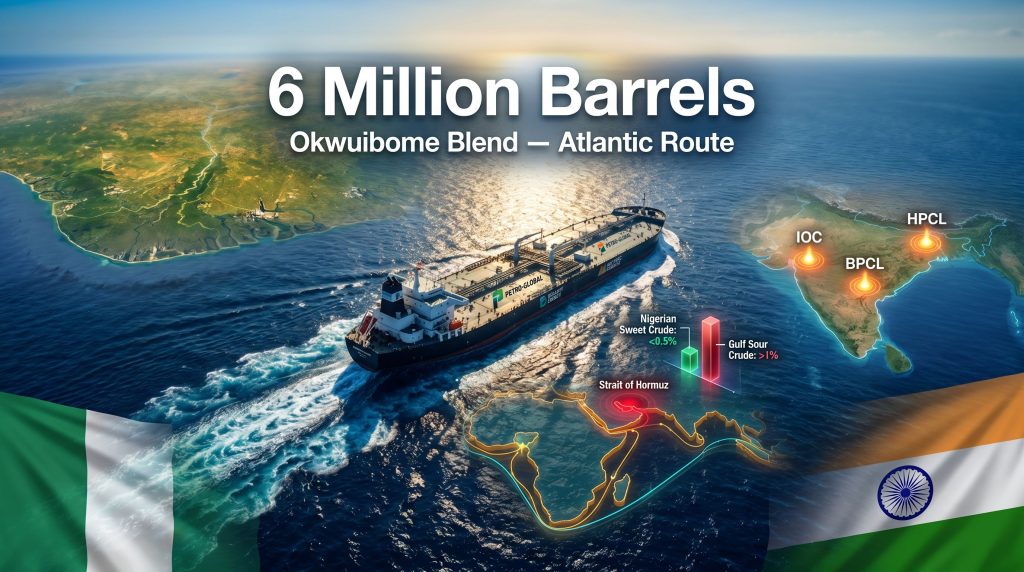
Between March and May 2026, SEEPCO supplies Nigerian crude to Indian refiners collectively amounted to approximately 6 million barrels of Okwuibome crude to IOC, BPCL, and HPCL. Averaged across the three-month delivery window, this represents roughly 200,000 barrels per day (bpd) of supplementary supply. The volume is modest relative to India's total import requirement of 4 to 5 million bpd, but operationally meaningful when contextualised as a coordinated diversification injection during a period of acute Gulf supply uncertainty.
What is particularly notable from a supply chain architecture perspective is that all three major Indian public-sector refiners participated simultaneously. Independent commercial decisions by three separate procurement teams rarely converge on the same non-traditional supplier within the same three-month window unless there is a coordinating signal. The simultaneity of participation suggests this was structured procurement activity rather than fragmented spot market opportunism.
Procurement Coordination Signal: The fact that IOC, BPCL, and HPCL all received SEEPCO crude within the same delivery window implies aggregated procurement intent rather than independent commercial decisions. This coordination model allows India to consolidate negotiating leverage against alternative suppliers and signal strategic intent to the broader global energy market.
The Atlantic Route Advantage: Eliminating the Primary Risk Variable
The crude was transported to India via Atlantic shipping routes, entirely bypassing the Strait of Hormuz. This routing decision is strategically significant in ways that extend beyond the immediate transaction. Consequently, the geopolitical trade tensions that have disrupted Gulf supply chains have simultaneously made Atlantic-routed crude more attractive than ever.
A comparative look at key shipping corridors serving India's crude import demand illustrates the risk differentiation:
| Route | Key Chokepoints | Geopolitical Risk Level | Approximate Voyage Duration to India |
|---|---|---|---|
| Arabian Gulf to India | Strait of Hormuz | High during West Asia tensions | 7 to 10 days |
| West Africa (Atlantic) to India | None significant | Low to moderate | 20 to 25 days |
| Russia (Baltic/Arctic) to India | Danish Straits, Suez | Moderate (sanctions exposure) | 25 to 35 days |
| Americas (WTI blends) to India | Panama Canal | Low to moderate | 30 to 40 days |
The Atlantic route's longer voyage duration of 20 to 25 days versus the Gulf's 7 to 10 days introduces an important logistical trade-off that energy planners must account for. Longer transit times require larger working inventory buffers, more advanced procurement scheduling, and greater flexibility in refinery feedstock planning cycles. India's Strategic Petroleum Reserve capacity and commercial inventory management practices must be calibrated to absorb this extended pipeline length without creating feedstock gaps.
However, the geopolitical risk premium eliminated by Atlantic routing is substantial. When Hormuz disruption scenarios are priced into insurance rates, charter costs, and supply continuity premiums, the economics of Atlantic-routed crude can shift significantly in its favour even before factoring in the sweet crude processing cost advantage. Furthermore, oil price movements tied to Gulf instability reinforce the cost case for diversifying into Atlantic supply lanes.
Indian-Owned Overseas Assets: The Strategic Tier Above Market Procurement
Why SEEPCO's Ownership Structure Creates a Different Category of Supply Security
SEEPCO, formally Sterling Oil Exploration & Energy Production Company Limited, is an Indian-owned oil producer operating within Nigeria. This ownership dimension is frequently underweighted in analyses that focus on the transaction volume rather than the structural relationship it represents.
When Indian entities own upstream production assets in foreign jurisdictions, the supply relationship operates on fundamentally different terms than standard market procurement in several ways:
- Preferential volume access: Indian-owned producers can prioritise allocation to Indian buyers during global supply squeezes when third-party producers may divert volumes to higher-bidding markets.
- Price negotiation leverage: Equity ownership creates cost-structure transparency that strengthens negotiating positions versus arm's-length market pricing.
- Counterparty risk reduction: The principal-agent alignment between an Indian owner and Indian refiners reduces the commercial friction and counterparty risk inherent in contracts with foreign state or private producers.
- Reactivation optionality: Dormant or reduced supply relationships with Indian-owned overseas producers can be rapidly reactivated during crises without the lead time required to establish new commercial relationships with unfamiliar counterparties.
This model closely parallels the strategic logic underpinning ONGC Videsh Limited (OVL), India's state-owned overseas exploration and production vehicle, which has pursued upstream equity stakes across Russia, Vietnam, Brazil, and elsewhere precisely to create this preferential supply tier above pure market dependency. In addition, Russian oil trading sanctions have prompted Indian planners to further accelerate non-Russian diversification across alternative geographies, including West Africa.
SEEPCO's renewed engagement with India's public-sector refiners during the 2026 supply stress period validates the thesis that maintaining active commercial relationships with Indian-owned overseas producers provides crisis-period optionality that cannot be replicated through spot market participation alone.
West Africa as a Structural Pillar: Scenario Analysis for India's Evolving Crude Basket
Three Pathways for the India-Nigeria Crude Relationship Post-2026
India's crude diversification trajectory since 2022 has expanded across multiple geographies simultaneously, encompassing Russian Urals, American WTI blends, and increasingly West African sweet grades. The SEEPCO transaction adds empirical evidence to the case for West Africa's growing role, but the trajectory from here is not predetermined.
| Scenario | Description | Key Probability Drivers |
|---|---|---|
| Baseline Continuation | SEEPCO and other Nigerian producers maintain periodic term supply to IOC, BPCL, and HPCL | Ongoing Gulf uncertainty, competitive crude pricing relative to alternatives |
| Strategic Deepening | India formalises long-term offtake agreements with Nigerian producers; SEEPCO volumes scale toward 10 to 15 million barrels annually | Government-to-government energy diplomacy; explicit diversification policy targets |
| Equity Expansion | Indian companies pursue upstream equity stakes in additional Nigerian oil blocks beyond Okwuibome | ONGC Videsh appetite; Nigeria's upstream licensing round activity and fiscal terms |
The baseline scenario requires no structural change and is essentially self-sustaining given existing commercial relationships. The strategic deepening scenario would require deliberate policy direction from India's Ministry of Petroleum and Natural Gas, directing state refiners toward longer-term contractual commitments with Nigerian suppliers. The equity expansion scenario is the most transformative and would position India with embedded production rights in West Africa comparable to its existing positions in Central Asia and Russia.
What India Gains From Deepening West African Exposure
Beyond the immediate supply security argument, West Africa's crude landscape offers India several structural advantages worth recognising. OPEC's market influence is also relevant here, as Nigeria operates within OPEC's production framework, providing a degree of supply volume predictability absent from pure spot market sourcing.
- Nigeria's Atlantic coastal geography eliminates multiple chokepoints in a single routing decision.
- West African sweet crude grades are broadly compatible with India's existing refinery configurations without large capital investment in upgrading units.
- Nigeria operates within OPEC's structured production framework, providing a degree of supply volume predictability absent from pure spot market sourcing.
- The India-Nigeria bilateral relationship carries mutual economic incentive: Nigeria benefits from a large, stable export market while India secures a diversified supply node outside the Gulf.
Notably, coverage from Kerala-based news outlet New Kerala highlights regional Indian awareness of the growing strategic significance of these West African supply arrangements.
Frequently Asked Questions
What is SEEPCO and where does it operate?
SEEPCO, or Sterling Oil Exploration and Energy Production Company Limited, is an Indian-owned oil producer operating in Nigeria. It produces crude oil from the Okwuibome field and supplies volumes to international markets including India.
How much Nigerian crude did SEEPCO supply to Indian refiners in 2026?
Between March and May 2026, SEEPCO delivered approximately 6 million barrels of Okwuibome crude to Indian state-run refiners IOC, BPCL, and HPCL combined.
Why did Indian refiners source crude from Nigeria rather than the Gulf during this period?
Geopolitical tensions in West Asia during 2026 raised concerns about potential disruptions to oil shipments transiting the Strait of Hormuz. Nigerian crude shipped via Atlantic routes bypasses this chokepoint entirely, providing a lower geopolitical-risk supply source during a high-uncertainty period.
What type of crude does the Okwuibome field produce?
The Okwuibome field produces the Okwuibome Blend, a low-sulfur sweet crude recognised by Nigeria's NNPC. Sweet crude grades are preferred by refiners for their lower desulfurization processing costs and higher yields of premium refined products.
How does Atlantic routing improve India's energy security versus Gulf routing?
Atlantic-routed crude from West Africa does not transit the Strait of Hormuz or other Gulf maritime chokepoints, eliminating the primary geopolitical shipping risk affecting Gulf-origin crude imports. The trade-off is a longer voyage duration of approximately 20 to 25 days versus 7 to 10 days from the Arabian Gulf, requiring more advanced procurement planning and larger inventory buffers.
Is Nigeria a member of OPEC?
Yes. Nigeria is an OPEC member and holds Africa's largest proven crude reserves, making it the continent's largest oil producer.
The next major ASX story will hit our subscribers first
Key Takeaways
The transaction in which SEEPCO supplies Nigerian crude to Indian refiners — approximately 6 million barrels of Nigerian sweet crude delivered to India's three largest public-sector refiners between March and May 2026 — is analytically important on multiple levels simultaneously:
- Proof of concept: India demonstrated it can activate non-Gulf supply corridors at operationally meaningful scale during periods of acute geopolitical stress.
- Atlantic routing as structural hedge: West African supply eliminates the Strait of Hormuz risk variable entirely, not merely in theory but in executed practice.
- Ownership premium: Indian-owned overseas producers like SEEPCO provide a category of supply security — including preferential access and rapid reactivation capability — that pure market procurement cannot replicate.
- Sweet crude compatibility: The Okwuibome Blend's low-sulfur profile aligns well with Indian refinery configurations, reducing the processing cost differential that sometimes disadvantages non-Gulf crudes on a landed basis.
- Coordinated procurement signal: Simultaneous participation by IOC, BPCL, and HPCL points toward structured national-level procurement strategy rather than fragmented independent commercial decisions.
Disclaimer: This article contains forward-looking scenario analysis and industry commentary intended for informational purposes only. It does not constitute financial or investment advice. Readers should conduct independent research before making any investment or procurement-related decisions. Scenario projections involve inherent uncertainty and should not be interpreted as predictions of specific outcomes.
For ongoing coverage of India's oil and gas sector and crude import diversification strategy, ET EnergyWorld at energy.economictimes.indiatimes.com provides detailed reporting on developments across India's energy markets.
Want to Stay Ahead of the Next Major Commodity Discovery?
While India's crude diversification strategy demonstrates how supply-chain shifts can reshape commodity markets overnight, Discovery Alert's proprietary Discovery IQ model scans ASX announcements in real time, instantly alerting subscribers to significant mineral discoveries across more than 30 commodities before the broader market reacts. Explore historic discoveries and their exceptional returns, then begin your 14-day free trial to position yourself at the forefront of the next major find.