May 17, 2026
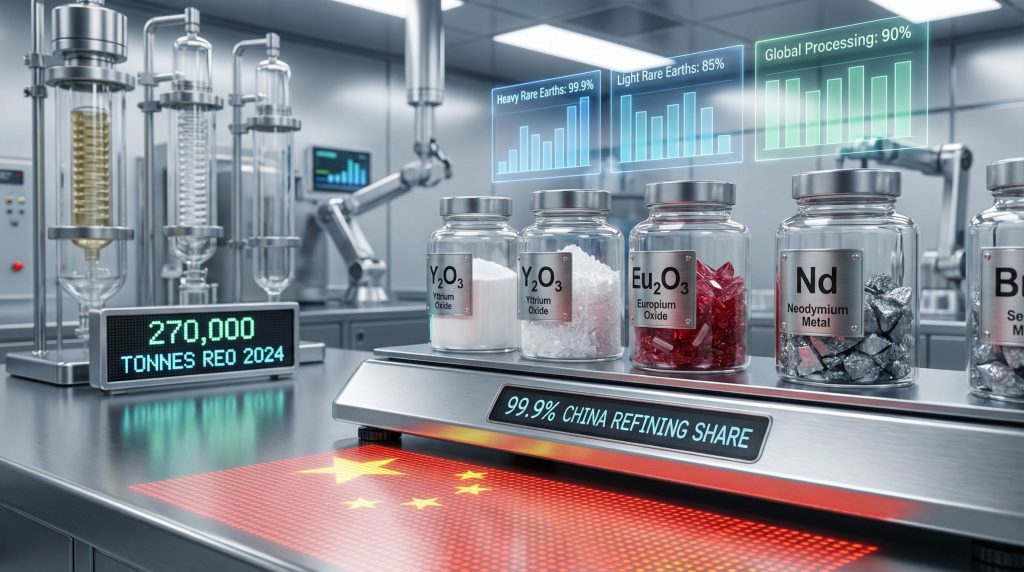
China's dominance in rare earth refining exemplifies how technical complexity, rather than resource availability, determines market control across critical materials sectors. The gap between mining and refining capabilities shapes geopolitical dynamics and investment opportunities, where processing expertise creates strategic advantages that mining diversification alone cannot address. This concentration demonstrates how technical barriers and capital requirements create structural dependencies that transcend simple resource ownership.
Investment implications emerge from understanding the distinction between upstream mineral access and midstream processing capabilities. Market participants seeking exposure to critical materials must evaluate not only deposit quality and mining economics but also the refining infrastructure necessary to deliver finished products to end users. The rare earth reserves analysis illustrates how processing concentration can persist even as mining operations diversify globally.
Understanding China's Rare Earth Processing Monopoly
China's control over rare earth refining extends far beyond its mining operations, reaching 85-99.9% market share across different element categories. This dominance reflects decades of integrated industrial development combining state-directed investment, technical expertise accumulation, and environmental trade-offs during facility construction phases.
The scale of processing concentration becomes evident through comparative analysis:
| Processing Region | Market Share | Infrastructure Status |
|---|---|---|
| China | 85-99.9% | Fully integrated operations |
| Asia-Pacific (excluding China) | 11% | Limited capacity |
| Europe | 1.6% | Minimal processing |
| North America | 0.7% | Negligible refining |
Heavy rare earths represent the most concentrated segment, with China processing 99.9% of global supply. These elements, including dysprosium and terbium, prove critical for permanent magnets in wind turbines and electric vehicle motors. Light rare earths, while somewhat more diversified, still see 85% of processing occurring within Chinese facilities.
Furthermore, China's 2024 production quota of 270,000 tonnes rare earth oxides reflects centralised state management rather than market-driven optimisation. This quota system enables supply control that serves strategic rather than purely commercial objectives, distinguishing China's approach from private sector competitors attempting diversification.
When big ASX news breaks, our subscribers know first
The Critical Distinction Between Mining and Refining Economics
Market participants often conflate rare earth mining with refining, missing the fundamental economic and technical differences that determine supply security. China controls approximately 69% of global rare earth mining but commands 85-99.9% of refining capacity, illustrating how processing capabilities exceed raw material control.
Rare earth refining requires sequential separation of 17 lanthanide series elements possessing nearly identical chemical properties. The complexity involves:
• Roasting operations: Converting oxides to chlorides or sulphates using specialised furnaces
• Acid leaching: Dissolving processed ore in concentrated hydrochloric or sulphuric acid
• Solvent extraction: Multiple-stage separation using organic solvents and selective precipitation
• Purification processes: Achieving 99.5%+ purity levels for commercial applications
• Waste management: Neutralising radioactive thorium and uranium byproducts
Capital requirements for commercial-scale refining facilities range from $500 million to $2 billion, with development timelines extending 10-20 years from permitting through full production. These barriers explain why alternative mining operations, including the Mountain Pass facility in the United States and Mount Weld in Australia, continue depending on Chinese processing for final products.
Mountain Pass exemplifies this dependency. MP Materials Corporation operates one of the world's largest rare earth mining operations outside China, producing approximately 12.3% of global mining output. However, the facility lacks integrated refining infrastructure, requiring ore shipment to China for separation into individual elements.
Consequently, Lynas Corporation's integrated approach in Australia and Malaysia demonstrates partial diversification success while highlighting remaining constraints. Their processing facility achieves approximately 12,000 tonnes annual rare earth oxide capacity, representing 4-5% of global refined supply. Environmental licensing challenges in Malaysia and product range limitations compared to Chinese facilities illustrate ongoing diversification obstacles.
China's Strategic Infrastructure Development Approach
China's rare earth refining dominance emerged through coordinated state policy combining technological development, environmental compliance flexibility during construction phases, and integrated supply chain planning. This systematic approach created structural advantages that market-based competitors struggle to replicate.
The consolidation timeline reveals strategic planning:
• 1980s-1990s: Initial processing development with lower environmental standards enabling cost advantages
• 2000s: Consolidation of 150+ small processors into large state-owned entities
• 2011: Government mandate creating six major state-owned rare earth groups
• 2015-2020: Integration of remaining independent processors through acquisition and mandatory mergers
State-owned enterprise structure enables coordination impossible under market conditions:
| Enterprise | Geographic Focus | Processing Capacity | Strategic Role |
|---|---|---|---|
| China Northern Rare Earth Group | Inner Mongolia | 120,000-150,000 tonnes REO | Light rare earth specialisation |
| China Rare Earth Group | Southern regions | 80,000-100,000+ tonnes REO | Heavy rare earth focus |
| Shenghe Resources | Mixed domestic/international | Variable capacity | Global sourcing strategy |
Technical expertise accumulation occurred through systematic technology acquisition during the 1990s-2000s, including joint ventures with Western companies, academic exchange programmes, and recruitment of international chemical engineering talent. This institutional knowledge, combined with proprietary process improvements developed over decades, creates competitive advantages beyond cost differentials.
In addition, environmental compliance cost advantages during China's development phase provided 15-25% processing cost reductions compared to current Western regulatory requirements. While legacy facilities benefit from grandfather clause protections, new Western refining operations face full environmental compliance costs from project initiation.
Western Diversification Challenges and Market Realities
Alternative rare earth refining capacity outside China remains minimal despite recognition of supply chain risks and decade-long diversification efforts. Current non-Chinese processing represents less than 15% of global refined output, concentrated primarily in Australian and Malaysian facilities.
Capital and technical barriers create fundamental challenges:
• Infrastructure investment: $500 million to $2 billion per commercial-scale facility
• Technical expertise: Limited availability of solvent extraction specialists outside China
• Development timelines: 10-20 years from permitting to commercial operation
• Environmental permitting: Complex regulatory approval processes in Western jurisdictions
• Market competition: Risk of Chinese capacity expansion during competitor startup phases
Economic challenges compound technical barriers. China's integrated operations achieve cost advantages through vertical integration, shared infrastructure, and coordinated supply chain management. New Western facilities operate as standalone processors without upstream mining integration or downstream manufacturing coordination.
For instance, the qualification timeline reality adds complexity to diversification efforts. Rare earth refining facilities require 2-5 years of operational qualification after construction completion to achieve commercial reliability and purity standards. This extended commissioning period increases total project timelines and capital requirements beyond initial construction estimates.
Current alternative processing examples illustrate limited scale:
What Are the Key Alternative Processing Operations?
Lynas Corporation (Australia/Malaysia):
• Mount Weld mining operation in Western Australia
• Kuala Lumpur processing facility in Malaysia
• Annual capacity: 12,000 tonnes REO (4-5% of global supply)
• Product limitations: Cannot match Chinese facility element range or purity levels
• Environmental challenges: Malaysian wastestream management created regulatory complexities
European Union Initiatives:
• Critical Raw Materials Act implementation targeting strategic autonomy
• Public-private partnership models under development
• Technology development funding programmes
• Limited progress toward commercial-scale refining capacity
These developments align with broader European CRM facility insights and reflect the challenging economics of establishing alternative processing capacity.
Export Control Evolution and Strategic Positioning
China has increasingly utilised export restrictions as geopolitical tools, particularly targeting heavy rare earths critical for defence and advanced technology applications. These controls demonstrate how processing dominance enables strategic influence beyond simple market mechanics.
Recent export control developments include:
• Enhanced restrictions: Tightened controls on heavy rare earth exports
• Technology limitations: Restrictions on processing equipment and technical knowledge transfer
• Strategic stockpiling: Mandatory domestic inventory requirements
• Licensing complexity: Increased administrative requirements for export permits
Market impact analysis reveals price volatility effects concentrated in heavy rare earth categories where China's dominance in rare earth refining approaches 99.9%. Dysprosium and terbium prices demonstrate particular sensitivity to export policy changes, affecting permanent magnet manufacturers globally.
Supply chain disruption risks extend beyond immediate price effects to longer-term availability concerns. End users in defence and renewable energy sectors face planning uncertainties when single-source suppliers control strategic materials through policy mechanisms rather than market forces.
However, investment patterns reflect these concerns through accelerated funding for alternative processing capacity development. Lead times for commercial-scale alternatives remain 10-20 years, creating extended vulnerability periods for import-dependent industries.
Demand Growth Projections and Supply Security Implications
Rare earth demand faces projected tripling by 2035, driven primarily by renewable energy and electric vehicle adoption. Permanent magnets, representing 45% of current consumption, may reach 60%+ of total demand as wind turbine and electric motor production scales globally.
Demand growth scenarios by application:
| Application Sector | Current Share | 2035 Projection | Supply Risk Level |
|---|---|---|---|
| Permanent Magnets | 45% | 60%+ | Critical |
| Catalysts | 20% | 15% | Moderate |
| Electronics | 20% | 15% | High |
| Glass/Ceramics | 15% | 10% | Low |
Critical elements for permanent magnet applications include neodymium, dysprosium, and terbium. Neodymium demand may increase 300-500% by 2035 based on electric vehicle and wind turbine deployment projections. Dysprosium and terbium, essential for high-temperature magnet performance, face even more concentrated supply risks due to lower geological abundance and 99.9% Chinese refining dominance.
Supply elasticity analysis suggests Chinese refining capacity could accommodate increased demand through facility expansion and efficiency improvements. Nevertheless, strategic considerations may limit export availability regardless of processing capability, creating artificial scarcity scenarios for importing nations.
Alternative technology development offers potential demand substitution, but timeline mismatches create interim vulnerabilities. Research into rare earth-free permanent magnets continues, yet commercial deployment timelines extend beyond projected demand growth periods.
The next major ASX story will hit our subscribers first
Investment Implications and Market Opportunities
The rare earth refining landscape presents both systematic risks and specialised opportunities for investors seeking critical materials exposure. Understanding the distinction between mining and processing investments proves essential for portfolio construction and risk management. These considerations align with broader investment guide 2025 principles for navigating critical materials markets.
Risk assessment framework components:
• Single-point failure risks: Concentration in Chinese processing creates systemic supply vulnerabilities
• Geopolitical exposure: Export control policies affect availability independent of commercial considerations
• Price manipulation potential: State-controlled quota systems enable artificial scarcity creation
• Technology access limitations: Proprietary processing knowledge concentrated within Chinese enterprises
Diversification investment opportunities include:
• Alternative processing development: Financing new refining facilities in Western jurisdictions
• Recycling technology advancement: Urban mining and rare earth recovery from end-of-life products
• Substitute material research: Investment in rare earth-free alternatives for critical applications
• Strategic inventory management: Physical stockpiling and commodity financing structures
Mining investment considerations require careful evaluation of downstream processing access. Projects without secured refining partnerships face completion risks even with high-quality deposits. Integrated mining-refining ventures offer superior strategic positioning but demand significantly higher capital commitments.
Technology investment opportunities focus on process innovation and environmental compliance improvements. Solvent extraction efficiency enhancements, waste management solutions, and automated separation systems could reduce capital requirements for new refining facilities.
Furthermore, market psychology factors include institutional awareness of supply chain vulnerabilities driving investment allocation toward alternative capacity development. Government funding programmes in Western nations provide co-investment opportunities but operate with political rather than commercial timelines.
Environmental Factors and Location Decisions
Rare earth processing generates significant environmental challenges that influence facility location decisions and operational costs. Understanding these factors proves essential for evaluating diversification prospects and investment viability.
Environmental processing challenges include:
• Radioactive byproduct handling: Thorium and uranium separation and disposal
• Acid waste neutralisation: Management of concentrated sulphuric and hydrochloric acid streams
• Water treatment requirements: Recycling and purification of process water
• Tailings management: Long-term storage of solid waste materials
• Air emissions control: Dust and chemical vapour containment systems
Regulatory compliance costs in Western jurisdictions represent 5-8% of total refining operating expenses, compared to lower historical compliance burdens in Chinese facilities constructed during less stringent regulatory periods. New facilities in developed economies face full environmental compliance costs from project initiation.
Waste management requirements create ongoing operational complexities. Rare earth processing generates 2-3 tonnes of acidic waste per tonne of refined product, requiring neutralisation and disposal systems. Radioactive waste streams require specialised handling and regulatory oversight extending facility operational costs beyond basic processing equipment.
Community consultation processes in Western jurisdictions add 2-5 years to development timelines and require extensive public engagement programmes. Social licence considerations affect facility location options and may restrict optimal geographic positioning for technical or economic reasons.
However, environmental compliance advantages emerge for facilities utilising renewable energy and closed-loop water systems. These innovations reduce operational costs while addressing regulatory requirements, though they demand higher initial capital investment.
Strategic Scenarios for Reshaping Global Processing
Multiple factors could potentially alter China's dominance in rare earth refining, though each scenario faces significant implementation challenges and extended development timelines. These potential changes reflect broader patterns in the mining industry evolution toward more distributed processing capacity.
Technology breakthrough scenarios involve:
• Advanced separation technologies: Ion exchange or membrane separation alternatives to solvent extraction
• Process automation: Reduced labour requirements and improved operational consistency
• Environmental innovation: Lower waste generation and simplified compliance requirements
• Modular facility design: Reduced capital requirements through standardised processing units
Geopolitical pressure scenarios include:
• Coordinated Western investment: Alliance-based funding for alternative processing capacity
• Technology sharing agreements: Collaborative development of proprietary separation techniques
• Emergency capacity development: Accelerated facility construction under national security provisions
• Strategic alliance formation: Military and civilian cooperation frameworks
Market disruption scenarios involve:
• Substitute material adoption: Widespread implementation of rare earth-free alternatives
• Recycling technology advancement: Urban mining achieving commercial scale
• Demand pattern shifts: Changes in end-use applications affecting element requirements
• Supply chain regionalisation: Development of regional processing hubs serving specific markets
Timeline analysis suggests technology breakthrough scenarios offer the most realistic diversification pathway, though commercial implementation requires 10-15 year development periods. Geopolitical coordination faces political sustainability challenges over extended timeframes necessary for infrastructure development.
Consequently, investment implications favour early-stage technology development and pilot facility funding over immediate large-scale processing investments. Risk-return profiles benefit from portfolio approaches combining multiple diversification strategies rather than concentration in single alternative solutions.
The Persistent Reality of Processing Concentration
China's dominance in rare earth refining represents a convergence of technological expertise, coordinated industrial policy, and first-mover advantages accumulated over decades of systematic development. This concentration persists despite widespread recognition of supply chain risks and substantial investment in diversification efforts.
The fundamental challenge extends beyond financial capital to encompass technical knowledge, environmental compliance, and commercial scale requirements that market-based solutions struggle to address within politically acceptable timelines. Alternative processing capacity development requires sustained commitment over 15-20 year periods, exceeding typical investment horizons and political cycles.
Market participants must distinguish between mining diversification achievements and processing concentration realities when evaluating supply chain security and investment opportunities. The gap between geological resource control and refining capability determines actual supply availability for end-use applications.
Future developments in rare earth processing will likely emphasise technological innovation and coordinated policy responses rather than purely market-driven solutions. The intersection of national security considerations and commercial viability suggests continued state involvement in critical materials supply chain development across multiple jurisdictions.
Disclaimer: This analysis contains forward-looking statements regarding rare earth demand projections, processing capacity development, and geopolitical scenarios. Actual outcomes may differ significantly from projections due to technological developments, policy changes, and market dynamics. Investment decisions should consider multiple risk factors and consult qualified financial advisors. Historical performance does not guarantee future results in critical minerals markets.
Are You Positioning for the Next Critical Materials Market Shift?
China's stranglehold on rare earth refining creates unprecedented investment opportunities as demand triples by 2035, yet most investors miss the distinction between mining and processing advantages. Discovery Alert's proprietary Discovery IQ model instantly identifies ASX companies developing alternative processing capabilities and critical materials projects, delivering real-time alerts when significant discoveries could reshape global supply chains and unlock substantial returns from historic mineral discoveries.