August 5, 2026
The Quiet Architecture of Control: Understanding China's Grip on Rare Earth Output
Few industrial policy mechanisms carry the global weight of China rare earth production quotas. While export controls tend to attract the most media attention, it is the quieter, upstream lever of production quotas that gives Beijing its most durable form of market influence. By regulating how much can be mined and how much can be processed, China effectively determines the volume, composition, and timing of rare earth materials entering the global economy. Understanding this system in full requires looking beyond the headlines and into the structural logic of how it operates, who controls it, and where it is heading.
When big ASX news breaks, our subscribers know first
How China's Rare Earth Quota System Actually Works
China's quota framework is not a single instrument but a layered policy architecture operating across two distinct stages of the supply chain. The first tier governs mining extraction, placing hard numerical ceilings on how much rare earth ore can be physically removed from the ground within a given calendar year. The second tier controls smelting and separation, the chemical processing stage that transforms raw ore into the refined oxides, metals, and alloys that downstream manufacturers actually require.
These two tiers are independent of one another, which is precisely what gives the system its strategic depth. A government could, in theory, permit high mining volumes while restricting smelting capacity, creating an ore stockpile effect. Alternatively, smelting quotas can be expanded while mining remains constrained, drawing down existing inventories. This dual-lever design gives Beijing extraordinary flexibility to manage supply conditions without resorting to blunt export bans that would invite immediate international trade challenge.
Quota volumes are typically assigned to eligible state-designated enterprises through a formal administrative process managed by China's Ministry of Industry and Information Technology (MIIT), often in coordination with the Ministry of Natural Resources. Historically, these allocations were announced in batches, usually with the first tranche released in the early months of the calendar year and a second batch following mid-year.
Origins and Evolution of the Framework
China first formalised rare earth production quotas as a centralised resource governance tool in the mid-2000s, with the system taking recognisable shape around 2006. At its origin, the framework was primarily framed as an environmental and resource conservation measure, aimed at curbing illegal mining and reducing the ecological damage associated with unregulated rare earth extraction, particularly in southern China's ionic clay deposits.
Over time, however, the system evolved into something far more precise. Following the 2010 rare earth export restriction episode, in which China drastically curtailed export volumes and triggered a global price spike, the World Trade Organization ruled against several Chinese trade restrictions in subsequent disputes. Beijing responded by recalibrating its toolkit, shifting emphasis from export-side controls toward production-side governance. The quota system became sharper, more targeted, and increasingly aligned with China's rare earth strategy and its broader industrial and geopolitical objectives.
Quantifying China's Dominance: What the Production Numbers Reveal
China's position in the global rare earth market is not simply one of significance. It is one of structural dominance at multiple points simultaneously.
| Metric | Estimated Figure |
|---|---|
| China's share of global rare earth mining output | 60%+ |
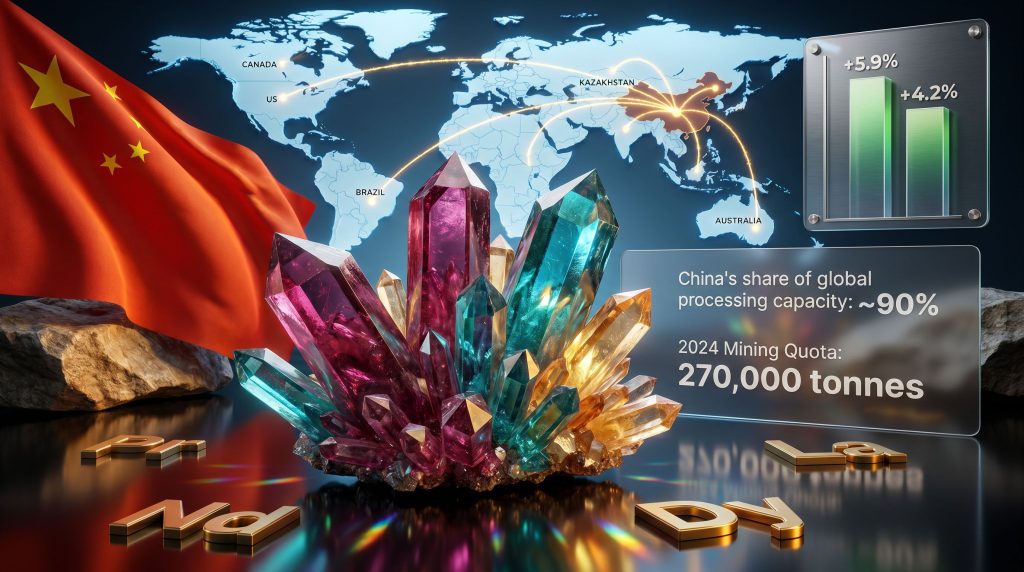
| China's share of global rare earth processing and separation capacity | ~90% |
| 2024 total mining quota | 270,000 tonnes |
| Year-on-year increase in mining quota (2024 vs. 2023) | +5.9% |
| 2024 smelting and separation quota | 254,000 tonnes |
| Year-on-year increase in smelting quota (2024 vs. 2023) | +4.2% |
The 2024 figures represent a continuation of what has been a consistent upward trajectory in annual quota volumes, broadly tracking the rise in global demand driven by electric vehicle production, wind turbine deployment, and defence procurement. However, the growth rate itself carries analytical significance. A 5.9% increase in mining quotas is meaningful in absolute volume terms but modest relative to the pace at which demand for neodymium-praseodymium oxide is accelerating across the EV sector.
This potential gap between quota-sanctioned supply growth and underlying demand growth is one of the lesser-discussed structural tensions in the rare earth market. Furthermore, if demand compounds faster than quota expansion, the result is not simply price appreciation but a tightening of the physical market that cascades through the entire downstream manufacturing ecosystem, from magnet producers in Japan to motor assemblers in Germany.
The 2025 Quota Silence: A Deliberate Policy Departure
Perhaps the most consequential recent development in China's quota governance framework is not a number at all. It is the absence of one. China's 2025 rare earth production quotas were reportedly issued without public announcement, with recipients understood to have been instructed not to disclose the figures. This represents a clear departure from prior practice, in which quota announcements were published through official channels and available to market participants globally.
The withdrawal of quota transparency is not a minor administrative change. It removes a foundational piece of market intelligence that spot traders, magnet producers, and downstream manufacturers have relied upon to forecast supply conditions months in advance.
The timing of this shift is not incidental. It coincides with an intensification of US-China trade tensions and occurs against the backdrop of broader Chinese policy moves to introduce rare earth export restrictions on specific elements and processing technologies. The deliberate suppression of quota data signals that Beijing is treating production governance as a security instrument rather than a conventional industrial policy tool, a meaningful escalation in the strategic posture around these materials.
Consolidation to Two: The State Enterprise Duopoly
The concentration of China's rare earth quota system into the hands of just two state-owned enterprises marks one of the most significant structural shifts in the sector's recent history. Where once a fragmented landscape of provincial producers and smaller state firms shared quota allocations, the field has now narrowed to China Rare Earth Group and China Northern Rare Earth Group High-Tech Co.
China Northern Rare Earth Group is the dominant force in light rare earth production, controlling extraction from the Bayan Obo deposit in Inner Mongolia, the world's largest known rare earth reserve by volume. China Rare Earth Group, formed through a 2021 consolidation of several southern Chinese producers, holds primary authority over heavy rare earth production, including the ionic clay deposits of Jiangxi province that are the primary global source of dysprosium, terbium, and other critical heavy rare earth elements.
This duopoly structure carries profound implications for how the quota system functions in practice:
- Enforcement becomes substantially simpler when compliance monitoring covers two entities rather than dozens
- Output data becomes more tightly controlled, reducing the flow of production intelligence to external observers
- Pricing coordination capacity increases, as fewer actors are needed to influence the volume of material reaching spot markets
- State policy transmission is faster, with production adjustments implementable at the enterprise level without requiring broad regulatory revision
The consolidation mirrors patterns seen in other Chinese strategic resource sectors, including lithium processing and coal production, where state-directed mergers have progressively replaced competitive market structures with centralised, administratively manageable entities.
Which Elements Are Covered, and Why They Are Irreplaceable
China's quota framework covers the full spectrum of rare earth elements, but the strategic weight falls most heavily on a subset of materials for which substitution remains technically elusive.
| Rare Earth Element | Symbol | Primary Strategic Application |
|---|---|---|
| Neodymium | Nd | Permanent magnets for EV motors and wind turbines |
| Praseodymium | Pr | High-strength NdFeB magnets, aerospace alloys |
| Dysprosium | Dy | Heat-resistant magnets for defence systems and high-performance EVs |
| Terbium | Tb | Magnet coercivity enhancement, green phosphors |
| Lanthanum | La | Petroleum refining catalysts, high-k dielectric materials in semiconductors |
| Cerium | Ce | Automotive catalytic converters, glass polishing compounds |
The irreplaceability of neodymium-iron-boron (NdFeB) permanent magnets in high-performance applications is a critical technical reality that underpins the entire strategic conversation around these quotas. NdFeB magnets achieve energy densities that no other magnet technology currently matches at commercial scale. For electric vehicle drivetrains requiring high torque in compact motor formats, and for direct-drive wind turbines where weight and efficiency are paramount, there is no functionally equivalent substitute available at industrial volumes.
Dysprosium adds a further layer of irreplaceability. When NdFeB magnets are operated at elevated temperatures, coercivity drops, meaning the magnet loses its resistance to demagnetisation. Dysprosium additions to the NdFeB matrix restore coercivity at high temperatures. The challenge is that dysprosium is a heavy rare earth element produced almost exclusively from ionic clay deposits concentrated in southern China and, to a lesser extent, in Myanmar. This geographic concentration makes it one of the highest-criticality materials in the entire clean energy and defence supply chain.
The Imported Ore Proposal: Extending Beijing's Regulatory Reach
A proposal now under consideration by Chinese regulators would extend the quota framework beyond domestic mining activity to encompass rare earth ore imported from foreign sources and processed within Chinese facilities. This is a structurally significant development that has received insufficient attention in broader market commentary.
Currently, ore mined in Myanmar, Laos, and parts of Africa and then shipped to Chinese separation facilities operates in a regulatory grey space relative to the domestic quota framework. If imported ore is brought within the quota governance structure, the practical effect would be to place Beijing's administrative authority over a substantially larger share of the global rare earth processing pipeline than its domestic mining quota alone currently captures.
For junior mining companies in Southeast Asia and Africa that have built business models around shipping concentrate to Chinese processors, this proposal introduces material regulatory risk. Processing access could become contingent on quota availability, and quota availability would be determined by the same two state enterprises that already control domestic Chinese output.
The broader consequence, if enacted, would be an acceleration of investment interest in ex-China processing infrastructure, as buyers seek rare earth supply chains that operate entirely outside the reach of Chinese administrative controls.
The next major ASX story will hit our subscribers first
How Quota Signals Drive Rare Earth Price Behaviour
The relationship between China's quota announcements and rare earth spot price movements is not linear, but it is systematic. Quota signals are one of the most influential inputs into the pricing models used by traders, magnet manufacturers, and procurement teams across Japan, South Korea, Germany, and the United States.
The price transmission mechanism works through several channels:
- Anticipation effects: Market participants begin adjusting purchasing behaviour in advance of expected quota tightening, often weeks before physical supply changes materialise
- Inventory accumulation: Downstream processors respond to quota uncertainty by building safety stocks, pulling forward demand and amplifying near-term price pressure
- Spot market thinning: When quota volumes are constrained, the volume of material available in spot markets decreases, widening bid-ask spreads and increasing price volatility
- Sentiment contagion: Quota-related news flows quickly through the NdFeB magnet supply chain, affecting contract negotiations even when physical supply has not yet changed
Among all quota-controlled elements, NdPr oxide functions as the primary price barometer. Its spot price is most directly correlated with shifts in annual smelting and separation quota volumes and is the reference point used by most commercial contracts in the permanent magnet supply chain.
Dysprosium presents a different dynamic: lower in volume but extreme in price sensitivity. Because global supply is so geographically concentrated and end-use applications so technically specific, even modest changes in quota allocation or processing availability can produce sharp price dislocations with very little warning. According to data on China's rare earth export volumes, these fluctuations have become increasingly pronounced in recent years, reflecting the tightening interplay between quota policy and global demand.
Geopolitical Dimensions: Quotas as Strategic Instruments
The geopolitical dimension of China rare earth production quotas has become increasingly explicit. What was once framed primarily as domestic resource management has evolved into a visible component of China's economic statecraft toolkit, operating alongside export licensing regimes, technology transfer restrictions, and strategic stockpiling programmes.
The 2010 precedent remains instructive. When China curtailed rare earth exports that year, prices for some elements increased by multiples within months, exposing the depth of global dependency and triggering a sustained, if ultimately incomplete, response from consuming nations. The WTO rulings that followed constrained China's ability to use export restrictions openly, but they did not constrain production-side governance. The quota system has since been refined precisely because it sits in a different regulatory category.
Western governments are responding, however, through a combination of policy instruments:
- The United States has pursued domestic rare earth production investment, with MP Materials operating the Mountain Pass facility in California representing the most advanced non-Chinese integrated rare earth operation in the Western Hemisphere
- The European Critical Raw Materials Act establishes diversification benchmarks, including targets for processing capacity that reduce dependency on single-source supply chains
- Australia's position as the host of the world's richest known rare earth deposit at Mount Weld, operated by Lynas Rare Earths, gives the Five Eyes alliance a meaningful anchor point for allied supply chain development
- Japan, historically the most exposed major economy to Chinese rare earth supply risk, has maintained long-term offtake agreements with non-Chinese producers and invested heavily in rare earth recycling and substitution research
The Diversification Challenge: Structural Barriers to Rapid Change
Understanding the realistic timeline for supply chain diversification requires confronting several structural barriers that policy intent alone cannot overcome.
| Region | Key Development | Estimated Scaling Timeline |
|---|---|---|
| Australia | Lynas Mount Weld; Kalgoorlie rare earth processing facility | Near-term (2025-2027) |
| United States | MP Materials Mountain Pass; defence-linked processing investment | Medium-term (2026-2029) |
| Canada | Vital Metals, Appia Rare Earths exploration pipeline | Medium-to-long-term |
| Brazil | Ionic clay deposits; emerging junior sector activity | Long-term (2028+) |
| Kazakhstan | State-directed rare earth processing development ambitions | Long-term |
The most persistent bottleneck is not mining capacity but processing challenges inherent to rare earth separation. Rare earth separation is a chemically complex, capital-intensive process requiring specialised solvent extraction circuits, significant volumes of chemical reagents, and highly skilled metallurgical expertise. China has spent decades building and refining this expertise, and it cannot be replicated quickly regardless of the capital deployed.
A critical and underappreciated distinction within the diversification discussion is the difference between light and heavy rare earth processing. Light rare earth separation, covering elements such as lanthanum, cerium, and neodymium, is technically achievable outside China with the right investment. Heavy rare earth separation, particularly for dysprosium and terbium derived from ionic clay ore, is considerably more difficult and currently has almost no meaningful commercial capacity operating outside Chinese jurisdiction.
This asymmetry means that even a successful build-out of ex-China light rare earth processing still leaves the defence and high-performance EV sectors critically exposed to Chinese control over heavy rare earth materials. Consequently, this specific vulnerability remains the most underweighted risk in current Western supply chain planning. In addition, the US rare earth supply chain faces particular pressure given its simultaneous exposure across both defence and commercial EV manufacturing sectors. Furthermore, analysts tracking China's rare earth production oversight have noted that consolidation of quota governance is accelerating these structural vulnerabilities.
Frequently Asked Questions: China Rare Earth Production Quotas
What is the difference between China's rare earth quotas and its export controls?
Rare earth production quotas operate on the supply side, limiting how much material can be extracted and processed within China's borders. Export controls operate on the trade side, restricting how much of that processed material can leave China for foreign buyers. These are two separate but complementary policy levers. Quotas constrain absolute production volume; export controls determine how that volume is distributed between domestic consumption and foreign supply.
Which countries face the greatest exposure to Chinese quota risk?
Japan, South Korea, Germany, and the United States carry the highest dependency exposure, primarily through their permanent magnet manufacturing sectors and the EV and defence industries those magnets serve. Japan is particularly exposed given its dominant position in NdFeB magnet production and its historical reliance on Chinese rare earth supply.
Why did China reportedly restrict public disclosure of its 2025 quota figures?
The suppression of 2025 quota data appears consistent with a broader pattern of treating rare earth governance as a national security matter rather than a commercial policy function. By removing market transparency, Beijing reduces the ability of consuming nations to plan around supply constraints and increases uncertainty for procurement teams, traders, and policymakers alike.
Is there a realistic path to reducing dependence on Chinese rare earth processing within the next decade?
For light rare earth elements, meaningful progress is achievable within five to seven years with sustained investment and policy support. For heavy rare earth elements, particularly dysprosium and terbium, genuine supply chain independence from Chinese processing infrastructure is a ten-plus-year proposition at minimum. This may not be achievable without breakthroughs in alternative deposit development or ionic clay processing technology outside of China's current geographic monopoly. However, understanding China rare earth production quotas remains essential context for any investor or policymaker navigating this landscape.
This article is intended for informational purposes only and does not constitute financial or investment advice. Rare earth market dynamics involve significant uncertainty, and forward-looking assessments of supply, pricing, and geopolitical outcomes involve inherent risks and assumptions that may not materialise as described.
Want To Stay Ahead of the Next Major Mineral Discovery?
Discovery Alert's proprietary Discovery IQ model delivers real-time alerts on significant ASX mineral discoveries, transforming complex mineral data into actionable investment insights for both traders and long-term investors. Start your 14-day free trial today and explore historic examples of exceptional discovery returns to understand what positioning early in a major discovery can mean for your portfolio.