July 17, 2026
The China rare earth supply chain dominance extends far beyond simple resource extraction into sophisticated technological control that affects global industrial networks. This comprehensive control creates unprecedented dependency risks across critical technology sectors while demonstrating how resource concentration can evolve into strategic leverage through vertical integration and technological mastery.
Understanding China's Multi-Layered Rare Earth Control
China's strategic position in rare earth markets operates through interconnected control mechanisms that extend across extraction, processing, and manufacturing stages. The Bayan Obo complex in Inner Mongolia represents the world's largest light rare earth deposit, containing over 50 million metric tons of measured resources while supplying approximately 25-30% of global demand. This single facility maintains reserves sufficient for decades of operation at current extraction rates.
The ion-adsorption clay deposits across Southern Chinese provinces provide additional strategic advantages through heavy rare earth element concentrations. These formations in Jiangxi, Hunan, and Guangdong provinces contain critical elements like dysprosium and terbium at concentrations ranging from 0.5-5 kg per ton. Heavy rare earths represent approximately 60-70% of global supply from these southern operations.
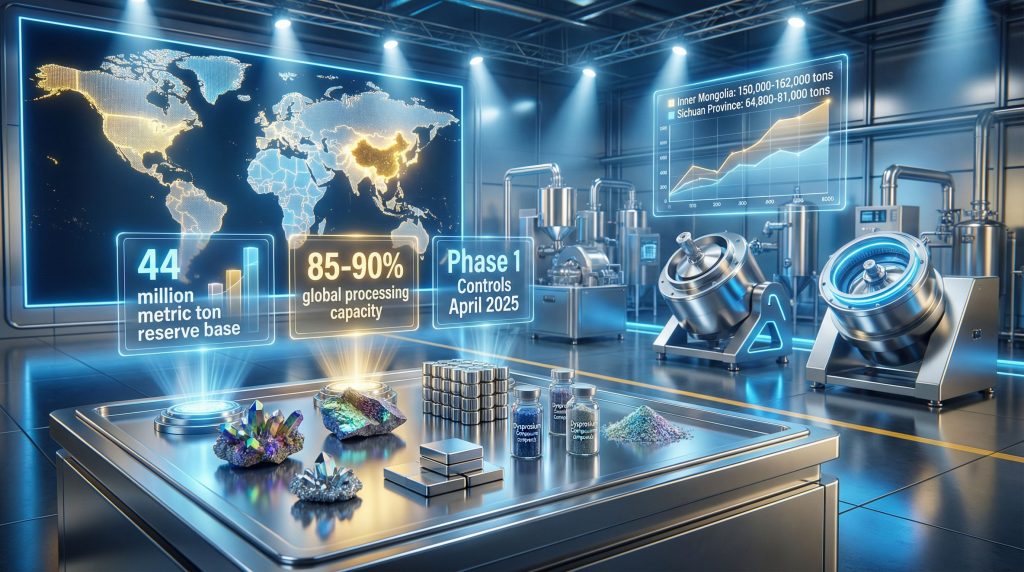
Processing technological superiority creates the most formidable competitive barrier. Chinese facilities process approximately 300,000-360,000 metric tons annually, representing 85-90% of global processing capacity. This dominance includes sophisticated separation chemistry achieving 99.9%-99.99% purity levels while maintaining impurity concentrations below 100 ppm for aerospace applications.
When big ASX news breaks, our subscribers know first
How Does Global Production Compare to Chinese Capabilities?
International rare earth production demonstrates significant concentration risks beyond China's dominance. Myanmar represents the second-largest producer with approximately 23,000-27,000 metric tons annually, though political instability creates supply security concerns for Western purchasers.
Australia contributes roughly 16,000-18,000 metric tons annually through Lynas Rare Earths' Mt. Weld project, representing 8% of global production. However, operational competitiveness depends entirely on processing capacity located in Malaysia, with costs ranging A$35-45/kg rare earth oxide equivalent based on commodity price fluctuations.
United States production through MP Materials' Mountain Pass mine provides 12,000-15,000 metric tons annually, representing 5-6% of global output. The facility focuses on light rare earth production but lacks integrated processing capacity for separated products, limiting strategic value for supply chain independence initiatives.
Reserve Distribution Patterns
China holds approximately 37-44 million metric tons of rare earth oxide equivalent reserves, representing roughly 37% of proven global reserves according to USGS assessments. However, reserve accessibility involves complex considerations including proximity to processing infrastructure, environmental frameworks, and political stability factors.
Furthermore, projected supply-demand dynamics indicate growing imbalances as the critical minerals energy transition accelerates. Demand growth for neodymium and dysprosium could exceed 8-12% annually through 2030, while new supply sources face 8-15 year development timelines including permitting and operational optimization phases.
Why Processing Technology Dominates Competitive Advantages
The technological mastery required for rare earth processing represents the most significant barrier to global supply chain diversification efforts. Separating seventeen chemically similar elements into high-purity individual products requires sophisticated chemical processes that demand decades of optimization experience.
Chinese processors employ multi-stage liquid-liquid extraction systems using proprietary organic reagent combinations with precise pH, temperature, and concentration controls. These systems achieve 90-95% recovery rates while maintaining environmental management of acidic waste streams through specialized treatment processes.
Patent Portfolio and Technological Control
Patent analysis reveals China's technological dominance in separation methods. Chinese institutions account for approximately 80% of global solvent extraction equipment patents filed during 2015-2025. This intellectual property concentration creates significant barriers for competitors attempting alternative processing development without licensing Chinese innovations.
Moreover, China's China export control strategy includes restrictions on equipment exports, technology licensing, and engineering expertise transfer. These limitations affect new processing facilities outside China, creating 3-5 year delays for developing alternative equipment and processes.
Manufacturing integration across the value chain provides additional competitive advantages. Chinese facilities control approximately 85-93% of global neodymium-iron-boron permanent magnet production according to US Department of Energy assessments. This integration enables rapid optimization between mining output, processing parameters, and final product specifications.
Economic Implications of Export Control Implementation
China's implementation of rare earth export controls represents a fundamental shift toward strategic resource weaponization rather than market-based competition. The tiered implementation approach maximizes strategic leverage while allowing gradual market adjustment to new supply realities.
Phase 1 controls target seven heavy rare earth elements under licensing requirements beginning April 2025. These elements, including dysprosium, terbium, europium, and yttrium, are essential for high-performance applications with limited substitution possibilities. Initial market responses demonstrate 15-25% price increases within three months of control announcements.
Phase 2 expansion in October 2025 adds five additional elements while extending restrictions to equipment and technology transfer. Extraterritorial compliance requirements apply to products containing 0.1% Chinese-sourced rare earth content, creating verification challenges for complex global supply chains.
Industry Vulnerability Assessment
Electronics manufacturing faces the most immediate impact due to high rare earth content in displays, speakers, and electronic components. Alternative sourcing carries cost premiums ranging 20-50% above Chinese pricing, while availability constraints affect traditional just-in-time inventory management practices.
The automotive industry's exposure accelerates with electric vehicle adoption. EV traction motors typically contain 1-3 kg of neodymium and dysprosium per vehicle, while hybrid vehicles require additional rare earth content in battery systems and electronic controls.
Defense applications present the highest strategic vulnerability due to performance requirements that often preclude substitution. Military guidance systems, radar arrays, and communication equipment require rare earth elements for characteristics that alternative materials cannot match.
Global Response Strategies and Market Adaptations
International responses to China rare earth supply chain concentration have evolved from reactive policies toward comprehensive strategic initiatives spanning government investment, private innovation, and geopolitical alliance formation.
United States congressional initiatives include CHIPS and Science Act allocations totaling $52 billion for semiconductor and critical materials production. Specific provisions include loan guarantees for processing facility development and strategic stockpile expansion targeting 180-day supply coverage for critical elements.
The executive order on critical minerals demonstrates policy commitment to domestic capacity development through public-private partnerships. MP Materials received $35 million in Department of Defense funding for processing facility development, while additional contracts support alternative supply source development.
European Strategic Responses
European Union initiatives focus on diversifying supply sources through development finance and trade agreements. The European Raw Materials Alliance coordinates €3 billion in public and private investment for critical materials development. The European critical materials facility supports African rare earth development through financing and technology transfer agreements.
However, private sector investment patterns reflect growing recognition of supply chain vulnerabilities. Venture capital funding for rare earth technology companies increased 300% between 2020-2025, while industrial companies establish direct investment in alternative supply sources.
Technological Innovation and Alternative Development
Synthetic rare earth substitute research focuses on developing materials with equivalent magnetic and optical properties without rare earth element content. Iron-nitride magnets show promise for certain applications but require breakthrough manufacturing techniques with 5-10 year development timelines for market viability.
Recycling technology advancement enables recovery from end-of-life products through urban mining initiatives. University of British Columbia research indicates LED recycling can yield critical metals while reducing mining environmental impacts by 80-90%. However, recycling currently provides less than 1% of global rare earth supply due to collection challenges.
In addition, IP protection in mining becomes increasingly important as companies develop proprietary separation technologies and alternative materials. Patent strategies must balance innovation disclosure with competitive protection in an environment where technological advantages determine market position.
Material Efficiency Improvements
Permanent magnet optimization reduces rare earth content by 15-30% in motor applications while maintaining performance specifications. Electric vehicle manufacturers invest in motor designs that minimize dysprosium requirements while preserving high-temperature performance characteristics necessary for automotive applications.
Nevertheless, substitute materials often involve trade-offs in weight, efficiency, or operating temperature that limit applicability across industrial applications. Ferrite magnets provide alternatives for applications tolerating performance compromises, while electromagnetic systems replace permanent magnets in selected industrial equipment.
The next major ASX story will hit our subscribers first
Challenges Facing Non-Chinese Development Projects
Developing rare earth production capacity outside China confronts multiple interconnected challenges that explain limited diversification success despite significant investment and policy support. These challenges span economic, technical, environmental, and regulatory dimensions that create compounding development difficulties.
Capital intensity requirements for integrated rare earth production create substantial financial barriers. Processing facility development costs typically range $300-800 million for commercial-scale operations, while mining infrastructure adds $100-500 million depending on deposit characteristics and geographical location.
Operating cost disparities with subsidized Chinese production create ongoing competitive challenges. Chinese operations benefit from electricity pricing subsidies, government financing below market rates, and environmental compliance advantages that international projects cannot match while achieving profitability.
Environmental and Regulatory Complexities
Radioactive waste management represents one of the most complex challenges facing international development projects. Most rare earth ores contain thorium and uranium that concentrate during processing operations. Regulatory frameworks in developed countries require sophisticated handling systems that add substantial cost and operational complexity.
Water treatment requirements for acid leaching operations demand extensive environmental infrastructure. Processing generates acidic waste streams containing dissolved metals requiring neutralization before discharge. Environmental monitoring and treatment systems often represent 20-30% of total project capital costs.
Furthermore, community acceptance challenges particularly affect projects in developed countries with established environmental oversight. Public concerns about radioactive materials and groundwater contamination create lengthy permitting processes extending project development by 3-5 years while adding substantial costs.
Future Evolution Through 2030
China's rare earth strategy through 2030 will likely emphasise consolidation, technological advancement, and selective international engagement while maintaining strategic control over global supply chains. China Rare-Earths Group integration targets 70% market control through mergers and acquisitions of smaller regional producers.
Downstream value addition focus includes magnet manufacturing capacity expansion targeting 93% global market share through continued investment in advanced facilities. China's strategy emphasises developing proprietary alloy compositions and manufacturing processes that maintain technological leads over international competitors.
Advanced materials research for quantum computing and artificial intelligence hardware positions China for leadership in emerging technology sectors. Rare earth elements play critical roles in quantum sensing, superconducting systems, and specialized electronic components where early investment creates competitive advantages.
Investment Opportunities in Alternative Supply Chains
Investment opportunities in alternative rare earth supply chains span exploration through processing technology and recycling innovations. Resource quality assessment requires comprehensive evaluation of geological characteristics, ore composition, and processing requirements alongside infrastructure development needs.
Technology investment priorities include separation process innovation, recycling technology development, and alternative material research with commercial viability potential. Urban mining technologies targeting electronic waste and permanent magnet recycling represent growing market opportunities with shorter development timelines.
Strategic partnership models provide risk mitigation while enabling access to technical expertise and market relationships. Joint venture structures combine mining companies, processing technology providers, and end-user companies seeking supply chain security through coordinated development approaches.
Navigating Supply Chain Security Challenges
The evolution of global rare earth supply chains fundamentally shapes technological advancement and geopolitical relationships through 2030. Understanding these dynamics requires recognising both the strategic importance of rare earth elements and the complexity of developing viable alternatives to current concentration patterns.
China's integrated advantage extends significantly beyond raw material control to encompass technological expertise, processing capacity, and manufacturing integration that competitors cannot easily replicate. This comprehensive dominance creates multiple dependency points throughout global industrial networks while demonstrating limitations of traditional market responses.
Diversification efforts require coordinated strategies spanning government policy, private investment, and international cooperation rather than individual project approaches. Successful alternatives must address the entire value chain from mining through processing to finished products while achieving cost competitiveness equivalent to established operations.
Strategic recommendations for supply chain resilience include multi-source procurement strategies incorporating sophisticated risk assessment protocols. Investment in recycling and efficiency technologies offers immediate opportunities to reduce primary supply dependencies while supporting circular economy objectives.
Collaborative international frameworks for shared supply security enable resource pooling, risk distribution, and coordinated responses to supply chain disruptions. These frameworks should include strategic stockpiling cooperation, technology development coordination, and emergency sharing arrangements among allied nations for optimal results.
Ready to capitalise on rare earth market disruptions?
Discovery Alert's proprietary Discovery IQ model delivers real-time alerts on significant ASX mineral discoveries, including critical materials opportunities that could benefit from shifting global supply chains and emerging resource security demands. Understand why major mineral discoveries can lead to substantial market returns by exploring Discovery Alert's dedicated discoveries page, then begin your 30-day free trial today to position yourself ahead of supply chain developments.