August 25, 2026
The Architecture of Nuclear Diplomacy: Why State-Backed Agreements Reshape Energy Markets for Decades
When historians examine the long arc of energy geopolitics, they rarely focus on individual agreements. Instead, the inflection points tend to be structural shifts, moments when the underlying logic of who builds, who fuels, and who sets standards for an entire generation of energy infrastructure becomes locked in. The China and Russia nuclear MoUs formalised during the May 2026 Xi-Putin summit represent exactly this kind of structural moment, one that extends well beyond a ceremonial signing ceremony into the mechanics of how nuclear power will be deployed, financed, and governed across the developing world through the second half of this century.
Understanding why these agreements carry such weight requires stepping back from the headlines and examining how state-directed nuclear enterprises operate differently from private-sector vendors. Furthermore, the technology domains being covered now, including fusion, fast reactors, closed fuel cycles, and space nuclear power, sit at the frontier of global energy competition.
When big ASX news breaks, our subscribers know first
What the Three MoUs Actually Cover
Breaking Down the Agreement Framework
The May 2026 summit produced three distinct memoranda of understanding, each targeting a different layer of the bilateral nuclear relationship. Rather than redundant or overlapping instruments, they form a coherent architecture spanning workforce, frontier science, and advanced technology.
| MoU Focus Area | Parties Involved | Core Scope |
|---|---|---|
| Human Resources for Peaceful Nuclear Use | Rosatom / China Atomic Energy Agency | Personnel training exchange, industry community development |
| Scientific and Technical Cooperation in Fusion | Rosatom / Chinese Ministry of Science and Technology | Joint fusion research and development |
| Broad Science, Technology and Advanced Nuclear Domains | Rosatom / Chinese Academy of Sciences | Fusion, nuclear medicine, accelerator technology, photonic and quantum technologies |
The human resources agreement between Rosatom and the China Atomic Energy Agency formalises the exchange of personnel training methodologies and best practices across both countries' nuclear industries. It also establishes frameworks for cooperation between youth and women's professional communities within the sector, recognising that long-term nuclear capability is as much a workforce challenge as a technical one.
The fusion MoU, signed between Rosatom and China's Ministry of Science and Technology, is arguably the most strategically consequential of the three. It commits both nations to joint scientific and technical cooperation specifically in controlled thermonuclear fusion, a domain where national leadership is increasingly framed as an explicit strategic objective by both Moscow and Beijing. Indeed, Russia and China's nuclear industry cooperation has accelerated considerably across these frontier domains in recent years.
The third agreement, between Rosatom and the Chinese Academy of Sciences, is the broadest in scope. It encompasses fusion research alongside nuclear medicine, accelerator technology, and cooperation in emerging photonic and quantum technologies. This pairing of nuclear and quantum domains within a single instrument signals that both nations view advanced science infrastructure as an integrated strategic asset rather than a collection of separate disciplines.
The depth of these agreements reflects a partnership that has moved well beyond transactional reactor construction into coordinated technological development across multiple frontier domains simultaneously.
The Joint Presidential Statement: Reactor Completions and Beyond
The Xi-Putin joint statement issued following the summit reinforced the MoUs with direct commitments at the heads-of-state level. Among its energy provisions, the statement affirmed the intention to complete construction at both the Tianwan Nuclear Power Plant and the Xudapu Nuclear Power Plant, ensuring timely commissioning and using those completions as a foundation for deepening broader nuclear cooperation.
Beyond immediate construction, the statement articulated forward-looking commitments across nuclear fusion, fast neutron reactors, and the closed nuclear fuel cycle. It also referenced package agreements covering the initial stage of the nuclear fuel cycle and the joint construction of future nuclear power plants based on mutual benefit. This language matters because it signals that the bilateral relationship is designed to extend well past the current fleet of reactors under construction.
The space provisions of the joint statement are frequently underreported in nuclear energy coverage. Both presidents agreed to continue advancing large-scale space projects including the International Lunar Research Station, lunar exploration, and deep space exploration. Nuclear power and nuclear propulsion systems are central infrastructure components of these missions, making this dimension a genuinely new frontier in the China and Russia nuclear MoUs strategic technology partnership.
Construction Milestones: Tianwan and Xudapu
Four VVER-1200 Units Approaching Commissioning
The near-term operational core of China-Russia nuclear cooperation is concentrated in four VVER-1200 pressurised water reactors being built at two sites.
| Project | Reactor Type | Construction Start | Scheduled Commissioning |
|---|---|---|---|
| Tianwan Unit 7 | VVER-1200 | May 2021 | 2026 |
| Tianwan Unit 8 | VVER-1200 | February 2022 | 2027 |
| Xudapu Unit 3 | VVER-1200 | July 2021 | 2027 |
| Xudapu Unit 4 | VVER-1200 | May 2022 | 2028 |
The original framework agreements for Tianwan units 7 and 8 were signed in June 2018. Xudapu units 3 and 4, located in Liaoning province, were agreed as part of the same bilateral expansion. All four units are VVER-1200 generation III+ light water reactors, representing Rosatom's flagship export design.
As these units come online between 2026 and 2028, they will meaningfully increase China's installed nuclear capacity and simultaneously deepen its operational dependency on Russian fuel supply chains, enrichment services, and technical support ecosystems. The uranium market dynamics surrounding these commissioning milestones will consequently draw considerable attention from energy analysts and investors alike.
A notable recent milestone is the completion of cold testing at Xudabao unit 3, and the delivery of the first VVER-1200 fuel to China for Tianwan unit 7, both of which confirm that the commissioning schedule remains on track.
Fast Reactors, Closed Fuel Cycles, and Generation IV Ambitions
Why the Fuel Cycle Dimension Is Strategically Sensitive
Of all the technical domains covered in the China and Russia nuclear MoUs and bilateral statements, closed fuel cycle cooperation draws the most scrutiny from nonproliferation analysts. Understanding why requires a brief explanation of what the closed fuel cycle actually means in practice.
In a standard open fuel cycle, uranium is enriched, used in a reactor, and the spent fuel is eventually disposed of as waste. In a closed fuel cycle, spent fuel is reprocessed to extract remaining fissile material, including plutonium, which is then fabricated into new fuel and fed back into reactors. Fast neutron reactors, which operate on higher-energy neutrons than conventional light water reactors, are specifically designed to make this cycle work efficiently.
They can breed more fissile material than they consume, and they can also transmute long-lived radioactive waste into shorter-lived isotopes, dramatically reducing the geological timeframes required for waste storage. In addition, the uranium supply challenges associated with open fuel cycles make the closed cycle model increasingly attractive for nations planning long-term energy security.
China and Russia formalised fast reactor cooperation in March 2023. The May 2026 commitments build on that foundation by embedding fast reactor and closed fuel cycle development within a broader package of advanced nuclear cooperation.
The dual-use dimension of this technology is where nonproliferation concerns concentrate. Reprocessing capabilities and fast reactor operations intersect with technologies that are also relevant to weapons-grade fissile material production. IAEA safeguards apply, but bilateral cooperation agreements of this nature are subject to intense scrutiny precisely because they accelerate capability development in areas that sit at the boundary of civilian energy and weapons-relevant technology.
It is worth noting that both China and Russia are nuclear-weapon states operating under established safeguards frameworks. The nonproliferation concern is less about the bilateral relationship itself and more about the precedent it sets for technology transfer to third-party recipient countries as both nations expand their nuclear export programmes.
The Global Nuclear Export Race: Where China and Russia Lead
Mapping the Competitive Landscape
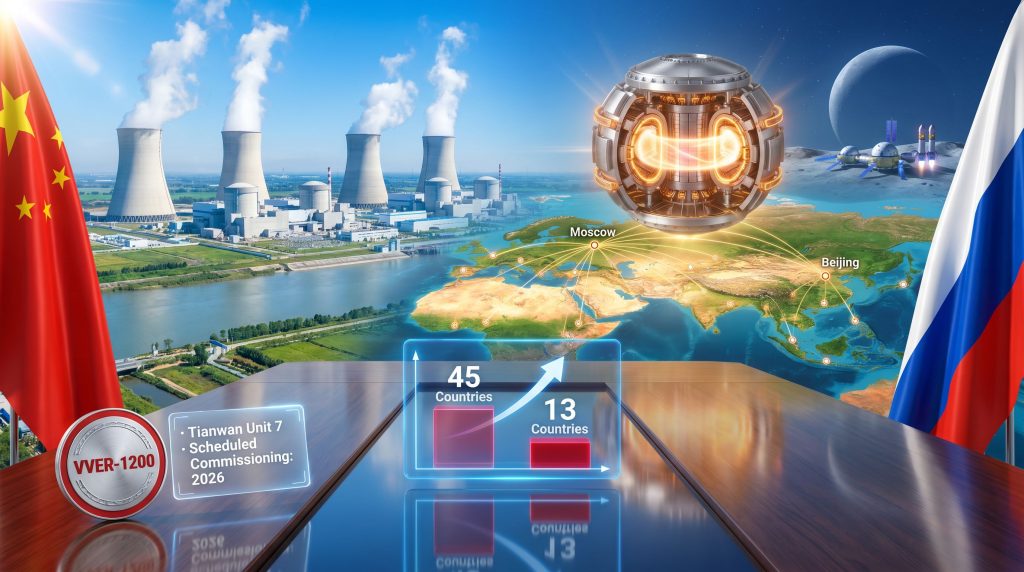
The scale of China and Russia's nuclear export diplomacy becomes clearest when viewed comparatively. According to Third Way's nuclear diplomacy research, Russia holds hard nuclear agreements with approximately 45 countries, making it the world's most active nuclear export partner by that measure. China holds hard agreements with approximately 13 countries, a number that is growing rapidly, with momentum concentrated in the Global South.
| Dimension | Western Vendors (US / France / South Korea) | China and Russia (Rosatom / CNNC) |
|---|---|---|
| Financing Model | Primarily market-based, export credit agencies | State-backed, often concessional financing |
| Bundling | Partial (reactor and some fuel) | Full package (reactor, fuel, training, waste, grid) |
| Speed to Agreement | Regulatory and political complexity slows deals | State-to-state MoUs enable faster commitment |
| Technology Scope | Primarily Gen III+ light water reactors | Gen III+, fast reactors, SMRs, fusion R&D |
| Standards Influence | IAEA-aligned, Western regulatory frameworks | Bilateral standards, potential divergence from IAEA norms |
The gap between Western and Sino-Russian nuclear export activity has widened considerably since approximately 2015. The structural advantage held by state-backed vendors is not primarily technological. It is financial and institutional. Rosatom and China National Nuclear Corporation can offer concessional financing, government-to-government commitment speed, and full-lifecycle packages that private-sector or partially privatised Western vendors simply cannot match through standard commercial mechanisms.
How Full-Package Deals Create Long-Term Dependency
When a developing nation accepts a full-package nuclear deal, it is not simply purchasing a power plant. It is entering a relationship that will span 60 to 80 years of reactor operation, potentially covering:
- Initial fuel supply and enrichment services from the vendor nation
- Operational and maintenance training shaped by the vendor's technical standards
- Waste management and spent fuel handling protocols aligned with the vendor's frameworks
- Regulatory advisory relationships that embed the vendor's safety norms into the host nation's regulatory infrastructure
- Potential extension agreements for new reactor units built to the same design standard
This bundling logic explains why nuclear MoUs carry geopolitical weight far exceeding their immediate commercial value. Countries that build their first reactor on a Russian or Chinese design frequently find that their regulatory frameworks, workforce training pipelines, and fuel procurement relationships become structurally aligned with the vendor nation for the lifetime of that asset and often beyond. Furthermore, critical minerals and energy security considerations intensify this dependency dynamic for recipient nations.
Emerging Markets and the First-Build Opportunity
Southeast Asia, Africa, and Central Asia as Nuclear Frontiers
The most consequential competition in nuclear export diplomacy is not between established nuclear nations. It is for the first-build programmes of countries that have never operated a commercial reactor before. These first-build relationships are disproportionately valuable because they set the technical, regulatory, and supply chain standards for everything that follows.
Indonesia represents one of the most closely watched cases. The country has engaged with both Chinese and Russian vendors regarding small modular reactor options as part of its emerging first nuclear power programme, reflecting a broader pattern across Southeast Asia. Consequently, nuclear power agreements between governments and both China and Russia are being signed with increasing frequency across the region. Energy demand growth, decarbonisation pressure, and energy security concerns are converging to accelerate nuclear consideration across Africa and Central Asia as well.
The next major ASX story will hit our subscribers first
Fusion Cooperation: The Long Game
Why Bilateral Fusion Agreements Matter Beyond ITER
The fusion MoUs signed in May 2026 sit within a broader international fusion landscape anchored by the ITER project in France, in which both China and Russia are participating members. However, bilateral fusion cooperation agreements serve a different function from multilateral programmes. They allow nations to pursue specific technology pathways, share proprietary research data, and develop joint intellectual property outside the more diffuse governance structure of a 35-nation project.
For both China and Russia, maintaining parallel bilateral and multilateral fusion tracks is a deliberate strategy. If fusion energy reaches commercial viability, the nation or partnership that controls the dominant reactor design, the enabling materials science, or the tritium breeding technologies will hold an energy technology advantage comparable to early dominance in fission reactor design.
Rosatom's leadership has characterised this bilateral fusion commitment as a determination to move forward together and secure leadership in fundamental technology areas, language that frames fusion cooperation explicitly as a competitive strategic objective rather than a purely scientific endeavour.
Quantum and Photonic Technologies: The Overlooked Dimension
Less commented upon but notable is the inclusion of photonic and quantum technologies within the Rosatom-Chinese Academy of Sciences MoU. These fields are not traditionally nuclear but their inclusion alongside nuclear fusion, nuclear medicine, and accelerator technology points to a broader conception of strategic science infrastructure cooperation. It uses the nuclear relationship as an institutional vehicle for advancing collaboration across multiple frontier technology domains simultaneously.
Nonproliferation Architecture Under Pressure
Can Technical Cooperation Be Compartmentalised?
The deepening of China and Russia nuclear MoUs raises genuine questions about whether multilateral nuclear governance mechanisms, centred primarily on the IAEA, can continue to function effectively in an environment of intensifying strategic competition between nuclear-armed blocs. IAEA safeguards apply to civilian nuclear facilities regardless of bilateral cooperation arrangements, but their effectiveness depends on access, information sharing, and cooperative relationships that become more difficult to maintain as geopolitical tensions rise.
Some policy institutions, including Brookings, have argued that compartmentalising nuclear security cooperation from broader diplomatic disputes remains both possible and necessary. The reasoning is that certain technical domains, including reactor safety standards, radiological security, and export control coordination, carry such high stakes for global security that they warrant continued engagement even where broader strategic relationships are adversarial. Whether that compartmentalisation is politically sustainable over the medium term remains one of the more difficult open questions in nuclear governance.
The Russian uranium import ban enacted by the US Senate, for instance, illustrates precisely how geopolitical tensions can fracture previously stable nuclear supply relationships, adding further complexity to any assumption of continued compartmentalisation.
Near-Term Market Implications and Strategic Scenarios
What the 2026-2028 Commissioning Window Means for Energy Markets
The commissioning of four VVER-1200 units between 2026 and 2028 will add meaningful capacity to China's nuclear fleet and generate sustained demand for Russian enriched uranium fuel, enrichment services, and operational support. This creates a durable commercial relationship that reinforces the strategic one, as China's growing nuclear fleet becomes increasingly integrated with Russian fuel cycle infrastructure.
The distribution of global uranium reserves across multiple jurisdictions adds another layer of complexity to how these supply chains will be managed through this commissioning window. Looking further out, three broad scenarios shape how China-Russia nuclear cooperation may evolve through 2035:
Scenario A – Deepening Integration: Both nations successfully co-develop and begin exporting joint fast reactor and SMR designs, establishing a new global nuclear technology standard that directly competes with Western Generation IV programmes and creates a cohesive alternative nuclear supply ecosystem.
Scenario B – Parallel Development: Each nation advances its own nuclear programme with MoUs maintained primarily for political signalling, with cooperation remaining in science and training rather than converging on shared commercial technology platforms.
Scenario C – Selective Re-engagement: Western nations pragmatically re-engage with China and Russia on specific nonproliferation and safety standards issues, producing a bifurcated global nuclear governance architecture where technical cooperation coexists with strategic competition.
The China and Russia nuclear MoUs signed in May 2026 do not predetermine which scenario unfolds. However, they do establish the institutional architecture, the workforce pipelines, the research relationships, and the commercial dependencies through which deeper integration would become possible if both governments choose to pursue it. In nuclear energy, as in few other industries, the agreements signed today shape the energy infrastructure, the regulatory norms, and the geopolitical alignments of the next half-century.
This article reflects publicly available information as of May 2026. Projections and scenario analyses represent analytical frameworks and should not be interpreted as financial or investment advice. Readers are encouraged to consult primary sources including World Nuclear News, Third Way's nuclear diplomacy mapping research, and the World Nuclear Association's country profiles for updated information.
Want to Identify the Next Major Commodity Discovery Before the Broader Market?
Discovery Alert's proprietary Discovery IQ model delivers real-time alerts on significant ASX mineral discoveries — including uranium — instantly transforming complex data across 30+ commodities into clear, actionable insights for both short-term traders and long-term investors. Explore how historic mineral discoveries have generated extraordinary returns and begin your 14-day free trial today to position yourself ahead of the market.