May 21, 2026
The Engineering Phase That Separates Resource Estimates from Real Mines
Most uranium deposits never become mines. The gap between a published resource estimate and a bankable feasibility study is where projects either prove their worth or quietly disappear from investor attention. Eagle investigative drilling at Oregon uranium site represents precisely the kind of purposeful, engineering-phase work that crosses this gap. It demands geotechnical data, metallurgical samples, hydrogeological measurements, and resource classification upgrades gathered through multi-objective drilling programs designed to answer engineering questions rather than geological ones.
This distinction sits at the heart of what Eagle Nuclear Energy is undertaking at its Aurora Uranium Project along the Oregon-Nevada border, where the company has announced a 27,000-foot investigative drill program scheduled to begin in July 2026. Understanding why this program matters requires looking beyond the headline footage and into the technical architecture of what the company is actually trying to accomplish.
When big ASX news breaks, our subscribers know first
Why U.S. Uranium Development Is Entering a Critical Phase
The Domestic Supply Gap and the Structural Vulnerability It Creates
The United States operates the world's largest fleet of commercial nuclear reactors, collectively requiring approximately 40 to 50 million pounds of U₃O₈ annually. Yet domestic mine production has satisfied only a fraction of that demand for decades, with the country relying heavily on imports from Kazakhstan, Canada, Australia, Russia, and Uzbekistan to keep its reactors fuelled. The uranium supply-demand outlook for the U.S. is, consequently, a matter of increasing strategic concern.
This structural dependence is not a recent development. It is the product of a prolonged period of low uranium prices following the Cold War, during which domestic mines became economically unviable and exploration investment migrated to lower-cost jurisdictions. The result is that America finds itself in the unusual position of being a major uranium consumer with relatively limited active domestic supply infrastructure.
The contrast between conventional hard-rock uranium mining and in situ recovery (ISR) methods is worth understanding here. ISR involves pumping a chemical solution through a porous uranium-bearing ore body underground, recovering the dissolved uranium without bringing rock to the surface. Furthermore, while ISR dominates current U.S. production due to its lower capital requirements and simpler permitting profile, it is only viable in specific geological settings. Conventional deposits like Aurora, which are hosted in different geological environments, cannot use this method and require traditional mining approaches.
What Is the Aurora Uranium Project and Why Does Its Scale Matter?
Geographic and Geological Context
The Aurora Uranium Project sits along the Oregon-Nevada border corridor, located west of McDermitt, Nevada. The McDermitt region is no stranger to exploration attention. The broader area is underlain by caldera-related volcanic geology that has historically concentrated a range of critical minerals, and its uranium endowment has drawn periodic exploration interest dating back to the mid-twentieth century.
What distinguishes Aurora from a geological perspective is its classification as a conventional uranium deposit rather than an ISR-amenable system. This means the mineralisation occurs in a form and host rock setting that would require conventional mining methods, either open pit or underground depending on geometry and depth, to extract economically. For additional context, Aurora Energy Metals has published updated project information that outlines the deposit's broader development parameters.
Aurora's Resource Estimate in Context
The resource scale at Aurora is what places it in a category of national significance within the U.S. uranium development pipeline:
| Resource Category | Volume (Pounds U₃O₈) | Basis |
|---|---|---|
| Indicated Resource | 32.75 million lbs | 675 historical drillholes |
| Inferred Resource | 4.98 million lbs | Peripheral and deeper zones |
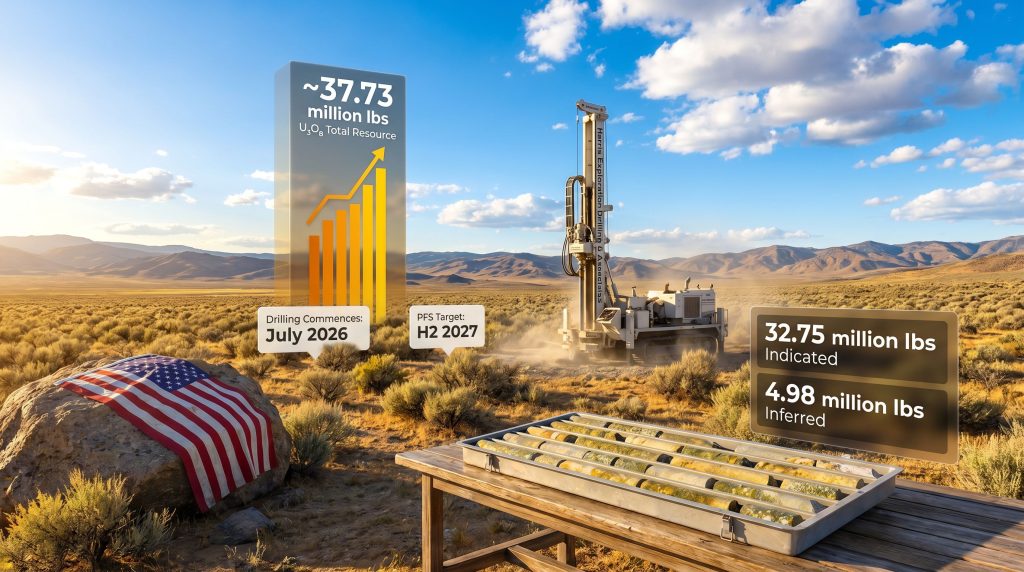
| Total Resource Base | ~37.73 million lbs | Combined estimate |
This positions Aurora as the largest conventional measured and indicated uranium deposit in the United States, a designation that carries real weight when considered against the scale of domestic reactor demand. The resource estimate is built on a foundation of 675 historical drillholes, the majority of which were completed prior to 1980 during earlier uranium exploration cycles.
This historical data depth is both an asset and a limitation. It establishes geological confidence in the deposit's existence and scale, but pre-1980 drilling practices did not capture the geotechnical, metallurgical, or hydrogeological sample quality needed for modern engineering studies. That is precisely the gap the current program is designed to close.
Disclaimer: Resource estimates are geological assessments and do not guarantee economic viability or future production. Indicated and inferred resource classifications carry different levels of geological confidence under reporting standards such as NI 43-101 and SK-1300. This article does not constitute financial advice.
How Does Investigative Drilling Differ from Exploration Drilling?
The Engineering-Phase Distinction
The terminology used to describe drilling programs reveals a great deal about where a project sits in its development lifecycle. Exploration drilling is discovery-oriented. Its primary goal is identifying mineralisation, mapping deposit geometry, and establishing that a resource exists. However, investigative drilling operates at the engineering phase. The deposit's existence is already established, and the objective shifts entirely toward collecting data required to design a mine and satisfy the technical inputs demanded by a pre-feasibility study. Interpreting drill results at this stage demands a fundamentally different analytical lens than exploration-phase assessment.
Key Insight: When a company with 675 historical drillholes announces a new 47-hole program, the question is not whether they are still looking for uranium. They are collecting a fundamentally different category of information than what historical holes provide.
The Five Technical Objectives of Eagle's 27,000-Foot Program
Eagle investigative drilling at Oregon uranium site is structured to address five concurrent technical priorities, each of which feeds directly into the pre-feasibility study:
- Resource expansion – Testing the lateral and depth extensions of known mineralised zones to assess whether the resource footprint can be grown ahead of the PFS.
- Resource classification enhancement – Upgrading inferred material to indicated or measured categories by infilling drill spacing to meet the density thresholds required under reporting standards.
- Metallurgical characterisation – Collecting oriented core samples for laboratory processing tests to determine uranium recovery rates under different processing conditions.
- Rock mechanics and geotechnical assessment – Measuring physical properties of the host rock, including compressive strength, fracture frequency, and structural integrity.
- Hydrogeological analysis – Understanding the groundwater regime within and around the deposit for dewatering system design and environmental permitting.
Why Diamond Core Drilling Is the Method of Choice
The program will use 47 diamond drill holes across the full 27,000-foot footage. Diamond core drilling recovers a continuous cylindrical sample of intact rock, unlike rotary or reverse circulation methods that produce fragmented chips. In addition, this matters because geotechnical testing requires unbroken core to measure structural properties accurately, and metallurgical testing requires sufficient sample mass of known spatial origin. The additional cost of diamond drilling over faster rotary methods is justified by the data density it provides per hole.
Program Timeline, Permitting, and Operational Structure
Regulatory Approvals: The Dual-Permit Framework
Before a single drill bit engages with the Oregon ground surface, Eagle must secure approvals from two separate regulatory bodies:
- Bureau of Land Management (BLM): Federal authorisation is required because the Aurora site sits on federal land administered by the BLM, which evaluates surface disturbance plans, reclamation bonding, water use provisions, and compliance with the National Environmental Policy Act framework.
- Oregon Department of Geology and Mineral Industries (DOGAMI): Oregon's state-level mining regulatory body requires a separate exploration permit addressing state-specific environmental protection requirements, site reclamation obligations, and disturbance thresholds.
The requirement to satisfy both a federal and a state permitting process simultaneously reflects the multi-jurisdictional complexity inherent in western U.S. mineral development. The table below illustrates how different western jurisdictions compare:
| Jurisdiction | Key Regulatory Bodies | Notable Considerations |
|---|---|---|
| Oregon (Aurora) | BLM + DOGAMI | State-level mining oversight; less established uranium track record |
| Wyoming | BLM + Wyoming DEQ | Historically active ISR framework; well-established timelines |
| Utah/Colorado | BLM + State agencies | Conventional mining history; NRC and Agreement State licensing |
| Nevada | BLM + NDEP | Active mining state; established permitting infrastructure |
Milestone Timeline from Drill to PFS
| Milestone | Estimated Date |
|---|---|
| Permit Applications Submitted | Pre-July 2026 |
| Drilling Services Agreement Signed | Confirmed (Harris Exploration Drilling & Associates) |
| Field Drilling Program Commences | July 2026 |
| Field Program Completion | Q3-Q4 2026 |
| Data Compilation and Analysis | Q4 2026 – Q1 2027 |
| Pre-Feasibility Study Completion | H2 2027 |
The engagement of Harris Exploration Drilling & Associates as the drilling contractor reflects a deliberate operational decision. Contractor selection at the investigative drilling stage carries greater technical significance than at the greenfield exploration stage, since the quality of core recovery and sample handling procedures directly affects the reliability of geotechnical and metallurgical test results.
What a Pre-Feasibility Study Actually Requires
From Resource to Bankable Study: The Data Hierarchy
The mine development pathway follows a staged progression, and understanding where Aurora sits within it clarifies why the current drill program is a pivotal event rather than routine fieldwork. Completing a definitive feasibility study ultimately requires working through each of the following stages:
- Mineral Resource Estimate – Geological confidence in the deposit's size and grade. Aurora already has this.
- Pre-Feasibility Study (PFS) – Conceptual mine and process design supported by enough technical data to estimate capital and operating costs within a defined accuracy range, typically plus or minus 25 to 30 per cent.
- Feasibility Study – Bankable-grade engineering with sufficient accuracy for financing and construction decisions.
- Construction Decision – Final investment decision based on feasibility outcomes.
A PFS cannot be completed using resource data alone. It requires a defined mining method, preliminary process flowsheet with metallurgical recovery estimates, geotechnical parameters, a hydrogeological dewatering concept, and preliminary infrastructure and capital cost inputs. The current investigative drill program is specifically structured to generate all of these inputs simultaneously.
Technical Callout: A common misconception among lay investors is that a large resource estimate implies mine development is imminent. In reality, the resource estimate represents only the first stage of a multi-year technical de-risking sequence. The PFS is the milestone that converts a geological asset into a project with defined engineering parameters and a preliminary economic case.
The next major ASX story will hit our subscribers first
Aurora Within the Broader U.S. Uranium Supply Picture
The Processing and Conversion Pathway
Uranium extracted from a conventional mine does not go directly to a reactor. The ore undergoes crushing and leaching on site or at a nearby mill to produce yellowcake (U₃O₈), which is then shipped to a conversion facility where it becomes uranium hexafluoride (UF₆). The limited number of licensed conversion and enrichment facilities operating within the United States adds a layer of infrastructure consideration to any domestic mining project's commercial case.
Understanding the broader uranium market dynamics at play is essential when assessing Aurora's longer-term positioning, particularly given the capital and logistical costs associated with transporting uranium-bearing material to processing facilities.
Positioning Aurora in the Competitive Development Queue
With a PFS target completion date in the second half of 2027, Aurora would sit among the more advanced conventional uranium development projects in the U.S. pipeline if that timeline is achieved. Most competing domestic projects remain at earlier resource-stage work, and the number of conventional uranium projects with sufficient resource scale to supply meaningful volumes to the domestic market is genuinely limited. Consequently, the drill results interpretation from the 2026 programme will be closely watched by market participants tracking domestic supply development.
Speculative note: If the pre-feasibility study delivers favourable economics and the uranium price environment remains supportive, Aurora could potentially attract utility off-take interest during the feasibility study phase. However, this outcome depends on multiple variables including permitting progression, processing infrastructure access, and capital availability, none of which are certain at this stage.
Frequently Asked Questions: Eagle's Aurora Uranium Drilling Program
What is investigative drilling and how does it differ from exploration drilling?
Investigative drilling is an engineering-phase activity conducted after a mineral resource has already been defined. Rather than searching for mineralisation, it collects the specific data types needed to design a mine and processing facility, including geotechnical rock samples, metallurgical test material, and hydrogeological measurements. Exploration drilling, by contrast, is discovery-oriented and focused on identifying and delineating a resource.
How large is Aurora's uranium resource?
The deposit holds an indicated resource of 32.75 million pounds U₃O₈ and an inferred resource of 4.98 million pounds U₃O₈, giving a combined resource base of approximately 37.73 million pounds. This makes it the largest conventional indicated uranium deposit in the United States. Indicated resources carry higher geological confidence than inferred resources and are closer to the level of certainty required for mine planning.
When will the drill program begin and when is the pre-feasibility study expected?
Field drilling is scheduled to commence in July 2026, with completion expected within three to four months. Eagle investigative drilling at Oregon uranium site is targeting pre-feasibility study completion in the second half of 2027.
What permits must be obtained before drilling begins?
Eagle requires authorisation from both the Bureau of Land Management for federal land access and the Oregon Department of Geology and Mineral Industries for the state-level exploration permit. Both agencies review surface disturbance plans, environmental impacts, reclamation obligations, and water use provisions.
Why does a project with 675 existing drillholes need additional drilling?
Historical drillholes completed before 1980 were designed to identify and delineate uranium mineralisation, not to collect engineering-grade data. Modern pre-feasibility studies require core samples suitable for geotechnical laboratory testing, metallurgical processing trials, and in-hole hydrogeological measurements, none of which were systematically collected during earlier exploration campaigns. The new holes use diamond core drilling techniques that preserve sample integrity for these specific analytical purposes.
This article is intended for informational purposes only and does not constitute financial or investment advice. Mining and resource development involves significant technical, regulatory, and market risks. Readers should conduct their own due diligence before making any investment decisions. Resource estimates and project timelines referenced herein are based on publicly available information and are subject to change. For ongoing coverage of U.S. uranium fuel cycle developments, the American Nuclear Society's nuclear news provides independent tracking of the sector. Additional technical detail on the Aurora project's SK-1300 compliant resource estimate can be found in Eagle's published technical report.
Want to Know When the Next Major Uranium Discovery Hits the ASX?
Discovery Alert's proprietary Discovery IQ model scans ASX announcements in real time, instantly identifying significant mineral discoveries — including uranium — and delivering actionable alerts to subscribers before the broader market has time to react. Explore historic examples of major discovery returns and begin your 14-day free trial today to position yourself ahead of the next significant find.