May 21, 2026
The Geology That Makes Ultra-High-Grade Uranium So Rare — and Why Hurricane's Boundaries Are Still Being Redrawn
Uranium deposit economics are determined less by total tonnage than by concentration. A deposit grading 34.5% U₃O₈ requires a fraction of the infrastructure, haulage, and processing capacity that a deposit at 0.1% demands to deliver the same amount of finished product. That single fact reframes how investors, geologists, and mine planners think about the Athabasca Basin in northern Saskatchewan — a jurisdiction where geological conditions created something the rest of the world's uranium provinces simply cannot replicate. Understanding why grade matters this much, and why even the world's highest-grade deposits often carry meaningful uranium beyond their officially mapped limits, is the starting point for evaluating what the IsoEnergy Hurricane uranium deposit expansion actually represents.
When big ASX news breaks, our subscribers know first
Why Ultra-High-Grade Uranium Forms Where It Does
The Athabasca Basin's extraordinary grade profile is not accidental. It is the product of a specific geological mechanism repeated across the eastern and western margins of the basin over hundreds of millions of years.
Uranium-rich hydrothermal fluids migrated through deep basement fault systems and concentrated at the unconformity contact between overlying Proterozoic sandstone and underlying crystalline basement rock. This contact zone created the chemical and physical conditions — changes in oxidation state, temperature, and permeability — that caused dissolved uranium to precipitate out of solution in narrow, extremely high-grade pods rather than dispersing through large volumes of rock.
The result is mineralisation that looks nothing like the disseminated or bulk-tonnage deposits found elsewhere globally. Instead of broad, low-grade halos, Athabasca deposits form tight, structurally controlled concentrations along fault corridors. Those faults branch, offset, and extend in irregular patterns — which means no single early-stage drilling programme, regardless of how well-designed, captures the full structural extent of the system. Furthermore, uranium supply and demand dynamics in 2025 have made understanding these geological nuances more commercially critical than ever.
How Hurricane Compares to Basin and Global Benchmarks
The grade differential between the Hurricane deposit and even the basin's established producing mines is substantial:
| Deposit / Region | Approximate Grade (U₃O₈) | Mine Status |
|---|---|---|
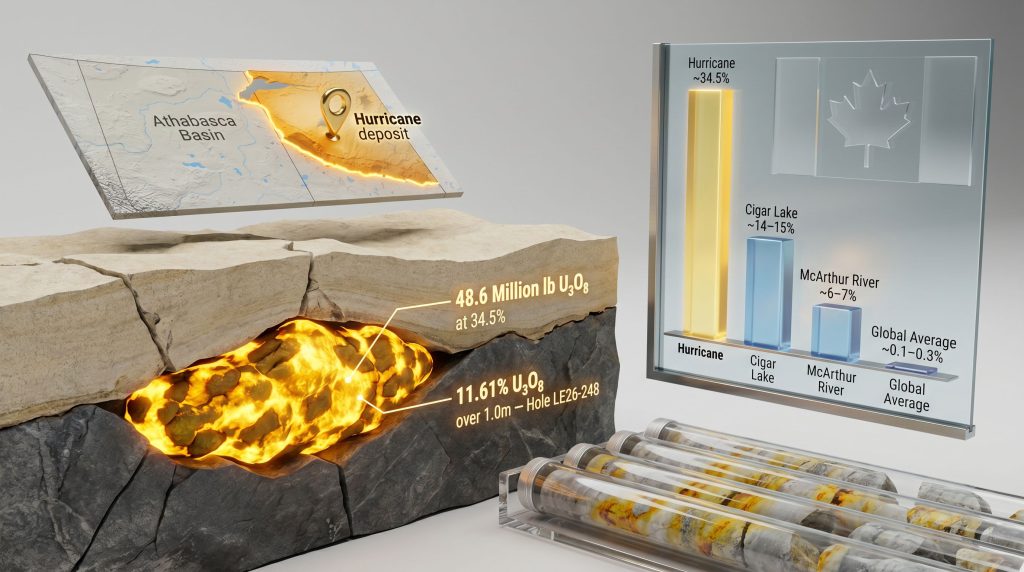
| Hurricane, Larocque East | ~34.5% (indicated resource) | Pre-production |
| Cigar Lake, Saskatchewan | ~14–15% | Operating |
| McArthur River, Saskatchewan | ~6–7% | Operating |
| Global average mine grade | ~0.1–0.3% | Various |
Sources: Cameco corporate disclosures; IsoEnergy 2022 Technical Report; World Nuclear Association
According to Cameco's published operational data, Athabasca Basin uranium grades run approximately 100 times higher than the global mine average. Hurricane's indicated resource grade sits more than twice as high as Cigar Lake, the basin's benchmark high-grade producer. This is not a marginal advantage — it represents an entirely different order of magnitude in terms of ore concentration and processing efficiency.
The current resource stands at an indicated mineral resource of 48.6 million lb U₃O₈ at 34.5%, alongside an inferred component of 2.7 million lb at 2.2% U₃O₈, as reported in IsoEnergy's technical disclosures. The grade divergence between the indicated and inferred portions reflects the geological complexity of a fault-hosted system where peripheral zones carry lower confidence and lower average concentration than the central, well-drilled core.
How Resource Boundaries Are Set — and Why They Often Understate Reality
A critical distinction that many investors overlook is the difference between where uranium ends and where the drill programme ended. These are not the same thing, but under Canadian National Instrument 43-101 standards, only the former is permitted to appear in a published resource estimate — and it can only be defined as far as physical drilling has confirmed.
Why Drill Density Determines the Map's Edge
Early-stage programmes concentrate investment on the richest, most accessible central zones. Peripheral fault strands, particularly those branching away from the primary corridor, receive proportionally less attention because their contribution to the known resource is uncertain and their drilling cost is identical to any other location on the property.
This creates a structural pattern across the Athabasca Basin: multiple established deposits were originally delineated under programmes with lower drill density than current standards, and their mapped boundaries were drawn conservatively where drilling thinned out — not where geology suggested mineralisation stopped.
As uranium prices have increased and structural interpretation has improved through reprocessed geophysical datasets and updated fault modelling, the economics of systematic boundary testing have shifted. Revisiting underdrilled peripheral zones in a known high-grade system carries lower geological risk than greenfield exploration, while offering resource growth from ground a company already controls. In addition, understanding uranium market dynamics helps contextualise why these boundary-testing programmes are receiving increased investor attention.
Infill vs. Step-Out vs. Structural Targeting: Understanding the Toolkit
| Drilling Type | Primary Purpose | Value Mechanism |
|---|---|---|
| Infill drilling | Increases confidence between known intercepts | Upgrades inferred to indicated classification |
| Step-out drilling | Tests mineralisation beyond mapped boundaries | Expands total resource footprint |
| Structural targeting | Tests reinterpreted fault strands | Potentially identifies new corridors |
Each approach serves a different function in the resource growth process. What IsoEnergy's 2026 winter programme achieved at Hurricane falls primarily into the step-out and structural targeting categories — extending the search into a fault corridor that previous programmes had not systematically tested. Properly interpreting drill results is therefore essential for investors assessing the significance of each hole.
What the 2026 Winter Drilling Program Found at the Hurricane South Trend
The most consequential result from IsoEnergy's 2026 winter programme came from hole LE26-248, which intersected 4.21% U₃O₈ over 3.5 metres, including a higher-grade core interval of 11.61% U₃O₈ over 1.0 metre. To put those numbers in context, the higher-grade core interval alone sits at a concentration more than 38 times the grade of Cigar Lake's resource.
The significance of this result is inseparable from its location. The intersection sits along the southernmost known fault strands within the Hurricane fault zone — an area that received materially less historical drilling than the northern fault strands hosting the main resource body. Because of that lower drill density, the existing resource model had assigned predominantly low-grade classification to this southern corridor. The LE26-248 result challenges that classification fundamentally.
IsoEnergy's exploration team confirmed the geological importance of the intersection's position through Vice President of Exploration Dan Brisbin, the project's designated Qualified Person under NI 43-101. He noted that additional step-out holes to the east — specifically LE26-243 and LE26-234 — also intersected uranium across multiple spatially separated points, collectively defining the Hurricane South Trend as a newly identified mineralised corridor distinct from the main resource body.
Why Corroboration Is the Critical Threshold
A single anomalous intercept, regardless of its grade, does not establish a trend. The geological and regulatory significance of the 2026 winter results lies in the combination of three distinct data points:
- LE26-248 demonstrating above-prediction grades in the southern fault strands
- LE26-243 confirming uranium to the east of that intersection
- LE26-234 providing a third spatially separated data point along the same corridor
Multi-point confirmation across separate drill holes establishes spatial extent — the first prerequisite for demonstrating the continuity that NI 43-101 requires before new material can enter a formal resource estimate.
Hurricane's Current Physical Dimensions
The deposit as currently defined spans approximately 550 metres along strike with an average width of roughly 40 metres and thickness reaching up to 10 metres. Critically, the deposit remains open for expansion in both strike directions and at depth — a descriptor that, combined with the South Trend results, suggests the 550-metre strike length may represent a conservative current measurement rather than the system's true extent.
The Regulatory Pathway from Drill Result to Resource Addition
Understanding why IsoEnergy cannot simply announce an expanded resource following the winter results requires a working knowledge of NI 43-101's continuity requirement. Under this standard, mineralisation must be demonstrated to persist continuously between drill holes before a Qualified Person can incorporate it into a formal resource estimate. Isolated intercepts, whatever their grade, require follow-up confirmation before reclassification occurs.
Three sequential conditions must be satisfied before the Hurricane South Trend results can appear in updated resource figures:
- Spatial continuity confirmed — follow-up holes must demonstrate uranium persists between the winter 2026 intercepts without significant grade interruption across the trend
- Qualified Person validation — all data must be reviewed and formally certified by a designated QP meeting NI 43-101 requirements
- Updated technical report — a revised resource estimate must be completed and published before any new material enters the official deposit total
IsoEnergy's announced summer 2026 programme of approximately 20 holes over 8,000 metres targeting the Hurricane South Trend is specifically designed to satisfy condition one. The programme also includes secondary targets east of the current resource footprint that were identified through structural reinterpretation during the 2024 and 2025 field seasons.
Infrastructure Economics: Why Processing Access Defines Project Viability
Grade and resource size are only two components of a uranium project's economic case. A third factor — often underweighted in early-stage analysis — is proximity to licensed processing infrastructure. Uranium ore cannot be sold in its extracted form. It must first be processed at a licensed mill to produce uranium oxide concentrate, known commercially as yellowcake, before it has commercial value.
Constructing a new uranium mill in a remote northern jurisdiction is not simply expensive — it is time-prohibitive. The regulatory approval process alone can extend across years, and capital requirements for remote-location construction are substantial enough that most pre-production deposits cannot independently justify the investment.
Hurricane's Processing Advantage
The Larocque East project sits within practical trucking distance of the McClean Lake mill, operated by Orano Canada. This facility holds an existing processing licence and has been operating as part of the eastern Athabasca Basin's uranium production infrastructure for decades. Access to it removes what would otherwise be one of the most capital-intensive and time-consuming requirements in any path to production.
This advantage is not universally available across the basin. It represents a genuine structural differentiator for projects in the eastern corridor.
Depth Comparison: Why Shallower Mineralisation Matters
| Deposit | Approximate Depth to Mineralisation | Mining Complexity Implication |
|---|---|---|
| Hurricane, Larocque East | Shallower than basin producers | Lower shaft costs, simpler ground support |
| Cigar Lake | ~450–500 metres | Jet boring / ground freeze required |
| McArthur River | ~500–640 metres | Raise bore / remote mining methods |
Hurricane's shallower mineralisation profile relative to both operating basin mines has meaningful implications for extraction cost and method selection. Shallower deposits require less shaft sinking investment and simpler ground support engineering, reducing pre-production capital requirements. The deposit also sits along the same regional basement structure hosting high-grade uranium on an existing Cameco and Orano joint venture, validating the geological model that underpins exploration at Larocque East.
The next major ASX story will hit our subscribers first
The Supply Gap That Makes Basin Resource Expansion Strategically Important
The World Nuclear Association's 2025 Nuclear Fuel Report projects global uranium demand could more than double by 2040, while several of the world's largest high-grade producing mines are forecast to wind down through the 2030s.
The critical challenge this creates is not geological — it is temporal. New uranium mines require between 10 and 20 years from discovery to first production under current regulatory and construction frameworks. Consequently, projects advancing resource definition today are the supply candidates for the 2035–2045 demand window, not the present decade. The uranium supply deficit expected to materialise over this period makes early-stage resource expansion programmes strategically significant beyond their immediate drilling metrics.
This timeline dynamic fundamentally shifts the relative value of expanding an established, already-drilled deposit in a licensed jurisdiction compared to pursuing greenfield discovery in a new area. The former starts with known geology, existing permits, and established community relationships. The latter starts from zero on every dimension.
Saskatchewan's Position as an Investment Destination
| Jurisdiction Factor | Saskatchewan Assessment |
|---|---|
| Fraser Institute 2026 Mining Attractiveness | Top-tier globally |
| Regulatory framework | Established NI 43-101 / provincial regime |
| Processing infrastructure | McClean Lake, Key Lake mills operational |
| Mine development labour pool | Established uranium mining workforce |
| Indigenous consultation | Established provincial protocol frameworks |
The Fraser Institute's 2026 mining survey reinforced Saskatchewan's position among the world's most attractive jurisdictions for resource investment — a ranking based on regulatory transparency, geological prospectivity, and infrastructure availability rather than any project-specific factor.
How Investors Should Evaluate Uranium Resource Expansion Announcements
Not all high-grade drill intercepts carry equal analytical weight. Distinguishing genuinely material results from isolated anomalies requires a structured evaluation framework. In particular, drill results interpretation can meaningfully change how investors assess whether a new intercept represents a resource-defining moment or simply an isolated data point.
- Grade and width combination — Does the intercept deliver sufficient grade and thickness to be economically meaningful at the deposit scale, or is it a narrow high-grade sliver?
- Location context — Is the hole genuinely testing an extension of the system, or re-drilling ground already captured in the existing resource?
- Structural alignment — Does the result confirm a reinterpreted fault strand supported by geophysical data, or does it represent an unexplained anomaly?
- Multi-hole corroboration — Have spatially separated holes in the same programme confirmed the result is not isolated?
- Follow-up programme specificity — Has the company committed to a defined programme with stated hole counts and metres, or is follow-through left vague?
- Qualified Person attribution — Has a named QP formally reviewed and validated the data under applicable reporting standards?
Signal Quality Assessment
| Signal Type | Positive Indicator | Caution Flag |
|---|---|---|
| Drill result context | Step-out from underdrilled zone | Re-drill of previously known high-grade area |
| Corroboration | Multiple holes confirm spatial trend | Single isolated intercept |
| Follow-up commitment | Defined programme with hole count and metres | Vague reference to future drilling |
| QP attribution | Named QP with stated credentials | Anonymous or absent attribution |
| Resource trajectory | Defined path from inferred to indicated | Perpetual inferred classification |
The 2026 winter results at Hurricane score positively across most of these criteria: step-out location in an underdrilled zone, three-hole corroboration defining the South Trend, a quantified summer follow-up programme, and named QP sign-off. The remaining question — spatial continuity across the trend — is precisely what the summer 2026 campaign is structured to answer.
Frequently Asked Questions: IsoEnergy Hurricane Deposit Expansion
What is the current size of IsoEnergy's Hurricane uranium deposit?
The Hurricane deposit holds an indicated mineral resource of 48.6 million lb U₃O₈ at 34.5% grade, with an additional inferred component of 2.7 million lb at 2.2% U₃O₈, as stated in IsoEnergy's technical disclosures.
What grade did the standout 2026 winter drill hole return?
Hole LE26-248 intersected 4.21% U₃O₈ over 3.5 metres, including a higher-grade core of 11.61% U₃O₈ over 1.0 metre, from the southernmost fault strands in the Hurricane fault zone.
Why can't IsoEnergy immediately add winter results to the official resource?
Under NI 43-101 standards, mineralisation must demonstrate spatial continuity between drill holes before a Qualified Person can formally incorporate it into a resource estimate. The summer 2026 programme of approximately 20 holes over 8,000 metres is designed to test whether that continuity exists along the Hurricane South Trend.
What processing infrastructure does the project have access to?
Larocque East sits within trucking distance of the McClean Lake mill operated by Orano Canada — an existing licensed uranium processing facility that eliminates the need to construct new milling infrastructure.
How does Hurricane's depth compare to the basin's producing mines?
Hurricane's mineralisation is shallower than both Cigar Lake and McArthur River, allowing for simpler and less capital-intensive extraction methods relative to the basin's existing operations.
What does the global uranium demand outlook mean for projects like Hurricane?
The World Nuclear Association's 2025 Nuclear Fuel Report projects demand could more than double by 2040, while major producing mines face end-of-life timelines in the 2030s. Given that new mines require 10 to 20 years from discovery to production, projects advancing resource definition now are positioned for the demand window that matters most.
Resource Growth as a Structural Investment Thesis in High-Grade Uranium
The IsoEnergy Hurricane uranium deposit expansion story is ultimately about the gap between what early-stage geological mapping records and what the underlying mineralised system actually contains. That gap exists across multiple Athabasca Basin deposits, and it is being systematically closed as higher uranium prices make boundary testing economically rational, and as improved structural interpretation tools identify peripheral fault strands that earlier programmes passed over.
For a deposit already carrying the world's highest grade among similarly classified resources, the question of whether the southern fault strands host additional high-grade material is not peripheral to the investment thesis — it sits at its centre. The combination of exceptional grade, shallower depth than basin peers, proximity to licensed processing infrastructure, and Saskatchewan's top-tier regulatory environment creates a convergence of technical and economic attributes that few uranium projects globally can assemble across all four dimensions simultaneously.
The summer 2026 drilling programme will not resolve the full picture, but it will answer the most pressing geological question: does the Hurricane South Trend represent a genuine, continuous extension of one of the world's most significant uranium systems, or an encouraging but disconnected cluster of results? That answer, when it arrives, will carry significant weight for anyone tracking the long-term supply mathematics of the global uranium market.
Disclaimer: This article is for informational purposes only and does not constitute financial or investment advice. Resource estimates, drill results, and demand projections referenced herein are subject to inherent uncertainties. Readers should conduct their own due diligence and consult a qualified financial adviser before making investment decisions. Forward-looking statements, including demand forecasts and development timelines, involve assumptions that may not prove accurate.
Want to Identify the Next Major Uranium Discovery Before the Broader Market Does?
Discovery Alert's proprietary Discovery IQ model delivers real-time alerts on significant ASX mineral discoveries — including high-grade uranium opportunities — turning complex geological data into actionable insights for both short-term traders and long-term investors. Explore historic examples of exceptional mineral discovery returns and begin your 14-day free trial at Discovery Alert to position yourself ahead of the market.