July 27, 2026
China's steel industry transformation represents a pivotal shift in global manufacturing dynamics, with the China steel output regulation 2026-2030 framework establishing unprecedented production controls that will reshape international commodity markets. This policy evolution extends far beyond domestic industrial planning to influence global supply chains, infrastructure development costs, and strategic resource relationships across multiple continents.
What Does China's Extended Steel Output Control Mean for Global Markets Through 2030?
The global steel landscape stands at a critical inflection point as structural overcapacity meets environmental imperatives across the world's largest producing regions. Market dynamics that have shaped commodity flows for decades now face unprecedented policy interventions, creating ripple effects that extend far beyond traditional supply-demand calculations. Understanding these transformative forces requires examining how industrial policy, carbon reduction mandates, and trade protection measures converge to reshape fundamental market structures.
Understanding the 15th Five-Year Plan's Industrial Restructuring Framework
China's commitment to steel output regulation through 2030 represents a continuation and expansion of policies initiated in 2021, when the world's largest steel producer froze production growth as part of broader carbon emission reduction efforts. The China steel output regulation 2026-2030 framework operates within the Fifteenth Five-Year Plan, marking a decisive shift from temporary demand management to permanent structural reform.
The National Development and Reform Commission has positioned this industrial restructuring as addressing what it terms an insufficient supply-demand balance in raw materials sectors. This characterisation suggests recognition that previous demand levels, particularly those driven by residential construction, will not return during the planning period. Furthermore, the policy framework emphasises supply-side reform through competitive consolidation rather than across-the-board production cuts.
Supply-Side Reform Acceleration and Market Consolidation Targets
The survival of the fittest approach promoted by Chinese planners indicates a fundamental shift in industrial policy philosophy. Rather than protecting employment through capacity preservation, the 2026-2030 framework actively encourages market-driven consolidation among steel producers. This represents acceptance that overcapacity resolution requires permanent capacity retirement rather than temporary production restraint.
Key indicators of this transformation include:
- Production trajectory: First 11 months of 2025 showed 4% year-over-year decline in crude steel output
- Capacity utilisation: Annual production tracking toward first sub-billion-ton total since 2019
- Market structure: Consolidation targeting elimination of less competitive producers
- Geographic distribution: Regional efficiency variations driving differential impact across provinces
However, the magnitude of this adjustment becomes clear when considering that China's steel output falling below 1 billion tons annually represents a structural break from growth patterns established over the past six years. This production level suggests demand destruction rather than temporary cyclical adjustment.
Carbon Emission Reduction Goals Driving Production Constraints
Environmental compliance requirements embedded within the China steel output regulation 2026-2030 framework extend beyond simple output limitations to encompass technology upgrading and energy efficiency improvements. The carbon intensity targets established in 2021 continue to influence production decisions, though specific emission reduction percentages for the 2026-2030 period have not been publicly detailed.
Steel production's carbon footprint creates particular challenges for China's broader climate commitments. Traditional steelmaking processes generate approximately 2 tons of CO2 per ton of crude steel produced, making the sector a critical focus for emission reduction efforts. Consequently, the production control policies serve dual purposes: managing overcapacity while advancing environmental objectives through forced technological modernisation.
When big ASX news breaks, our subscribers know first
How Will China's Steel Export Licensing System Reshape International Trade Dynamics?
Global trade patterns established over decades of Chinese steel export growth face fundamental disruption through the implementation of comprehensive licensing controls beginning in 2026. The scope and structure of these controls will determine whether international steel markets experience managed transition or acute supply disruption across multiple product categories and regional markets.
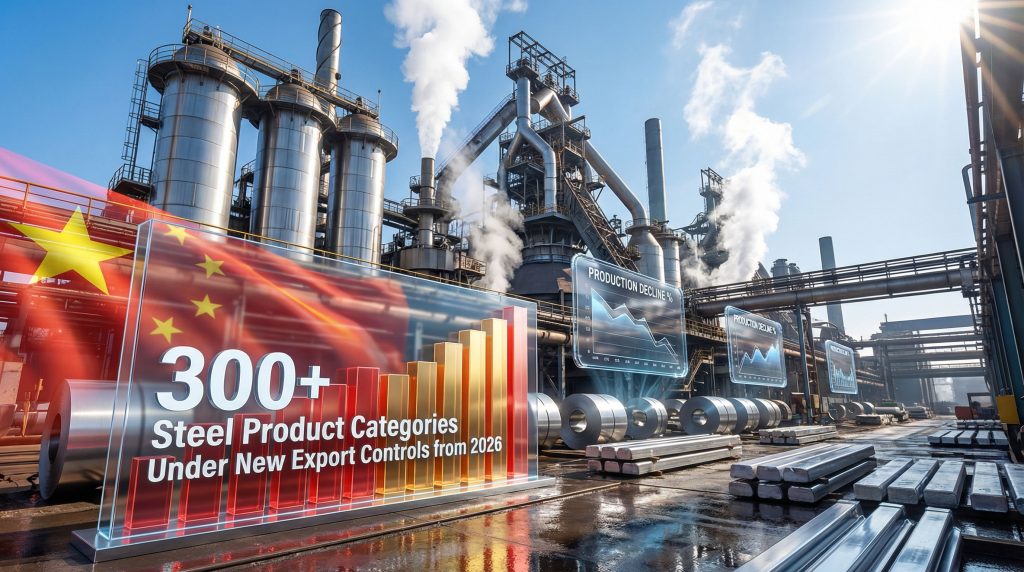
300+ Steel Product Categories Under New Export Controls from 2026
Beijing's December 2025 announcement of licensing requirements covering approximately 300 steel-related product categories represents the most comprehensive export control system implemented by China in the steel sector. The licensing framework, scheduled for implementation beginning in 2026, will regulate exports across the full spectrum of steel products from basic commodity grades to specialised alloys and finished products.
The technical scope of this system encompasses:
- Primary steel products: Hot-rolled and cold-rolled coils, plates, bars, and structural shapes
- Specialised grades: Stainless steel, tool steels, and high-strength automotive grades
- Processed products: Galvanised and coated materials for construction applications
- Finished goods: Pipes, tubes, and fabricated structural components
In addition, export licensing criteria will likely include quality standards, destination market assessments, and price floor mechanisms designed to prevent accusations of dumping while maintaining China's competitive position in higher-value product segments. The administrative complexity of managing 300+ product categories suggests significant implementation challenges and potential for supply chain disruptions during the transition period.
Global Trade Barrier Responses and Protectionist Policy Escalation
The licensing system emerges as a direct response to what Chinese officials characterise as a protectionist backlash worldwide against robust steel export growth since 2023. Growing numbers of countries have implemented trade barriers targeting Chinese steel products, citing damage to domestic manufacturing capabilities from low-priced imports.
This escalating trade tension manifests through several mechanisms:
Anti-dumping investigations launched by major steel-consuming regions have increased substantially, with cases pending across multiple product categories and destination markets.
- Tariff implementations: Graduated tariff structures targeting specific steel grades
- Quota systems: Volume-based import restrictions in key destination markets
- Quality standards: Technical barriers requiring certification compliance
- Local content requirements: Infrastructure projects mandating domestic steel sourcing
Furthermore, the licensing system represents China's attempt to manage export flows proactively rather than responding to individual trade disputes reactively. By controlling export volumes and potentially establishing price floors, Chinese policymakers aim to reduce incentives for importing countries to implement punitive trade measures. This development aligns with broader tariffs impact analysis trends affecting global trade relationships.
Impact on Developing Nations' Infrastructure Development Costs
Developing economies heavily dependent on Chinese steel imports for infrastructure development face the most severe cost implications from export licensing controls. These nations typically lack domestic steel production capacity and rely on competitive Chinese pricing to maintain infrastructure investment affordability.
Regional impact assessment shows:
| Region | Steel Import Dependence | Infrastructure Project Exposure | Alternative Supply Options |
|---|---|---|---|
| Southeast Asia | 60-80% from China | High-speed rail, port development | Limited regional capacity |
| Sub-Saharan Africa | 70-90% from China | Transportation, energy projects | Minimal domestic production |
| Latin America | 40-60% from China | Urban infrastructure, mining | Brazil, Mexico alternatives |
| Middle East | 50-70% from China | Construction, petrochemical | Regional production limited |
The timing of export controls coincides with significant infrastructure investment plans across developing regions, particularly those associated with Belt and Road Initiative projects. Cost increases of 15-30% for steel-intensive infrastructure components could force project delays or scope reductions in capital-constrained economies.
What Are the Economic Drivers Behind China's Continued Production Caps?
Understanding the persistence of Chinese steel production controls requires examining the structural economic forces that have fundamentally altered demand patterns and competitive dynamics within the domestic market. These drivers extend beyond environmental policy to encompass fundamental shifts in economic growth patterns and sectoral demand allocation.
Property Market Downturn Creating Structural Demand Shifts
The protracted property market downturn identified by Chinese officials represents the primary structural driver behind steel overcapacity challenges. Residential construction historically consumed approximately 30-35% of China's steel output, making property sector weakness a critical factor in production planning decisions.
Key indicators of this structural shift include:
- Construction starts decline: New residential floor space initiations down significantly from peak levels
- Completion rate impacts: Delayed or cancelled projects reducing steel consumption timing
- Developer financing constraints: Credit availability limitations affecting project viability
- Urban development saturation: Reduced demand in tier-1 and tier-2 cities reaching development maturity
Alternative demand sectors have proven insufficient to offset residential construction weakness. Infrastructure investment, while significant, operates on different steel consumption patterns and cannot fully compensate for reduced property sector activity. Meanwhile, manufacturing export demand provides some offset but remains subject to global economic conditions and trade policy uncertainties, as discussed in broader China demand prospects analysis.
Overcapacity Crisis Management Through "Survival of the Fittest" Policies
Chinese policymakers have explicitly embraced market-driven consolidation as the primary mechanism for addressing steel sector overcapacity. The survival of the fittest approach represents a departure from previous industrial policies that prioritised employment protection and regional economic stability over efficiency considerations.
This consolidation strategy operates through several channels:
Financial pressure mechanisms:
- Credit allocation preferences for efficient producers
- Environmental compliance costs favouring modern facilities
- Energy price policies affecting high-consumption operations
- Export licensing allocation potentially favouring large producers
Regulatory enforcement priorities:
- Strict implementation of environmental standards
- Quality control requirements eliminating substandard capacity
- Safety compliance mandates requiring capital investment
- Land use regulations affecting facility operations
The success of this approach depends on willingness to accept social costs associated with mill closures and employment reduction. Regional governments historically resistant to capacity reduction may find central government policies limiting their ability to protect inefficient local producers.
Raw Materials Industry Supply-Demand Imbalance Solutions
The National Development and Reform Commission's characterisation of raw materials sector challenges as requiring supply-side reform indicates recognition that demand recovery to previous levels appears unlikely during the 2026-2030 planning period. This assessment extends beyond steel to encompass broader industrial commodity sectors experiencing similar structural adjustments.
Supply-side reform priorities include:
- Technology upgrading: Forced modernisation through environmental compliance requirements
- Energy efficiency improvements: Reducing production costs through technology advancement
- Product quality enhancement: Shifting toward higher-value steel grades and applications
- Regional specialisation: Concentrating production in areas with competitive advantages
The integration of steel policy within broader raw materials sector planning suggests coordination across multiple commodity industries experiencing overcapacity challenges. Iron ore consumption patterns, coking coal demand, and related input materials all face adjustment pressures from reduced steel production levels, creating broader implications for commodities volatility hedging strategies.
How Do China's Steel Output Trends Compare to Global Production Patterns?
International steel production patterns during 2024-2025 reveal divergent trends that highlight China's unique position within global market dynamics. While Chinese output contracts under policy constraints, other major producing regions face different demand conditions and regulatory frameworks that influence their production trajectories and competitive positioning.
First Sub-Billion Ton Production Year Since 2019: Market Implications
China's steel production falling below 1 billion tons annually for the first time since 2019 represents a 4% decline in the first 11 months of 2025 compared to the previous year. This production level creates significant implications for global steel availability and pricing dynamics across international markets.
Historical context of this production decline:
- 2019-2021: Production growth frozen at approximately 1.03-1.06 billion tons annually
- 2022-2024: Gradual decline beginning as property sector weakened
- 2025 trajectory: Sub-billion ton level indicating structural rather than cyclical adjustment
- 2026-2030 outlook: Production controls suggesting further managed decline possible
The magnitude of this production reduction equals approximately 40-50 million tons of steel annually, representing significant supply removal from global markets. This volume exceeds the total annual production capacity of many national steel industries, creating opportunities for alternative suppliers while potentially increasing price volatility. These trends directly influence iron ore demand insights across global mining markets.
Regional Steel Hub Competition Opportunities
China's production restraint creates market share expansion opportunities for steel producers in other regions, particularly those with available capacity and competitive cost structures. The geographic distribution of these opportunities depends on logistics advantages, trade policy environments, and technical capabilities to serve markets previously supplied by Chinese producers.
Emerging competitive positioning includes:
| Region/Country | Production Capacity | Cost Advantages | Market Access | Growth Potential |
|---|---|---|---|---|
| India | Expanding rapidly | Labour, raw materials | Regional preference | High |
| Southeast Asia | Limited but growing | Energy, logistics | ASEAN integration | Medium-High |
| Turkey | Established capacity | Regional position | Europe/Middle East | Medium |
| Brazil | Integrated operations | Iron ore access | Latin America | Medium |
| Russia | Significant capacity | Energy costs | Geopolitical constraints | Low-Medium |
Indian steel producers appear particularly well-positioned to benefit from Chinese production constraints, with expanding capacity, competitive raw material access, and government policies supporting domestic manufacturing. Southeast Asian producers face capacity limitations but benefit from proximity to major consumption markets and regional trade preferences.
Price Volatility Patterns and Commodity Market Effects
Chinese production control policies contribute to increased price volatility across global steel markets as supply predictability decreases and alternative suppliers adjust output levels. The China steel output regulation 2026-2030 framework creates ongoing uncertainty about supply availability, particularly for export markets historically dependent on Chinese steel.
Volatility drivers include:
- Policy implementation uncertainty: Timing and extent of production controls
- Licensing allocation transparency: Export quota distribution methods unclear
- Alternative supplier response: Production expansion timelines and capacity constraints
- Demand pattern shifts: Market adjustments to new supply availability
Iron ore markets face particular volatility as Chinese demand represents approximately 70% of seaborne iron ore trade. Production constraints directly translate to reduced raw material import requirements, affecting pricing for major suppliers including Australia, Brazil, and smaller regional producers. This demand reduction creates competitive pressures among iron ore suppliers while potentially benefiting other steel-producing regions through lower input costs. The extent of these changes contributes to broader iron ore price decline patterns affecting global mining investments.
What Investment Opportunities Emerge from China's Steel Industry Transformation?
The restructuring of China's steel sector creates distinct investment opportunities across multiple asset classes and geographic regions as market dynamics shift toward new competitive equilibriums. These opportunities span direct steel industry investments, raw material suppliers, and downstream industries adapting to altered supply chain patterns.
Iron Ore Demand Forecasting Under Production Constraints
Chinese steel production constraints directly impact global iron ore demand patterns, creating both challenges and opportunities for mining companies and commodity investors. The China steel output regulation 2026-2030 framework suggests sustained reduction in Chinese iron ore consumption, forcing suppliers to adapt marketing strategies and potentially develop alternative demand sources.
Iron ore demand implications:
- Volume reduction: Each million tons of Chinese steel production decline reduces iron ore demand by approximately 1.6 million tons
- Grade preferences: Remaining Chinese production may shift toward higher-grade ores for efficiency
- Alternative markets: Suppliers must develop relationships with expanding steel producers in India and Southeast Asia
- Price discovery: Reduced Chinese dominance may alter iron ore pricing mechanisms
Investment opportunities in iron ore markets include:
High-grade ore producers positioned to benefit from Chinese mills seeking efficiency improvements through superior raw materials. Brazilian producers with 65%+ iron content ores may command premium pricing as Chinese steelmakers optimise remaining production capacity.
Regional suppliers serving expanding steel production in India, Southeast Asia, and other growing markets. Proximity advantages and established relationships with alternative steel producers create competitive positioning as Chinese demand moderates.
Alternative Steel Producer Market Share Expansion Potential
Steel producers outside China face significant market share expansion opportunities as Chinese export licensing controls and production constraints create supply gaps across global markets. The timing and scale of capacity expansion decisions will determine which producers capture the greatest benefit from this structural shift.
Investment criteria for alternative steel producers:
| Investment Factor | High Priority Characteristics | Medium Priority | Lower Priority |
|---|---|---|---|
| Geographic Position | Proximity to growth markets | Regional trade advantages | Export-dependent |
| Cost Structure | Integrated operations, low energy costs | Competitive labour costs | High-cost operations |
| Capacity Utilisation | Underutilised existing capacity | Expansion-ready facilities | Greenfield requirements |
| Product Mix | Specialised grades, high-value products | Standard commodity grades | Limited product range |
| Financial Strength | Balance sheet capacity for expansion | Moderate leverage | High debt burden |
Indian steel companies present particularly attractive investment opportunities given domestic demand growth, government manufacturing support policies, and competitive cost structures. Companies with integrated iron ore and coking coal access benefit from supply chain control and reduced input cost volatility.
For instance, Southeast Asian producers offer exposure to regional economic growth while benefiting from ASEAN trade preferences and proximity to major construction markets. Vietnam, Thailand, and Indonesia present different risk-return profiles based on domestic demand growth and export market access.
Green Technology Integration in Chinese Steel Manufacturing
Chinese steel producers implementing advanced environmental technologies to meet carbon emission requirements create investment opportunities in industrial technology, energy efficiency systems, and alternative production processes. The survival of the fittest approach rewards technological advancement and operational efficiency.
Green steel technology investment areas:
- Electric arc furnace technology: Companies supplying EAF equipment and automation systems
- Hydrogen reduction processes: Developers of hydrogen-based steelmaking technologies
- Carbon capture systems: Industrial CO2 capture and utilisation technology providers
- Energy management: Smart grid and industrial energy efficiency solution providers
Renewable energy integration within steel production facilities creates opportunities for solar, wind, and energy storage companies serving industrial customers. Large-scale steel mills require significant electricity consumption, making them attractive customers for renewable energy developers offering competitive pricing and environmental compliance benefits.
Scrap steel processing technologies benefit from increased emphasis on circular economy principles within Chinese industrial policy. Companies providing advanced scrap sorting, cleaning, and processing equipment serve growing demand for recycled steel inputs as primary production faces constraints.
How Will Supply Chain Disruptions Affect Global Infrastructure Projects?
Infrastructure development worldwide faces mounting cost pressures and timeline challenges as Chinese steel export controls interact with broader supply chain complexities. The scale and timing of these impacts vary significantly across regions, project types, and procurement strategies employed by developers and government agencies.
Construction Cost Inflation Scenarios Across Major Economies
Steel price volatility resulting from Chinese production constraints creates budgeting challenges for infrastructure projects across multiple geographic regions. The China steel output regulation 2026-2030 framework introduces long-term supply uncertainty that complicates project planning and financial forecasting for major infrastructure initiatives.
Regional cost impact projections:
North American markets face moderate cost pressures due to established domestic steel production capacity and NAFTA trade relationships. However, specialised steel grades previously imported from China may experience 10-15% price increases as alternative suppliers develop production capabilities.
European infrastructure projects benefit from regional steel production capacity but face higher costs for construction-grade materials as global steel prices adjust. Projects in Eastern European countries with limited domestic production capacity may experience greater cost volatility.
Developing economy projects face the most significant cost pressures, with steel-intensive infrastructure potentially experiencing 20-30% cost increases where alternative supply sources require higher transportation costs or lack competitive pricing compared to historical Chinese imports.
Key cost drivers include:
- Alternative supplier premiums: Higher prices from non-Chinese steel producers
- Transportation cost increases: Longer supply chains from alternative sources
- Quality specification challenges: Ensuring alternative suppliers meet project requirements
- Procurement timeline extensions: Longer lead times for steel delivery and installation
Strategic Material Stockpiling Trends by Government Bodies
Government agencies worldwide are reassessing strategic material stockpiling policies in response to Chinese steel export controls and broader supply chain vulnerability concerns. These stockpiling initiatives create both demand support for steel markets and budgetary challenges for infrastructure development programs.
Stockpiling strategy variations:
Critical infrastructure grades: Government agencies prioritising stockpiles of specialised steel grades essential for transportation, energy, and defence infrastructure projects. These materials typically require specific metallurgical properties and certification standards that limit supplier alternatives.
Regional cooperation frameworks: Multi-country initiatives to coordinate strategic material purchases and share stockpiling costs across allied nations. These arrangements can provide negotiating leverage with suppliers while reducing individual country storage and financing requirements.
Public-private partnerships: Collaboration between government agencies and private sector infrastructure developers to establish shared stockpiling facilities and procurement strategies. These arrangements spread costs while ensuring material availability for both public and private projects.
Emergency procurement protocols: Development of accelerated procurement procedures for critical materials during supply disruption events. These protocols typically involve pre-qualified supplier lists and streamlined approval processes for premium pricing during shortage periods.
Alternative Supplier Development in ASEAN and Latin America
Infrastructure project developers are actively cultivating relationships with steel suppliers in ASEAN countries and Latin America to reduce dependence on Chinese steel imports. This supplier diversification strategy requires significant investment in relationship development and quality assurance processes.
ASEAN supplier development priorities:
| Country | Production Capacity | Key Advantages | Development Requirements |
|---|---|---|---|
| Vietnam | Rapidly expanding | Competitive labour costs, regional proximity | Quality certification upgrades |
| Thailand | Established capacity | Technical capabilities, infrastructure | Capacity expansion financing |
| Indonesia | Integrated operations | Raw material access, domestic demand | Transportation infrastructure |
| Malaysia | Specialised production | Advanced technology, skilled workforce | Market access expansion |
Latin American opportunities:
Brazilian producers offer significant capacity and integrated operations with competitive access to iron ore resources. However, transportation costs to major infrastructure markets and currency volatility create pricing uncertainty for long-term procurement contracts.
Mexican steel producers benefit from NAFTA trade advantages and proximity to North American infrastructure markets. Integration with automotive and industrial supply chains provides operational efficiency and quality assurance capabilities.
The development of alternative suppliers requires substantial investment in:
- Quality assurance systems: Certification processes ensuring materials meet project specifications
- Logistics infrastructure: Transportation and storage facilities supporting efficient delivery
- Financial arrangements: Trade financing and currency hedging mechanisms
- Technical support: Engineering assistance and problem-solving capabilities
The next major ASX story will hit our subscribers first
What Are the Long-Term Geopolitical Implications of China's Steel Policy?
The China steel output regulation 2026-2030 framework extends far beyond industrial policy to influence international relations, trade negotiations, and strategic resource dependencies across multiple regions. These geopolitical implications will shape diplomatic relationships and economic partnerships throughout the remainder of the decade.
Resource Diplomacy Shifts in Australia-China Trade Relations
Australia's position as a leading iron ore supplier to Chinese steel mills creates complex diplomatic dynamics as production constraints reduce Chinese import requirements. The bilateral trade relationship must adapt to structural changes in commodity demand patterns while managing broader geopolitical tensions between the two nations.
Trade relationship evolution includes:
Volume adjustment pressures: Australian iron ore exports to China face structural headwinds as Chinese steel production declines. Each 10% reduction in Chinese steel output translates to approximately 15-20 million tons less Australian iron ore demand annually, creating pressure for Australian mining companies to develop alternative markets.
Price negotiation dynamics: Reduced Chinese demand strengthens Australian negotiating position in annual price negotiations while creating incentives for China to diversify supplier relationships toward lower-cost alternatives in Brazil and West Africa.
For instance, both nations face considerations about supply chain resilience and strategic material dependencies. Australia must balance economic relationships with security alliance commitments, while China seeks to reduce import dependencies for critical industrial inputs. This reflects broader trends in China steel output control policy implementation.
European Union and North American Manufacturing Competitiveness
Chinese steel production constraints create opportunities for European and North American steel producers to regain market share in both domestic and export markets. However, these opportunities require significant capital investment and policy support to develop competitive capabilities against other emerging steel-producing regions.
EU competitive positioning strategies:
- Carbon border adjustments: Trade policies potentially favouring EU steel producers with lower carbon intensity compared to alternative suppliers
- Green Deal integration: Industrial policy linking steel production support with environmental technology advancement
- Strategic autonomy objectives: Reduced dependence on non-EU steel suppliers for critical infrastructure and industrial applications
- Technology leadership: Investment in advanced steelmaking technologies including hydrogen reduction and electric arc furnace capabilities
North American manufacturing renaissance potential:
USMCA integration creates opportunities for coordinated steel production policies across Canada, United States, and Mexico. Regional supply chain optimisation can provide competitive advantages against overseas suppliers while supporting domestic manufacturing sector growth.
Infrastructure investment coordination between federal, state, and provincial governments can create predictable demand for domestic steel production while supporting broader economic development objectives. Similarly, China's policies align with broader steel demand projections affecting global market balance.
Belt and Road Initiative Project Delivery Timeline Adjustments
Chinese steel export licensing controls directly affect Belt and Road Initiative project implementation timelines and cost structures across participating countries. These impacts require fundamental reassessment of project delivery strategies and financing arrangements for infrastructure development programs.
Project delivery challenges include:
Cost escalation management: BRI projects historically relied on competitive Chinese steel pricing to maintain affordability in developing economy markets. Export licensing controls may require cost sharing adjustments or project scope modifications to maintain financial viability.
Timeline extension planning: Longer procurement processes for steel materials may extend project completion schedules, affecting economic development timelines and government planning cycles in recipient countries.
Alternative supplier integration: BRI project developers must establish relationships with non-Chinese steel suppliers, potentially requiring modifications to technical specifications and quality assurance procedures.
Strategic implications for participating nations:
- Dependency reduction pressure: Countries may seek to develop domestic steel production capabilities rather than relying on Chinese imports for critical infrastructure
- Regional cooperation enhancement: Multi-country infrastructure projects may develop shared procurement strategies to achieve economies of scale with alternative suppliers
- Technology transfer priorities: Greater emphasis on knowledge transfer and local capacity building rather than pure construction project implementation
Which Sectors Will Experience the Greatest Impact from Chinese Steel Market Changes?
Different industrial sectors exhibit varying degrees of vulnerability to Chinese steel market disruptions based on their steel consumption intensity, supply chain flexibility, and ability to pass increased costs through to end customers. Understanding these sectoral differences enables more precise assessment of investment opportunities and risk management strategies.
Automotive Industry Raw Material Cost Pressures
The automotive sector's extensive use of specialised steel grades creates particular vulnerability to supply chain disruptions from Chinese steel export controls. Vehicle production requires precise metallurgical specifications for safety-critical components, limiting the speed at which manufacturers can qualify alternative suppliers.
Steel consumption patterns in automotive manufacturing:
- Body panels and structure: Approximately 60-65% of vehicle weight consists of various steel grades
- High-strength applications: Advanced high-strength steels for crash safety structures
- Specialised components: Tool steels for manufacturing equipment and production systems
- Electric vehicle requirements: Electrical steel for motor applications and battery enclosures
Cost impact assessment for automotive manufacturers:
| Vehicle Segment | Steel Content per Unit | Cost Sensitivity | Alternative Supplier Options |
|---|---|---|---|
| Compact Cars | 900-1,100 kg | High | Limited for specialised grades |
| SUVs/Trucks | 1,200-1,800 kg | Medium | Regional suppliers available |
| Electric Vehicles | 800-1,200 kg | Medium-Low | Growing supplier base |
| Luxury Vehicles | 1,000-1,400 kg | Low | Premium suppliers established |
Automotive supply chain adaptation strategies include:
Regional sourcing development: Establishing relationships with steel producers in manufacturing regions to reduce transportation costs and supply chain complexity. European automotive manufacturers increasingly sourcing from regional steel producers rather than relying on Asian imports.
Material substitution research: Accelerated development of aluminium, carbon fibre, and advanced composite materials to reduce steel dependency while maintaining vehicle performance and safety characteristics.
Renewable Energy Project Economics Under New Pricing Dynamics
Renewable energy infrastructure projects require substantial steel inputs for wind turbines, solar mounting systems, and electrical transmission infrastructure. The China steel output regulation 2026-2030 framework creates cost pressures that may affect renewable energy project economics and deployment timelines.
Steel requirements by renewable energy technology:
Wind power installations: Each megawatt of onshore wind capacity requires approximately 150-200 tons of steel for tower construction, foundation systems, and transmission connections. Offshore wind projects require 250-350 tons per megawatt due to more robust structural requirements and marine environment specifications.
Solar photovoltaic systems: Ground-mounted solar installations require 30-50 tons of steel per megawatt for mounting structures and electrical infrastructure, while rooftop installations use significantly less steel but require specialised mounting hardware with specific corrosion resistance properties.
Project economics impact scenarios:
- Cost increase range: Steel cost inflation of 15-25% may increase total project costs by 3-7% depending on technology type
- Timeline extensions: Procurement delays for specialised steel grades may extend project completion by 2-4 months
- Financing implications: Higher costs may require additional equity investment or debt capacity for project financing
- Power purchase agreement adjustments: Long-term electricity contracts may require price escalation clauses to account for material cost volatility
Maritime and Shipbuilding Sector Competitive Landscape Evolution
The shipbuilding industry's reliance on large quantities of marine-grade steel creates significant exposure to Chinese steel market changes. Ship construction typically requires 3,000-15,000 tons of steel per vessel depending on size and type, with specialised grades required for corrosion resistance and structural integrity in marine environments.
Shipbuilding steel requirements by vessel type:
| Vessel Category | Steel Content (tons) | Grade Specialisation | Chinese Supplier Dependence |
|---|---|---|---|
| Container Ships | 8,000-15,000 | High-strength marine grades | Medium-High |
| Bulk Carriers | 6,000-12,000 | Standard marine steel | High |
| Tankers | 7,000-14,000 | Corrosion-resistant grades | Medium |
| Cruise Ships | 10,000-25,000 | Premium marine steel | Low-Medium |
Global shipbuilding competitive dynamics:
Asian shipyard dominance: China, South Korea, and Japan control approximately 90% of global shipbuilding capacity, creating complex supply chain relationships as Chinese steel exports face licensing controls. South Korean and Japanese shipyards may benefit from preferential access to domestic steel production while Chinese shipyards face potential cost increases.
Investment opportunities within maritime steel supply chains:
- Specialised marine steel producers with certification capabilities and established shipyard relationships
- Steel processing facilities providing value-added services including cutting, forming, and surface treatment for marine applications
- Quality assurance services supporting shipyard qualification of alternative steel suppliers and materials testing capabilities
- Logistics infrastructure optimising steel transportation to shipbuilding facilities and inventory management systems
What Economic Modelling Scenarios Should Analysts Consider for 2026-2030?
Economic analysis of the China steel output regulation 2026-2030 framework requires scenario-based modelling that accounts for policy implementation effectiveness, international trade responses, and broader economic conditions influencing steel demand patterns. These scenarios provide decision-making frameworks for investors, policymakers, and industry participants.
Baseline Production Control Effectiveness Assumptions
The baseline scenario assumes moderate success in Chinese steel production control implementation, with gradual capacity reduction achieved through market-driven consolidation rather than forced closures. This scenario provides the foundation for economic impact assessment and investment planning decisions.
Key baseline assumptions include:
Production trajectory: Chinese steel output declining 2-4% annually through 2030, reaching approximately 850-900 million tons by the end of the planning period. This represents continuation of current trends rather than accelerated capacity reduction.
Export volume management: Licensing system achieving 15-25% reduction in Chinese steel exports by 2028 through quota allocation and price floor mechanisms. Export value may decline less significantly if licensing system successfully eliminates low-margin commodity exports while maintaining higher-value product shipments.
Domestic demand stabilisation: Chinese steel consumption stabilising around 800-850 million tons annually as infrastructure investment offsets continued property sector weakness and manufacturing demand reaches equilibrium levels.
Market consolidation outcomes: 20-30% reduction in number of active steel producers through mergers, acquisitions, and capacity retirement, with surviving companies achieving improved capacity utilisation and profitability.
Global market adjustment mechanisms:
- Alternative supplier response: Non-Chinese steel production increasing 5-8% annually through 2028 to partially offset Chinese export reductions
- Price equilibrium establishment: Global steel prices stabilising 10-20% above 2024 levels as supply-demand balance adjusts to new market structure
- Trade policy stabilisation: Reduced anti-dumping actions against Chinese steel as export licensing system addresses dumping concerns
- Infrastructure project adaptation: Development of alternative procurement strategies reducing project cost impacts to 5-10% above historical baselines
The transformation of China's steel industry through the 2026-2030 regulatory framework represents a fundamental shift in global commodity markets that will influence international trade, infrastructure development, and industrial competitiveness for the remainder of the decade. Consequently, investors, policymakers, and industry participants must adapt strategies to navigate this evolving landscape while identifying opportunities emerging from structural market changes.
Ready to Capitalise on China's Steel Industry Transformation?
Discovery Alert's proprietary Discovery IQ model provides instant notifications on significant ASX mineral discoveries, empowering investors to identify actionable opportunities as China's steel regulation reshapes global commodity markets. With major steel industry disruptions creating new demand patterns for iron ore, alternative metals, and emerging steel producers, explore Discovery Alert's dedicated discoveries page showcasing historic examples of exceptional market returns from mineral discoveries. Begin your 30-day free trial today to position yourself ahead of these transformative market dynamics.