July 27, 2026
The Hidden Architecture of Global Oil Risk Has Changed Permanently
Most commodity traders grew up professionally in a world where geopolitical risk in energy markets was essentially a single-variable equation. Price in the Strait of Hormuz, adjust your models, move on. That framework served reasonably well for decades because the global oil trade, for all its complexity, flowed along predictable corridors with a broadly understood hierarchy of vulnerability. That hierarchy no longer exists in its previous form.
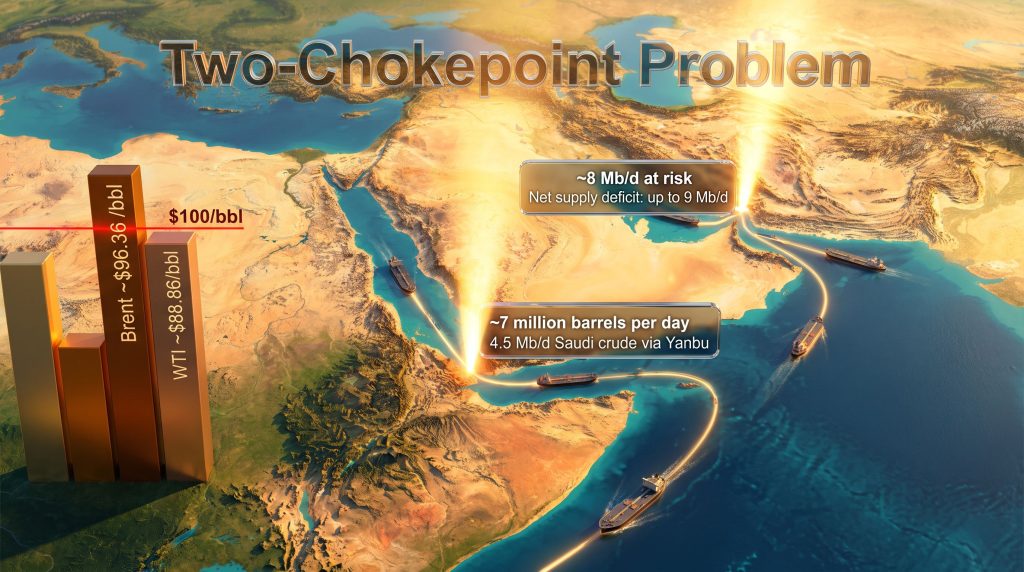
The simultaneous activation of threat conditions across two of the world's most consequential maritime passages has introduced a qualitatively different kind of market environment, one where concurrent disruption is no longer a stress-test scenario but an active pricing input. Standard Chartered oil markets must now price two Middle East chokepoints — a structural shift that fundamentally alters how risk is modelled and managed across the energy sector.
Standard Chartered's commodity research team has characterised this shift with unusual directness, framing the current situation as a two-chokepoint problem. Traders and analysts are now required to model scenarios involving simultaneous operational constraints at both the Strait of Hormuz and the Bab el-Mandeb Strait. For oil markets, this is not merely a quantitative upgrade to risk models. It represents a structural repricing of the entire Middle Eastern supply architecture.
When big ASX news breaks, our subscribers know first
The Strait of Hormuz: Why Scale Makes It Irreplaceable
To understand why the Hormuz-Bab el-Mandeb combination is so significant, it helps to start with what makes Hormuz so consequential in isolation. Roughly one-fifth of the world's entire oil supply transits this 33-kilometre-wide waterway at its narrowest point on any given day, alongside a substantial share of global LNG volumes. No other single maritime passage concentrates this much energy value in such a geographically constrained corridor.
The arithmetic of a disruption scenario is stark. Standard Chartered's geopolitical oil price analysis quantifies the exposure as follows:
| Risk Component | Estimated Volume |
|---|---|
| Crude oil transit at risk | ~8 million barrels per day |
| Associated refinery capacity disruption | ~3 million barrels per day |
| Pre-conflict market surplus buffer | ~2 million barrels per day |
| Net supply deficit in disruption scenario | Up to 9 million barrels per day |
The critical insight embedded in this table is that the potential supply gap from a serious Hormuz disruption dwarfs the surplus buffer that markets had built in prior to the current escalation cycle. A pre-existing cushion of roughly 2 million barrels per day offers minimal protection against a shock of this magnitude.
What makes the current situation distinct from previous Hormuz tension episodes is that military activity in the broader Persian Gulf theatre has already altered tanker behaviour without a physical blockade being imposed. War-risk underwriters have repriced the corridor, vessel operators have adjusted routing decisions, and cargo owners are factoring in scenarios previously treated as negligible-probability events. The result is a functional tightening of effective transit capacity even before any direct interference with navigation occurs.
The Tanker Market's Invisible Transmission Mechanism
One of the less widely understood dynamics in maritime energy logistics is how quickly insurance market repricing translates into real supply chain effects. When underwriters elevate war-risk premiums for a specific corridor, vessel operators face an immediate cost calculation: absorb the premium increase, reroute to a longer but cheaper-to-insure pathway, or wait for conditions to improve.
In practice, many choose rerouting, which removes effective vessel capacity from the market even though no ships have been damaged or seized. This mechanism means that the market impact of geopolitical escalation at Hormuz begins well before any physical disruption event. Furthermore, Hormuz tanker crossings have already fallen to their lowest levels since earlier in the year as war-risk premiums have spiked, according to current market data. This quiet contraction of throughput is precisely what makes the oil price movements so difficult to price accurately in a dual-chokepoint environment.
How the Bab el-Mandeb Became a Primary Chokepoint Almost Overnight
The Bab el-Mandeb Strait, the narrow passage separating Yemen from Djibouti that connects the Red Sea to the Gulf of Aden, has long been recognised as strategically important. What changed recently is the volume of traffic it must now absorb, and the security context in which it operates.
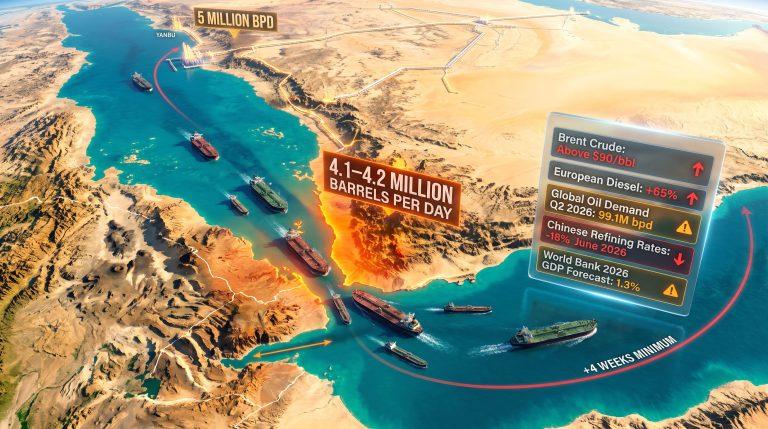
The transformation was partly a consequence of Saudi Arabia's own contingency planning. As Hormuz disruptions intensified, Riyadh redirected approximately 70% to 75% of its crude exports through its East-West pipeline, routing them to the Red Sea port of Yanbu rather than through the Arabian Gulf. Standard Chartered estimates that loadings at Yanbu climbed to approximately 4.5 million barrels per day as this redirection took effect.
When combined with southbound crude flows arriving through the Suez Canal, total oil throughput at the Bab el-Mandeb Strait reached approximately 7 million barrels per day before the Houthi attacks began. A waterway that was previously a secondary concern had become one of the world's primary oil transit corridors within a matter of weeks. For further context on OPEC market influence and how production decisions interact with these chokepoints, the dynamics are deeply interconnected.
This is perhaps the most significant unintended consequence of the current crisis: Saudi Arabia's contingency plan for Hormuz disruption has created a new and arguably more vulnerable concentration point. The rerouting designed to maintain export continuity has placed an enormous share of Saudi production within range of a second, and now active, threat vector.
Understanding the Red Sea Corridor's Physical Constraints
The Red Sea export route, comprising the Bab el-Mandeb Strait, the Suez Canal, and the SUMED pipeline across Egyptian territory, forms the shortest maritime pathway between Middle Eastern and Asian energy producers and their European customers. However, the corridor carries a significant physical limitation that is not widely understood outside the tanker industry.
Fully laden Very Large Crude Carriers cannot transit the Suez Canal due to draft depth restrictions. This means that crude moving from the Arabian Gulf to Europe via this corridor must follow one of two paths:
- Partial discharge and transshipment — Cargo is transferred to smaller Suezmax tankers at an intermediate point before the Canal is entered.
- SUMED pipeline transit — Crude is offloaded at the Egyptian Red Sea terminal, transported overland through the 320-kilometre SUMED pipeline, and then reloaded onto Mediterranean-capable vessels at the Sidi Kerir terminal near Alexandria.
Both options introduce additional cost, logistical complexity, and time. When Bab el-Mandeb itself is compromised, both options become either unavailable or prohibitively expensive, forcing vessels to circumnavigate Africa entirely.
The Houthi Escalation: From Threat to Kinetic Action
Yemen's Houthi movement imposed a targeted maritime blockade against Saudi-linked shipping, framing the action as retaliation for both sustained regional pressure on Yemen and a specific airstrike on Sanaa International Airport. The trade war impact on oil and regional conflict have compounded this pressure, creating layered disruption across multiple supply corridors. The market response unfolded in two distinct phases:
- Phase 1: Following the blockade announcement, multiple Saudi-linked VLCCs immediately diverted away from the Bab el-Mandeb, choosing the Cape of Good Hope routing instead. Each such diversion adds approximately 10 to 15 days to voyage duration, depending on origin and destination.
- Phase 2: The Houthis followed through with kinetic action, launching ballistic missiles and drone strikes at two Saudi oil tankers. Both vessels sustained damage and onboard fires were reported.
- Market response: Brent crude surged by nearly $20 per barrel, briefly breaching the psychologically significant $100 per barrel threshold before diplomatic signals prompted a partial retreat.
The Cape of Good Hope diversion deserves particular attention because its effects on the tanker market are cumulative and self-reinforcing. When large numbers of vessels are simultaneously committed to extended routings, effective fleet capacity contracts. Freight rates rise, insurance premiums for the Red Sea and Gulf of Aden region escalate across the board, and cargo delivery timelines lengthen — extending the inventory replacement cycles that refiners and importers must manage. Analysts at Beaumont Capital Markets have similarly highlighted how chokepoint risk at these levels fundamentally alters market structure.
Europe's Refined Product Vulnerability: The Clean Tanker Problem
Of all the markets exposed to Bab el-Mandeb disruption, Standard Chartered's analysis identifies European refiners as facing the most acute supply risk. The reason is specific to vessel economics and routing patterns.
Clean product tankers — the specialised vessels that carry refined petroleum products including diesel, jet fuel, and gasoline — are fundamentally more dependent on Suez Canal transit than the VLCC fleet serving long-haul crude trade. This is because VLCCs that primarily serve Asian crude demand already routinely circumnavigate Africa in normal market conditions. Their economics are calibrated for long voyages. Clean product tankers are not.
European diesel markets are simultaneously under pressure from a separate supply constraint: sustained attacks on Russian refinery and tanker infrastructure have been compressing middle distillate availability from that direction as well. Consequently, the convergence of these two pressures creates a compounded vulnerability for European refined product consumers.
If Bab el-Mandeb disruption persists, European buyers would face pressure to source incremental volumes from Atlantic Basin alternatives:
| Alternative Supply Source | Crude or Product Type | Key Logistical Consideration |
|---|---|---|
| West Africa (Nigeria, Angola) | Light, sweet crude | Shorter voyage than Middle East alternatives |
| United States Gulf Coast | WTI and associated grades | Competitive pricing, freight-intensive |
| Brazil (pre-salt offshore) | Medium-heavy crude | Growing capacity, longer voyage than West Africa |
This supply substitution would not be frictionless. Regional price differentials would widen as European buyers compete for Atlantic Basin barrels, while Middle Eastern producers selling to Asian markets would face different, though equally complex, logistical and pricing adjustments.
Price Dynamics: Reading the Volatility Pattern
The oil market's response to the dual-chokepoint environment has displayed a recognisable but important pattern: sharp upward moves followed by retreats triggered by diplomatic signalling, with each trough establishing a higher floor than the previous one.
Brent crude for September delivery fell approximately 4.4% to around $96.36 per barrel following reports of renewed diplomatic engagement around a potential return to U.S.-Iran nuclear negotiations, while WTI crude for September delivery declined approximately 3.6% to around $88.86 per barrel in the same session. These moves were substantial in absolute terms, yet they occurred within a price environment that would have been considered elevated by any pre-escalation baseline.
Standard Chartered had published revised Brent price estimates in March 2026, reflecting the early-stage chokepoint risk environment at that time:
| Period | Standard Chartered Brent Estimate |
|---|---|
| Q1 2026 | $74 per barrel |
| Q2 2026 | $67 per barrel |
| Full Year 2026 Average | $70 per barrel |
The gap between those forecasts and prices that subsequently breached $100 per barrel illustrates precisely how severely concurrent dual-chokepoint disruption was underweighted in consensus models. This is not a criticism of the analysts involved. It reflects an inherent difficulty in probability-weighting simultaneous, correlated geopolitical events that each carry individually low likelihoods. Standard Chartered oil markets must now price two Middle East chokepoints as a baseline condition, not an outlier scenario.
The degree to which realised prices have overshot pre-escalation forecasts reflects a market that is genuinely in the process of repricing geopolitical risk from scratch, not simply applying a premium to an existing baseline.
The next major ASX story will hit our subscribers first
The Production Ceiling Scenario Nobody Wants to Model
Standard Chartered's analysis raises a scenario that is particularly consequential for anyone thinking about the long-term structural implications of this crisis. If security conditions at both Bab el-Mandeb and Hormuz deteriorate sufficiently to saturate Saudi Arabia's alternative export routes, Riyadh could face pressure to curtail crude production. This would occur not because of any demand weakness or OPEC+ policy decision, but because viable export pathways simply cannot absorb the volume being produced.
This is a qualitatively different kind of supply shock from anything energy markets have modelled in the modern era. Previous supply disruptions have stemmed from wellhead capacity constraints, political production decisions, sanctions, or infrastructure damage at the point of production. A disruption driven by export infrastructure saturation would be harder to detect early, harder to remedy quickly, and harder to substitute around — because the constraint is logistical rather than geological.
Asia's Procurement Pivot and Its Market Implications
Asian energy importers are already repositioning in response to the elevated risk environment. China has accelerated purchases of Russian crude as a partial hedge against Persian Gulf supply uncertainty. Meanwhile, the broader US-China oil price impact has added another layer of complexity to procurement strategies across the region.
India has begun actively exploring alternative procurement relationships with West African and Latin American producers as Hormuz transit risk elevates both the cost and reliability of Iraqi and Iranian barrel procurement. India has also emerged as the world's largest long-term LNG buyer in 2025 according to GIIGNL data, suggesting a broader strategic diversification of energy sourcing beyond the immediate crude oil picture.
These procurement shifts matter for price formation because they alter the competitive dynamics for every alternative supply basin. When India and China simultaneously compete for West African or Atlantic Basin barrels as a substitute for Persian Gulf crude, they drive up prices in those markets, compressing the relief that rerouting was supposed to provide.
What Persistent Disruption Means for Long-Term Trade Architecture
A critical question for energy market participants is whether the current routing and procurement changes represent temporary tactical responses or the early stages of a more durable restructuring of global oil trade flows. Several structural factors suggest the latter possibility deserves serious consideration. Researchers at Standard Chartered have similarly noted the persistence of these risk dynamics in their broader market outlook:
- Insurance market entrenchment: Once war-risk underwriters reprice a region, premium reductions lag well behind any improvement in the physical security environment. Insurers require sustained periods of incident-free operations before adjusting downward.
- Operator risk aversion persistence: Shipping companies and vessel operators that have witnessed or experienced attacks in a corridor tend to maintain elevated caution long after the immediate threat subsides. Behavioural risk aversion outlasts the objective threat level.
- Procurement relationship stickiness: Buyers who develop alternative supply relationships during a disruption frequently retain those relationships even after the original corridor reopens, because reliability has been demonstrated and commercial terms have been negotiated.
For investors and energy market participants, the practical implication is that even a diplomatic resolution of the immediate conflict may not fully reverse the risk premium embedded in oil prices, freight markets, or insurance costs. The structural floor for prices in this environment is higher than pre-crisis consensus models assumed. Furthermore, it may remain elevated well beyond the resolution of the immediate geopolitical triggers, as Standard Chartered oil markets must now price two Middle East chokepoints as a durable feature of global energy risk.
Disclaimer: This article is for informational and educational purposes only and does not constitute financial, investment, or trading advice. Oil price forecasts and supply scenario estimates referenced herein represent analyst views subject to material uncertainty. Readers should conduct independent research and consult qualified financial advisers before making investment decisions. Forward-looking statements involve inherent risks and should not be relied upon as predictions of future outcomes.
Want Real-Time Alerts When Geopolitical Shocks Move Commodity Markets?
Discovery Alert's proprietary Discovery IQ model scans ASX announcements the moment they are released, delivering actionable insights on significant mineral discoveries — including those tied to energy and resource commodities — so subscribers can position ahead of the broader market. Explore Discovery Alert's discoveries page to see how historic finds have generated substantial returns, and begin a 14-day free trial to gain a market-leading edge before the next major shift unfolds.