
July 13, 2026
The Architecture of Control: How China Is Systematically Locking In Its Critical Minerals Advantage
The global race for critical minerals demand is not simply a story of competing companies or rival nations bidding up asset prices. At its core, it is a story about institutional design. Which countries have built the most sophisticated, durable, and adaptive systems for securing the raw materials that define economic and military power in the twenty-first century? Measured by that standard, China's approach as a China strategic mineral investment firm is undergoing a significant and underappreciated evolution in 2026, one that moves well beyond the opportunistic deal-making that characterised its early overseas mining expansion.
Understanding this shift requires examining not just the individual transactions, but the coordinating infrastructure being quietly assembled around them.
When big ASX news breaks, our subscribers know first
Why China Is Redesigning Its Overseas Mining Playbook
For roughly two decades, China's overseas resource strategy rested on a relatively straightforward model: deploy large state-owned enterprises with long time horizons, patient capital, and a higher tolerance for political risk than their Western counterparts. While institutional investors in London and New York pressured mining majors to cut capital expenditure and return cash to shareholders, Chinese firms were quietly building dominant positions across Congo's copper belt, transforming Indonesia's nickel industry, and taking strategic stakes in iron ore projects from West Africa to Australia.
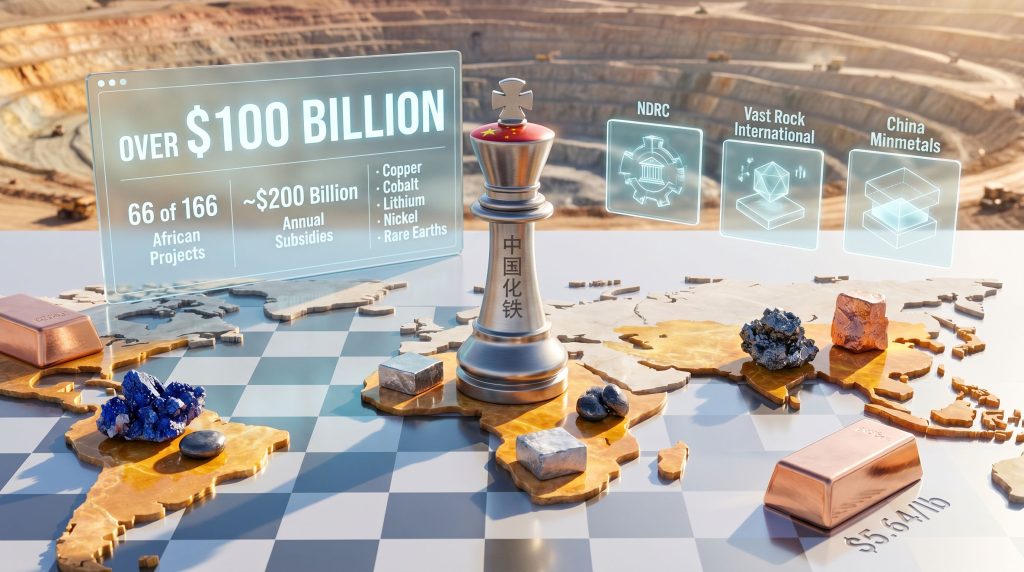
The results of that asymmetric period of investment are now deeply embedded in global supply chains. According to analysis by Bain & Co., Chinese companies deployed over $100 billion in strategic outbound mining mergers and acquisitions over the past two decades. When combined with domestic processing investments and government subsidy programmes estimated at approximately $200 billion annually, the cumulative scale of China's mineral supply chain build-out has no precedent among any single nation in modern history.
However, the conditions that made that original model successful are no longer fully in place.
Three Structural Forces Driving Strategic Adaptation
Three converging pressures are forcing Beijing to move beyond the champion-company model and build something more sophisticated.
First, the Western world has shifted from passive concern to active counter-mobilisation. The United States has concluded bilateral mineral access partnerships with the Democratic Republic of Congo, providing preferential investment access to copper, cobalt, lithium, and tantalum deposits. The European Union, Japan, and allied nations are independently accelerating their own critical mineral supply chain diversification programmes. The combined weight of these initiatives represents the most coordinated Western response to Chinese mineral dominance in history, and it is creating new friction points for Chinese firms operating in key jurisdictions.
Second, producer nations are no longer passive participants in the global mineral economy. They have discovered and are actively exercising their leverage.
| Country | Policy Action | Mineral Affected |
|---|---|---|
| Democratic Republic of Congo | Implemented cobalt export controls (2025) | Cobalt |
| Guinea | Proposed bauxite export restrictions; demanding pellet/steel production at Simandou | Bauxite, Iron Ore |
| Zimbabwe | Mandated additional refining investment or face lithium concentrate export ban | Lithium |
| Indonesia | Implemented domestic nickel processing mandates | Nickel |
Producer nations are no longer willing to function as raw material exporters while the processing premium flows elsewhere. This structural shift in negotiating posture is altering the economics of full-ownership acquisition models for all foreign investors, not just Chinese firms.
Third, the sheer complexity and cost of executing overseas mineral deals has risen substantially. Permitting timelines are lengthening, royalty and tax demands are escalating, and the political conditionality attached to large mining investments is becoming more intricate. Furthermore, the DRC cobalt export ban implemented in 2025 demonstrated these forces together are eroding the return profile of outright project ownership, particularly in high-risk jurisdictions.
Introducing China's New Strategic Mineral Investment Firm
Beijing's response to these challenges is embodied in the establishment of Guangyan International Investment Co., which also operates under the English trade name Vast Rock International Investment Co. This entity represents a meaningful addition to China's existing mineral strategy toolkit, functioning not as a replacement for established state-owned enterprises but as a coordinating and risk-management layer designed to sit above individual deal transactions.
The firm operates within the broader framework overseen by China's National Development and Reform Commission (NDRC), the country's primary economic planning authority. While Guangyan does not appear to occupy the uppermost tier of China's political hierarchy, its functional mandate places it at the centre of Beijing's effort to bring greater coherence and oversight to outbound mineral investment activity.
What Guangyan Actually Does
The services this new China strategic mineral investment firm is designed to provide span several distinct but interrelated functions:
- Direct equity co-investment in overseas mineral projects, allowing Chinese mining companies to share capital exposure across a broader base
- Compliance and regulatory advisory tailored to the requirements of specific host-country jurisdictions, a growing need as producer nations implement more complex licensing and fiscal regimes
- Risk assessment and risk-sharing frameworks that formalise the shift toward consortium-based ownership structures rather than single-entity full control
- Market intelligence and deal-flow analysis covering strategic mineral markets and geopolitical dynamics relevant to specific transactions
Importantly, engagement with Guangyan is not mandatory. Larger, more established state-owned enterprises are likely to resist requirements to share detailed investment plans and risk assessments with a centralised coordinating body. However, smaller and mid-tier Chinese mining companies are being encouraged to communicate their outbound investment intentions so they can be assessed and potentially supported. Hiring activity on WeChat job postings suggests the firm has been building its operational capacity since approximately February 2026.
The Shift Towards Consortium Ownership
One of the most significant signals embedded in the Guangyan model is its explicit encouragement of consortium-based project ownership. This represents a strategic recalibration driven by hard experience.
Full project ownership generates maximum control but also maximum exposure. In jurisdictions where resource nationalism is intensifying, being the sole foreign owner of a large mineral asset creates a highly visible target for renegotiated fiscal terms, export restrictions, or operational interference. Distributing ownership across multiple partners — potentially including host-country entities, development finance institutions, or even Western mining companies — reduces that exposure while still maintaining strategic access.
The move toward structured risk-sharing is not a retreat from China's ambitions. It is a more sophisticated expression of those ambitions, adapted to a more complex operating environment.
Mapping China's Full Strategic Mineral Toolkit
Guangyan represents one layer of a multi-instrument architecture that China has been assembling across different mineral markets and deal types.
| Vehicle | Primary Function | Target Commodity | Mechanism |
|---|---|---|---|
| China Mineral Resources Group (CMRG) | Purchasing coordination and price leverage | Iron ore | Demand aggregation from steel producers |
| State-Owned Enterprises (e.g., China Minmetals) | Direct asset ownership and operation | Copper, nickel, zinc | M&A, greenfield development |
| Guangyan / Vast Rock International | Deal support, risk management, equity co-investment | Broad critical minerals | Advisory and co-investment |
China Minmetals Corporation serves as a useful historical benchmark. Holding 15 overseas mines and ranked 86th on the Fortune Global 500, it represents the commercial execution speed and scale that underpins China's existing mineral footprint. On the iron ore side, China Mineral Resources Group was created specifically to aggregate purchasing demand from domestic steel producers and reduce China's price-taking position in a $190 billion global market. Guangyan extends this coordination philosophy into a wider range of minerals and deal structures.
Africa's Central Role in China's Mineral Math
Of the 166 Chinese-owned or Chinese-affiliated mining projects tracked across Africa, 66 are in the Democratic Republic of Congo alone, a figure that underscores just how concentrated China's strategic mineral exposure is in a single, high-risk jurisdiction. This concentration creates both structural advantage and structural vulnerability. As research from the Stimson Center highlights, the competition for Africa's mineral resources between major powers is intensifying, meaning Beijing cannot assume frictionless access to assets it has spent billions acquiring.
Guinea presents a parallel dynamic in bauxite. As the world's largest bauxite producer, Guinea's proposed export restrictions and demands that the Simandou iron ore project include downstream steel or pellet production facilities represent exactly the kind of escalating conditionality that the Guangyan framework is designed to help Chinese companies navigate. In addition, the broader China rare earth strategy reinforces how Beijing views downstream processing control as equally important as upstream asset ownership.
The Minerals Themselves: Why These Commodities Are Non-Negotiable
Copper: The Foundational Metal
Copper sits at the centre of every major energy transition pathway, from grid expansion and EV manufacturing to renewable energy infrastructure. Currently trading at approximately $5.64 per pound, the copper supply crunch reflects structural demand that most analysts expect to intensify through the 2030s as electrification programmes accelerate globally. China's dominant position in Congo's copper belt is therefore not incidental to its energy transition strategy. It is foundational.
Cobalt, Lithium, and Battery Supply Chain Control
The strategic logic of cobalt and lithium investment extends well beyond resource ownership. China's decades-long investment in both extraction rights and processing capacity means it controls a critical share of the pathway from raw ore to battery-grade material. This processing premium is where the long-term value is captured, not at the mine gate. Zimbabwe's lithium export restrictions are a direct challenge to this model, forcing Chinese investors to commit capital to in-country refining infrastructure as the price of continued access. Consequently, Argentina lithium opportunities are also attracting heightened interest as investors seek alternative supply sources outside of Africa.
Nickel, Rare Earths, and Bauxite
Indonesia's nickel sector has been fundamentally transformed by Chinese investment in domestic processing, creating a vertically integrated supply chain that now feeds global battery manufacturing. China's dominance in rare earth processing, regardless of where ore is physically extracted, remains one of its most durable strategic advantages. Bauxite from Guinea flows into an aluminium supply chain that Chinese downstream processors depend upon at scale.
What This Means for Western Investors and Mining Companies
The Competitive Gap and How It Formed
Western mining companies spent much of the 2010s under relentless shareholder pressure to reduce capital expenditure, return cash through dividends and buybacks, and avoid high-risk jurisdictions. Chinese state-backed entities faced no equivalent constraint. This structural divergence created a decade-long window during which Chinese firms could acquire strategically significant assets at prices that Western companies, answerable to quarterly earnings cycles, could not or would not match.
Closing that gap now requires not just capital but a fundamentally different political risk framework, and the willingness to absorb the kind of long-horizon uncertainty that private-sector investors have historically been reluctant to price in.
Emerging Investment Themes for Western Capital
The institutionalisation of China's mineral investment process does create some identifiable opportunities for Western investors who understand the landscape:
- Consortium structures are becoming the standard model in complex jurisdictions, which means Western capital may find co-investment alongside Chinese partners more accessible than direct competition against them in certain geographies
- Processing and refining capacity in Western-aligned jurisdictions (North America, Australia, and select European markets) commands a growing value premium as supply chain diversification becomes a policy priority
- Resource nationalism risk is now a priced variable that must be modelled explicitly into any emerging-market mineral investment, including scenarios involving export controls, renegotiated fiscal terms, or processing mandates
- Latin America presents the most actively contested landscape, with Chinese and Western capital competing directly for influence across Chile, Argentina, and Brazil's lithium and copper endowments
Investor consideration: The formalisation of China's overseas mineral investment process may, paradoxically, produce more predictable deal structures in some jurisdictions over time. Standardised risk frameworks replacing ad hoc deal-making could reduce the frequency of unexpected deal failures, benefiting all participants in those markets, not only Chinese firms.
The next major ASX story will hit our subscribers first
Scenario Outlook: Three Trajectories Through 2035
Coordinated Consolidation (Base Case)
China successfully institutionalises its overseas mineral coordination framework, reducing deal failure rates and improving risk-adjusted returns across its mining portfolio. Producer nation demands are met through consortium structures and downstream processing commitments. Western competitors continue to lag on deployment speed, and China's supply chain positions strengthen incrementally.
Geopolitical Fragmentation (Stress Case)
Escalating US-China tensions trigger retaliatory restrictions on Chinese mining operations in multiple jurisdictions. Producer nations use competing bloc dynamics to extract maximum economic concessions from all foreign investors, driving up access costs across the board. Supply chain bifurcation accelerates, with parallel mineral ecosystems serving Western-aligned and China-aligned economies. As ASPI's analysis on China's leverage in critical minerals makes clear, Beijing's strategic intent extends well beyond mere commercial gain.
Multilateral Recalibration (Optimistic Case)
International governance frameworks emerge to manage critical mineral investment flows, reducing zero-sum competition and creating shared infrastructure development models. China's coordination mechanisms, including Guangyan, become integrated into broader multilateral supply chain architecture rather than operating as instruments of strategic competition. This China strategic mineral investment firm model, however adapted, may ultimately serve as a template that others seek to engage with rather than simply compete against.
Key Takeaways
- China's mineral investment strategy is shifting from individual state-owned champions to a multi-instrument, coordinated ecosystem anchored by the NDRC's planning framework
- Guangyan International / Vast Rock International adds risk-sharing capacity, compliance expertise, and co-investment support to China's existing toolkit without replacing established SOEs
- Over $100 billion in outbound mining M&A over two decades has created deeply entrenched positions across copper, cobalt, lithium, nickel, rare earths, and bauxite supply chains
- Rising resource nationalism, coordinated Western counter-investment programmes, and escalating deal complexity are the three structural forces driving this strategic adaptation
- The shift toward consortium ownership signals a more risk-aware posture — one that may reshape how all foreign investors structure deals in high-complexity mineral jurisdictions through the 2030s
This article contains forward-looking analysis and scenario projections. These represent analytical frameworks rather than investment advice. Actual geopolitical, regulatory, and market outcomes may differ materially from scenarios described.
Want to Stay Ahead of ASX Mineral Discoveries Shaped by Global Commodity Shifts?
As China's evolving critical minerals strategy reshapes supply chains for copper, cobalt, lithium, and rare earths, the opportunities flowing through to ASX-listed explorers and producers are accelerating — Discovery Alert's proprietary Discovery IQ model delivers real-time alerts on significant ASX mineral discoveries, instantly converting complex mineral data into actionable insights for investors at every level. Explore historic discoveries and their remarkable returns, then begin your 14-day free trial at Discovery Alert to position yourself ahead of the market.