August 8, 2026
The Quiet Architecture Behind the World's Most Consequential Resource Race
Mineral supply chains rarely make headlines until they break. For most of the past two decades, the steady accumulation of upstream mining assets by a China strategic mineral investment firm or state-linked entity proceeded largely below the threshold of mainstream financial attention. Western institutional investors focused on ESG constraints, shareholder returns, and capital discipline, while a parallel and far more patient capital system was quietly constructing the foundational architecture of global critical mineral control. Understanding how that architecture is evolving today requires stepping back from individual deals and examining the systemic logic driving Beijing's latest institutional moves.
When big ASX news breaks, our subscribers know first
Two Decades of Strategic Accumulation: The Numbers Behind China's Mineral Dominance
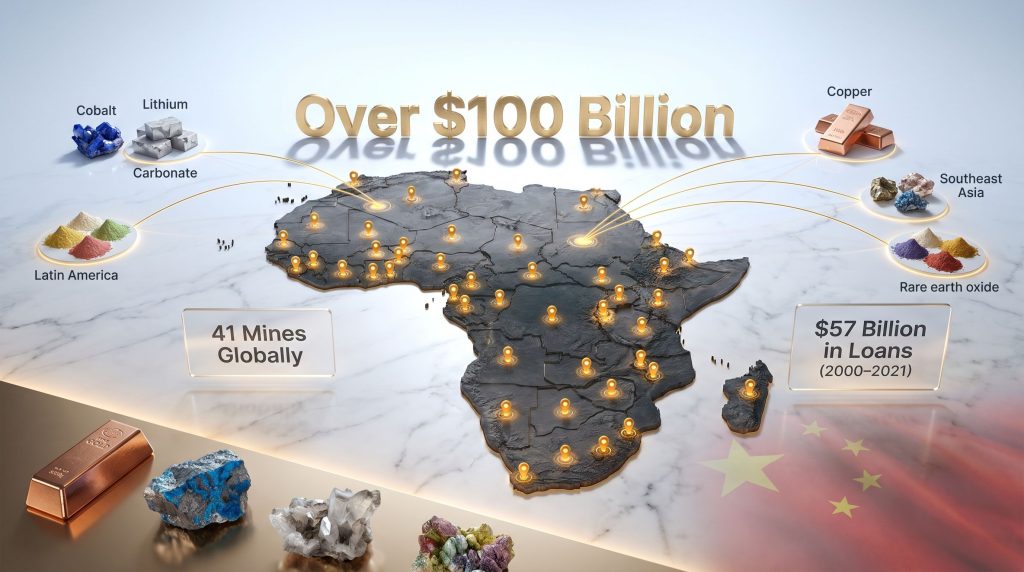
The scale of China's outbound mining investment is difficult to overstate. According to data from Bain & Co., Chinese entities have executed more than $100 billion in strategic outbound mining mergers and acquisitions since the early 2000s. That figure does not include the separate but equally significant financing layer: Chinese policy and commercial banks deployed approximately $57 billion in dedicated mining and processing loans to developing economies between 2000 and 2021 alone.
The priority asset classes targeted across this period reflect deliberate strategic planning rather than market-driven opportunism:
- Copper and cobalt, concentrated heavily in the Democratic Republic of Congo
- Iron ore, with major positions across West Africa and Latin America
- Lithium, nickel, and rare earths, increasingly across Africa and Southeast Asia
- Gold, as both a financial hedge and a diplomatic entry point into new jurisdictions
Geographically, Africa has absorbed the largest share of this capital deployment. Of 166 Chinese-owned global mining projects, approximately 66 are located across the African continent, representing the single highest regional concentration worldwide. This pattern was not accidental. Chinese firms entered jurisdictions where Western majors, constrained by shareholder risk aversion and governance scrutiny, were unwilling to operate. The result was a structural first-mover advantage that now underpins China's processing dominance across multiple critical mineral categories.
Furthermore, as detailed in research on competing African resource investment, the structural gap between Chinese and Western approaches has widened considerably over the past decade, making catch-up strategies increasingly difficult for allied nations to execute.
"The competitive gap between China's mineral investment model and the Western approach was not created overnight. It was built through two decades of consistent capital deployment into jurisdictions most institutional investors refused to touch."
What Is Guangyan International Investment Company and Why Does Its Formation Matter Now?
The establishment of Guangyan International Investment Company, also operating under the English name Vast Rock International Investment, represents a meaningful evolution in how China coordinates its overseas mineral strategy. Rather than relying solely on existing state-owned enterprise (SOE) champions, Beijing is adding a dedicated coordination and investment layer designed to standardise deal processes, improve oversight, and provide smaller domestic miners with the institutional support needed to compete internationally.
Guangyan's operational mandate spans several distinct functions:
- Direct equity investment in overseas mining assets
- Compliance advisory services to help Chinese firms navigate host-nation regulatory environments
- Risk management support, particularly as producer-nation governance requirements become more complex
- Market intelligence to improve deal assessment and pricing discipline
The entity operates within the broader economic planning framework overseen by China's National Development and Reform Commission (NDRC), which coordinates strategic resource investment at the national level. Critically, Guangyan does not appear to occupy the uppermost tier of China's political hierarchy. This positioning is likely deliberate: a lower-profile vehicle can engage in sensitive international negotiations with less diplomatic visibility than a flagship SOE like China Minmetals Corporation.
How Guangyan Fits Within China's Layered Mineral Investment Architecture
| Entity | Primary Function | Key Minerals Focus |
|---|---|---|
| Guangyan / Vast Rock International | Equity investment, risk advisory, deal coordination | Broad strategic minerals |
| China Minmetals Corporation | State backbone enterprise, direct mine ownership | Copper, lithium, nickel, cobalt, rare earths |
| China Mineral Resources Group (CMRG) | Iron ore purchasing consolidation, sector bargaining power | Iron ore |
| Policy and Commercial Banks | Project financing, approx. $57B in loans (2000-2021) | Copper, cobalt, nickel, lithium, rare earths |
One notable operational detail: participation with Guangyan is not compulsory. Larger SOEs may resist information-sharing mandates, mirroring dynamics already observed with CMRG. However, domestic companies are being encouraged to communicate their international project plans so they can be assessed and coordinated within the broader national framework. Job postings on Chinese social media platform WeChat suggest the company accelerated its hiring from approximately February 2026 onward.
Three Structural Pressures Forcing China's Strategic Recalibration
The timing of Guangyan's formation reflects the convergence of three distinct pressures that are collectively reshaping the risk calculus for Chinese overseas mining investment.
1. Producer-Nation Resource Nationalism Is Intensifying
Resource-rich governments are no longer passive recipients of foreign mining capital. A wave of assertive policy changes is raising the cost and complexity of operating in key jurisdictions:
- The drc cobalt export ban introduced controls directly targeting the mineral where Chinese firms hold their most concentrated upstream positions
- Guinea, the world's largest bauxite producer, has discussed plans to restrict bauxite shipments and is pushing for domestic alumina processing investment as a condition of continued access
- Guinea has also demanded that consortium partners behind the Simandou iron ore project construct downstream iron pellet or steel manufacturing facilities within the country
- Zimbabwe mandated that lithium producers invest in in-country refining capacity or face export bans on lithium concentrate; the Chinese embassy in Harare formally advised domestic companies to strengthen risk prevention protocols in response
These are not isolated incidents. They reflect a maturing political economy in resource-producing nations, where governments increasingly understand the leverage their mineral endowments provide. For Chinese operators accustomed to relatively unconstrained access, this shift requires a fundamentally different project development model.
2. Geopolitical Competition Is Creating Alternative Supply Chain Pathways
The United States has moved aggressively to construct an alternative critical mineral supply chain, including by negotiating preferential access agreements with the DRC covering copper, cobalt, lithium, and tantalum. The us critical mineral strategy and the European Union, Japan, and a range of allied nations are pursuing parallel frameworks with similar strategic intent.
What makes Western counter-investment particularly challenging to sustain is a structural asymmetry that China exploited during its first wave of expansion: private capital, accountable to shareholders, cannot match the risk tolerance of state-backed capital deployed with strategic rather than financial return objectives as its primary mandate. In addition, greenland critical minerals have emerged as a focal point for allied nations seeking to diversify supply away from Chinese-controlled sources.
3. Project Cost Escalation and Political Complexity Are Redefining Optimal Deal Structure
Full project ownership, once Beijing's preferred model for ensuring supply security, is becoming increasingly difficult to justify as capital costs rise and political conditions in host nations grow more demanding. China's emerging preference, actively encouraged through platforms like Guangyan, is shifting toward partial equity stakes and joint venture structures that distribute financial and political risk across multiple partners while preserving strategic influence over output.
China Minmetals and the SOE Backbone: Scale, Reach, and Recent Moves
While Guangyan represents a new layer in China's mineral architecture, the established SOE backbone remains the primary instrument of upstream control. China Minmetals Corporation, the most prominent state-owned mining enterprise, operates 41 mines globally, including 15 overseas assets spanning copper, lithium, nickel, cobalt, and rare earth categories.
Recent capital deployment by Minmetals underscores that expansion is ongoing:
- Acquisition of the Khoemacau copper mine in Botswana, adding a high-quality African copper asset to its portfolio
- A stake in the Goulamina lithium mine in Mali, positioning the firm in one of West Africa's most significant hard-rock lithium deposits
- An announced investment commitment of $400 to $450 million in Peru's Las Bambas copper mine to expand production capacity
These moves illustrate the continued geographic diversification of China's upstream copper strategy, with a notable shift toward African assets as Latin American political risk and community opposition have intensified.
The Processing Bottleneck: Where China's Leverage Is Most Durable
A dimension of China's mineral strategy that receives less attention than its upstream acquisitions is its dominance in refining and processing. Even where Western nations, companies, or allied-nation frameworks succeed in securing upstream equity positions, the pathway from raw ore to battery-grade or industrial-grade materials typically runs through Chinese processing infrastructure.
China's National Plan for Mineral Resources, covering the 2016–2020 period, formally identified 24 strategic minerals and established a dual-track approach: conserving domestic reserves while aggressively expanding international cooperation for supply. This framework continues to shape outbound investment prioritisation and processing infrastructure development today. Furthermore, critical minerals energy transition dynamics are accelerating demand for precisely those refined materials where China holds its most durable processing advantages.
"Processing dominance is arguably more durable than upstream ownership because it is harder to replicate quickly and is less vulnerable to host-nation resource nationalism. Smelters and refineries require years to build and represent embedded industrial capability that cannot be expropriated."
This advantage is further reinforced by China's use of export restrictions. For instance, chinas export controls bismuth and other processed materials demonstrate how Beijing translates processing dominance into direct geopolitical leverage, a pattern increasingly replicated across multiple mineral categories.
The next major ASX story will hit our subscribers first
Scenario Analysis: Three Possible Trajectories for Global Mineral Supply Chain Competition
The establishment of Guangyan and the broader evolution of China's mineral governance model create several plausible forward scenarios for investors and policymakers to consider. These represent analytical frameworks rather than predictions, and actual outcomes will likely involve elements of multiple scenarios simultaneously.
| Scenario | Core Dynamic | Key Risk Factor |
|---|---|---|
| Entrenchment | Guangyan standardises deal processes; China deepens upstream grip | Producer nations accept Chinese terms for infrastructure investment |
| Friction and Fragmentation | Resource nationalism accelerates; political costs rise for Chinese operators | Full-ownership projects face renegotiation or partial nationalisation |
| Competitive Equilibrium | Western investment programmes reach sufficient scale to offer genuine alternatives | Processing dominance remains with China even as upstream diversifies |
The risk-sharing model Guangyan is designed to promote may prove most resilient under a fragmentation scenario, as distributing equity across multiple partners reduces the political profile and financial exposure of any single China strategic mineral investment firm operating internationally.
Frequently Asked Questions: China's Strategic Mineral Investment Architecture
What is Guangyan International Investment Company?
Guangyan International Investment Company, also known as Vast Rock International Investment, is a recently established Beijing-linked entity designed to support China's overseas mineral acquisition strategy. It provides equity investment support, compliance guidance, and risk management services for international mining transactions, operating within the economic planning framework of the NDRC.
Which minerals does China's strategic framework prioritise?
China's National Plan for Mineral Resources identified 24 strategic minerals. Core investment priorities include copper, cobalt, lithium, nickel, iron ore, rare earths, bauxite, and tantalum. These resources are critical to both industrial manufacturing and the global energy transition supply chain.
Why is China moving toward partial equity stakes rather than full project ownership?
Rising project development costs, increasing political complexity in producer nations, and escalating geopolitical competition are all contributing to a preference shift. Partial equity and joint venture structures allow a China strategic mineral investment firm to maintain strategic influence over mineral output while distributing financial and political exposure across partner entities.
How are producer nations reshaping the terms of Chinese mineral investment?
Several resource-producing nations have introduced policies requiring downstream processing investment, export controls on raw mineral concentrates, or domestic value-addition requirements as conditions of continued mining access. Consequently, these policy shifts are fundamentally altering the operating environment that Chinese firms navigated during the first wave of expansion. Academic analysis of these dynamics suggests this trend will continue to intensify as mineral demand grows through the energy transition.
Disclaimer: This article is intended for informational purposes only and does not constitute financial or investment advice. All statistics and financial figures referenced are drawn from publicly available sources including Bain and Co. research and Bloomberg reporting. Forward-looking scenarios represent analytical frameworks and should not be interpreted as predictions of future outcomes. Readers should conduct independent due diligence before making any investment decisions.
Want to Stay Ahead of the Next Major Mineral Discovery on the ASX?
While China's state-backed entities quietly accumulate strategic mineral positions worth hundreds of billions of dollars, individual investors can gain their own edge closer to home — Discovery Alert's proprietary Discovery IQ model scans ASX announcements in real time, delivering instant alerts on significant mineral discoveries across copper, lithium, rare earths, and more than 30 other commodities, so subscribers can act on actionable opportunities before the broader market catches on. Explore historic discoveries and their returns to understand what's possible, then begin your 14-day free trial today.