August 9, 2026
China's decision to implement a sulphuric acid export halt has sent shockwaves through global industrial supply chains, creating unprecedented challenges for industries dependent on this critical chemical compound. The intersection of geopolitical tensions, domestic policy priorities, and critical infrastructure vulnerabilities has created a complex web of interdependencies that extend far beyond traditional trade relationships. Furthermore, understanding these dynamics requires examining how nations balance export revenues against internal security considerations, particularly when essential industrial inputs become scarce during periods of international instability.
Strategic Resource Prioritisation in Global Markets
China's position as the world's dominant sulphuric acid producer reflects broader patterns of industrial concentration that have evolved over decades of manufacturing specialisation. With annual production exceeding 70 million metric tons, representing approximately 25-28% of global output, the nation has established itself as a critical supplier for industries ranging from fertiliser manufacturing to mineral processing operations.
The economic calculus behind export restrictions extends beyond simple supply-demand mechanics. Policy frameworks increasingly prioritise domestic resource security over international market commitments, particularly when external disruptions threaten essential supply chains. However, this shift represents a fundamental change in how major producing nations approach commodity export strategies during periods of global uncertainty.
Beijing's agricultural sector requires substantial chemical inputs to maintain production levels across approximately 19% of global agricultural output while supporting 18% of the world's population on just 9% of available arable land. Consequently, the timing of supply allocation decisions during peak planting seasons demonstrates how domestic food security considerations can override traditional export commitments, as evidenced by the broader US-China trade war implications.
Key factors driving resource allocation decisions include:
- Domestic agricultural production requirements during critical growing seasons
- Strategic buffer maintenance against supply chain disruptions
- Long-term food security policy implementation
- Geopolitical risk assessment across multiple commodity sectors
When big ASX news breaks, our subscribers know first
Geopolitical Infrastructure Vulnerabilities
The Strait of Hormuz represents one of the world's most critical commodity chokepoints, facilitating approximately one-third of seaborne fertiliser trade alongside significant global sulfur exports. When transportation routes through this strategic waterway face disruption, alternative shipping pathways add 3,000-6,000 nautical miles to journey distances, extending transit times from 2-3 weeks to 4-6 weeks while substantially increasing transportation costs.
Lynn Song, chief economist for Greater China at ING Bank, emphasised that administrative controls would effectively suspend sulphuric acid exports from May 2026, noting that the contribution of such exports to gross domestic product held far less importance than broader food security objectives. His analysis highlighted how the blockage affected approximately one-third of seaborne fertiliser trade in addition to substantial global sulfur exports.
Sulfur supply chains demonstrate particular vulnerability to Middle Eastern disruptions, as 30-35% of global sulfur derives from petroleum refining byproducts, primarily from refineries that depend on Hormuz shipping lanes. In addition, this concentration creates cascading effects throughout chemical supply chains when geopolitical tensions escalate in the region, contributing to ongoing trade war oil prices volatility.
Critical supply route dependencies:
- Petroleum-derived sulfur exports through Hormuz corridor
- Alternative routing via Suez Canal increases costs by 40-60%
- Cape of Good Hope diversions extend delivery schedules significantly
- Regional processing capacity limitations restrict immediate substitution
How Do Supply Chain Disruptions Cascade Across Industries?
The sulphuric acid export halt creates differential impacts across multiple industrial sectors, with varying degrees of dependency and alternative sourcing capabilities. Understanding these exposures requires examining both direct consumption patterns and downstream processing requirements that rely on sulfuric acid as an essential input.
| Sector | Annual Consumption | Alternative Sources | Geographic Concentration | Timeline Vulnerability |
|---|---|---|---|---|
| Fertiliser Manufacturing | 40-50% of global demand | Limited regional capacity | High dependency regions | Immediate impact |
| Copper Mining Operations | 15-20% of ore processing | Established regional suppliers | Chile, Peru, Indonesia | 3-6 month adjustment |
| Chemical Processing | 25-30% of industrial use | Diverse global capacity | Distributed globally | 6-12 month transition |
| Oil Refining Alkylation | 10-15% of sector demand | Synthetic alternatives | Major refining centers | 12-18 month adaptation |
Chile's industrial exposure demonstrates the complexity of dual-sector dependencies. As the world's largest copper producer (28% of global supply) and a significant phosphate fertiliser manufacturer, the country imports over 1 million tons of sulphuric acid annually from China. This creates vulnerabilities across both mineral processing operations and agricultural input production simultaneously, highlighting the supply chain crisis affecting strategic sectors.
Indonesia's nickel laterite processing operations represent another critical vulnerability. The nation now produces approximately 35% of global nickel supply, with nearly all laterite ore processing requiring sulfuric acid leaching in high-pressure autoclaves. Furthermore, supply constraints directly threaten Indonesia's recent production expansion trajectory in this strategically important battery metal, forming part of broader critical minerals strategy considerations.
Regional dependency assessment:
- India: Represents 9% of China's export volume (approximately US$26.1 million annually)
- Chile: Over 1 million tons annual import dependency across mining and agriculture
- Indonesia: Critical for nickel laterite processing expansion plans
- Saudi Arabia and Morocco: Significant importers for phosphate fertiliser production
Market Response Mechanisms and Price Discovery
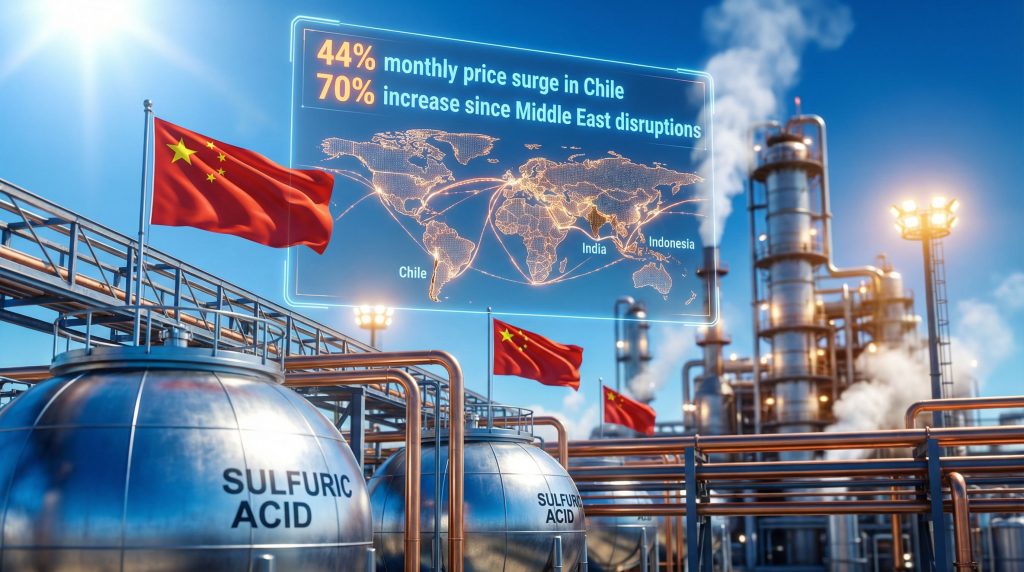
Global commodity markets have demonstrated rapid adjustment mechanisms in response to supply constraint announcements. Chile's spot sulfuric acid pricing surged 44% within a single month, reflecting market participants' immediate recognition of supply scarcity implications. This price movement magnitude indicates sophisticated forward-looking assessment by industrial buyers and chemical traders.
Sulfur commodity pricing experienced a 70% increase since Middle Eastern disruptions began, suggesting markets incorporated Hormuz closure effects into pricing expectations well before formal export announcements emerged. This anticipatory pricing behavior demonstrates how geopolitical risk assessment influences commodity valuations across interconnected supply chains, necessitating advanced market volatility hedging strategies.
Price escalation factors:
- Immediate spot market adjustments reflecting supply scarcity
- Forward contract repricing across quarterly and annual agreements
- Transportation premium increases for alternative sourcing routes
- Risk premium incorporation for ongoing geopolitical uncertainties
Industrial sulfuric acid typically trades through long-term contract arrangements rather than true spot markets, with quarterly and annual agreements representing the majority of volume transactions. Published spot prices from industry sources like Platts and Argus Media reflect recent transaction pricing but represent relatively small percentages of total trade volumes.
Storage and logistics considerations significantly influence market responses to supply disruptions. Sulfuric acid requires specialised infrastructure including corrosion-resistant tanks, acid-compatible handling equipment, environmental containment systems, and temperature management capabilities. However, storage costs typically range from $20-50 per ton annually for medium-term storage periods, creating economic constraints on inventory accumulation strategies.
Alternative Supply Source Development
Global sulfuric acid production capacity substantially exceeds China's export volumes, with total annual production estimated at 250-280 million metric tons. However, alternative producers primarily focus on domestic market supply, requiring significant adjustments to redirect production toward export markets affected by Chinese restrictions.
Major alternative production regions:
- United States: 40-45 million metric tons annually
- India: 15-18 million metric tons annually
- Russia: 12-15 million metric tons annually
- Japan: 8-10 million metric tons annually
Production methodology differences create varying expansion capabilities across regions. The contact process, representing 65-70% of global production, utilises elemental sulfur oxidation and requires substantial sulfur feedstock availability. For instance, roasting processes, accounting for 30-35% of production, depend on metal sulfide byproducts from mining operations and cannot easily increase without corresponding mining capacity expansion.
What Are the Technical Constraints on Rapid Production Scaling?
Secondary sulfuric acid recovery represents an underutilised alternative source, potentially capturing 5-10% of industrial supply through spent acid reconcentration from metal pickling, fertiliser plant tail gases, and other industrial processes. However, recovery operations require specialised equipment and cannot scale rapidly to address large supply gaps.
Technical production constraints:
- Contact process expansion requires increased sulfur feedstock access
- Roasting process capacity tied to mining operation byproduct availability
- Recovery and recycling systems need specialised infrastructure investment
- Environmental permitting and safety protocols limit rapid capacity additions
The sulphuric acid export halt has prompted industry stakeholders to accelerate alternative sourcing initiatives and regional production capacity development plans.
Supply Chain Resilience and Risk Mitigation
Corporate inventory management strategies have shifted toward strategic stockpiling behaviours as companies attempt to secure supplies ahead of anticipated disruptions. This rational response to announced supply constraints reflects standard supply chain risk management protocols when facing confirmed availability reductions.
However, inventory accumulation faces practical limitations imposed by storage infrastructure requirements, working capital constraints, and safety regulations governing sulfuric acid handling. Companies must balance supply security objectives against increased operational costs and regulatory compliance requirements associated with expanded chemical storage.
Risk mitigation approaches:
- Supply chain stress testing across multiple disruption scenarios
- Hedging mechanisms for chemical commodity price exposure
- Partnership development with geographically diverse suppliers
- Technology investments in chemical recycling and recovery systems
Investment considerations for supply security infrastructure require substantial capital allocation toward specialised storage facilities, transportation equipment, and processing capabilities. Geographic diversification of sourcing operations demands long-term contract restructuring and relationship development with alternative suppliers across multiple regions.
Operational adaptations include production scheduling adjustments for chemical-intensive processes, inventory management optimisation during supply uncertainty periods, and cost structure modifications to accommodate higher input prices. Consequently, these changes represent fundamental shifts in how companies approach supply chain management in an environment of increased geopolitical volatility.
The next major ASX story will hit our subscribers first
Future Trade Pattern Implications
The sulphuric acid export halt signals broader trends toward strategic resource nationalism, where nations prioritise domestic security considerations over traditional export revenue optimisation. This pattern reflects growing awareness of supply chain vulnerabilities exposed during recent global disruptions and represents a fundamental shift in international trade relationship management.
Critical mineral export control precedents established through rare earth restrictions, lithium processing limitations, and semiconductor material constraints demonstrate how strategic resource management has evolved beyond simple economic considerations. National security frameworks increasingly influence commodity trade policies across multiple sectors simultaneously.
Market structure evolution trends indicate reduced concentration risk acceptance in global chemical markets, with consuming nations investing in regional production hub development and supply chain sovereignty initiatives. These changes suggest long-term structural modifications to international commodity trade patterns rather than temporary disruption responses.
Emerging trade pattern characteristics:
- Regional supply chain hub development prioritisation
- Strategic stockpiling policy implementation across critical materials
- Technology transfer restrictions affecting processing capability expansion
- Bilateral trade agreement emphasis on supply security provisions
Investment decisions regarding chemical commodity exposure should incorporate comprehensive geopolitical risk assessment and supply chain diversification strategies. Market participants should consider the evolving nature of international trade relationships when evaluating long-term positioning in chemical-dependent sectors. This analysis reflects market conditions and policy developments as of April 2026 and may require updates as situations continue evolving.
Are You Looking for Investment Opportunities in Commodity-Exposed ASX Stocks?
Discovery Alert's proprietary Discovery IQ model delivers real-time alerts on significant ASX mineral discoveries, helping investors identify actionable opportunities in commodity-dependent sectors ahead of market movements. With supply chain disruptions creating new investment dynamics across mining and chemical sectors, Discovery Alert's dedicated discoveries page showcases how major mineral finds have historically generated substantial returns for early investors.