August 20, 2026
China's rapidly evolving approach to supply chain protection reflects broader global trends toward economic security prioritisation over pure efficiency optimisation. The intersection of national security concerns and economic vulnerabilities has created a new paradigm where China supply chain security rules fundamentally reshape international business operations and strategic resource management across multiple industries.
China's systematic response to what Beijing perceives as an increasingly fragmented global trading environment demonstrates how major economies are restructuring their approach to critical resource management. Furthermore, this regulatory framework illustrates the growing importance of US-China trade war impact on global supply chain strategies.
Understanding China's Supply Chain Security Framework
Regulatory Architecture and Enforcement Structure
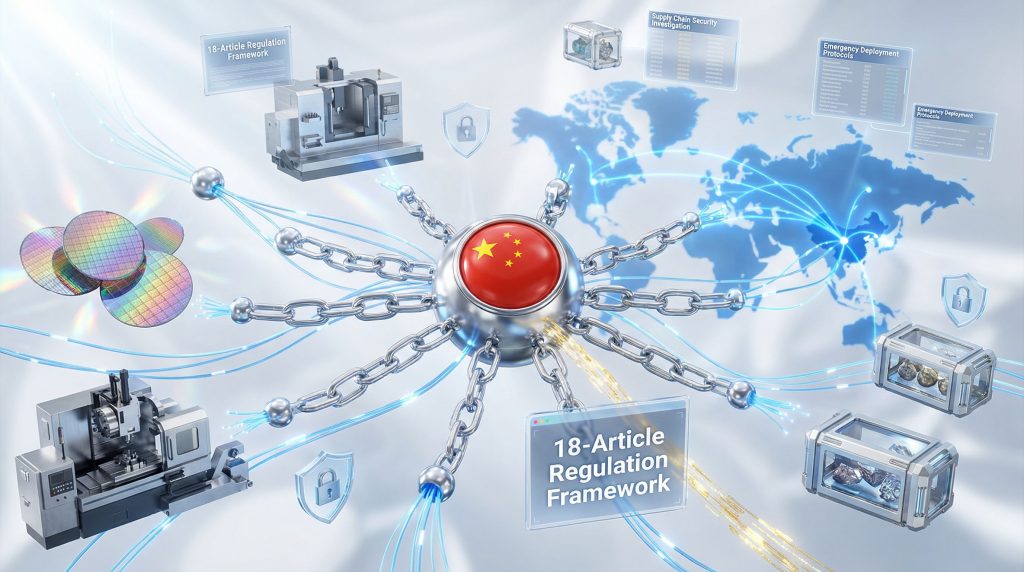
China's supply chain security rules establish a comprehensive 18-article framework that became effective on March 31, 2026. This regulation transforms supply chain protection from an economic policy issue into a national security priority, granting the State Council and related departments broad investigative and enforcement powers.
The regulatory structure creates multiple layers of oversight, with national authorities maintaining primary responsibility for strategic decision-making. Meanwhile, local governments handle operational implementation across different regions and sectors.
This multi-tiered approach enables rapid response capabilities during supply chain disruptions. However, it maintains centralised control over critical resource flows and strategic decision-making processes.
| Framework Component | Authority Level | Primary Function |
|---|---|---|
| Strategic Planning | State Council | Policy formulation and countermeasure authorisation |
| Risk Assessment | National Departments | Threat analysis and investigation initiation |
| Operational Implementation | Local Governments | Day-to-day monitoring and compliance enforcement |
| Emergency Response | Multi-level Coordination | Crisis management and resource deployment |
Critical Sector Classifications and Protection Scope
The regulation mandates the creation of comprehensive lists identifying sectors vital to China's economic and national security. While specific sector designations remain under development, the framework emphasises protection of raw materials, technologies, equipment, and finished products across key industries.
Consequently, the approach builds upon existing China export controls mechanisms whilst expanding protective measures across broader industrial sectors.
Strategic sectors requiring enhanced protection include those involving critical technologies, essential manufacturing capabilities, and resource-dependent industries that form the backbone of China's economic infrastructure.
The scope extends beyond traditional manufacturing to encompass:
• Technology transfer mechanisms and intellectual property flows
• Critical mineral extraction and processing capabilities
• Manufacturing equipment and specialised industrial machinery
• Energy infrastructure and alternative fuel technologies
• Pharmaceutical ingredients and medical device components
Emergency deployment protocols enable rapid mobilisation of strategic reserves during crisis situations. In addition, these reserves encompass both physical stockpiles and production capacity that can be activated when normal commercial channels face restrictions.
When big ASX news breaks, our subscribers know first
International Business Operation Transformations
Investigation and Countermeasure Protocols
Articles 14 and 15 of the regulation establish clear procedures for investigating external actions that potentially endanger China's industrial and supply chains. The State Council and related departments can initiate investigations when foreign entities implement discriminatory bans, restrictions, or suspend normal business transactions.
| Violation Type | Investigation Trigger | Potential Countermeasures |
|---|---|---|
| Discriminatory Trade Restrictions | Suspension of normal business transactions | Special charges on targeted entities |
| Technology Export Bans | Critical technology access limitations | Entry bans for responsible organisations |
| Supply Chain Disruptions | Intentional resource flow interruptions | Export restrictions on strategic materials |
| Regulatory Discrimination | Unequal treatment of Chinese entities | Reciprocal regulatory barriers |
The investigation process differentiates between actions taken by foreign governments versus private entities. This distinction enables proportionate responses based on the nature and scale of perceived threats.
Furthermore, this approach allows for diplomatic solutions when government policies create supply chain vulnerabilities. However, it maintains enforcement options against private sector discrimination affecting Chinese interests.
Multinational Corporation Compliance Requirements
Foreign companies operating within China's supply chain ecosystem face enhanced scrutiny and documentation requirements. The regulation creates potential restrictions on Chinese entity transactions with organisations flagged during security investigations.
This development fundamentally alters business relationship dynamics across international markets. Moreover, it reflects broader concerns about tariff economic implications affecting global trade patterns.
Compliance obligations include:
- Enhanced due diligence on supply chain partners and their government relationships
- Documentation of business continuity plans for critical resource flows
- Coordination with Chinese authorities during investigation proceedings
- Risk assessment protocols for technology transfer and resource sharing agreements
- Emergency response capabilities for supply chain disruption scenarios
Entry ban procedures and special charge impositions create significant compliance costs. Consequently, organisations must maintain appropriate business relationships whilst avoiding inadvertent participation in discriminatory practices against Chinese entities.
Economic Strategy and Resource Security
Strategic Reserve Development and Capacity Planning
China's supply chain security rules mandate comprehensive strategic reserve building across multiple categories. These reserves encompass both physical inventory stockpiles and production capacity that can be rapidly deployed during emergency situations.
| Reserve Category | Primary Function | Deployment Timeline |
|---|---|---|
| Physical Stockpiles | Immediate supply buffer | 0-30 days |
| Production Capacity | Medium-term supply security | 30-180 days |
| Technology Reserves | Long-term capability maintenance | 180+ days |
| Human Capital | Specialised skill preservation | Variable based on training requirements |
The risk early-warning system architecture integrates data collection from multiple sources. In addition, this creates comprehensive visibility into potential supply chain vulnerabilities across different industrial sectors.
This system enables proactive resource allocation and capacity planning before disruptions materialise. Furthermore, the importance of critical minerals security becomes apparent in these strategic planning initiatives.
Data sharing protocols between national and local authorities ensure coordinated response capabilities. However, these protocols maintain information security for sensitive strategic planning information and operational details.
Technology Independence and Innovation Investment
The regulation emphasises reducing technological bottlenecks through targeted research and development investments in critical sectors. This approach seeks to minimise dependence on external technology sources that could become unavailable during geopolitical tensions.
Closed-loop supply chain data management systems enable real-time monitoring of resource flows and identification of vulnerability points before they become critical failures.
Performance metrics for supply chain resilience assessment include:
• Technology substitution capabilities for critical components
• Alternative supplier development across key industries
• Production capacity utilisation during stress scenarios
• Resource flow continuity under various disruption conditions
• Emergency response coordination effectiveness measures
Global Supply Chain Policy Comparisons
International Regulatory Framework Analysis
China's supply chain security rules operate within a broader context of global supply chain protection initiatives. These measures reflect worldwide trends toward strategic autonomy and economic security prioritisation over pure efficiency optimisation.
| Policy Framework | Geographic Scope | Primary Focus | Enforcement Mechanism |
|---|---|---|---|
| China Supply Chain Security | National and international | Comprehensive sector protection | Countermeasures and reserves |
| US CHIPS and Science Act | Domestic with international implications | Semiconductor manufacturing | Subsidies and export controls |
| EU Strategic Autonomy Initiative | European Union | Critical infrastructure and technology | Investment screening and diversification |
| Japan Economic Security Strategy | National with alliance coordination | Technology and resource security | Public-private partnerships |
The reciprocal countermeasure principle distinguishes China's approach from unilateral sanctions regimes. This framework creates potential for escalating trade disputes whilst providing mechanisms for proportionate responses to perceived discriminatory actions.
Furthermore, these developments align with broader Trump critical minerals order initiatives affecting global resource allocation strategies and international trade relationships.
Geopolitical Context and Strategic Positioning
These regulations represent China's response to what Beijing perceives as discriminatory trade restrictions and technology bans implemented by other major economies. The timing coincides with increased global supply chain fragmentation and strategic competition between major economic blocs.
Industries experiencing heightened global supply chain tensions include:
• Semiconductor manufacturing and advanced chip technology
• Rare earth element processing and distribution
• Renewable energy components including solar panels and battery materials
• Telecommunications equipment and 5G infrastructure
• Artificial intelligence and quantum computing technologies
Integration with broader economic security initiatives creates comprehensive protection for strategic industries. However, it maintains flexibility for commercial relationships in less sensitive sectors and non-critical supply chain components.
Implementation Challenges and Practical Considerations
Administrative Coordination Complexity
The multi-level governance structure creates significant coordination challenges between national policy objectives and local implementation capabilities. Information sharing requirements must balance transparency needs with data security concerns for sensitive strategic planning information.
| Administrative Level | Primary Responsibilities | Coordination Challenges |
|---|---|---|
| State Council | Policy formulation and strategic direction | Inter-agency coordination and resource allocation |
| National Departments | Investigation and enforcement | Technical capacity and expertise requirements |
| Provincial Governments | Regional implementation and monitoring | Resource constraints and local economic impacts |
| Local Authorities | Day-to-day compliance and reporting | Information security and data management |
Resource allocation for monitoring and investigation activities requires substantial technical infrastructure and specialised personnel. The complexity of modern supply chains demands sophisticated analytical capabilities that may strain existing administrative capacity.
According to China's new supply chain security regulations, the implementation process involves extensive coordination between multiple government levels and regulatory agencies.
Business Compliance and Risk Management
Foreign companies must develop comprehensive compliance frameworks to navigate the new regulatory environment. Due diligence requirements extend beyond traditional commercial relationships to encompass political and security considerations.
Essential compliance steps include:
- Supply chain mapping to identify potential vulnerability points
- Partner screening for political and security risk factors
- Documentation systems for demonstrating compliance during investigations
- Emergency response planning for supply disruption scenarios
- Legal counsel engagement with expertise in Chinese security regulations
Documentation and reporting obligations require extensive record-keeping systems that can demonstrate business continuity planning and risk mitigation efforts throughout complex international supply chains.
Legal recourse options remain limited for entities subject to countermeasures. Consequently, this emphasises the importance of proactive compliance rather than reactive legal challenges after enforcement actions begin.
Long-term Strategic Implications
Supply Chain Restructuring Trends
The implementation of China's supply chain security rules will likely accelerate global supply chain diversification and regionalisation trends. Multinational corporations face pressure to develop alternative sourcing strategies that reduce dependence on single-country suppliers or customers.
| Sector | Restructuring Timeline | Primary Impact | Cost Implications |
|---|---|---|---|
| Semiconductors | 3-5 years | Manufacturing regionalisation | 15-25% cost increase |
| Critical Minerals | 5-10 years | Alternative source development | 10-20% cost increase |
| Renewable Energy | 2-4 years | Supply chain diversification | 5-15% cost increase |
| Pharmaceuticals | 3-7 years | Regional manufacturing capacity | 20-30% cost increase |
Diversification strategies require significant capital investment and operational reorganisation. Companies must balance cost efficiency with supply chain resilience whilst maintaining competitive positioning in global markets.
Key risk factors for different industry verticals include:
• Technology transfer restrictions affecting innovation partnerships
• Critical component dependencies creating vulnerability points
• Regulatory compliance costs reducing operational efficiency
• Market access limitations impacting revenue potential
• Intellectual property protection concerns in collaborative relationships
Adaptive Business Strategy Development
Organisations must develop dynamic compliance frameworks capable of evolving with changing regulatory requirements. Strategic planning processes should incorporate scenario analysis for various geopolitical and economic conditions.
Best practices for compliance preparation include developing flexible operational structures that can adapt to changing regulatory environments whilst maintaining business continuity and competitive advantages.
Integration with existing risk management frameworks enables comprehensive approach to supply chain security. This encompasses commercial, operational, and regulatory considerations across different business units and geographic regions.
Regular monitoring mechanisms help organisations anticipate policy updates and adjust strategies proactively. Furthermore, industrial supply chain security measures provide additional context for understanding implementation requirements.
The next major ASX story will hit our subscribers first
Frequently Asked Questions About China's Supply Chain Rules
Implementation Timeline and Immediate Effects
When did the regulations take effect and what triggered immediate compliance requirements?
The China supply chain security rules became effective on March 31, 2026, with the complete regulatory text published on April 8, 2026. The timing coincided with increased global supply chain uncertainty and geopolitical tensions affecting international trade relationships.
Immediate compliance requirements include enhanced documentation of supply chain relationships and risk assessment protocols. These apply to entities operating within or supplying to Chinese markets across various industrial sectors.
Organisations must demonstrate ongoing business continuity planning and emergency response capabilities. Furthermore, they must maintain comprehensive documentation systems for regulatory review and investigation purposes.
Which sectors face the most urgent adaptation requirements?
While specific sector designations continue to develop, industries involving critical technologies, strategic materials, and essential manufacturing capabilities face heightened scrutiny. Companies in semiconductor, renewable energy, telecommunications, and advanced manufacturing sectors should prioritise compliance framework development.
How do emergency deployment protocols activate during crisis situations?
Emergency protocols enable rapid mobilisation of strategic reserves and alternative supply sources when normal commercial channels face disruption. The State Council and related departments maintain authority to coordinate resource allocation and implement temporary measures to maintain supply chain continuity.
International Business Implications
What constitutes a discriminatory ban under the new regulatory framework?
Discriminatory actions include suspending normal business transactions, implementing unequal regulatory treatment, or restricting access to critical technologies based on national origin or political considerations. The regulation provides broad interpretation authority to Chinese officials for determining discriminatory intent.
How are foreign entities notified of investigation proceedings?
Investigation procedures follow established administrative law frameworks, though specific notification requirements remain subject to implementation guidance. Entities under investigation typically receive formal notification through diplomatic channels or direct regulatory communication.
What appeal mechanisms exist for countermeasure decisions?
Limited appeal options exist within China's administrative law framework, though diplomatic channels may provide alternative dispute resolution mechanisms. The emphasis on national security considerations restricts traditional commercial arbitration options for contested decisions.
Disclaimer: This analysis is based on publicly available regulatory information and should not be considered legal advice. Organisations should consult qualified legal counsel for specific compliance guidance.
Looking to Capitalise on China's Supply Chain Restructuring?
Discovery Alert's proprietary Discovery IQ model delivers real-time alerts on significant ASX mineral discoveries, instantly empowering investors to identify actionable opportunities as global supply chains shift toward critical minerals security. With major economies prioritising resource independence, explore how historic mineral discoveries have generated substantial returns and begin your 14-day free trial today to position yourself ahead of the market.