July 16, 2026
Inside the Race to Control Argentina's Lithium Brine Reserves
The global competition for battery-grade lithium supply has entered a new phase, one defined less by exploration risk and more by the strategic acquisition of assets that already carry defined resources and completed technical studies. Across the Lithium Triangle spanning northwestern Argentina, northern Chile, and southwestern Bolivia, the scramble for large-scale brine tenure has intensified dramatically as industrial buyers from Asia seek to lock in long-duration feedstock outside their domestic supply chains. The China Union Holdings Arizaro lithium project transaction is one of the clearest expressions of this trend playing out in real time.
When big ASX news breaks, our subscribers know first
What the Arizaro Asset Actually Represents
Not all lithium projects are created equal, and understanding why Arizaro has attracted a nine-figure acquisition price requires unpacking what separates a genuinely de-risked brine asset from the hundreds of speculative plays scattered across the Andean altiplano.
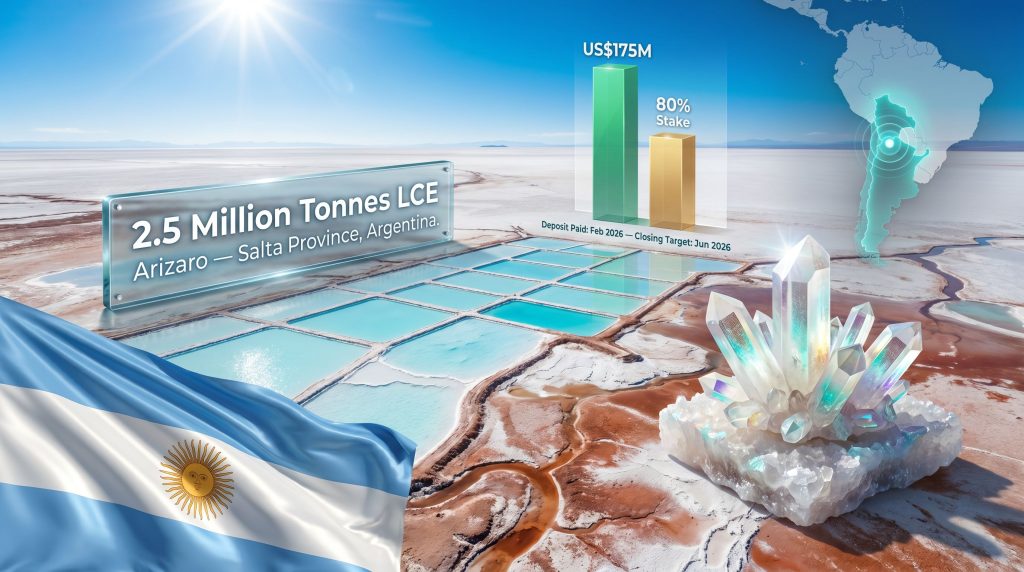
Located in Salta Province within northwestern Argentina, the Arizaro salar sits firmly within the heart of the Lithium Triangle corridor. The project covers approximately 205 square kilometres of contiguous brine-bearing tenure, a meaningful footprint that matters enormously when it comes to the hydrogeological continuity that underpins long-term brine extraction. Fragmented or non-contiguous tenure creates complications around resource definition, water rights, and ultimately the economics of evaporation pond infrastructure.
The resource base has been formally classified at approximately 2.5 million tonnes of lithium carbonate equivalent (LCE) across measured and indicated categories. That distinction is important. Measured and indicated resources have been subjected to a higher standard of drill-hole density and geological modelling than inferred resources, meaning the confidence level attached to these tonnage and grade estimates is substantially greater. For industrial acquirers building supply chain scenarios, this classification carries genuine bankability implications.
Critically, Arizaro has advanced through a pre-feasibility study (PFS), positioning it firmly beyond the exploration stage. A PFS converts the resource estimate into preliminary mine design scenarios complete with indicative capital expenditure, operating cost projections, and processing route assessments. It is the technical gateway between exploration and committed development capital, and its completion at Arizaro removes a layer of uncertainty that would otherwise deter large-scale industrial buyers.
The intended product form is battery-grade lithium carbonate, the chemical specification required by cathode active material manufacturers producing lithium iron phosphate (LFP) and nickel manganese cobalt (NMC) battery chemistries. This matters because not all lithium end-uses demand the same purity levels; battery-grade carbonate commands a premium over technical-grade material and requires tighter process control throughout the brine concentration and purification chain. The broader lithium carbonate market continues to evolve rapidly as battery demand scales globally.
Transaction Structure and Deal Mechanics
The acquisition involves China Union Holdings purchasing an 80% ownership stake in Argentum Lithium S.A., the Argentine-registered corporate vehicle that holds the Arizaro project outright. The agreed consideration sits at approximately US$175 million, implying a total project valuation of roughly US$218 million on a 100% basis.
The seller is Lithium Chile, a Toronto-listed exploration and development company that had controlled the asset and shepherded it through the PFS stage. According to reporting on the Arizaro sale, the transaction was initially announced in late 2025, with a US$5 million deposit paid by China Union to Lithium Chile in February 2026. The targeted closing date is June 2026, subject to the completion of outstanding conditions.
| Milestone | Timing | Status |
|---|---|---|
| Acquisition agreement announced | Late 2025 | Completed |
| Deposit payment | February 2026 | Completed |
| Shareholder approval (Lithium Chile) | Pending | Outstanding |
| Regulatory clearances | Pending | Outstanding |
| Targeted transaction close | June 2026 | Subject to approvals |
The share purchase agreement has been formally lodged on SEDAR+, Canada's public filing platform for securities disclosures, providing transparency around the deal's structural terms. However, until shareholder votes have been cast and applicable regulatory reviews finalised across relevant jurisdictions, the transaction remains legally incomplete.
Why Chinese Industrial Capital Is Targeting South American Brine Systems
China Union Holdings reportedly began pivoting toward lithium-related technologies and supply chain assets around 2023, a strategic repositioning that reflects broader pressures facing Chinese battery and electric vehicle manufacturers seeking to secure non-domestic upstream supply.
The logic behind brine-focused acquisition in the Argentina lithium brine market specifically rests on several interconnected factors that are not always well understood outside specialist circles:
-
Cost structure advantages: Brine-based lithium extraction, particularly where solar evaporation ponds can be employed at high-altitude, low-humidity environments like the Puna plateau, carries structurally lower operating costs than hard rock spodumene mining and conversion. Evaporation is powered by solar energy rather than fossil fuels, reducing operating expenditure per tonne of LCE produced.
-
Product flexibility: Brine operations can produce both lithium carbonate and lithium hydroxide depending on downstream processing configurations, giving operators flexibility to serve different battery chemistry markets as demand profiles evolve.
-
Argentina's investment framework: Unlike Chile, where the state retains significant co-participation rights in lithium through CORFO and the newly established National Lithium Company structure, Argentina's mining governance is decentralised to the provincial level. Salta Province retains its own permitting authority, and the country has historically permitted majority foreign ownership of mining assets, making deal structures like the Arizaro acquisition achievable without mandatory state equity participation.
-
Resource inventory depth: The Argentine portion of the Lithium Triangle contains dozens of underdeveloped salars with limited modern technical work completed, providing a pipeline of future acquisition targets for offshore capital with patient investment horizons.
This pattern of upstream acquisition is not opportunistic. It reflects a deliberate multi-year strategy to embed Chinese capital into the lowest-cost, largest-scale brine systems before they reach production-ready status, at which point valuations rise substantially.
Furthermore, among the largest lithium reserve countries, Argentina stands out for its combination of resource scale and relative regulatory accessibility, making it a preferred destination for strategic capital of this kind.
The Technical Case for Arizaro's Development Pathway
How Does Brine Hydrogeology Affect Project Value?
One aspect of brine lithium projects that receives insufficient attention in mainstream coverage is the hydrogeological complexity underlying resource definition. Brine aquifers in Andean salars are not uniform reservoirs. They exist within halite-dominated nuclei and marginal facies zones with varying porosity, permeability, and lithium concentration gradients.
The spatial distribution of high-grade brine within a salar footprint is a function of geological history, recharge dynamics, and evaporite stratigraphy that can take years of drilling and pump testing to characterise adequately. Understanding how lithium brine mining works is therefore essential context for evaluating why Arizaro's measured and indicated classification carries such weight with industrial acquirers.
Arizaro's measured and indicated resource classification implies that this characterisation work has been conducted to a standard sufficient to underpin mine planning. The PFS would have required brine grade data, aquifer transmissivity estimates, and sustainable yield assessments to produce credible capital and operating cost projections.
Conventional Evaporation vs. DLE: Which Path Forward?
The extraction methodology under consideration encompasses both conventional solar evaporation and potentially direct lithium extraction technology. These represent meaningfully different process economics:
-
Conventional solar evaporation concentrates brine over 12 to 24 months in a series of pond stages, progressively precipitating impurities before the lithium-enriched solution reaches a processing plant. It is proven, low-cost, but slow and dependent on climatic conditions.
-
DLE technology uses selective sorbents, membranes, or ion exchange resins to extract lithium directly from raw brine without multi-month pond residence times. Recovery rates can exceed 90% compared to 40–60% for conventional evaporation, and the process returns depleted brine to the aquifer, reducing net water consumption. However, DLE at commercial scale remains capital-intensive and operationally complex, with only a handful of projects demonstrating full-scale viability as of 2025–2026.
The integration of DLE with Argentine brine chemistry, which often contains elevated magnesium-to-lithium ratios that complicate conventional evaporation, could be particularly significant for Arizaro's long-term process design.
Scenario Pathways: What Happens After Closing
Assuming the transaction reaches its June 2026 target, China Union Holdings faces three credible strategic pathways, each with different capital implications and timelines:
Scenario 1: Accelerated Development
China Union advances Arizaro through a definitive feasibility study (DFS) and into construction, targeting first lithium carbonate production within four to six years post-acquisition. Offtake would logically flow to Chinese battery manufacturers under long-term supply agreements. This scenario requires sustained capital commitment in a period when lithium carbonate prices remain well below 2022–2023 peak levels.
Scenario 2: Strategic Optionality
The project is maintained at a care-and-maintenance or low-spend level while lithium market conditions are monitored. This preserves the asset without committing major development capital until prices recover to incentive levels that justify DFS expenditure. Given that lithium carbonate spot prices fell from above US$80,000 per tonne in late 2022 to below US$15,000 per tonne by early 2025, patience may be commercially rational.
Scenario 3: Capital Partnership
China Union retains operational control while bringing in a co-investor, potentially a Japanese, Korean, or European battery supply chain participant, to share DFS and construction capital in exchange for offtake rights. This reduces China Union's net capital exposure while maintaining strategic influence over the project's development trajectory.
The next major ASX story will hit our subscribers first
Risk Factors Investors and Observers Should Monitor
No resource acquisition of this scale is without material risk. Several factors warrant careful attention:
-
Water access and environmental permitting in Salta Province's high-altitude Puna region are evolving. Indigenous community consultation requirements under Argentine law, combined with growing scrutiny of brine extraction's impact on fragile wetland ecosystems like flamingo breeding grounds in adjacent salars, are creating longer permitting timelines for new projects.
-
Lithium price uncertainty remains the dominant commercial variable. A US$175 million acquisition price for an 80% stake must be justified against realistic long-run lithium carbonate price assumptions, and current market conditions compress the internal rate of return for projects still several years from production.
-
Transaction completion risk is non-trivial. Shareholder votes can produce unexpected outcomes, and multi-jurisdictional regulatory reviews introduce timeline variability that can affect financing arrangements and strategic momentum.
-
Geopolitical dynamics around Chinese ownership of critical mineral assets in Latin America are shifting incrementally. While Argentina's current regulatory environment is permissive, policy continuity across government transitions cannot be assumed.
In addition, Lithium Chile's announcement of the US$5 million deposit underscores the seriousness of China Union's commitment, though it does not eliminate the regulatory and shareholder hurdles that remain outstanding before the China Union Holdings Arizaro lithium project transaction can be considered finalised.
Argentina vs. Peer Jurisdictions: A Comparative Framework
| Factor | Argentina | Chile | Bolivia |
|---|---|---|---|
| Foreign ownership | Majority ownership permitted | State co-participation required | Nationalised; restricted |
| Provincial vs. federal control | Provincial (more flexible) | National (structured) | Centralised |
| Chinese investment activity | High and accelerating | Moderate | Minimal |
| Brine resource scale | Very large, mostly undeveloped | Large, mature projects | Largest globally, underdeveloped |
| Development risk profile | Medium | Low to medium | High |
| DLE applicability | High potential | Moderate | High potential |
Frequently Asked Questions
What is the Arizaro lithium project?
Arizaro is a lithium brine development project in Salta Province, Argentina, covering approximately 205 square kilometres within the Lithium Triangle. It holds an estimated resource of around 2.5 million tonnes LCE in measured and indicated categories, with a pre-feasibility study completed.
Who is buying the Arizaro project?
China Union Holdings has agreed to acquire an 80% stake in Argentum Lithium S.A., the entity holding the project, from Lithium Chile for approximately US$175 million.
Has the acquisition closed?
As of mid-2026, the transaction remains pending. A US$5 million deposit was paid in February 2026, with closing targeted for June 2026 subject to shareholder and regulatory approvals.
What product will Arizaro produce?
The project is designed to produce battery-grade lithium carbonate for use in lithium-ion cathode manufacturing.
What extraction technology will be used?
The project is amenable to both conventional solar evaporation and potentially direct lithium extraction technology, which offers higher recovery rates and reduced water consumption compared to traditional pond-based methods. Consequently, the China Union Holdings Arizaro lithium project may represent one of the more technically versatile brine developments currently advancing through the acquisition pipeline in South America.
Disclaimer: This article is intended for informational purposes only and does not constitute financial or investment advice. Forward-looking statements, scenario projections, and market forecasts involve inherent uncertainty. Readers should conduct independent due diligence before making any investment decisions related to lithium markets or the companies discussed.
Want to Stay Ahead of the Next Major Mineral Discovery on the ASX?
Discovery Alert's proprietary Discovery IQ model delivers real-time alerts on significant ASX mineral discoveries — including lithium and other battery metals — instantly translating complex resource data into actionable investment insights for both short-term traders and long-term investors. Explore how historic mineral discoveries have generated substantial returns and begin your 14-day free trial today to position yourself ahead of the broader market.