May 21, 2026
Why Pegmatite Geology Is Redefining the Western Battery Supply Chain
The global race to secure lithium for electric vehicle batteries has fundamentally shifted the economics of hard-rock mining. For decades, brine-based lithium extraction from South American salars dominated production economics, but the calculus has changed. Western battery manufacturers and governments alike are increasingly prioritising supply chain sovereignty, and spodumene lithium extraction from pegmatite deposits in politically stable jurisdictions has become the geological backbone of that strategy.
Quebec's James Bay region sits at the intersection of two powerful forces: exceptional pegmatite geology inherited from Archean-age crustal sequences, and proximity to North American manufacturing corridors hungry for domestically sourced critical minerals. Within this context, the PMT Resources Shaakichiuwaanaan lithium drill campaign represents far more than a routine exploration program. It is a high-stakes technical de-risking exercise at one of the most significant lithium pegmatite systems in the Western Hemisphere.
When big ASX news breaks, our subscribers know first
Shaakichiuwaanaan in Global Context: Scale, Geology, and Strategic Positioning
Quebec's Pegmatite Geology and Its Global Peers
The James Bay Lowlands and surrounding Archean cratons host a class of lithium-caesium-tantalum (LCT) pegmatites that geologists increasingly regard as among the most resource-endowed on the planet. These formations, which crystallised from evolved granitic melts approximately 2.6 to 2.7 billion years ago, are notable for their exceptional lithium enrichment and the presence of commercially significant by-product minerals including caesium-bearing pollucite and tantalite-columbite.
Compared to other major pegmatite terranes globally, including Western Australia's Pilbara and Yilgarn cratons, Zimbabwe's Bikita district, and Portugal's Barroso region, Quebec's James Bay corridor stands out for deposit scale and the relative absence of complex processing challenges. Furthermore, countries holding the largest lithium reserves are increasingly competing with Canada's James Bay corridor for strategic investment. Shaakichiuwaanaan specifically hosts what is considered one of the top 10 largest lithium pegmatite mineral resources in the world, a distinction with direct implications for mine life, capital efficiency, and attractiveness to large-scale offtake partners.
PMT Resources: From Explorer to Development-Stage Developer
PMT Resources (ASX: PMT) holds the Shaakichiuwaanaan project approximately 220 kilometres east of Radisson, Quebec, in Canada's northern mining corridor. With a market capitalisation of $121.3 million as of May 2026, the company sits at a pivotal inflection between exploration-stage and development-stage status, a transition that carries very different risk profiles for investors.
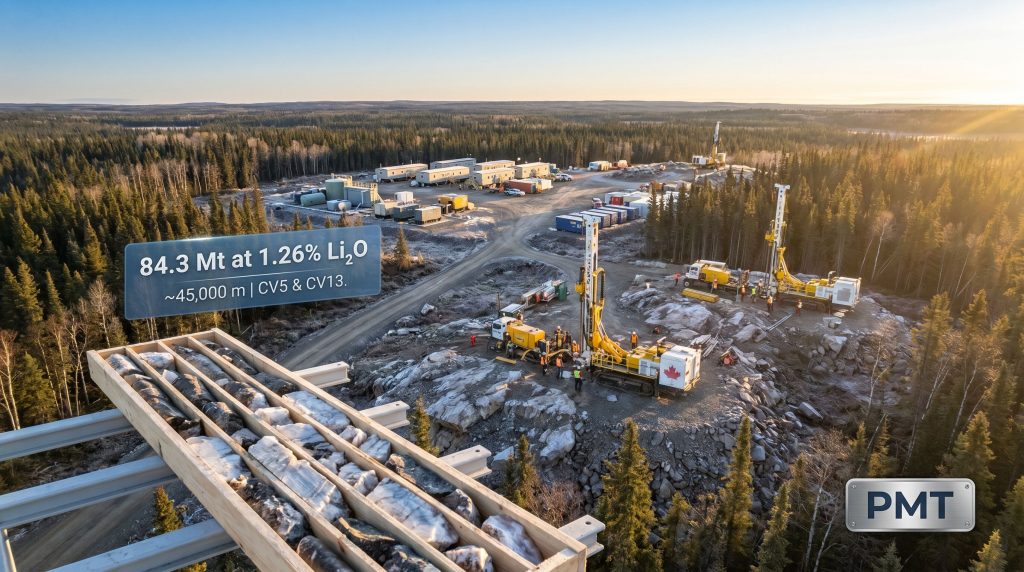
At the exploration stage, value is driven primarily by geological discovery. At the development stage, value is increasingly anchored to engineering certainty, resource confidence, and regulatory progress. The commencement of the PMT Resources Shaakichiuwaanaan lithium drill campaign in May 2026 marks a deliberate step into this second phase, with the bulk of the 45,000-metre program oriented toward generating the technical datasets required to support feasibility updates and, ultimately, a Final Investment Decision (FID).
How the 2026 Drill Program Is Engineered for Maximum Technical Output
Program Architecture at a Glance
The sheer scale of this program warrants careful examination. At approximately 45,000 metres planned through to October 2026, using between four and eight drill rigs simultaneously, this is not an exploration campaign in the conventional sense. It is an engineering data-gathering exercise that happens to use drilling as its primary tool.
| Parameter | Detail |
|---|---|
| Total Drill Metres | ~45,000 m |
| Campaign Duration | Through to October 2026 |
| Number of Drill Rigs | 4 to 8 rigs |
| Primary Targets | CV5 and CV13 pegmatites |
| CV5 Allocation | ~25,000 m |
| CV13 Allocation | ~18,000 m |
| Campaign Phase | Pre-Final Investment Decision (FID) |
One of the less-appreciated efficiencies built into this program architecture is the deliberate engineering of individual drill holes to serve multiple technical objectives simultaneously. A single hole drilled through competent pegmatite at a proposed infrastructure site might simultaneously:
- Confirm the absence of economic mineralisation beneath the planned footprint (condemnation purpose)
- Collect core samples for geotechnical analysis of rock mass strength
- Provide groundwater data through packer testing for hydrogeological modelling
- Yield material for metallurgical testing or bulk sample programme design
This multi-objective approach substantially improves the cost-per-data-point efficiency of large pre-feasibility to feasibility transition programs. In addition, understanding drill results interpretation is essential to appreciating how these datasets translate into resource confidence upgrades.
Geotechnical and Hydrogeological Drilling: The Underappreciated Workhorses
While resource drilling captures investor attention, geotechnical and hydrogeological programs are arguably more consequential for mine economics. Geotechnical drilling defines rock mass quality parameters including Rock Quality Designation (RQD), uniaxial compressive strength, and joint orientation data that directly feed into pit slope angle calculations and underground opening stability assessments.
A steeper permissible pit wall angle can reduce waste stripping ratios dramatically, with flow-through effects on capital and operating cost estimates. Conversely, overly optimistic geotechnical assumptions are a common source of cost overruns in open-pit mining feasibility studies.
Hydrogeological drilling maps aquifer systems and groundwater pressure regimes, data that is simultaneously critical for:
- Designing the dewatering infrastructure required to keep open-pit benches dry
- Quantifying potential mine water management obligations for environmental permitting
- Assessing long-term water supply availability for processing plant operations
Hydrogeological data collected during pre-feasibility drilling is among the most frequently cited gaps in failed or delayed mining feasibility studies globally. Projects that invest in comprehensive groundwater characterisation early routinely experience fewer cost surprises at the bankable feasibility stage.
CV5 Pegmatite: The Production Anchor Underpinning the Feasibility Case
What the 2025 Feasibility Study Established
The positive CV5 feasibility study for the CV5 pegmatite delivered several metrics that underpin the project's development credentials:
- Maiden Probable Mineral Reserve: 84.3 million tonnes at 1.26% Li₂O
- Planned ore throughput of approximately 12,000 tonnes per day
- Projected mine life of approximately 19 years
- Hybrid open-pit and underground mining configuration
The designation of this as a lithium-only study is significant and somewhat underappreciated. It means the economic modelling excluded potential revenue contributions from caesium and tantalum by-products, which are present in the broader Shaakichiuwaanaan system. Future study iterations incorporating by-product credits could materially improve the project's net present value and reduce its effective lithium production cost.
What the ~25,000 Metre CV5 Allocation Is Designed to Achieve
The allocation of roughly 25,000 metres to CV5 is calibrated to support the updated feasibility study and associated detailed engineering work. Key objectives include:
- Infill drilling to upgrade inferred resource tonnes to the measured and indicated categories required for reserve declarations
- Geotechnical hole programs targeting both open-pit wall sectors and planned underground development headings
- Bulk sample design drilling to collect representative material across multiple mineralogical domains for processing test work
- Condemnation holes confirming that proposed processing plant and tailings facility footprints are free of economic mineralisation
The 1.26% Li₂O grade that underpins the maiden reserve is considered robust for a large-tonnage hard-rock operation. By way of comparison, several operating Australian spodumene mines operate at feed grades in the 1.0 to 1.4% Li₂O range, suggesting CV5 sits comfortably within the economic envelope of established industry benchmarks.
CV13 and Exploration Upside: Blue-Sky Within a Development Framework
CV13's Strategic Role and the ~18,000 Metre Allocation
While CV5 is the production anchor, CV13 occupies a different but complementary strategic role. The approximately 18,000 metres allocated to CV13 encompasses geotechnical, hydrogeological, infill, step-out, and condemnation drilling objectives, mirroring the multi-purpose architecture applied to CV5.
CV13 drilling will focus on lifting resource confidence categories to support any future expansion of the mine plan beyond the current CV5-anchored production schedule. Higher confidence resource classification at CV13 would provide optionality for:
- Extending mine life beyond the current 19-year CV5 schedule
- Justifying higher mill throughput capacity in updated capital cost estimates
- Potentially supporting additional reserve declarations ahead of FID
The Vega Zone and CV5-to-CV4 Corridor: Exploration Vectors Worth Watching
Two areas within the broader property warrant particular attention from an exploration upside perspective. The Vega Zone, proximal to CV13, has returned caesium mineralisation in addition to lithium-bearing pegmatite intersections. Given that caesium, primarily sourced from the mineral pollucite, commands exceptionally high prices in specialty chemicals and high-technology applications and has an extremely limited global supply base, even modest pollucite intersections at Vega carry potential economic significance.
The CV5-to-CV4 corridor represents a second exploration vector, targeting the potential for additional pegmatite bodies along the structural trend connecting the two known deposits. Step-out drilling along these corridors is inherently speculative, but the geological rationale is sound given the well-documented tendency of LCT pegmatite swarms to occur in spatially clustered, structurally controlled arrays.
Furthermore, multiple new lithium-caesium discoveries from 2025 drilling at the Shaakichiuwaanaan property have added considerable momentum to the exploration narrative. Speculative note: The presence of caesium mineralisation at the Vega, Rigel, and Helios zones could, if confirmed at scale, position Shaakichiuwaanaan as a multi-commodity asset with a revenue profile materially different from a single-commodity lithium mine. This remains a prospective scenario pending further drilling and is not reflected in current feasibility economics.
By-Product Economics: Why Caesium and Tantalum Could Change the Project's Financial Profile
The LCT Pegmatite By-Product Advantage
Hard-rock LCT pegmatites are geochemically distinctive in their enrichment of lithium, caesium, and tantalum as a coherent geochemical suite. This is not coincidental: these elements preferentially partition into late-stage pegmatite melts through a process of fractional crystallisation, concentrating progressively as the melt evolves. The practical consequence is that a highly evolved LCT pegmatite system often hosts economic concentrations of all three elements within the same geological package.
Tantalum by-product credits have historically reduced the effective cash cost of lithium production at several operating pegmatite mines, most notably in Western Australia. Caesium, extracted from pollucite, is a smaller but extremely high-value market. Global caesium production is dominated by just a handful of operations worldwide, and Shaakichiuwaanaan's caesium occurrences at multiple named zones warrant careful evaluation in future study iterations.
However, it is worth noting that alternative approaches such as direct lithium extraction and lithium brines remain competing production pathways that hard-rock developers must continue to benchmark against in terms of cost and scalability.
The lithium-only framing of the 2025 feasibility study should be understood as a conservative baseline, not a ceiling. By-product incorporation in future economic studies represents a potential but unquantified upside lever.
The next major ASX story will hit our subscribers first
Regulatory Progress: The Federal Impact Assessment Dimension
The IAAC Process and Its Intersection With Technical Milestones
Canada's federal Impact Assessment Agency of Canada (IAAC) review process applies to projects that meet designated thresholds for environmental significance, typically including large-scale mine developments in sensitive ecological zones. As of April 2026, Shaakichiuwaanaan entered a public and Indigenous consultation phase under this framework, an important procedural milestone that runs in parallel with the ongoing technical drilling program.
The data generated by the 2026 drill program, particularly hydrogeological and geotechnical datasets, will feed directly into the environmental impact statement submissions required to advance through the IAAC process. This creates a tight and deliberate alignment between the technical and regulatory workstreams: the drilling program is not merely a geological exercise but a regulatory data-gathering mission as well.
Indigenous engagement in Quebec's northern mining corridor carries particular significance given the legal requirements for consultation and accommodation that arise under Canadian constitutional frameworks. Progress on this dimension is a substantive project risk factor that operates independently of geological and technical outcomes.
Camp Recommissioning: Operational Readiness as a Development Signal
What a Smooth Restart Tells Investors
Ahead of the 2026 drill campaign launch, PMT Resources successfully recommissioned the Shaakichiuwaanaan Camp, completing all critical restart activities safely and ahead of schedule. Systems restored to operational status included power generation infrastructure, camp heating systems, water treatment facilities, and the full suite of operational support services required to sustain a multi-rig drilling operation in a remote subarctic environment.
The completion of this restart without any health and safety incidents is not a trivial achievement. Remote mining camp operations in northern Quebec present genuine logistical complexity, including seasonal access limitations, extreme temperature exposure, and the challenge of maintaining technical systems through extended winter standby periods. A smooth recommissioning signals competent project management and operational readiness that extends beyond pure geological capability.
For investors assessing development-stage mining companies, operational execution at this level of detail is a meaningful indicator of management's capacity to deliver complex projects within cost and schedule frameworks.
Key Milestones and Forward Timeline
| Milestone | Status / Target Date |
|---|---|
| 2025 Lithium-Only Feasibility Study (CV5) | Completed |
| Maiden Probable Mineral Reserve (84.3 Mt @ 1.26% Li₂O) | Declared |
| Shaakichiuwaanaan Camp Recommissioning | Completed (ahead of schedule) |
| 2026 Summer-Fall Drill Campaign Launch | Commenced May 2026 |
| IAAC Public Consultation Phase | April 2026 |
| 2026 Drill Campaign Completion | October 2026 |
| Updated Feasibility Study | Post-campaign (TBC) |
| Final Investment Decision (FID) | Subject to study and permitting outcomes |
Frequently Asked Questions: PMT Resources Shaakichiuwaanaan Lithium Project
What is the Shaakichiuwaanaan lithium project?
Shaakichiuwaanaan is a large-scale lithium pegmatite project located approximately 220 kilometres east of Radisson in northern Quebec, Canada. Owned and operated by ASX-listed PMT Resources, it hosts one of the top-ranked lithium pegmatite mineral resources globally and is currently advancing through the pre-FID technical de-risking phase anchored by the CV5 and CV13 pegmatite deposits.
What is the 2026 drill campaign targeting at Shaakichiuwaanaan?
The PMT Resources Shaakichiuwaanaan lithium drill campaign covers approximately 45,000 metres across both CV5 and CV13, with drilling objectives spanning geotechnical characterisation, hydrogeological mapping, resource infill and step-out, condemnation of infrastructure sites, and bulk sample programme design. The campaign is expected to conclude in October 2026.
What is the mineral reserve at CV5?
CV5 holds a maiden probable mineral reserve of 84.3 million tonnes at 1.26% Li₂O, declared as part of the 2025 lithium-only feasibility study. This underpins a planned 19-year mine life at approximately 12,000 tonnes per day throughput using a hybrid open-pit and underground mining configuration.
How large is the Shaakichiuwaanaan lithium resource globally?
Shaakichiuwaanaan is considered one of the top 10 largest lithium pegmatite mineral resources in the world, a distinction that carries significant implications for long-term mine economics, capital efficiency, and attractiveness to battery supply chain partners seeking large-volume, long-duration offtake agreements.
What is a Final Investment Decision and when might PMT reach it?
A Final Investment Decision is the formal commitment by a company's board to proceed with full project construction and development, typically contingent on a completed bankable feasibility study, secured financing, and advanced permitting status. For Shaakichiuwaanaan, the FID pathway depends on the outcomes of the 2026 drill campaign, an updated feasibility study incorporating its datasets, and satisfactory progress through the IAAC regulatory process.
What by-products does Shaakichiuwaanaan contain beyond lithium?
In addition to lithium-bearing spodumene, the project contains caesium mineralisation in the form of pollucite at the Vega, Rigel, and Helios zones, as well as tantalum mineralisation. Neither by-product is currently incorporated into the project's feasibility economics, meaning any future study that includes these revenue streams could improve the overall financial profile of the development.
Where is Shaakichiuwaanaan located?
The project is situated in northern Quebec, Canada, approximately 220 kilometres east of Radisson. Access to the site is subject to seasonal and logistical constraints typical of subarctic Canadian mining operations.
From Geological Confidence to Engineering Certainty: What the 2026 Campaign Must Deliver
The fundamental challenge facing any large-scale mining project at the pre-FID stage is the conversion of geological confidence, expressed through resource classification, into engineering certainty, expressed through bankable feasibility assumptions. These are not the same thing, and the gap between them is where the majority of development-stage mining projects either succeed or stall.
The 45,000-metre PMT Resources Shaakichiuwaanaan lithium drill campaign is architected precisely to close that gap across both CV5 and CV13. By simultaneously advancing geotechnical, hydrogeological, resource, and condemnation objectives within a single integrated campaign, the program is designed to generate the full suite of datasets required to update feasibility assumptions and advance the regulatory process.
Consequently, what successful execution of this program would mean in practical terms is straightforward: a technically robust, data-dense updated feasibility study capable of supporting a financing process, an FID, and ultimately the construction of what could become one of Canada's most significant lithium mining operations. The geological endowment is not in question. What the 2026 program is designed to prove is that the engineering and environmental frameworks can convert that endowment into a viable, financeable mine.
This article is for informational purposes only and does not constitute financial advice. Readers should conduct their own due diligence and consult a licensed financial adviser before making any investment decisions. Forward-looking statements and projections referenced herein are subject to material risks, uncertainties, and assumptions that may cause actual results to differ materially from those anticipated.
Want to Stay Ahead of the Next Major Lithium Discovery on the ASX?
Discovery Alert's proprietary Discovery IQ model delivers real-time alerts the moment significant mineral discoveries — including lithium pegmatite projects like those reshaping the Western battery supply chain — are announced on the ASX, transforming complex geological data into actionable investment insights. Explore how historic discoveries have generated substantial returns by visiting Discovery Alert's dedicated discoveries page, and begin your 14-day free trial today to position yourself ahead of the broader market.