August 4, 2026
The Clean Energy Supply Chain's Hidden Nuclear Variable
Every tonne of cobalt that leaves the Democratic Republic of Congo carries with it the chemistry of one of the planet's most geologically unusual ore bodies. In most mining regions, target minerals sit in relative isolation. In the Katanga province of southeastern DRC, they do not. Cobalt, copper, and uranium share the same polymetallic ore system, and this is where the issue of China uranium from DR Congo begins to take on profound significance. It was this same Katangan geology that supplied the United States with uranium for its wartime nuclear weapons programme.
Eight decades later, a detailed investigative report co-published by Lighthouse Reports and the Financial Times has raised a deeply consequential possibility: that China has been receiving uranium from this same region for more than twenty years, not through any declared nuclear trade, but embedded silently within cobalt hydroxide exports destined for battery supply chains.
Understanding how this could occur, and what it means for nuclear security, requires stepping inside the geochemistry of cobalt processing itself.
When big ASX news breaks, our subscribers know first
Katanga's Polymetallic Ore System: Why Uranium Is Not an Anomaly Here
The Geological Architecture of the Copper Belt
The Katanga copper belt sits at the southern tip of the DRC and extends into Zambia, forming one of the world's most mineralogically dense sedimentary ore systems. The extraordinary DRC mineral wealth found here is unlike granite-hosted uranium deposits found elsewhere; Katangan uranium occurs as a co-constituent of stratiform copper-cobalt mineralisation. This means uranium is not a peripheral contaminant but a structural feature of the ore body itself.
The Shinkolobwe mine, formally closed by presidential decree in 2004, is the most historically significant site within this corridor. It supplied the uranium used in the Manhattan Project's atomic bombs dropped on Hiroshima and Nagasaki. While Shinkolobwe itself is officially inactive, the broader Katangan ore system remains commercially exploited for cobalt and copper, and the uranium content of that ore has not diminished simply because the primary extraction target changed.
Why the DRC's Export Ban Created a Regulatory Blind Spot
The DRC has maintained an indefinite prohibition on commercial uranium exports for more than two decades. On paper, this should have created an impenetrable barrier to nuclear material leaving the country. In practice, however, the ban was constructed around the concept of intentional uranium trade. It was not designed to account for uranium that departs the country chemically bonded within cobalt hydroxide, a commodity classified under international trade law as a battery-sector input rather than a nuclear material.
This distinction between deliberate uranium export and uranium as an undeclared mineral constituent is the regulatory fracture at the centre of the investigation's findings. Furthermore, cobalt hydroxide is not subject to International Atomic Energy Agency safeguards declarations, nuclear export licensing, or radiological monitoring applied to yellowcake or uranium oxide. The material simply moves through commodity channels as if its uranium content does not exist.
The DRC cobalt export policy has consequently created an unintended blind spot, where uranium moves freely under the guise of battery-sector trade.
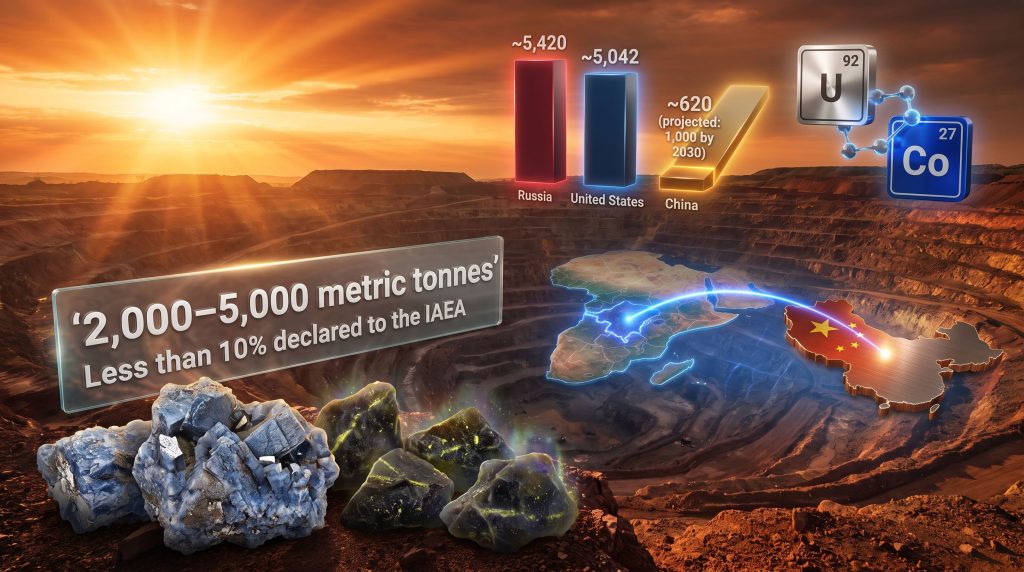
According to findings cited in the investigation, less than 10% of the estimated uranium volume that left the DRC through cobalt trade flows appears to have been formally declared to the IAEA over the relevant period.
How Uranium Travels Inside a Cobalt Supply Chain
The Processing Step That Determines Everything
When cobalt ore is extracted from Katangan mines, it undergoes initial processing to produce cobalt hydroxide, the standard semi-refined intermediate form in which the material is exported in bulk. This processing step is critical to understanding the uranium pathway.
Uranium separation from cobalt ore requires the application of phosphoric acid as a chemical reagent in a specific extraction process. If mines perform this separation, uranium is retained domestically or disposed of under regulatory oversight. If they do not, uranium remains chemically integrated within the hydroxide concentrate and exits the country with the cobalt shipment.
Researchers from the University of Wisconsin and Princeton University applied this logic as a diagnostic test. By examining whether mines in the Katanga region were importing phosphoric acid in quantities consistent with industrial uranium extraction, they could infer whether uranium separation was occurring. The finding was unambiguous: no evidence emerged that these mines were procuring the chemical volumes necessary for separation at scale. The inference was that uranium was departing with the ore, not being extracted and retained.
Internal Mine Records and the Concentration Question
The investigation drew additional weight from internal records reportedly obtained from the Tenke Fungurume mine, one of the largest cobalt and copper operations in the Katanga region. These documents allegedly documented uranium concentrations within the ore reaching up to 15 times the legally permissible threshold. If accurate, this figure would represent not a marginal exceedance but a systemic and substantial compliance failure over an extended period.
CMOC, the Chinese mining company that operates Tenke Fungurume, has rejected these findings. The company maintains that uranium concentrations in its cobalt ore have never exceeded legal limits, that all products comply with applicable local regulations, and that it has no knowledge of or access to the historical data sources underpinning the researchers' estimates. The corporate denial is categorical, though it does raise a separate question that analysts have noted: what testing and monitoring protocols were in place at the point of export to verify uranium concentrations in shipped material?
Estimated Scale of Uranium Movement from DRC to China (2000–2024)
| Parameter | Estimated Figure |
|---|---|
| Period of analysis | 2000 to 2024 |
| Total uranium volume estimated | 2,000 to 5,000 metric tonnes |
| Primary destination of DRC cobalt | China |
| DRC cobalt exported to China | Approximately 95% of total output |
| China's share of global cobalt refining | Approximately 80% of world supply |
| Uranium formally declared to IAEA | Less than 10% of estimated volume |
Methodology note: These figures represent modelled scientific estimates derived from geochemical analysis, historical ore sampling, and mining production cross-referencing. They are not directly metered shipment records. Uncertainty ranges reflect variability in historical uranium concentration data and the absence of shipment-level measurement.
China's Nuclear Expansion and the Arithmetic Problem
Warhead Growth at a Historically Unprecedented Rate
To understand why the DRC cobalt trade attracted nuclear security scrutiny, it is necessary to first appreciate the scale of China's arsenal expansion. According to the Federation of American Scientists, China held an estimated inventory of approximately 620 nuclear warheads as of 2026. Projections place that figure exceeding 1,000 warheads by 2030, representing a near-doubling of its nuclear capability within a compressed timeframe that analysts have described as without precedent in the post-Cold War era.
For context, Russia currently leads global nuclear inventories with an estimated 5,420 warheads, followed by the United States at approximately 5,042 warheads. Together, these two nations account for roughly 80% of all nuclear weapons globally. China's arsenal, while substantially smaller, has grown at a rate that no other nuclear power has matched during the same period.
Global Nuclear Warhead Inventory (2026 Estimates)
| Country | Estimated Warhead Inventory | Share of Global Total |
|---|---|---|
| Russia | ~5,420 | ~45% |
| United States | ~5,042 | ~42% |
| China | ~620 | ~5% |
| All other nuclear states combined | ~900 | ~8% |
Source: Federation of American Scientists, 2026 estimates
The Supply Gap That Drove the Research
China's declared uranium imports, combined with domestic production volumes, do not arithmetically reconcile with the fissile material requirements implied by its documented warhead expansion. This gap is what prompted researchers to look for an alternative, unrecognised source, and the DRC cobalt trade emerged as the most structurally plausible candidate.
The reasoning follows a clear logic: approximately 95% of DRC cobalt output flows to China, China refines approximately 80% of global cobalt mining supply, and the Katangan ore from which that cobalt originates carries measurable uranium concentrations. Given these parameters, any uranium co-content within DRC cobalt flows would, by structural default, accumulate predominantly within Chinese industrial infrastructure.
The investigation does not assert that China deliberately procured uranium from the DRC for weapons programmes. The more defensible scientific conclusion is that uranium moved through commercial cobalt trade channels, with China as the dominant recipient by virtue of its position in global cobalt refining, not by virtue of deliberate nuclear acquisition strategy.
The IAEA's Awareness and the Limits of Nuclear Material Tracking
A Confidential Memo That Predates the Investigation by 15 Years
One of the more striking elements of the Lighthouse investigation is the reported existence of a confidential IAEA internal memorandum, drafted in 2009, which explicitly acknowledged the mechanism by which uranium was moving from the DRC as a by-product of cobalt exports. If accurate, this suggests institutional awareness of the issue predated the current investigation by more than fifteen years, raising questions about why the regulatory gap was not closed during the intervening period.
The IAEA's safeguards framework operates through voluntary national disclosure. States are required to declare nuclear materials under formal agreements, but uranium embedded within a non-nuclear commodity classification, exported without radiological testing, falls structurally outside standard monitoring protocols. The system was not designed for a world in which battery-sector mineral trade and nuclear material movement intersect.
Why the Classification Problem Is Structural, Not Incidental
The cobalt hydroxide classification issue is not a technicality. It reflects a fundamental design choice in international trade and nuclear oversight architecture: nuclear material tracking frameworks were built around intentional nuclear trade, not around the possibility that nuclear-relevant materials could travel undetected within civilian commodity supply chains that have scaled enormously since those frameworks were designed.
As demand for cobalt has surged alongside the growth of electric vehicle battery manufacturing, the volume of Katangan ore moving through international supply chains has increased dramatically. The regulatory systems governing that trade have not evolved at the same pace. No international treaty or IAEA protocol currently mandates uranium testing of cobalt hydroxide exports as a condition of trade, leaving a structurally significant volume of nuclear-relevant material moving through commercial channels without systematic oversight. In addition, the shifting uranium supply dynamics globally make this oversight gap increasingly difficult to ignore.
The next major ASX story will hit our subscribers first
The Forensic Methodology: How Researchers Reconstructed Two Decades of Hidden Flows
Step-by-Step Reconstruction of the Geochemical Estimate
The methodology employed by researchers from the University of Wisconsin and Princeton University was multi-layered and cross-referenced across several independent data sources:
-
Historical ore sampling – Rock samples from the Katanga region preserved at Belgium's AfricaMuseum provided a long-run baseline for uranium concentrations present in the ore body, independent of current mine operator data.
-
Mining production cross-referencing – Decades of published cobalt production records from Katangan mines were used to estimate total ore volumes processed and exported across the 2000 to 2024 period.
-
Uranium concentration modelling – Geochemical models were applied to project the likely uranium content embedded within the cobalt hydroxide volumes shipped over this period.
-
Phosphoric acid import analysis – Import records for phosphoric acid, the reagent required for uranium-cobalt separation, were examined. The absence of large-scale imports indicated that uranium extraction prior to export was not occurring systematically.
-
Internal documentation review – Leaked mine records allegedly corroborating elevated uranium concentrations provided qualitative support for the quantitative model outputs.
-
Trade flow destination mapping – Published cobalt export and refining statistics confirmed China as the dominant recipient of DRC cobalt output, establishing the likely endpoint of any uranium co-content.
The resulting estimate of 2,000 to 5,000 metric tonnes of natural uranium moving from the DRC to China over twenty-four years represents a modelled projection, not a directly observed quantity. The peer-reviewed methodology has been assessed as internally consistent, though independent replication using primary mine data would strengthen confidence in the specific range.
Geopolitical and Strategic Implications for Critical Mineral Supply Chains
The Dual Exposure of Supply Chain Concentration
China's dominance in cobalt refining is the product of two decades of sustained strategic investment in critical mineral processing capacity. That investment was commercially motivated. Its nuclear material implications are a structural consequence of ore body geology and supply chain architecture, not of deliberate weapons procurement strategy. The distinction matters enormously for geopolitical and legal interpretation.
However, the strategic implications exist regardless of intent. Western policymakers seeking to reduce economic dependency on Chinese cobalt refining are now confronted with a simultaneous imperative: supply chain diversification must account not only for commercial resilience but for the nuclear material tracking gaps that supply chain concentration has inadvertently created. Indeed, the broader critical minerals demand driven by the global energy transition has made these regulatory gaps more consequential than ever.
Policy Responses Now Under Active Discussion
The investigation has accelerated conversations across multiple regulatory jurisdictions. Among the measures being considered:
- Mandatory radiological testing of cobalt hydroxide exports at point of origin, as a standard condition of international trade
- Expanded IAEA safeguards coverage to include uranium co-content in non-nuclear commodity exports above defined concentration thresholds
- Bilateral transparency agreements between the DRC, China, and the IAEA to establish baseline uranium accounting for the Katanga mining corridor
- Integration of nuclear material tracking requirements into critical mineral supply chain due diligence frameworks being developed in the European Union, United States, and Australia
The DRC case is unlikely to remain singular. Other mineral-rich regions where uranium co-occurs with battery or technology metals, including parts of central Africa, Central Asia, and South America, may present analogous oversight gaps as critical mineral extraction scales globally.
Speculative but analytically defensible: As battery demand continues to grow and DRC cobalt output expands, the volume of uranium co-content entering international commodity flows could increase proportionally, unless regulatory frameworks specifically address uranium concentration thresholds in cobalt hydroxide exports. The current absence of such thresholds represents a growing rather than static risk. Princeton University's nuclear security research further underscores the urgency of closing these systemic gaps before the problem compounds.
Frequently Asked Questions: China Uranium from DR Congo
Is it illegal for uranium to leave the DRC inside cobalt exports?
The DRC maintains a ban on commercial uranium exports. However, uranium that exits the country as an undeclared constituent of cobalt hydroxide, classified internationally as a non-nuclear battery-sector commodity, occupies a regulatory grey zone that current international frameworks do not explicitly resolve.
How much uranium is estimated to have moved from the DRC to China?
Geochemical modelling by researchers from the University of Wisconsin and Princeton University estimates that between 2,000 and 5,000 metric tonnes of natural uranium likely moved from the DRC through cobalt exports to China between 2000 and 2024.
Did China intentionally import uranium from the DRC?
The available evidence does not support a conclusion of deliberate uranium procurement. The scientifically defensible finding is that China uranium from DR Congo travelled as an unintended by-product within cobalt trade flows, with China as the primary recipient due to its structural dominance in global cobalt refining.
What is the Tenke Fungurume mine?
The Tenke Fungurume mine is one of the largest cobalt and copper operations in the Katanga region of the DRC, currently operated by CMOC, a Chinese mining company. Internal records from the mine allegedly documented uranium concentrations up to 15 times the legal threshold, though CMOC has categorically denied these findings.
What is the IAEA's role in tracking this material?
The IAEA's safeguards system depends on voluntary national disclosure of declared nuclear materials. Uranium embedded within cobalt hydroxide exports falls outside standard IAEA monitoring protocols because the commodity is not classified as a nuclear material. A confidential IAEA memo reportedly drafted in 2009 acknowledged the mechanism, suggesting the agency had awareness of the issue well before the current investigation.
How does this connect to China's nuclear weapons programme?
China's nuclear arsenal has expanded from approximately 300 warheads to an estimated 620 as of 2026, with projections exceeding 1,000 by 2030. Researchers noted that China's declared uranium supply sources do not fully account for the material requirements implied by this expansion rate, a discrepancy that prompted the investigation into DRC cobalt flows as a potential unrecognised source.
Key Takeaways: What the DRC Uranium Investigation Reveals
- The Katanga region's polymetallic ore geology means uranium is a structural feature of cobalt deposits, not an incidental contaminant, making uranium co-extraction an inherent feature of the mining process
- Geochemical modelling estimates 2,000 to 5,000 metric tonnes of uranium moved from the DRC to China via cobalt exports over a 24-year period, with less than 10% formally declared to the IAEA
- China's position as the refiner of approximately 80% of global cobalt supply, receiving approximately 95% of DRC cobalt output, made it the structural recipient of uranium co-content regardless of procurement intent
- Internal mine records allegedly showed uranium concentrations reaching 15 times legal limits at Tenke Fungurume, though CMOC denies this
- A confidential IAEA memo from 2009 reportedly identified the cobalt-by-product uranium export mechanism more than fifteen years before the current investigation
- China's nuclear arsenal has grown at a historically unprecedented rate, with declared uranium supply chains unable to arithmetically account for the full scale of that expansion
- No international framework currently mandates uranium testing of cobalt hydroxide exports, leaving a structural and growing gap in nuclear material oversight as critical mineral trade volumes continue to scale
This article is based on investigative findings co-published by Lighthouse Reports and the Financial Times, and on publicly available data from the Federation of American Scientists. Uranium volume estimates cited throughout are modelled scientific projections, not directly measured shipment quantities. Readers should consider these figures within their stated uncertainty ranges. Nothing in this article constitutes financial or investment advice.
Want To Stay Ahead Of The Next Major Mineral Discovery Before The Market Moves?
Discovery Alert's proprietary Discovery IQ model scans ASX announcements in real time, instantly identifying significant mineral discoveries across more than 30 commodities — from uranium and cobalt to copper and beyond — and translating complex geological data into clear, actionable investment insights. Explore how historic discoveries have generated substantial market returns, then begin your 14-day free trial at Discovery Alert to position yourself ahead of the broader market.