August 4, 2026
The Two Producers That Shape Global Uranium Supply
When analysts attempt to model uranium supply availability over a multi-year horizon, their attention inevitably converges on two companies. Together, Kazatomprom and Cameco represent a disproportionate share of global mined uranium output, and their mid-year reporting windows function as some of the most consequential data releases in the nuclear fuel cycle calendar. Understanding what their 2026 half-year figures actually reveal, and what they obscure, requires moving beyond headline numbers and into the operational mechanics behind them.
The Kazatomprom and Cameco uranium production update released in early August 2026 confirmed a nuanced picture: one producer growing output against a structurally reduced ceiling, another recovering from a logistical setback while relying on a back-end weighted delivery schedule. Both have maintained full-year guidance. Neither outcome was inevitable.
When big ASX news breaks, our subscribers know first
Global Uranium Supply Concentration: Understanding the Kazatomprom-Cameco Duopoly
How Much of the World's Uranium Do These Two Producers Control?
Uranium mining is among the most geographically concentrated commodity supply chains on earth. Kazakhstan alone accounts for roughly 43% of global uranium production, with Kazatomprom operating as the national atomic company and the single largest uranium producer worldwide. Canada, anchored by the Athabasca Basin in northern Saskatchewan, hosts the world's highest-grade uranium deposits, with grades routinely exceeding 10% U₃O₈, compared to a global average closer to 0.1%. Cameco's operations sit at the heart of this jurisdiction.
When a supply disruption occurs at either company, the impact radiates across the uranium spot market, long-term contracting dynamics, and utility procurement strategies simultaneously. There is no readily available substitute supply capable of replacing output at scale from either producer at short notice, which is precisely why their semi-annual updates carry such weight. Furthermore, understanding the broader uranium supply and demand picture helps contextualise the significance of these reporting windows.
Key Production Metrics Snapshot: H1 2025 vs. H1 2026
| Metric | Kazatomprom | Cameco |
|---|---|---|
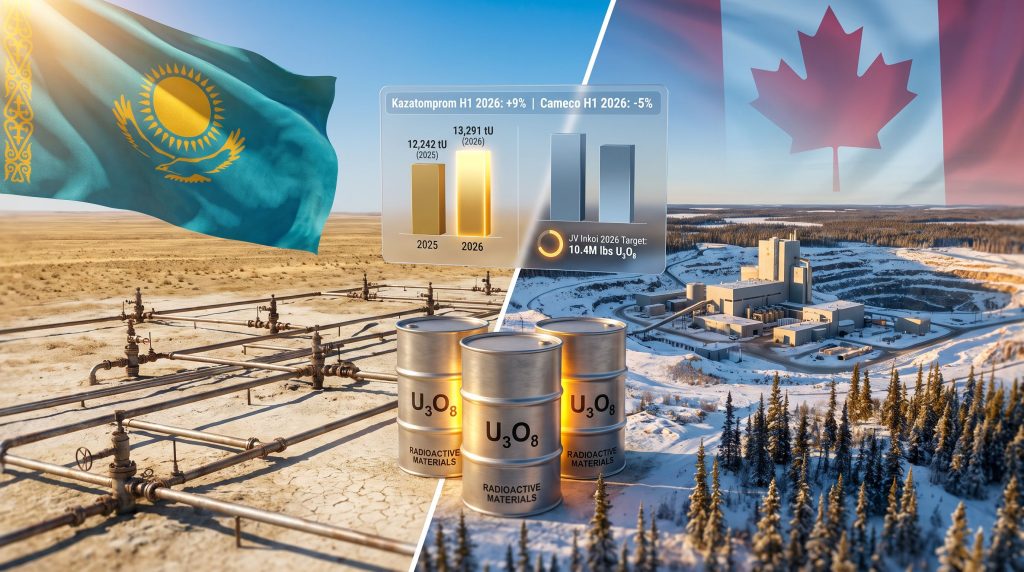
| H1 2025 Production (100% basis) | 12,242 tU | ~4,095 tU (attributable, Canada only) |
| H1 2026 Production (100% basis) | 13,291 tU | 3,885 tU (attributable, Canada only) |
| Year-on-Year H1 Change | +9% | -5% |
| 2025 Full-Year Attributable Output | N/A | 21.0 million lbs U₃O₈ |
| 2026 Full-Year Guidance (100% basis) | 27,500-29,000 tU | 14.0-16.5M lbs (McArthur/Key Lake) |
| JV Inkai 2026 Target (100% basis) | Shared asset | 10.4 million lbs U₃O₈ |
Despite operating across entirely different geological settings, regulatory frameworks, and logistical environments, both producers have confirmed their full-year 2026 targets remain intact. This simultaneous resilience, under distinct pressures, warrants close examination.
Kazatomprom's H1 2026 Performance: Production Growth Against a Revised Ceiling
What Drove the 9% Year-on-Year Output Increase?
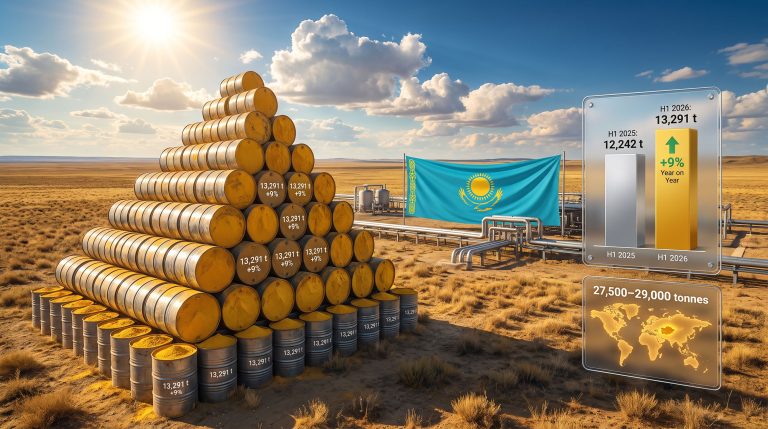
Kazatomprom's H1 2026 output of 13,291 tU on a 100% basis exceeded the 12,242 tU recorded in H1 2025, representing a 9% year-on-year increase. The company attributed this growth directly to a higher production plan for 2026, consistent with updated Subsoil Use Agreement requirements for the year.
This framing matters. The increase is not the result of unexpected capacity gains or resource windfalls. It reflects a deliberate upward calibration of the production plan relative to 2025 settings, which itself was constrained by a period of below-target output driven by reagent and supply chain challenges. Kazakhstan's in-situ recovery (ISR) mining methodology does offer more operational flexibility than conventional hard-rock mining, as production rates can be adjusted by modifying the flow of acidic leaching solution through underground ore bodies. However, this flexibility operates within the boundaries of SUA commitments, which are negotiated between Kazatomprom and the Kazakhstani government.
Understanding Kazatomprom's Revised 2026 Production Ceiling
A detail that often escapes broader market commentary is the structural reduction in Kazatomprom's nominal production ceiling for 2026. The previous nominal level stood at 32,777 tU on a 100% basis. Under updated Subsoil Use Agreements, this ceiling was revised downward to approximately 29,697 tU, a reduction of roughly 3,000 tU, equivalent to approximately 8 million lbs of U₃O₈, representing close to a 10% downward revision.
The current 2026 production guidance range of 27,500-29,000 tU (100% basis), with attributable guidance of 14,500-15,500 tU, therefore sits below even the revised nominal ceiling. This creates a buffer, but a narrower one than the headline figures suggest.
The primary constraint underpinning this recalibration is sulphuric acid availability. ISR uranium mining is reagent-intensive by design: acidic solution is injected into the ore body to dissolve uranium minerals, and the uranium-bearing solution is then pumped to surface for processing. Kazakhstan's ISR operations consume enormous volumes of sulphuric acid, and domestic refinery capacity, combined with logistical and seasonal constraints on supply distribution, has historically created a hard ceiling on output regardless of SUA targets. This dependency represents the single most consequential operational risk in Kazatomprom's production model.
Sales Volume Stability and What It Signals
Kazatomprom described H1 2026 sales volumes as closely aligned with the prior corresponding period, characterising overall performance as stable. This stability alongside rising production raises an analytical question: is inventory accumulating, or are forward contract delivery schedules absorbing the incremental output?
Uranium sales volumes are inherently lumpy. Long-term utility contracts specify delivery windows, not continuous drawdown rates, and quarterly figures can vary substantially depending on contract scheduling. The company itself noted this variability explicitly in its Q2 2026 update. Reading too much into any single half-year sales figure risks misinterpreting structural trends from timing noise.
Cameco's H1 2026 Update: Logistics, Infrastructure, and Operational Recovery
What Caused the Temporary Production Shortfall?
Cameco's Canadian operations produced 10.1 million lbs U₃O₈ (3,885 tU) on an attributable basis in H1 2026, down 5% from the equivalent period in 2025. The cause was neither geological deterioration nor grade decline. It was a bridge. In May 2026, flooding caused the collapse of a bridge on the primary supply route servicing both McArthur River and Key Lake in northern Saskatchewan. The consequences were direct and significant:
- Key Lake milling operations were temporarily suspended
- McArthur River mining activity was reduced for approximately two weeks
- The entire supply chain connecting mine output to milled product was interrupted at a critical point
This type of infrastructure vulnerability is an underappreciated feature of operating world-class uranium mines in subarctic, road-access-limited environments. Northern Saskatchewan's spring breakup season, when frozen ground thaws and ice roads become impassable, represents an annual risk window that Cameco's operational planning must account for. The May 2026 event was an acute expression of a chronic logistical reality.
McArthur River/Key Lake vs. Cigar Lake: Diverging Performance Profiles
| Operation | 2025 Full-Year Output | 2026 Guidance (100% basis) | Key Risk Factor |
|---|---|---|---|
| McArthur River/Key Lake | 14-15M lbs (revised) | 14.0-16.5 million lbs | Infrastructure/logistics |
| Cigar Lake | 18 million lbs | 17.5-18.0 million lbs | Flooding/ground conditions |
The operational interdependency between McArthur River and Key Lake is a structural feature often overlooked by investors focused on individual asset metrics. McArthur River is a mining-only operation; ore is transported to Key Lake for milling and conversion to uranium oxide. When Key Lake is suspended, McArthur River's output has nowhere to go. The two assets effectively function as a single integrated system, meaning a disruption to either propagates through the whole.
Cigar Lake, by contrast, operates independently with its own milling infrastructure at McClean Lake. Its stronger performance trajectory and potential capacity to add approximately 1 million lbs of additional output provides a natural portfolio hedge within Cameco's Canadian operations.
Cameco's total 2026 attributable production guidance stands at 19.5-21.0 million lbs U₃O₈, reflecting confidence that H2 output from both operations can compensate for the H1 shortfall. Consequently, the uranium market dynamics surrounding Cameco's recovery trajectory are being closely watched by utilities and investors alike.
Cameco's Inventory Position and Supply Commitment Resilience
As of 30 June 2026, Cameco held 8.7 million lbs U₃O₈ in uranium inventory. This buffer is not incidental; it is a deliberate strategic tool. When mine output falls short of contracted delivery obligations, producers can draw down inventory or procure uranium from third parties to honour commitments. Cameco has historically employed both mechanisms, and its purchasing model includes a third-party procurement component that activates when production gaps emerge.
This flexibility distinguishes Tier 1 producers from smaller mining companies. The ability to absorb short-term production disruptions without defaulting on utility contracts is a competitive moat that reinforces long-term customer relationships.
JV Inkai: The Operational Bridge Between Both Producers
Why This Joint Venture Deserves Its Own Analytical Framework
JV Inkai is a Kazakhstan-based ISR uranium operation jointly owned by Cameco and Kazatomprom. It sits at a rare intersection: a single asset whose performance simultaneously affects both of the world's largest uranium producers, making it doubly significant for supply forecasting models.
Key figures for 2026:
- H1 2026 production: 5.3 million lbs U₃O₈ (100% basis)
- Full-year 2026 target: 10.4 million lbs U₃O₈ (100% basis)
- Cameco's purchase allocation for 2026: 4.2 million lbs U₃O₈
- H1 deliveries to Cameco: 0.8 million lbs delivered
- Remaining deliveries: majority expected in H2 2026
The heavily back-end weighted delivery profile at JV Inkai creates a material concentration of revenue recognition and inventory receipt in Cameco's second half. If production at Inkai tracks to plan in H2, Cameco receives a substantial input to both inventory and contract fulfilment simultaneously. If Inkai underperforms, Cameco faces a compounding problem: reduced Canadian output from H1 combined with lower Inkai receipts in H2.
JV Inkai's H2 delivery cadence is arguably the single most important near-term variable for Cameco's ability to confirm its full-year production guidance. Market participants should monitor this closely as Q3 data becomes available.
Key Supply-Side Risk Variables for H2 2026
Kazatomprom's Sulphuric Acid Dependency
The acid supply risk embedded in Kazatomprom's operations is not a theoretical concern. Historically, shortfalls in domestic sulphuric acid availability have contributed directly to Kazatomprom missing production targets in prior years. The company's guidance language consistently acknowledges this constraint, and the downward revision of the nominal SUA ceiling from 32,777 tU to 29,697 tU can partly be understood as a structural acknowledgment that peak theoretical capacity is not reliably achievable given reagent supply realities.
Central Asian industrial supply chains carry exposure to regional infrastructure constraints, including refinery output variability, rail logistics, and seasonal distribution limitations. These factors are difficult to model with precision but are embedded in every production forecast that takes Kazakhstan's ISR methodology seriously. In addition, the uranium supply challenges resulting from these constraints are already influencing how utilities approach long-term procurement.
Northern Saskatchewan Infrastructure Vulnerability
The May 2026 bridge collapse was not a black swan event. It was a realisation of a known risk class: subarctic infrastructure degradation during spring thaw cycles. Cameco's operational continuity planning has evolved in response to recurring northern Saskatchewan supply chain challenges, and the 2026 incident will likely accelerate investment in redundant access routes and on-site stockpile management.
Even world-class assets in politically stable jurisdictions carry non-trivial operational risk profiles when geographic remoteness is a structural feature of the mining environment.
The next major ASX story will hit our subscribers first
The Broader Market Context: Why These Numbers Matter to Utilities
Nuclear utilities operating in the United States, Europe, and parts of Asia are currently navigating one of the most complex uranium procurement environments in decades. Reactor life extensions, new build programmes, and the emergence of small modular reactor development pipelines are expanding the long-term demand profile for enriched uranium fuel. However, the landscape has been further complicated by the Russian uranium import ban, which has reshuffled supply relationships and accelerated contracting activity with Western producers. Against this backdrop, production reliability from the world's two largest suppliers carries direct consequences for utility fuel cost forecasting and supply security planning.
When both Kazatomprom and Cameco confirm guidance simultaneously, it reduces near-term spot market anxiety and reinforces utilities' confidence in long-term contracting programmes. The reverse scenario, where both producers signal guidance risk simultaneously, would represent a significant tightening catalyst for uranium prices across both spot and term markets.
The mid-year 2026 data suggests neither outcome is materialising. Instead, the picture is one of managed resilience: production growing in Kazakhstan, recovering in Canada, and guidance intact across both companies. The margin for additional H2 setbacks, however, is narrow, and the second half of 2026 will be the true test of whether both producers can deliver on the commitments they have reaffirmed. Observing the broader uranium market trends alongside these production updates provides essential context for investors assessing the sector's near-term direction.
Frequently Asked Questions: Kazatomprom and Cameco 2026 Production Update
What is Kazatomprom's total uranium production guidance for 2026?
Kazatomprom has set its 2026 production guidance at 27,500-29,000 tU on a 100% basis, with attributable guidance of 14,500-15,500 tU. This follows a downward revision of the nominal SUA ceiling from 32,777 tU to approximately 29,697 tU, a reduction of roughly 10%.
Why did Cameco's H1 2026 uranium production decline year-on-year?
Cameco's Canadian attributable production totalled 10.1 million lbs U₃O₈ in H1 2026, down 5% from H1 2025, primarily due to a bridge collapse on the main access route to McArthur River and Key Lake in May 2026. This caused a temporary suspension at Key Lake and approximately two weeks of reduced mining at McArthur River.
What is JV Inkai's 2026 production target?
JV Inkai is targeting 10.4 million lbs U₃O₈ on a 100% basis for full-year 2026. Cameco's purchase allocation is 4.2 million lbs, with the majority of deliveries expected to be received in H2 2026.
Are both Kazatomprom and Cameco on track to meet their 2026 full-year targets?
As of their respective Q2 2026 operational updates, both companies have reaffirmed full-year 2026 production guidance. Kazatomprom's H1 output was 9% above the prior year period, while Cameco is relying on a stronger H2 performance to offset its logistics-driven H1 shortfall.
What is the biggest risk to Kazatomprom's 2026 production guidance?
Sulphuric acid availability remains the primary operational constraint on Kazatomprom's output. Any disruption to domestic acid supply chains in Kazakhstan could push production toward the lower end of the guidance range, or potentially below it.
Key Takeaways for Investors and Market Observers
- Kazatomprom's 9% H1 production growth reflects a deliberately elevated 2026 plan under revised SUAs, not unconstrained capacity expansion. The nominal production ceiling has been structurally reduced by approximately 10%
- Cameco's 5% H1 production decline is logistical in origin, not geological. The underlying ore quality at McArthur River and Cigar Lake remains intact and among the highest-grade uranium resources on earth
- JV Inkai's back-end weighted delivery profile makes H2 2026 a critical validation period for Cameco's full-year numbers; 3.4 million lbs of Cameco's 4.2 million lb allocation are yet to be received
- Both producers maintaining guidance signals operational maturity, but the margin for further H2 disruption is narrow given the H1 deficits already accumulated at Cameco's Canadian operations
- Sulphuric acid supply in Kazakhstan and northern Saskatchewan infrastructure integrity remain the two most consequential near-term risk variables for the global uranium supply outlook
This article contains forward-looking statements and references to production guidance that are subject to operational, logistical, regulatory, and market risks. Readers should conduct independent research and consult qualified financial advisers before making investment decisions based on information contained herein. Production figures referenced are sourced from company-issued operational updates as reported by World Nuclear News.
Want To Stay Ahead of the Next Major Uranium Discovery?
Discovery Alert's proprietary Discovery IQ model scans ASX announcements in real time, instantly translating complex mineral data into actionable opportunities across uranium and more than 30 other commodities — explore historic discoveries and their returns to understand what early positioning can mean, then begin your 14-day free trial at Discovery Alert to secure your market-leading edge before the next significant announcement hits.