August 3, 2026
Why Fuel Supply, Not Reactor Design, May Determine Who Wins the Advanced Nuclear Race
The history of transformative energy technologies is littered with examples where the primary constraint was never the power-generating hardware itself, but rather the upstream inputs required to run it. Advanced nuclear is rapidly proving no different. Across the Generation IV reactor development landscape, an uncomfortable reality has taken hold: the most sophisticated reactor designs in history may be delayed not by regulatory complexity or engineering challenges, but by the absence of a fuel type that does not yet exist at commercial scale.
High-assay low-enriched uranium, universally referred to as HALEU, sits at the centre of this challenge. Enriched to between 5% and 20% U-235, HALEU sits in a specification band that existing commercial enrichment infrastructure was simply never designed to serve at volume. The world's light water reactor fleet runs on uranium enriched to roughly 3% to 5%, and the enrichment plants serving that fleet have no economical pathway to pivot toward HALEU production without substantial capital investment and regulatory reconfiguration.
This is the industrial backdrop against which the TerraPower and ASP Isotopes HALEU supply agreement must be understood. Furthermore, the broader uranium market dynamics surrounding advanced fuel types make this agreement even more consequential for the sector's long-term trajectory.
When big ASX news breaks, our subscribers know first
The Technical Gap Between Conventional Fuel and HALEU
What Makes HALEU Fundamentally Different to Produce?
Uranium enrichment is measured by separative work units, or SWU, a technical metric quantifying the effort required to increase the concentration of fissile U-235 in a given mass of uranium. The SWU requirement scales non-linearly with enrichment level, meaning that producing HALEU at 19.75% enrichment demands dramatically more separative work per kilogram than producing conventional low-enriched uranium at 4.5%.
This non-linear scaling has significant commercial consequences. Existing enrichment capacity, largely dominated by Urenco and Orano in the Western world, is optimised for the light water reactor fuel cycle. Reconfiguring centrifuge cascades for HALEU production requires operational changes, additional regulatory authorisations, and in many cases, entirely new cascade configurations. No existing Western enrichment facility was producing HALEU at commercial volumes as of early 2025.
Why Advanced Reactor Designs Converged on HALEU
The fuel specification is not arbitrary. Advanced reactor designers chose HALEU because higher enrichment levels unlock physics advantages unavailable at conventional enrichment levels:
- Higher neutron economy, enabling more compact reactor cores without sacrificing criticality margins
- Extended fuel cycles, reducing refuelling frequency and improving capacity factors
- Compatibility with fast neutron spectra, which is essential for sodium-cooled and gas-cooled fast reactor designs
- Compatibility with tristructural isotropic (TRISO) particle fuel, which requires higher enrichment to function at design specifications
For TerraPower's Natrium reactor, a sodium-cooled fast reactor paired with a molten salt thermal storage system, HALEU is not a design preference but an operational requirement. The reactor's neutron economy is engineered around fuel at HALEU enrichment levels, and no lower-enriched substitute exists that would allow the design to function as intended.
Anatomy of the TerraPower and ASP Isotopes HALEU Supply Agreement
The Deal Structure in Detail
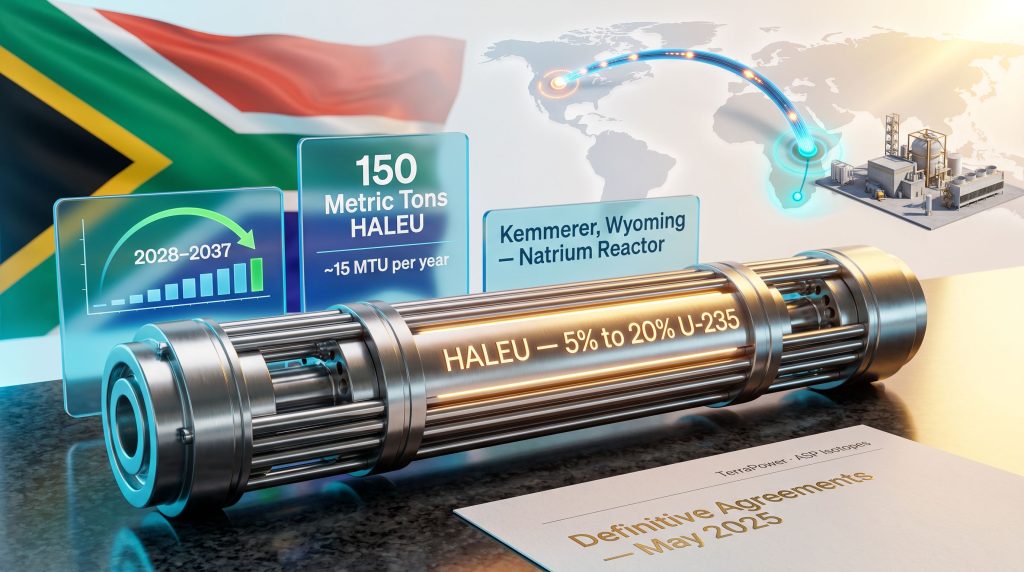
ASP Isotopes Inc. publicly disclosed on 19 May 2025 that it had entered into definitive agreements with TerraPower, converting an earlier term sheet announced in October 2024 into binding commercial commitments. The arrangement involves two interlocking components: a conditional loan from TerraPower intended to partially finance construction of a new uranium enrichment facility in South Africa, and a long-duration HALEU supply contract underpinning that facility's commercial rationale.
| Parameter | Detail |
|---|---|
| Agreement Type | Conditional loan commitment and HALEU supply contract |
| Facility Location | Pelindaba, South Africa |
| Supply Commencement | 2028 |
| Contract Duration | 10 years |
| Total HALEU Volume | Up to 150 metric tons (MTU) |
| Approximate Annual Volume | ~15 MTU per year |
| Primary Application | First fuel core, Natrium reactor, Kemmerer, Wyoming |
The conditional structure of the loan is worth examining carefully. Rather than providing unrestricted capital, TerraPower's financial commitment is linked to ASP Isotopes achieving defined construction and regulatory milestones. This approach protects TerraPower's balance sheet while simultaneously giving ASP Isotopes an anchor commitment credible enough to approach external debt and equity investors.
This deal structure mirrors the commercial logic applied in LNG infrastructure development and critical minerals supply chains, where a single anchor offtake agreement from a credible counterparty unlocks project financing that would otherwise be inaccessible for a first-of-kind facility.
Why 150 Metric Tons Matters as a Market Signal
The 150 MTU figure is not simply a procurement number. In a market where HALEU has never been commercially produced at scale outside Russian state infrastructure, a publicly disclosed offtake commitment of this size sends a demand signal visible to every potential investor, lender, and competing enrichment technology developer in the sector. It answers the fundamental project finance question: is there a buyer willing to commit at sufficient volume and duration to support capital recovery on a new enrichment facility?
For a decade-long, 150 metric ton commitment, that answer is now on the record. Consequently, the uranium supply-demand volatility that has characterised recent years gives this kind of long-term commitment particular strategic weight.
Pelindaba: South Africa's Nuclear Infrastructure Advantage
A Site With Unusual Depth of Nuclear Heritage
The selection of Pelindaba as the proposed enrichment facility location is not incidental. Pelindaba, located near Pretoria, South Africa, carries one of the most consequential nuclear histories of any site in the southern hemisphere. It served as the production site for South Africa's nuclear weapons programme, which the country voluntarily dismantled and declared to the IAEA in the early 1990s, becoming the only nation in history to independently develop and subsequently abandon a nuclear arsenal.
Today, Pelindaba hosts the SAFARI-1 research reactor, a 20-megawatt tank-type reactor that has operated since 1965 and produces medical radioisotopes for global markets. The site maintains nuclear-grade infrastructure, skilled technical personnel with decades of isotope and materials handling experience, active IAEA safeguards relationships, and established regulatory frameworks under the South African Nuclear Energy Corporation (NECSA).
This heritage provides ASP Isotopes with infrastructure advantages that a genuinely greenfield enrichment site cannot offer:
- Existing radiation protection and nuclear material control systems
- An established workforce familiar with nuclear material handling requirements
- Active IAEA inspection relationships reducing regulatory uncertainty
- Site characterisation and nuclear-grade construction standards already in place
Geopolitical Diversification as a Strategic Rationale
One dimension of this deal that deserves more attention than it typically receives is the geopolitical logic of locating HALEU production in South Africa. The United States advanced nuclear industry faces a structural vulnerability: if HALEU production concentrates exclusively within U.S. borders, the supply chain becomes exposed to domestic regulatory delays, congressional funding constraints, and the political cycle.
South Africa operates under a bilateral nuclear cooperation agreement with the United States, commonly referred to as a 123 Agreement under the U.S. Atomic Energy Act, which establishes the legal framework for transferring nuclear materials between the two countries. This framework makes South African HALEU production legally compatible with U.S. reactor fuel requirements, while simultaneously introducing supply chain geography that is independent of U.S. domestic policy fluctuations.
If Pelindaba successfully produces HALEU at commercial scale, it would represent the first significant HALEU production capacity in the Western-aligned supply chain located outside the United States. Furthermore, given the Russian uranium import ban that rendered TENEX-supplied HALEU commercially and politically untenable for most Western developers, the importance of alternative supply routes cannot be overstated.
The Competitive HALEU Supply Landscape
Mapping the Race to Commercial Production
The TerraPower and ASP Isotopes HALEU supply agreement exists within a broader competitive environment that is developing rapidly across multiple technology pathways and regulatory jurisdictions.
| Company | Production Approach | Status as of Mid-2026 |
|---|---|---|
| Centrus Energy | Domestic U.S. centrifuge cascade (Piketon, Ohio) | $900M DOE task order finalised, July 2026 |
| ASP Isotopes | South Africa enrichment facility at Pelindaba | Definitive agreements signed; construction pending |
| Urenco | LEU centrifuge capacity with HALEU pathway potential | Ongoing LEU capacity expansion programmes |
| Global Laser Enrichment (GLE) | Laser enrichment technology (SILEX process) | Pre-commercial development stage |
The Centrus pathway is structurally distinct from the ASP Isotopes approach. Centrus operates the only U.S. facility currently licensed to produce HALEU, its demonstration cascade at the American Centrifuge Plant in Piketon, Ohio. The DOE's decision to finalise a $900 million task order with Centrus in July 2026 represents a substantial public capital commitment to domestic HALEU production capacity. In addition, the US uranium production rebound to a six-year high underscores the broader momentum behind domestic fuel security efforts.
The TerraPower and ASP Isotopes HALEU supply agreement is structurally differentiated from the Centrus pathway in one critical dimension: it is privately financed and internationally sourced. This makes the two approaches complementary rather than competitive from a supply security standpoint, as the advanced reactor industry benefits from having multiple independent production pathways rather than single-source dependence.
Demand Expanding Beyond Power Reactors
A development that adds strategic urgency to the HALEU supply challenge is the expansion of demand into sectors beyond terrestrial power generation. In July 2026, the U.S. Department of Energy announced conditional commitments to provide HALEU to NASA for its Space Reactor-1 Freedom rocket programme and to Radiant Industries for its microreactor development programme.
These announcements confirm that HALEU demand is not exclusively a terrestrial power reactor story, and that competition for available supply will intensify as more end-use applications mature simultaneously. This demand diversification strengthens the aggregate market signal to potential investors and lenders that HALEU is becoming a broadly required industrial input, rather than a niche specialty material. The critical minerals demand surge occurring across advanced energy sectors only amplifies this dynamic.
TerraPower's Institutional Evolution in 2025 and 2026
Crossing the Threshold from Developer to Operator
Understanding the significance of the TerraPower and ASP Isotopes HALEU supply agreement requires appreciating the institutional trajectory TerraPower is on. In July 2026, TerraPower became the first advanced reactor company to be accepted into the Institute of Nuclear Power Operations (INPO), the industry body that sets operational excellence standards for the U.S. commercial nuclear fleet.
INPO membership is not a regulatory requirement; it is a voluntary commitment to peer review, operational standards, and the discipline associated with operating nuclear facilities at the level expected of commercial power generators. This milestone signals that TerraPower is no longer positioning itself primarily as a technology developer. It is actively transitioning into operator-class organisational behaviour. According to TerraPower's own announcement of the strategic agreement, this partnership reflects the company's broader commitment to securing every link in the advanced reactor delivery chain.
TerraPower has also engaged in NRC stakeholder roundtables alongside the Department of Energy and the Canadian Nuclear Safety Commission, demonstrating regulatory maturity across multiple jurisdictions that could accommodate future Natrium deployments beyond the initial Wyoming site.
The First Fuel Core as a Non-Negotiable Milestone
For any first-of-kind reactor, the initial fuel load occupies a unique position in the project timeline. Unlike equipment procurement, where delays can sometimes be accommodated through schedule compression elsewhere, fuel delivery sits on the project's critical path in a manner that admits no substitution.
The 2028 supply commencement date embedded in the TerraPower and ASP Isotopes HALEU supply agreement therefore functions as a hard constraint on the Natrium project's commissioning schedule. Any slippage in ASP Isotopes' construction and enrichment timeline propagates directly into the Natrium plant's operational date, with downstream consequences for project financing covenants, power purchase agreement obligations, and investor confidence.
The next major ASX story will hit our subscribers first
Key Risks Investors and Industry Observers Should Monitor
Technology Scale-Up Risk
ASP Isotopes is advancing enrichment technology toward commercial scale for the first time. The transition from demonstration or pilot-scale isotope separation to the production volumes implied by a 150 MTU, 10-year contract represents a step change in operational complexity. Nuclear enrichment facilities have historically demonstrated longer-than-projected construction timelines and commissioning periods, even when built by organisations with extensive prior experience.
Monitoring indicators for this risk include:
- Construction permit approvals from South African nuclear regulators
- IAEA safeguards agreement updates covering the Pelindaba enrichment facility
- Equipment procurement announcements indicating construction is advancing
- ASP Isotopes' own milestone-based communications tied to TerraPower's conditional loan disbursement triggers
Export Control and Nuclear Regulatory Risk
HALEU produced in South Africa for use in a U.S. reactor must navigate export authorisation under the U.S. Atomic Energy Act and comply with Nuclear Non-Proliferation Treaty obligations. The existing 123 Agreement between the U.S. and South Africa provides the foundational legal framework, but individual transfer authorisations involve regulatory processing timelines that can extend considerably depending on political and bureaucratic conditions at the time of application.
Any deterioration in U.S.-South Africa diplomatic relations, or shifts in U.S. nuclear export policy, would introduce execution risk into the commercial arrangement regardless of the bilateral agreement's current status.
What the Conditional Loan Structure Does and Does Not Protect Against
The conditional nature of TerraPower's loan commitment provides meaningful capital protection for TerraPower, but it does not eliminate the risk of ASP Isotopes failing to achieve the milestones that would trigger disbursement. If ASP Isotopes encounters financing shortfalls before reaching those milestones, TerraPower could find itself without a contracted HALEU supplier at the precise moment its fuel loading schedule demands certainty.
This interdependency makes monitoring ASP Isotopes' independent fundraising progress, alongside the milestone-based loan structure, an important leading indicator of whether the 2028 supply commitment is tracking toward delivery.
Long-Term Implications for the Advanced Nuclear Fuel Market
A Commercial Template Taking Shape
The most enduring significance of the TerraPower and ASP Isotopes HALEU supply agreement may not be the specific volumes or timelines it establishes, but the commercial template it provides. The combination of an anchor customer conditional loan with a decade-long offtake commitment represents a replicable financing architecture for HALEU infrastructure development.
Other advanced reactor developers observing this arrangement now have a structural model for how to engage with prospective fuel suppliers in a way that de-risks both parties: the reactor developer gains supply certainty without unrestricted capital exposure, while the fuel producer gains the demand anchor necessary to attract external project financing.
As the number of such bilateral agreements accumulates across the industry, the aggregate effect will be the gradual transition of HALEU from a constrained specialty product into something approaching a commercially available industrial input. That transition is not yet complete, but agreements of this kind are its necessary precondition.
The Decade-Scale Planning Horizon Now Required
The 2028 to 2037 contract window embedded in this agreement reflects a planning discipline that the advanced nuclear industry is still developing. Reactor developers accustomed to thinking in terms of construction schedules and regulatory timelines are increasingly required to layer on fuel procurement horizons that extend a decade or more beyond financial close.
This shift has implications for how advanced reactor companies are structured, staffed, and governed. Fuel procurement has moved from a late-stage operational consideration to a board-level strategic priority that must be addressed in parallel with, or even ahead of, reactor licensing and construction planning.
Developers that have not yet secured HALEU supply commitments face a growing competitive disadvantage, not only in fuel availability but in their ability to satisfy project lenders and equity investors that the full project delivery chain is commercially anchored.
Disclaimer: This article contains forward-looking statements and analytical assessments regarding commercial agreements, project timelines, and market developments. These reflect information available at the time of writing and are subject to change based on regulatory outcomes, construction progress, and commercial negotiations. Nothing in this article constitutes financial or investment advice.
For ongoing coverage of HALEU supply chain developments, advanced reactor fuel requirements, and nuclear industry milestones, the American Nuclear Society's Nuclear Newswire at ans.org/news provides regularly updated reporting and technical analysis across the full spectrum of nuclear fuel cycle topics.
Want To Stay Ahead of the Next Major Resource Discovery Before the Market Moves?
Discovery Alert's proprietary Discovery IQ model scans ASX announcements in real time, instantly identifying high-potential mineral discoveries across more than 30 commodities — from uranium to critical minerals — and delivering actionable alerts before the broader market reacts. Explore historic discoveries and their extraordinary returns, then begin your 14-day free trial at Discovery Alert to secure your market-leading edge.