August 4, 2026
The Quiet Revolution in Nuclear Surplus: Why Legacy Stockpiles Are Becoming Strategic Assets
For decades, the dominant framework governing Cold War–era nuclear materials was one of containment, remediation, and cost. Surplus plutonium was a liability. Enriched uranium stockpiles were security concerns. And stored heavy water was simply an environmental management problem waiting for a budget allocation. That framing is rapidly becoming obsolete.
A structural shift is underway across the U.S. nuclear landscape, driven by the convergence of advanced reactor commercialisation, a medical isotope supply crisis, and the accelerating timeline of commercial fusion energy. In this context, materials that once represented the deferred costs of Cold War weapons programmes are being reappraised as critical inputs for 21st-century energy and healthcare infrastructure.
The DOE's decision to issue a formal RFI for the reuse of SRS heavy water is one of the clearest expressions of this shift yet seen. Furthermore, understanding the broader uranium market dynamics helps contextualise why legacy nuclear assets are suddenly attracting renewed commercial interest.
When big ASX news breaks, our subscribers know first
Understanding the DOE's RFI for SRS Heavy Water
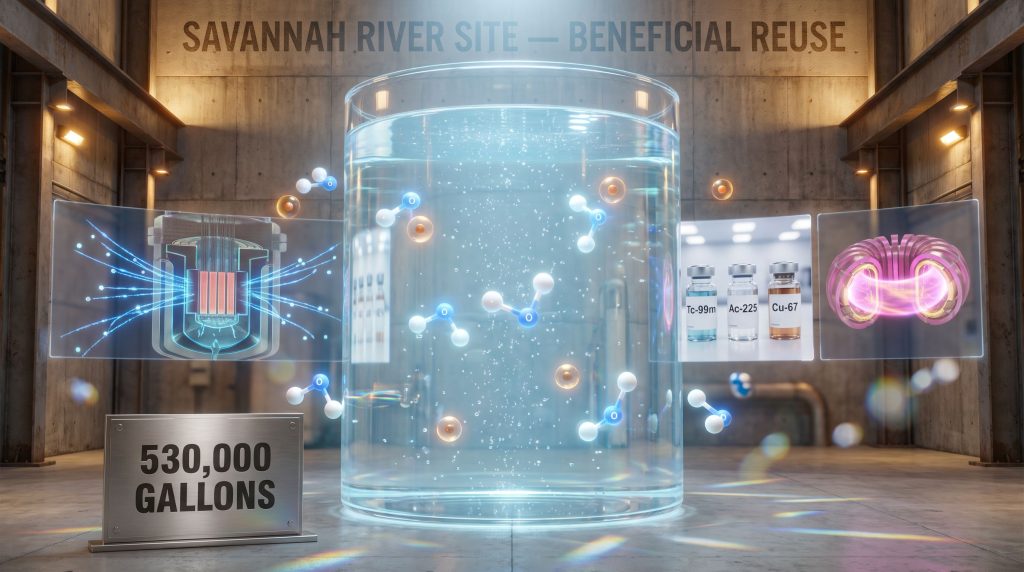
The DOE issues RFI for reuse of SRS heavy water through its Office of Environmental Management, formally opening an industry consultation process focused on the potential beneficial reuse of up to 530,000 gallons of deuterium oxide (D₂O) currently held in long-term storage at the Savannah River Site in Aiken, South Carolina. The notice appeared in the Federal Register on July 21, 2026 (Document No. 2026-14659), with responses due by September 21, 2026.
Submissions must be emailed to heavywaterrfi@doe.gov with the subject line EM Heavy Water RFI Collaboration Response. The RFI seeks engagement from a deliberately wide pool of stakeholders, reflecting the unusual breadth of potential applications for this material.
Who DOE Is Seeking to Engage
The RFI identifies five distinct partner profiles that DOE-EM is actively soliciting input from:
-
Organisations with a demonstrated operational need for deuterium or derived isotopes where no commercially available substitute exists
-
Technical specialists with proven expertise in heavy water processing, isotopic purification, or detritiation technology
-
Research institutions and commercial entities exploring novel applications for heavy water or its constituent isotopes
-
Project development partners capable of contributing to cost estimation, independent review, and structured project planning
-
Infrastructure developers interested in leasing SRS land or constructing dedicated processing facilities on-site
This final category is particularly notable. The explicit invitation for private-sector parties to consider co-locating infrastructure at SRS represents a meaningful evolution in how DOE-EM is conceptualising its role, moving from sole operator of legacy nuclear assets toward a facilitator of mixed public-private utilisation.
The Cold War Origins of a 21st-Century Opportunity
How 530,000 Gallons of Heavy Water Ended Up in Long-Term Storage
The SRS 400/D area complex was constructed in the 1950s with a singular purpose: producing heavy water at industrial scale to serve as a neutron moderator for five on-site production reactors. Those reactors were designed to generate tritium and weapons-grade plutonium during the height of the Cold War arms buildup, when American strategic posture demanded continuous fissile material production.
Heavy water was integral to this process. Unlike conventional light water reactors, which consume neutrons in the moderation process, heavy water reactors allow neutrons to pass through with minimal absorption. This property makes D₂O especially valuable in reactor designs where neutron economy is critical, including production reactors where maximising neutron flux directly determines output yield.
Manufacturing operations at the 400/D area wound down in the early 1980s, and the five production reactors themselves were taken offline by the late 1980s. What remained was a vast inventory of heavy water, significant portions of which had accumulated tritium and other radiological constituents through decades of reactor operations. That inventory has sat in on-site storage for more than four decades.
The presence of tritium within the stockpile is a genuinely double-edged consideration. While it complicates any processing pathway and introduces radiological safety obligations, tritium itself carries significant and growing commercial value for fusion energy programmes and neutron generator applications. A well-structured detritiation programme could recover a saleable byproduct rather than simply neutralising a contaminant.
The Science of Heavy Water: Why This Material Matters Now
Deuterium Oxide Properties and Nuclear Applications
Heavy water is chemically near-identical to ordinary water but contains deuterium, a stable hydrogen isotope carrying one additional neutron in its nucleus. This seemingly minor structural difference produces dramatically distinct physical behaviour in nuclear environments.
In fission reactor contexts, D₂O functions as a highly efficient neutron moderator precisely because deuterium absorbs far fewer neutrons than ordinary hydrogen. This allows reactor designers to use natural uranium fuel rather than enriched uranium, a significant cost and supply chain advantage. The CANDU reactor design, developed in Canada and exported globally, is the most commercially mature expression of this principle.
Beyond reactor applications, deuterium and its derived compounds serve critical roles across multiple scientific and industrial domains:
-
Fusion research: Deuterium is one half of the deuterium-tritium fuel cycle that underpins the leading commercial fusion pathway. The National Ignition Facility's historic ignition milestone in 2022 relied on D-T fuel, and virtually every major commercial fusion venture targets this same reaction.
-
Medical isotope production: Heavy water intersects with isotope production supply chains at multiple points, both as a processing medium and as a neutron source input in research reactor configurations.
-
Pharmaceutical R&D: Deuterium-modified drug development is an expanding segment of the pharmaceutical industry. Isotopic substitution of hydrogen with deuterium can extend drug half-lives by slowing metabolic degradation, a property that has attracted significant investment from major pharmaceutical developers.
-
Neutron scattering and NMR: Research institutions and national laboratories rely on deuterium oxide as a neutron scattering medium and nuclear magnetic resonance solvent, applications that require high-purity D₂O with consistent isotopic specification.
The Global Supply Context: A Market Defined by Scarcity
The global deuterium market is characterised by limited production geography, no ready substitutes, and inelastic demand across its primary end-use segments. Canada has historically been the dominant supplier through its CANDU reactor fleet, with surplus heavy water available for export when domestic reactor demand was satisfied.
The gradual evolution of Canada's reactor fleet and the growing international appetite for D₂O have tightened this supply picture considerably. Consequently, the pressures reshaping uranium supply and demand are mirrored in adjacent nuclear material markets, including heavy water.
The United States currently operates no heavy water-cooled reactors, which has historically suppressed domestic D₂O demand and investment in domestic production capacity. That structural absence is now becoming a strategic vulnerability as advanced reactor designs requiring heavy water moderation advance through the U.S. development pipeline.
Application Pathways: What Could Justify Reusing 530,000 Gallons
Advanced Reactor Fuel Cycles and Moderation Requirements
Several next-generation reactor concepts under active development in the United States and allied nations incorporate heavy water as a moderator or coolant. Pressurised heavy water reactor variants, certain molten salt configurations, and research reactor designs all represent potential domestic demand sources that did not exist at meaningful scale even five years ago.
The DOE's own Advanced Reactor Demonstration Program has accelerated commercialisation timelines for multiple reactor architectures, and some of these designs will require reliable access to domestically sourced D₂O. Without a reactivated domestic supply, developers would face dependence on international suppliers, introducing both cost and geopolitical risk into project economics.
Medical Isotopes: A Supply Chain Under Pressure
The medical isotope production sector represents perhaps the most immediately compelling demand signal for the SRS heavy water inventory. The DOE has itself characterised heavy water as indispensable for the production of life-saving medical isotopes, and the downstream numbers support this framing.
Technetium-99m, the world's most widely used diagnostic radioisotope, is administered in more than 40 million medical procedures annually according to reporting by the American Nuclear Society. Its upstream supply chain involves neutron irradiation processes that intersect with deuterium-based production pathways in research reactor configurations.
Beyond Tc-99m, the emerging class of targeted alpha therapy (TAT) isotopes is attracting substantial investment from pharmaceutical developers and national laboratories alike. Actinium-225, radium-223, and copper-67 are among the most actively pursued candidates. These isotopes require specialised production infrastructure, and heavy water can serve as a processing medium or neutron source input in several viable production routes.
Fusion Energy: Tritium Recovery as a Strategic Imperative
The tritium contamination within portions of the SRS heavy water inventory, long treated primarily as a complication, is increasingly being recognised as a potential asset. Tritium is a primary fuel component for deuterium-tritium fusion reactions, and as commercial fusion timelines accelerate, the question of tritium supply has moved from academic to urgent.
Current tritium supply is tightly constrained. The primary production mechanism in Western supply chains involves irradiation of lithium-6 targets in fission reactors, and the available inventory is largely tied to military programmes. Commercial fusion ventures will require access to tritium at a scale that existing supply chains were not designed to support.
A dedicated detritiation facility at SRS, which DOE has acknowledged does not currently exist, could accomplish two objectives simultaneously: purifying the heavy water inventory for downstream reuse while recovering tritium as a commercially and strategically valuable byproduct. The Savannah River National Laboratory has explored detritiation and heavy water treatment concepts in published research, meaning relevant institutional knowledge exists within the SRS ecosystem to anchor such a programme.
The Detritiation Technology Gap
The absence of a dedicated detritiation facility at SRS is both the central challenge and the central opportunity embedded in this RFI. Processing tritiated heavy water requires specialised isotopic separation technology, with the most proven industrial methods including Combined Electrolysis and Catalytic Exchange (CECE) and Liquid Phase Catalytic Exchange (LPCE) processes. Both approaches are capital-intensive, requiring significant upfront infrastructure investment.
This cost profile explains why DOE-EM is pursuing a private-sector partnership model rather than funding the infrastructure unilaterally. The RFI is, in effect, a mechanism for determining whether the commercial value of recovered D₂O and tritium can justify private capital investment in processing infrastructure, potentially on a cost-sharing or lease-based arrangement at SRS.
Comparing the SRS Heavy Water RFI to Prior DOE Surplus Material Programmes
| Factor | HALEU Availability Program | Surplus Plutonium Pathway | SRS Heavy Water RFI |
|---|---|---|---|
| Material State | Enriched uranium | Solid metal | Liquid, partially tritiated |
| Primary End Use | Advanced reactor fuel | Fuel fabrication | Reactors, isotopes, fusion, research |
| Processing Infrastructure Gap | Partial | Partial | Significant |
| Established Domestic Market | Developing | Developing | Nascent |
| Regulatory Complexity | High | High | Moderate-to-high |
| Year Announced | Est. 2020 | 2025 | 2026 |
The HALEU Availability Program, established in 2020, provided the foundational proof-of-concept that structured federal-to-industry material transfer frameworks could accelerate advanced reactor development. DOE's 2025 announcement making approximately 19.7 metric tons of surplus plutonium available for advanced fuel fabrication extended this logic to weapons-programme legacy materials.
The SRS heavy water RFI follows the same strategic architecture but introduces a dimension neither prior programme fully addressed: multiple competing end-use applications with meaningfully different processing requirements, regulatory profiles, and commercial economics. This complexity makes the heavy water case both more challenging and, potentially, more commercially valuable than its predecessors.
In addition, the broader context of uranium investment trends demonstrates that investor appetite for nuclear supply chain opportunities is expanding well beyond traditional enriched fuel, creating a more receptive environment for programmes like this one.
The next major ASX story will hit our subscribers first
Regulatory and Partnership Considerations
What Prospective Partners Need to Navigate
Any entity responding to this RFI with a serious development proposal will need to demonstrate competency across several interconnected regulatory domains:
-
Facilities co-located at SRS would operate within an existing DOE complex regulatory environment, which may provide some streamlining advantages compared to greenfield nuclear site permitting, though this should not be assumed to eliminate complexity.
-
Tritium recovery and redistribution activities are likely to trigger Nuclear Regulatory Commission licensing requirements depending on end-use classification and volume thresholds.
-
Any export of purified deuterium or recovered tritium to international fusion programmes or research institutions would require Department of Commerce and DOE export authorisation, adding another regulatory layer that prospective partners must demonstrate capacity to manage.
-
The environmental compliance obligations associated with tritium handling at an active DOE site are substantial and would form a central component of any project review process.
Furthermore, the shifting policy landscape around domestic nuclear supply chains — including the Russian uranium import ban — underscores how quickly federal regulatory posture can reshape commercial opportunity in the nuclear materials sector.
Frequently Asked Questions: DOE SRS Heavy Water RFI
What is the total volume of heavy water covered by the DOE's RFI?
The RFI covers up to 530,000 gallons of heavy water currently in storage at the Savannah River Site in Aiken, South Carolina.
When is the response deadline?
Submissions must be received by September 21, 2026, emailed to heavywaterrfi@doe.gov with the subject line EM Heavy Water RFI Collaboration Response.
Why does the SRS heavy water contain tritium?
The inventory originated from operations at the 400/D production complex, which supplied neutron moderator water for reactors producing tritium and plutonium during the Cold War. Tritium accumulated in the water through decades of reactor operations before the facility was decommissioned in the late 1980s.
Does the U.S. have infrastructure to process this material today?
No. DOE has confirmed that no dedicated detritiation facility currently exists for this inventory, which is a primary driver of the private-sector partnership model embedded in the RFI.
Can companies propose building new facilities at SRS?
Yes. The RFI explicitly invites expressions of interest from parties willing to lease land or develop processing infrastructure directly at the Savannah River Site.
What are the primary intended applications?
Applications under consideration include advanced reactor moderation, medical isotope production, fusion fuel supply chains including tritium recovery, deuterium-labelled pharmaceutical compounds, and neutron scattering research.
A Philosophical Shift in Environmental Management
Perhaps the most significant aspect of this RFI is what it signals about the evolving philosophy within DOE-EM. The office's traditional mandate has centred on cleanup, containment, and the safe disposal of legacy nuclear materials — a cost-centre model measured in remediation milestones rather than economic returns.
The DOE issues RFI for reuse of SRS heavy water as part of a fundamentally different orientation: treating stored nuclear materials as potential economic and strategic inputs for emerging industries rather than liabilities requiring remediation budgets. If the programme succeeds in attracting credible private-sector partners and results in a viable reuse framework, it may establish a precedent that shapes how DOE approaches other legacy material inventories across the broader complex.
However, realising this potential will require sustained policy commitment, credible private-sector participation, and regulatory frameworks that can accommodate the complexity of multi-application material reuse. The US uranium production resurgence offers one parallel for how domestic nuclear material supply chains can be rebuilt with the right combination of federal intent and commercial engagement.
For the advanced nuclear sector, the fusion energy community, and the medical isotope supply chain, the outcome of this RFI carries consequences that extend well beyond a single site in South Carolina. For context on how DOE-EM is formally framing this consultation, the official Federal Register notice provides the complete programme documentation and submission requirements.
Readers seeking additional technical context on the Savannah River Site's heavy water history and treatment concepts are encouraged to review publicly available research from Savannah River National Laboratory, the original Federal Register notice (Document No. 2026-14659), and ongoing coverage from the American Nuclear Society's Nuclear News publication at ans.org/news.
This article contains forward-looking analysis regarding potential applications, partnership models, and commercial outcomes associated with the DOE's SRS heavy water RFI. Such analysis involves inherent uncertainty and should not be construed as investment advice or as confirmation of any specific programme outcome. All figures cited are sourced from publicly available DOE and Federal Register documentation.
Want to Capitalise on the Next Major Resource Discovery Before the Broader Market?
Discovery Alert's proprietary Discovery IQ model delivers real-time alerts on significant ASX mineral discoveries — from uranium and nuclear fuel materials to emerging critical commodities — instantly translating complex resource data into actionable investment insights for both short-term traders and long-term investors. Explore how historic mineral discoveries have generated substantial returns and begin your 14-day free trial today to position yourself ahead of the market.