July 21, 2026
Global trade relationships are undergoing a fundamental transformation as major economies compete to establish preferential partnerships with resource-rich continents. This dynamic reflects broader shifts in economic diplomacy, where traditional conditional agreements are being challenged by comprehensive frameworks that prioritise economic integration over political conditionality. Understanding these evolving patterns requires examining how different trade architectures impact long-term economic development and strategic positioning, particularly regarding China zero-tariff access for African nations.
Understanding Beijing's Comprehensive Trade Framework for African Markets
China's implementation of zero-tariff treatment for imports from 53 African nations represents a watershed moment in continental trade architecture. Beginning May 1, 2026, this comprehensive framework eliminates import duties across virtually all product categories, creating unprecedented market access for African exporters while positioning Beijing as the primary economic partner for continental development. The tariff impact on markets demonstrates how such policies reshape global trading relationships.
Implementation Scope and Financial Commitment:
- Coverage extends to all African nations maintaining diplomatic relations with Beijing
- Exclusion limited to Eswatini due to its Taiwan diplomatic ties
- Annual revenue sacrifice: Approximately $1.4 billion in foregone tariff collections
- Timeline: Phased implementation from May 2026 through 2030
This policy evolution demonstrates Beijing's strategic commitment to African markets. Previously, China provided zero-tariff treatment on 97-98% of tariff lines for 33 African least developed countries. In 2024, this expanded to cover all products from African LDCs, and now encompasses nearly the entire continent regardless of development status.
Furthermore, the framework establishes bilateral arrangements through diplomatic channels, as evidenced by South Africa becoming the 33rd country to conclude formal agreements. South African President Cyril Ramaphosa's recent Beijing visit resulted in Trade Minister Parks Tau signing a non-binding framework with Commerce Minister Wang Wentao, with an Early Harvest Agreement expected by March 2026.
Uganda's President Yoweri Museveni has consistently advocated for measures addressing trade imbalances between China and African economies, demonstrating ground-level support for this comprehensive approach among African leadership. This initiative is part of broader US‑China trade war insights affecting global commerce.
When big ASX news breaks, our subscribers know first
Comparative Analysis of Global Trade Programs Targeting Africa
African governments increasingly favour China's approach due to its structural advantages over Western alternatives. The fundamental differences lie in conditionality requirements, coverage scope, and renewal mechanisms.
| Program | Geographic Coverage | Product Scope | Renewal Framework | Primary Conditions |
|---|---|---|---|---|
| China Zero-Tariff | 53 countries | All product categories | Permanent diplomatic alignment | Minimal political requirements |
| US AGOA | 39 countries | Selective products | Periodic congressional review | Democracy and governance standards |
| EU Everything But Arms | LDCs only | Limited scope | Permanent but restricted | Human rights compliance |
Structural Advantages of China's Framework:
- Predictability: Permanent arrangement without renewal uncertainty
- Comprehensive Coverage: Nearly all products included rather than selective categories
- Minimal Conditionality: Economic integration without governance surveillance
- Diplomatic Integration: Embedded within broader Belt and Road Initiative framework
The contrast becomes particularly significant when examining Western programme limitations. The European Union's Everything But Arms scheme restricts access to least developed countries, while non-LDC African nations must negotiate complex Economic Partnership Agreements. The United States' African Growth and Opportunity Act faces periodic congressional renewal and potential suspension based on governance assessments.
African leaders appreciate the absence of values-based conditionality in China's arrangement, which allows for economic cooperation without political oversight mechanisms that have historically created uncertainties in Western trade relationships. The global tariff impacts further highlight the importance of predictable trade arrangements.
Sectoral Impact Analysis: Winners and Strategic Opportunities
The elimination of tariff barriers creates distinct opportunities across African economic sectors, though success will depend on complementary capacity building and infrastructure development.
Primary Beneficiary Categories:
Agricultural and Food Processing:
- Coffee, cocoa, and specialty crop exports
- Processed foods and value-added beverages
- Organic and sustainable agriculture products
- Horticultural exports with enhanced shelf-life
Manufacturing and Industrial Production:
- Textile and apparel manufacturing
- Light assembly and component production
- Value-added mineral processing
- Automotive parts and industrial equipment
Technology and Services:
- Digital financial services and fintech solutions
- Renewable energy component manufacturing
- Telecommunications equipment assembly
- E-commerce platform development
What Are the Current Export Composition Patterns?
Mineral resources currently account for approximately 40% of China's imports from African least developed countries, followed by non-edible raw materials and semi-processed goods. This commodity-heavy structure presents both opportunities and challenges for diversification efforts.
Strategic Insight: Countries with existing manufacturing infrastructure and diversified export capabilities will capture disproportionate benefits from tariff-free access compared to nations dependent solely on raw material extraction.
The infrastructure requirements for capitalising on these opportunities remain substantial. China zero-tariff access for African nations will require significant investments in quality control systems, logistics networks, and regulatory compliance mechanisms to meet Chinese market standards.
Trade Imbalance Dynamics and Rebalancing Scenarios
Current bilateral trade patterns reveal significant structural imbalances that China zero-tariff access for African nations aims to address, though success will depend on broader economic transformation efforts. The connection to US tariffs and inflation demonstrates how tariff policies affect global economic balance.
Trade Flow Analysis (January-August 2025):
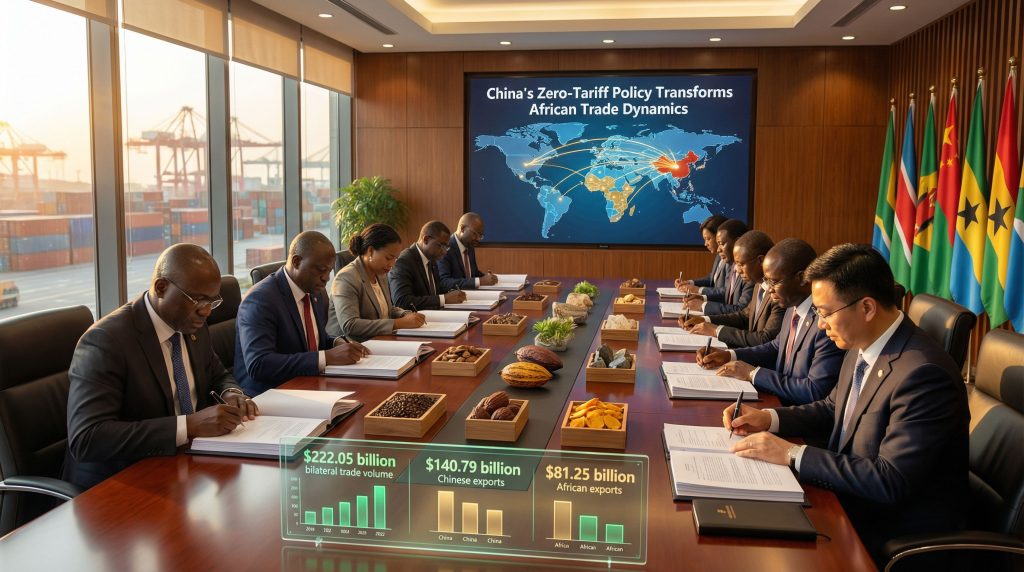
- Total bilateral trade: $222.05 billion (+15.4% YoY)
- Chinese exports to Africa: $140.79 billion (+24.7% YoY)
- African exports to China: $81.25 billion (+2.3% YoY)
- African trade deficit: $59.55 billion
The deficit in just eight months of 2025 ($59.55 billion) nearly matches the full-year 2024 deficit of $61.93 billion, indicating acceleration despite policy announcements. Chinese exports are growing at 24.7% year-on-year while African exports advance only 2.3%, widening the absolute gap.
Export Composition Challenges:
Africa's continued reliance on raw materials creates structural limitations for trade rebalancing. The dominance of crude oil, copper, cobalt, and iron ore exports contrasts sharply with imports of higher value-added manufactured goods from China.
However, the infrastructure demand patterns further complicate rebalancing efforts. Africa imported 15,032 megawatts of Chinese solar panels between July 2024 and June 2025, representing a 60% year-on-year increase. This capital equipment flow demonstrates both technology transfer opportunities and the capital-intensive nature of African modernisation.
Projected Rebalancing Scenarios:
Optimistic Scenario (2026-2031):
- African export growth: 15-20% annually
- Trade deficit reduction: 30-40% by 2030
- Successful diversification into manufactured goods
- Enhanced regional value chain integration
Conservative Scenario (2026-2031):
- African export growth: 8-12% annually
- Trade deficit reduction: 15-25% by 2030
- Continued commodity dependence with limited diversification
- Gradual capacity building in select sectors
Strategic Positioning and Geopolitical Implications
China's comprehensive trade framework delivers multiple strategic advantages that extend beyond simple economic benefits, positioning Beijing as the preferred long-term partner for African development within the emerging multipolar global economy.
Economic Diplomacy Leverage:
The $1.4 billion annual revenue sacrifice represents a quantifiable investment in strategic influence. This financial commitment contrasts with Western programmes that emphasise conditionality over financial sacrifice, creating goodwill among African leadership.
Institutional Framework Advantages:
- Permanent diplomatic alignment without governance oversight
- Supply chain integration opportunities for Chinese enterprises
- Technology transfer partnerships embedded in trade relationships
- Belt and Road Initiative synergies for infrastructure development
The policy timing proves strategically significant, arriving immediately after the United States extended AGOA and amid ongoing tensions between African nations and the European Union over Economic Partnership Agreements. This positioning allows China to present itself as offering solutions while Western partners struggle with programme limitations.
How Does This Impact Regional Soft Power Dynamics?
The contrast with conditional Western aid programmes resonates strongly with African governments seeking autonomy in their economic relationships. China's approach emphasises partnership without political surveillance, appealing to leaders who have experienced sanctions or trade restrictions based on governance concerns.
Country-Specific Impact Projections and Development Pathways
The economic impact of China zero-tariff access for African nations will vary significantly based on existing industrial capacity, export diversification levels, and infrastructure development. Zero-tariff policy initiatives have shown varying outcomes across different economic contexts.
Emerging Manufacturing Hubs:
South Africa:
- Industrial goods and automotive component exports
- Advanced manufacturing capabilities for electronics
- Existing infrastructure supporting immediate benefits
- Potential for technology partnership expansion
Morocco:
- Textile and aerospace manufacturing growth
- European market access experience transferrable to China
- Strategic geographic positioning for logistics
- Established quality control systems
Egypt:
- Processed food and construction material exports
- Large domestic market supporting scale economics
- Suez Canal logistics advantages
- Growing renewable energy sector
Which Resource-Rich Countries Are Best Positioned for Diversification?
Nigeria:
- Refined petroleum products and agricultural processing
- Large population supporting domestic demand
- Technology sector development opportunities
- Infrastructure investment requirements
Ghana:
- Processed cocoa and light manufacturing expansion
- Stable political environment supporting investment
- Growing fintech and digital services sector
- Port infrastructure advantages
Kenya:
- Coffee, tea, and horticultural product exports
- Technology services and digital innovation hub
- Regional logistics and financial center
- Strong agricultural processing capabilities
Least Developed Countries with Growth Potential:
Ethiopia:
- Textile manufacturing and agricultural processing
- Large labour force for assembly operations
- Government commitment to industrialisation
- Infrastructure development through Chinese investment
Tanzania:
- Processed mineral exports and agricultural products
- Strategic location for regional trade
- Natural resource diversity supporting processing
- Growing manufacturing sector
Rwanda:
- Coffee exports and technology services development
- Business-friendly regulatory environment
- Regional financial services hub potential
- Strong governance supporting investor confidence
The next major ASX story will hit our subscribers first
Overcoming Non-Tariff Barriers and Implementation Challenges
While tariff elimination removes significant cost barriers, African exporters must address substantial non-tariff obstacles to fully capitalise on market access opportunities.
Regulatory Compliance Requirements:
- Quality Standards: Chinese certification requirements for manufactured goods
- Phytosanitary Regulations: Agricultural product safety and health standards
- Technical Barriers: Product specification and testing requirements
- Documentation Standards: Trade facilitation and customs procedures
Infrastructure Constraints:
- Logistics Networks: Limited transportation and warehousing capabilities
- Cold Storage: Inadequate facilities for perishable agricultural exports
- Processing Facilities: Insufficient value-addition infrastructure
- Digital Infrastructure: Limited e-commerce and digital payment systems
Capacity Building Needs:
- Export Marketing: Limited understanding of Chinese consumer preferences
- Language Barriers: Communication challenges in business relationships
- Trade Finance: Inadequate financing mechanisms for export development
- Quality Control: Insufficient standardisation and certification systems
Beijing has pledged additional trade facilitation measures, including dedicated funds and financial products to support enterprises operating in Africa. These complementary programmes recognise that China zero-tariff access for African nations requires ecosystem support beyond tariff elimination.
Strategic Recommendations for Maximising Economic Benefits
African governments and businesses must implement comprehensive strategies to capitalise on preferential market access while building long-term competitive advantages.
Export Diversification Strategies:
Value-Added Processing Development:
- Establish special economic zones focused on export manufacturing
- Create incentives for foreign direct investment in processing industries
- Develop public-private partnerships for technology transfer
- Support small and medium enterprise development in export sectors
What Infrastructure Investment Priorities Should African Nations Pursue?
Logistics and Transportation:
- Upgrade port facilities and cargo handling capabilities
- Develop inland transportation networks connecting production areas
- Establish modern warehousing and distribution centres
- Create digital logistics platforms for supply chain optimisation
Institutional Capacity Building:
Trade Promotion and Market Development:
- Train trade officials in Chinese business practices and market dynamics
- Establish export promotion agencies with China-specific expertise
- Create quality assurance and standards compliance bodies
- Develop trade finance mechanisms specifically for Chinese market access
Technology and Innovation Support:
- Foster fintech development for cross-border trade facilitation
- Support e-commerce platform development for Chinese consumers
- Encourage renewable energy manufacturing capabilities
- Develop digital services targeted at Chinese market demands
Long-Term Scenario Modelling and Strategic Implications
The success of China zero-tariff access for African nations will largely depend on how effectively African economies can transform their export profiles and build competitive manufacturing capabilities over the next decade.
Scenario 1: Successful Economic Transformation (2026-2035)
Key Characteristics:
- African manufactured exports increase by 300-400%
- Trade deficit reduces to $20-30 billion range
- Enhanced regional value chains emerge through African Continental Free Trade Area synergies
- Diversification beyond extractive industries achieves critical mass
Success Factors:
- Sustained infrastructure investment in manufacturing and logistics
- Effective technology transfer and skills development programmes
- Regional coordination through continental trade agreements
- Stable macroeconomic policies supporting export competitiveness
Scenario 2: Limited Diversification Progress (2026-2035)
Key Characteristics:
- Continued commodity dependence with marginal manufacturing growth
- Trade deficit persists in $40-50 billion range
- Increased Chinese market share but limited structural transformation
- Regional integration proceeds slowly with uneven benefits
Constraining Factors:
- Inadequate infrastructure investment in non-extractive sectors
- Limited technology transfer and skills development
- Continued governance challenges affecting investor confidence
- Competition from other low-cost manufacturing regions
Could Regional Integration Accelerate Development Outcomes?
Scenario 3: Regional Integration Acceleration (2026-2035)
Key Characteristics:
- African Continental Free Trade Area creates powerful synergies with Chinese market access
- Intra-African trade growth of 25-30% annually
- Reduced dependency on any single external partner
- Enhanced collective bargaining power in international trade relationships
Enabling Conditions:
- Effective implementation of continental free trade agreement
- Coordinated industrial policy across major African economies
- Joint infrastructure development projects
- Harmonised standards and regulatory frameworks
Historical Context and Lessons from Similar Trade Transformations
Examining comparable trade policy shifts provides valuable insights into potential outcomes and implementation strategies for China zero-tariff access for African nations.
ASEAN-China Free Trade Agreement (2010-2020):
Key Outcomes:
- Bilateral trade volume increased 400% within five years of implementation
- Significant manufacturing relocation to ASEAN countries
- Enhanced regional economic integration and supply chain development
- Technology transfer accelerated through production partnerships
Success Factors:
- Proactive government policies supporting export diversification
- Substantial infrastructure investments in manufacturing capabilities
- Regional coordination minimising destructive competition
- Effective integration with global supply chains
EU-Mediterranean Partnership Experience:
Limited Success Factors:
- Conditional requirements created implementation uncertainties
- Uneven benefits across partner countries due to capacity differences
- Continued dependency on traditional export sectors
- Limited technology transfer and industrial development
Lessons for African Implementation:
Critical Success Elements:
- Early and sustained investment in manufacturing infrastructure
- Regional coordination to maximise collective benefits
- Proactive diversification strategies beyond traditional exports
- Effective utilisation of technology transfer opportunities
Risk Mitigation Strategies:
- Avoiding over-dependence on any single trading partner
- Building competitive manufacturing capabilities across multiple sectors
- Maintaining policy flexibility as market conditions evolve
- Developing domestic capacity for value-added production
Investment Implications and Business Opportunities
The implementation of China zero-tariff access for African nations creates significant opportunities for investors and businesses across multiple sectors, though early positioning will prove crucial for maximising returns.
Manufacturing and Processing Sector Opportunities:
Value-Added Commodity Processing:
- Mineral refining and beneficiation facilities
- Agricultural processing and packaging operations
- Textile manufacturing using local cotton and materials
- Food processing leveraging local agricultural production
Joint Venture Strategies:
- Partnerships with Chinese companies for technology transfer
- Export-oriented manufacturing with preferential market access
- Supply chain integration opportunities
- Quality certification and standards compliance support
What Agricultural and Food System Opportunities Emerge?
Specialised Crop Production:
- Organic and specialty coffee cultivation
- Sustainable cocoa processing operations
- Horticultural exports with enhanced logistics
- Food safety and quality certification systems
Infrastructure Requirements:
- Cold chain and logistics infrastructure development
- Processing facility modernisation
- Quality control laboratory establishment
- Transportation network optimisation
Technology and Financial Services:
Digital Innovation Opportunities:
- Fintech solutions for cross-border trade facilitation
- E-commerce platforms targeting Chinese consumers
- Digital payment systems for trade transactions
- Supply chain management technology solutions
Clean Technology Development:
- Renewable energy component manufacturing
- Energy efficiency solutions for industrial applications
- Environmental monitoring and compliance systems
- Sustainable technology transfer initiatives
Investment Insight: Companies that establish operations in African export-oriented industries before full implementation in May 2026 will benefit from first-mover advantages and preferential partnership opportunities with Chinese buyers.
Consequently, the long-term success of China zero-tariff access for African nations will depend on sustained commitment from both African governments and Chinese partners to build complementary economic ecosystems that go beyond simple trade facilitation to create lasting competitive advantages for African exporters.
Disclaimer: This analysis involves projections and scenarios based on current policy announcements and historical precedents. Actual outcomes may vary significantly based on implementation effectiveness, global economic conditions, and policy changes by participating governments. Readers should conduct independent research and seek professional advice before making investment or business decisions based on this analysis.
Are You Ready to Capitalise on Global Trade Policy Shifts?
Discovery Alert's proprietary Discovery IQ model provides instant notifications on significant ASX mineral discoveries, helping investors navigate market opportunities created by evolving trade relationships and policy changes affecting commodity markets. Explore how major mineral discoveries have historically delivered substantial returns for early investors and begin your 14-day free trial today to position yourself ahead of the market.