August 13, 2026
China's Clean Energy Boom: Economic Strategy Beyond Environmental Goals
The global energy landscape has undergone unprecedented transformation as nations worldwide pursue cleaner alternatives to traditional fossil fuels. China's clean energy boom represents more than environmental policy adjustments; it fundamentally alters international economic competitiveness, supply chain dependencies, and geopolitical influence patterns across major economies.
Understanding these macro-level changes requires examining how individual nations leverage clean technology transitions to strengthen their economic positions while maintaining energy security through strategic fossil fuel utilisation. Furthermore, the interplay between renewable expansion and continued hydrocarbon reliance creates complex economic dynamics that reshape international trade relationships and competitive advantages.
China's Economic Transformation Through Clean Technology Leadership
The renewable energy revolution has fundamentally restructured economic growth patterns in the world's second-largest economy. In addition, clean technology sectors now function as primary economic drivers, generating substantial GDP contributions through unprecedented investment levels and manufacturing scale advantages.
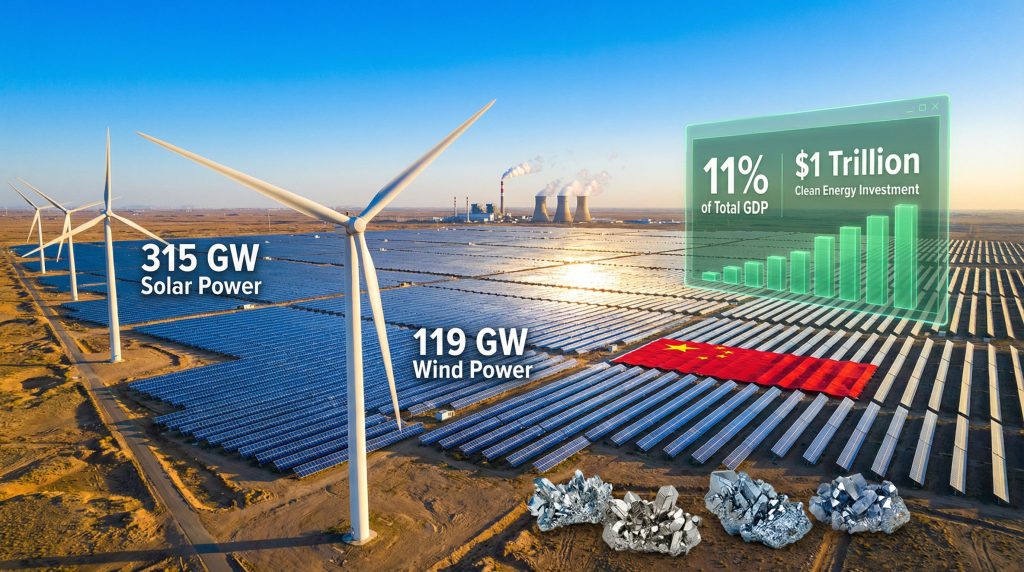
Investment patterns demonstrate the sector's economic magnitude, with 7.2 trillion yuan ($1 trillion) flowing into clean energy projects during 2025. This capital deployment represents over 11% of total GDP, creating growth rates three times faster than the broader economy.
The concentration of resources within solar, battery, and electric vehicle technologies has generated over 90% of investment increases across these strategic sectors. However, this focus on the critical minerals transition creates new dependencies on scarce materials essential for clean technology manufacturing.
Manufacturing Scale and Global Market Position
China's renewable capacity installations during 2024 illustrate the nation's manufacturing dominance across clean technology supply chains. Consequently, the deployment of 315 GW of solar capacity exceeded 50% of global installations, whilst 119 GW of wind capacity surpassed the combined additions of all other nations.
| Technology Sector | Capacity Added (2024) | Global Market Share | Economic Impact |
|---|---|---|---|
| Solar Power Systems | 315 GW | >50% worldwide | Manufacturing export leadership |
| Wind Energy Systems | 119 GW | Exceeds rest of world | Supply chain integration |
| Combined Renewables | 429 GW net additions | 83% wind+solar combined | Technology cost reduction |
This manufacturing scale creates significant economies of scope across integrated supply chains, from crystalline silicon production through turbine manufacturing and blade fabrication. The resulting cost advantages enable competitive technology exports while reducing global renewable energy prices through increased production volumes.
Grid Infrastructure Investment Strategy
China's clean energy boom requires substantial grid modernisation investments to accommodate variable renewable generation patterns. Infrastructure spending reached $80-83 billion during 2024, focusing on smart grid technologies and transmission capacity expansion necessary for renewable energy integration.
These grid investments create exportable expertise for international infrastructure projects, particularly within Belt and Road Initiative frameworks where Chinese companies provide turnkey renewable energy solutions to developing economies seeking modern electricity systems.
When big ASX news breaks, our subscribers know first
Coal's Strategic Foundation for Economic Competitiveness
Despite renewable energy expansion, coal remains central to China's economic strategy, providing industrial stability and manufacturing cost advantages that support clean technology production. For instance, this apparent contradiction reflects deliberate policy choices prioritising economic competitiveness over rapid fossil fuel phase-out timelines.
Industrial Production Dependencies
Coal provides 50% of electricity generation while accounting for 60-70% of primary energy consumption. Annual consumption exceeds 4 billion tons, representing over 50% of global coal demand. These statistics underscore coal's fundamental role in maintaining industrial production capacity.
Nevertheless, current coal supply challenges across global markets demonstrate the strategic importance of maintaining domestic production capabilities whilst transitioning toward cleaner alternatives.
The steel industry alone requires approximately 700 million tons of coal consumption annually, enabling China to capture over 50% of global steel market share through cost-competitive production.
New Capacity Development Trends
Coal capacity construction reached a 10-year high during 2024, with 94.5 GW of new coal-power capacity initiated alongside 3.3 GW of previously suspended projects being resumed. These developments indicate that coal retirement rates remain significantly lower than new capacity additions.
"The apparent contradiction between renewable commitments and coal expansion reflects prioritisation of near-term economic growth and manufacturing competitiveness over aggressive emissions reduction timelines."
Import patterns support domestic consumption growth, with 474 million tons of coal imported during 2023, establishing record import levels despite significant domestic production capacity.
Oil Import Dependencies and Economic Vulnerabilities
China's oil consumption patterns create persistent economic vulnerabilities that renewable energy expansion cannot immediately address. Transportation, petrochemicals, and industrial applications maintain robust crude oil demand despite rapid electric vehicle adoption and clean technology deployment.
Consumption and Supply Chain Analysis
Daily oil consumption ranges between 16.3-16.4 million barrels, making China the world's second-largest consumer after the United States. Import dependency reaches 74% of consumption, requiring 11.1 million barrels daily from international suppliers.
Projected 2025 demand of 16.74 million barrels daily indicates continued growth despite electrification efforts. Domestic production achieved record levels of 4.3 million barrels daily in 2025, increased from 3.8 million barrels daily in 2020.
However, the OPEC production impact on global oil markets affects China's import costs and supply security, creating ongoing economic vulnerabilities despite renewable expansion efforts.
Geopolitical Supply Dependencies
China's crude oil supply chain demonstrates strategic diversification across multiple regions, though this creates exposure to various geopolitical risks affecting energy security and economic stability.
| Supplier Region | Daily Import Volume | Strategic Significance | Transportation Method |
|---|---|---|---|
| Russia | 2+ million barrels | 20% of total imports | Pipeline + "shadow fleet" |
| Saudi Arabia | Major supplier | Gulf stability dependency | Maritime transport |
| Iraq | Key source | Regional risk exposure | Maritime transport |
Russian oil deliveries utilise 900,000 barrels daily via pipeline infrastructure, with remaining volumes transported by maritime "shadow fleet" operations designed to bypass Western sanctions.
Domestic Production Limitations
China's domestic oil production faces structural constraints limiting the ability to achieve energy independence through increased upstream development. Offshore production dominates new output growth, accounting for over 60% of new production for five consecutive years.
Major state-owned operators including CNOOC, CNPC, and Sinopec have invested over $50 billion in offshore development during 2020-2025, yet this capital deployment remains insufficient to meet demand growth.
Natural Gas Bridge Strategy and LNG Market Position
Natural gas serves as a critical transition fuel in China's energy strategy, providing dispatchable power generation to balance intermittent renewable sources whilst reducing coal dependency in specific applications. This bridge fuel approach enables grid stability maintenance during renewable capacity expansion.
Consumption Growth and Import Patterns
Natural gas consumption reached approximately 428 billion cubic meters in 2024, marking steady growth from 330 billion cubic meters in 2020. Industrial and residential demand drive consumption increases, with power generation applications providing grid balancing services for renewable integration.
Meanwhile, recent natural gas trends show price volatility affecting import costs and demand patterns across major consuming nations, including China.
Liquefied Natural Gas (LNG) imports are projected to rebound with up to 10% year-over-year increases reaching nearly 76 million metric tons during 2026, following a 10% decline in 2025.
Grid Balancing Applications
Natural gas power generation provides essential grid stability services as renewable capacity expands. Gas-fired plants offer rapid startup capabilities and load-following characteristics necessary to balance intermittent solar and wind generation patterns.
The flexibility of gas infrastructure enables seasonal demand management and peak load coverage during periods when renewable output cannot meet electricity demand.
Rare Earth Element Monopoly and Technology Control
China's dominance over rare earth element (REE) supply chains creates perhaps the most significant competitive advantage in global clean technology markets. This control extends from mining operations through processing and refining, establishing near-monopolistic influence over critical materials.
Supply Chain Control Metrics
China controls approximately 60-70% of global rare earth mining operations whilst maintaining over 90% of processing and refining capacity worldwide. This vertical integration enables price control and supply allocation across international markets.
Furthermore, understanding rare earth reserves distribution across different countries highlights China's strategic advantages in controlling these critical materials essential for clean technology deployment.
Critical Applications in Clean Technologies
Rare earth elements serve essential functions in renewable energy equipment, creating dependency relationships for competing nations seeking clean technology deployment.
Wind Turbine Applications:
- Neodymium and dysprosium enable high-strength permanent magnets
- Significantly increase power density and operational efficiency
- Particularly essential for offshore, direct-drive turbines requiring no gearbox
- Enable compact generator designs reducing installation costs
Solar Technology Components:
- Yttrium, lanthanum, and cerium utilised in specialised inverters
- Critical for power conversion and grid integration systems
- Essential for sensor technologies and converter components
- Enable efficiency optimisation in photovoltaic systems
Economic Leverage and Export Control
China's rare earth hegemony creates multiple layers of economic advantage extending beyond simple material supply. Processing capacity concentration enables value-added manufacturing that generates substantially higher margins than raw material exports.
This control mechanism allows China to influence global clean technology production costs, restrict competitor access to essential materials, and maintain technological leadership through material scarcity.
Economic Projections and Competitive Positioning
China's dual strategy of renewable expansion combined with strategic fossil fuel utilisation creates unique economic advantages that competing nations struggle to replicate. This approach enables capture of clean technology market share whilst maintaining industrial cost competitiveness through cheap energy inputs.
Long-term Capacity Targets and Market Implications
Renewable capacity projections indicate 2,461 GW of renewable capacity by 2030, with solar expected to surpass coal capacity by 2026. Non-fossil sources will reach 63% of total capacity, whilst coal declines to 31% of the capacity mix.
These targets suggest a fundamental restructuring of the energy system, though capacity figures differ significantly from actual generation patterns due to capacity factor variations between renewable and conventional sources.
Technology Export Opportunities
China's domestic renewable capacity creates economies of scale enabling competitive international technology exports. Manufacturing cost advantages derived from large-scale domestic deployment provide pricing advantages in international markets.
The $80-83 billion grid infrastructure investment demonstrates China's capacity for large-scale energy system transformation, creating exportable expertise particularly valuable for Belt and Road Initiative projects seeking modern electricity infrastructure.
Manufacturing Competitiveness Analysis
The integration of cheap fossil fuel energy with renewable technology manufacturing creates a unique competitive position. Coal-powered industrial bases enable low-cost production of solar panels, wind turbines, and battery systems sold globally at competitive prices.
This cost structure allows Chinese manufacturers to capture significant global market share whilst gradually transitioning toward cleaner domestic energy consumption patterns.
The next major ASX story will hit our subscribers first
Global Economic Power Redistribution
China's clean energy boom represents more than environmental policy implementation; it constitutes a calculated strategy to capture disproportionate economic value from the global energy transition whilst maintaining industrial competitiveness through continued fossil fuel utilisation.
According to Carbon Brief's analysis, clean energy sectors contributed over one-third of China's GDP growth in 2025, demonstrating the economic significance of this transition beyond environmental benefits.
The combination of renewable technology leadership, rare earth control, and strategic fossil fuel use creates an economic model that other major economies find difficult to replicate due to resource constraints and capital requirements.
Competitive Advantages:
- Integrated supply chains from raw materials through finished products
- Scale economies reducing per-unit manufacturing costs
- Export market capture in growing clean technology sectors
- Strategic material control creating competitor dependencies
Economic Implications:
- Potential reshaping of global trade flows toward Chinese technology exports
- Reduced influence of traditional fossil fuel exporters
- Increased technological dependencies for nations pursuing renewable transitions
- Concentration of clean technology value chains within Chinese manufacturing bases
What Does This Mean for Global Energy Markets?
This transformation suggests that nations pursuing aggressive renewable energy transitions may become increasingly dependent on Chinese technology exports and rare earth supplies. Consequently, this could shift economic power relationships as the global energy system transitions toward lower carbon sources.
The World Economic Forum reports that China is adding more renewable capacity to its grid than any other nation, with implications extending far beyond domestic energy policy.
The macroeconomic implications extend far beyond environmental considerations, representing a fundamental restructuring of international economic relationships as clean technology deployment accelerates worldwide. China's early investment in renewable manufacturing capacity and strategic resource control positions the nation to capture substantial economic benefits from global decarbonisation efforts.
This dual approach of leading clean technology deployment whilst maintaining energy security through diversified fuel sources demonstrates how China's clean energy boom serves multiple strategic objectives simultaneously, creating competitive advantages that extend well beyond environmental policy goals.
Ready to Capitalise on Clean Energy Market Opportunities?
Discovery Alert's proprietary Discovery IQ model identifies significant mineral discoveries across critical materials essential for clean technology development, including rare earth elements and battery metals driving China's renewable expansion. Explore how historic mineral discoveries have generated substantial returns for early investors, then begin your 14-day free trial today to gain immediate alerts on emerging opportunities in this rapidly evolving sector.