August 14, 2026
Understanding China's Strategic Clean-Tech Capital Deployment Framework
The global energy transition has accelerated beyond traditional development finance models, creating unprecedented opportunities for strategic capital deployment across developing economies. China's $180 billion clean-tech investments in the Global South represents a fundamental shift from project-based financing toward integrated industrial ecosystem development, establishing new paradigms for South-South economic cooperation and technological transfer.
This transformation reflects broader macroeconomic forces reshaping international trade architecture. Rather than simply exporting finished products, Chinese enterprises are establishing complete manufacturing value chains in recipient countries, creating compound economic benefits that extend far beyond initial capital deployment. Furthermore, the strategy leverages China's manufacturing overcapacity while simultaneously addressing global decarbonization imperatives and energy transition dynamics.
Economic Rationale Behind Massive Capital Allocation
China's clean technology investment surge stems from multiple converging economic factors. Manufacturing overcapacity in solar panels, batteries, and wind turbines necessitates new market creation rather than simple export expansion. By establishing production facilities overseas, Chinese companies maintain capacity utilisation while reducing trade friction and transportation costs.
The Belt and Road Initiative provides institutional framework for coordinating these investments across multiple sectors simultaneously. This comprehensive approach enables economies of scale and supply chain integration that individual projects cannot achieve. State-backed enterprises coordinate with private sector capital to accelerate deployment timelines and reduce financing costs for recipient countries.
Currency diplomacy plays an increasingly important role in investment structuring. Many agreements incorporate yuan-denominated transactions, gradually building alternative financial architecture that reduces dollar dependency for participating nations. This creates mutual benefits through reduced exchange rate exposure and enhanced monetary policy flexibility.
Integrated Supply Chain Investment Architecture
Chinese clean-tech investment differs fundamentally from traditional foreign direct investment through its comprehensive value chain approach. Rather than establishing isolated manufacturing facilities, investments typically include:
- Raw material processing capabilities integrated with local mining operations
- Manufacturing facilities designed for both domestic consumption and export markets
- Research and development centers focused on technology adaptation and innovation
- Training institutes developing local technical expertise and management capabilities
- Recycling and waste management systems ensuring circular economy principles
This integrated model creates multiple economic multiplier effects. Local suppliers develop capabilities serving Chinese operations while building expertise for independent market participation. Technology transfer occurs through operational collaboration rather than simple licensing agreements, ensuring deeper knowledge absorption and capability development.
The approach also incorporates renewable energy infrastructure to power manufacturing facilities, creating additional economic benefits through reduced energy costs and improved grid stability. This comprehensive planning reduces overall project risks while maximising economic development potential for host countries.
When big ASX news breaks, our subscribers know first
Regional Economic Impact Analysis: Southeast Asia's Industrial Transformation
Southeast Asia has emerged as the primary beneficiary of China's clean technology investment strategy, with over $15 billion in committed capital across battery manufacturing, electric vehicle assembly, and solar panel production. The region's strategic location, abundant raw materials, and growing energy demands create ideal conditions for integrated clean-tech manufacturing hubs.
Indonesia's Battery Manufacturing Revolution
Indonesia's transformation into a global battery production centre demonstrates the compound economic effects of strategic Chinese investment. The CATL complex in West Java, representing $6 billion in committed capital, integrates multiple value chain components within a single industrial ecosystem.
The facility processes locally mined nickel through state-of-the-art refining technology, producing battery-grade materials for domestic use and regional export. Annual production capacity of 6.9 GWh positions Indonesia as a major supplier to global electric vehicle manufacturers, fundamentally altering the country's export profile and industrial capabilities.
Employment impacts extend beyond direct manufacturing jobs. The project creates over 10,000 direct positions while generating additional opportunities in logistics, maintenance, and support services. Local engineering firms gain experience with advanced manufacturing systems, building capabilities that enable independent project development in related sectors.
The economic multiplier effects include upgraded port facilities, improved electrical grid capacity, and enhanced telecommunications infrastructure. These improvements benefit broader industrial development while reducing costs for future investments across multiple sectors.
Malaysia's Energy Storage Hub Development
Malaysia's evolution into a regional energy storage manufacturing centre reflects strategic positioning within China's broader supply chain architecture. EVE Energy's $1.2 billion investment creates large-scale battery production capabilities while establishing Malaysia as a key node in regional energy transition dynamics.
The investment complements Malaysia's existing palm oil industry through biofuel integration possibilities and sustainable chemistry applications. This industrial diversification reduces economic dependence on commodity exports while creating higher-value manufacturing opportunities for local workforce development.
Energy storage manufacturing enables Malaysia to develop domestic renewable energy capabilities more rapidly. Local production reduces import costs for solar and wind integration projects while providing technical expertise for grid modernisation initiatives. These capabilities position Malaysia as a regional leader in energy transition planning and implementation.
Thailand's EV Research Ecosystem
Thailand's emergence as a regional electric vehicle research and development centre demonstrates how Chinese investments can catalyse broader innovation ecosystems. Sunwoda's $1 billion battery plant includes comprehensive training centres designed to develop local technical expertise across multiple specialisations.
Changan's research partnerships with Thai automotive companies create knowledge-sharing frameworks that extend beyond immediate production requirements. Joint research initiatives focus on tropical climate battery performance, regional supply chain optimisation, and local component integration strategies.
These collaborations generate intellectual property jointly owned by Chinese and Thai partners, ensuring that knowledge development benefits remain within the region. The approach creates sustainable competitive advantages that persist beyond initial investment periods while building indigenous innovation capabilities.
Training programmes produce thousands of certified technicians annually, creating workforce capabilities that support broader automotive sector transformation. These skills transfer to related industries including electronics manufacturing, precision engineering, and renewable energy systems integration.
Regional Economic Impact Analysis: Middle East Diversification
The Middle East represents a particularly strategic region for Chinese clean technology investments, combining abundant renewable energy resources with urgent economic diversification imperatives. Chinese companies have committed over $12 billion across solar manufacturing, battery production, and hydrogen development projects, fundamentally altering regional energy and industrial landscapes.
Saudi Arabia's Solar Manufacturing Transformation
Saudi Arabia's partnership with Shanghai Electric on large-scale solar development demonstrates how Chinese investment accelerates industrial diversification from oil dependency. The $1.1 billion solar installation, capable of powering 1.5 million homes, represents just the beginning of comprehensive renewable energy industrial development.
The project incorporates local manufacturing components, with plans for expanding solar panel assembly capabilities using Chinese technology and Saudi financial resources. ACWA Power's staff training programmes in China create knowledge transfer mechanisms that build local expertise in project development, operations, and maintenance.
Economic benefits extend beyond electricity generation to include reduced energy costs for other industrial activities. Lower electricity prices enhance manufacturing competitiveness across multiple sectors while reducing operational costs for energy-intensive industries including petrochemicals, metals processing, and desalination.
The solar manufacturing capabilities position Saudi Arabia as a potential supplier to regional markets throughout the Middle East and North Africa. This export potential creates additional revenue streams while supporting broader regional energy transition dynamics.
Morocco's Battery Export Strategy
Morocco's development as a major battery manufacturing hub through Gotion's $5.6 billion investment creates unprecedented opportunities for European market access using Chinese technology and North African advantages. The facility's 100 GWh annual capacity targets both local automotive development and European electric vehicle supply chains.
Joint research laboratories established as part of the investment focus on developing specialised battery chemistries adapted to regional climate conditions and application requirements. This research collaboration creates intellectual property sharing arrangements that benefit both Chinese technology development and Moroccan industrial capabilities.
The manufacturing facility incorporates comprehensive recycling systems designed to process used batteries from across North Africa and Europe. This circular economy approach creates additional revenue streams while addressing environmental concerns associated with battery waste management, reflecting broader industry evolution trends.
Local content requirements ensure that Moroccan suppliers develop capabilities in precision manufacturing, quality control systems, and logistics management. These capabilities enable independent market participation while supporting broader industrial development objectives.
Regional Energy Infrastructure Modernisation
Chinese investments across the Middle East include comprehensive grid modernisation and energy infrastructure development. These improvements enable higher renewable energy penetration while reducing overall system costs and improving reliability for industrial and residential users.
Oman's solar cell production facility, developed through JA Solar's $564 million investment, combines manufacturing capabilities with grid integration expertise. The 6 GW production capacity serves both domestic renewable energy development and regional export opportunities.
Egypt's hydrogen development projects with LONGi create new possibilities for industrial applications and export revenue generation. Green hydrogen production using Chinese electrolysis technology positions Egypt as a potential supplier to European industrial users seeking clean energy alternatives, establishing a critical raw materials facility network across the region.
Nigeria's $8.27 billion clean energy agreements establish frameworks for comprehensive energy sector transformation using Chinese financing and technology. These investments address critical energy access challenges while building industrial capabilities that support broader economic development objectives.
Macroeconomic Implications for Global Trade Architecture
China's clean technology investment strategy is fundamentally reshaping global trade flows and industrial geography. By establishing integrated manufacturing hubs across developing economies, these investments create new patterns of South-South trade while reducing traditional dependencies on Western technology and financing sources.
Supply Chain Economics and Cost Structure Changes
The geographic distribution of Chinese clean-tech investments creates multiple supply chain advantages that compound over time. Raw material processing localisation reduces transportation costs while improving supply security for both Chinese companies and local industrial users.
Manufacturing hub decentralisation enables production optimisation based on local cost advantages, resource availability, and market access considerations. This distributed approach reduces concentration risks while creating competitive pressure that drives continuous efficiency improvements across the network.
Technology transfer pricing mechanisms embedded in investment agreements create ongoing revenue streams for Chinese technology providers while ensuring that recipient countries develop indigenous capabilities. This balanced approach maintains Chinese competitive advantages while enabling genuine local development, adapting to global trade war strategies.
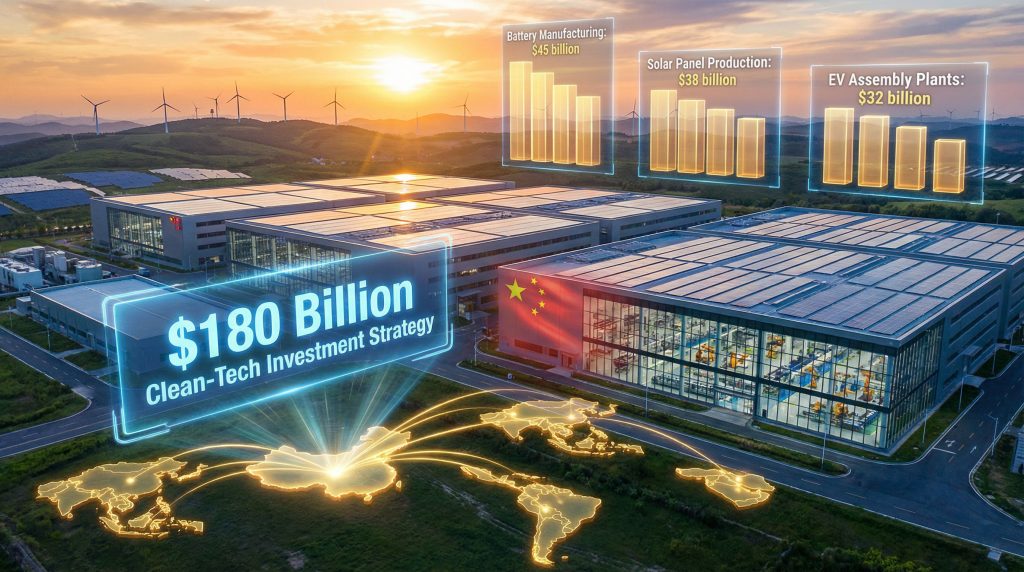
| Investment Category | Capital Deployed | Regional Distribution | Technology Transfer Level |
|---|---|---|---|
| Battery Manufacturing | $45 billion | Asia-Pacific 60%, Middle East 25%, Latin America 15% | High – Joint ventures with local R&D |
| Solar Panel Production | $38 billion | Middle East 45%, Asia-Pacific 35%, Africa 20% | Medium – Manufacturing technology transfer |
| EV Assembly Plants | $32 billion | Latin America 40%, Asia-Pacific 35%, Europe 25% | High – Complete production systems |
| Energy Storage Systems | $25 billion | Asia-Pacific 50%, Europe 30%, Middle East 20% | Medium – Application-specific adaptation |
Export Competitiveness and Market Access
Chinese investments systematically improve export competitiveness for recipient countries through multiple mechanisms. Lower energy costs from renewable energy integration reduce manufacturing expenses across all industrial sectors. Advanced manufacturing technology improves product quality while reducing production costs.
Market access facilitation occurs through Chinese companies' existing global sales networks and customer relationships. Local production facilities gain immediate access to established distribution channels while building capabilities for independent market development.
Technical standards harmonisation creates interoperability advantages that reduce certification costs and accelerate market entry. Chinese technology adoption establishes compatibility with the world's largest clean technology ecosystem, simplifying integration and maintenance requirements.
Trade agreement leverage enables preferential access to Chinese markets while maintaining third-country export flexibility. This dual-market access creates diversified revenue opportunities that reduce dependence on individual export destinations, particularly benefiting countries pursuing lithium industry innovations.
Economic Multiplier Analysis and Impact Assessment
The integrated nature of Chinese clean-tech investments generates economic multipliers significantly higher than traditional foreign direct investment. Complete value chain development creates backward linkages to local suppliers while establishing forward linkages to domestic and export markets.
Direct employment creation in manufacturing facilities represents only the initial economic impact. Indirect employment in supporting industries, logistics, and services often exceeds direct job creation by substantial margins. Long-term employment effects include higher-skilled positions in research, development, and technical management.
Productivity improvements from modern manufacturing technology and management practices spread throughout local industrial ecosystems. Local companies adopt quality control systems, efficiency optimisation techniques, and environmental management practices that improve overall competitiveness.
Knowledge spillovers create innovation capabilities that extend beyond immediate project requirements. University partnerships, research collaborations, and technical training programmes build human capital that benefits broader economic development initiatives.
Competitive Economic Positioning: Alternative Development Models
China's clean technology investment model differs substantially from Western development finance approaches in timing, scope, and integration depth. These differences create distinct advantages for recipient countries while establishing alternative frameworks for international economic cooperation.
Speed of Deployment and Implementation
Chinese investment deployment occurs significantly faster than comparable Western projects due to streamlined decision-making processes and integrated supply chain control. State-backed financing eliminates lengthy approval procedures while private sector execution ensures operational efficiency.
Project timeline comparisons reveal systematic advantages in construction speed, technology installation, and operational commencement. Chinese companies bring complete project teams with established working relationships, reducing coordination challenges and communication delays.
Rapid deployment creates immediate economic benefits through early employment generation and infrastructure improvement. Quick project completion demonstrates tangible results that build political support while generating early returns on invested capital, according to recent analysis from the Climate Energy Finance Centre.
The speed advantage particularly benefits countries with urgent energy access needs or economic development pressures. Fast project delivery addresses immediate challenges while building foundation for longer-term industrial development.
Technology Integration and Knowledge Transfer
Western clean technology investments typically focus on single-component technologies with limited local integration requirements. Chinese investments emphasise complete technology stacks that include manufacturing, application, maintenance, and optimisation capabilities.
Knowledge transfer occurs through operational collaboration rather than formal training programmes alone. Chinese technicians work directly with local counterparts on daily production challenges, creating practical expertise that extends beyond theoretical knowledge.
Local content requirements ensure that domestic suppliers develop capabilities in precision manufacturing, quality control, and system integration. These capabilities create sustainable competitive advantages that persist beyond initial investment periods.
Research and development collaboration produces innovations adapted to local conditions and requirements. Joint intellectual property development creates shared ownership arrangements that incentivise continued cooperation and technology advancement.
Financial Structuring and Risk Management
Chinese investment financing combines concessional elements with commercial returns to create attractive packages for recipient countries. State backing reduces borrowing costs while private sector involvement ensures operational efficiency and market responsiveness.
Risk sharing arrangements protect recipient countries from technology obsolescence and market volatility. Chinese companies maintain operational responsibility for performance guarantees while local partners focus on market development and regulatory compliance, as detailed in Reuters' comprehensive analysis of these investment structures.
Currency exposure management includes yuan-denominated transactions that reduce dollar dependency while creating natural hedging mechanisms. This approach particularly benefits countries with significant trade relationships with China.
Long-term financing availability enables comprehensive project planning without immediate repayment pressures. Extended payment schedules allow cash flow generation from operations to support debt service requirements.
Long-Term Economic Transformation Scenarios
The trajectory of China's $180 billion clean-tech investments in the Global South will significantly influence global economic architecture over the next decade. Different scenario outcomes depend on policy responses from recipient countries, competitive reactions from Western economies, and evolving geopolitical relationships.
Accelerated Global South Industrialisation Pathway
The most optimistic scenario envisions rapid industrial capacity development across participating developing economies, creating new manufacturing centres that rival established industrial regions. This transformation would generate substantial GDP growth through export expansion and import substitution.
Manufacturing export capacity development could increase Global South share of clean technology trade from current levels below 20% to over 40% by 2030. This shift would generate hundreds of billions in additional export revenues while creating millions of manufacturing jobs across participating countries.
Energy cost reductions from renewable energy deployment would enhance overall economic competitiveness across multiple sectors. Lower electricity prices benefit energy-intensive industries while improving household disposable income and consumption capacity.
Technology spillover effects could accelerate indigenous innovation capabilities, creating sustainable competitive advantages that persist beyond initial Chinese investment. Local research and development capabilities would enable product adaptation and process optimisation suited to regional conditions and requirements.
The success of this scenario depends on effective policy coordination between Chinese investors and recipient country governments, ensuring that maximum economic benefits accrue to local populations while maintaining Chinese competitive advantages.
Geopolitical Economic Bloc Formation
An alternative scenario involves the emergence of distinct economic blocs centred around different technology standards and trading relationships. Chinese clean-tech investments could create preferential trading arrangements that systematically favour participants in the investment network.
South-South trade corridor development would establish direct trading relationships that bypass traditional Western financial and logistics systems. Alternative payment mechanisms using digital currencies or commodity swaps could reduce transaction costs while minimising Western financial system exposure.
Technology standard divergence might create incompatible systems that require countries to choose between Chinese and Western technology ecosystems. This fragmentation could reduce overall economic efficiency while creating strategic dependencies that influence broader geopolitical relationships.
Supply chain regionalisation around Chinese technology standards would create economic integration among participating countries while potentially isolating them from Western markets. The net economic impact would depend on the relative size and growth rates of different trading blocs.
Sustainable Development Acceleration
The most environmentally beneficial scenario would see Chinese clean-tech investments catalyse broader sustainable development initiatives that address climate change while promoting economic growth. Carbon intensity reductions would create measurable environmental benefits while generating economic co-benefits.
Climate finance mobilisation through Chinese investments could unlock additional funding from international development banks and Western governments seeking to support competitive clean technology deployment. This funding multiplication would accelerate project implementation while reducing costs for recipient countries.
Energy access expansion in underserved regions would improve economic productivity through reliable electricity supply for manufacturing, agriculture, and services. Universal energy access could generate substantial economic returns through improved health, education, and economic opportunities.
Environmental cost avoidance through reduced air pollution and climate impact would create quantifiable economic benefits measured in healthcare savings, agricultural productivity improvements, and infrastructure protection. These co-benefits would justify continued investment even without immediate financial returns.
The next major ASX story will hit our subscribers first
Policy Implications and Economic Governance Considerations
Maximising economic benefits from Chinese clean-tech investments requires sophisticated policy frameworks that balance foreign investment attraction with domestic capacity building. Recipient countries must develop governance mechanisms that ensure promised benefits materialise while building sustainable competitive advantages.
Optimising Local Content and Technology Absorption
Successful technology absorption requires deliberate policy frameworks that go beyond simple local content requirements. Effective strategies include mandatory technology transfer agreements, joint research and development requirements, and local workforce development programmes integrated with investment approvals.
Local content maximisation strategies should focus on high-value components rather than simple assembly operations. Policies that incentivise local production of sophisticated components create greater economic value while building more advanced technical capabilities.
Technology absorption frameworks must include performance monitoring and compliance enforcement mechanisms. Regular assessment of knowledge transfer effectiveness ensures that promised capabilities actually develop within recipient countries.
Export market development support helps local suppliers transition from serving Chinese companies to competing independently in global markets. Government trade promotion programmes should specifically target companies that gain capabilities through Chinese investment participation.
Regulatory Frameworks for Economic Benefit Maximisation
Investment screening mechanisms should evaluate projects based on comprehensive economic impact rather than simple capital investment amounts. Scoring systems that consider employment quality, technology transfer depth, and export potential create incentives for higher-value investments.
Performance monitoring systems must track actual outcomes against promised benefits over multi-year periods. Regular reporting requirements ensure that investors maintain commitments while providing early warning of implementation challenges.
Local partnership requirements should mandate meaningful collaboration rather than token local involvement. Joint venture structures that share decision-making authority create stronger incentives for genuine technology transfer and capability development.
Export promotion incentives can leverage Chinese investment to build broader export capabilities. Tax benefits and regulatory support for companies that transition from serving domestic Chinese operations to competing in global markets encourage economic development that extends beyond initial investment requirements.
Financial Sustainability and Debt Management
Debt sustainability concerns require careful analysis of project economics and repayment capacity. Governments should conduct independent feasibility assessments to verify that promised economic returns justify borrowing requirements.
Fiscal impact management includes optimising tax revenues from Chinese investments while avoiding unsustainable debt accumulation. Revenue sharing agreements should ensure that government benefits from successful projects while maintaining investor incentives for performance.
Alternative financing structures could reduce debt exposure while maintaining Chinese investment attraction. Equity participation by government development banks or sovereign wealth funds could create risk-sharing arrangements that protect fiscal sustainability.
Currency exposure management becomes critical for projects involving yuan-denominated financing or revenue streams. Natural hedging through trade relationship development can reduce exchange rate risks while building economic integration benefits.
Economic Outlook and Success Measurement Framework
Evaluating the success of China's clean-tech investment strategy requires comprehensive metrics that capture both immediate economic impacts and longer-term structural changes. Traditional foreign direct investment measurements inadequately assess the integrated nature of these investments and their compound economic effects.
Key Performance Indicators for Economic Impact
GDP contribution metrics must account for both direct value creation from manufacturing operations and indirect effects through supply chain development and economic multipliers. Input-output modelling can quantify the full economic impact across multiple sectors and time periods.
Export diversification indices measure progress toward reducing commodity dependence and building manufactured export capabilities. Successful projects should demonstrate measurable increases in high-value export products and reduced reliance on raw material exports.
Technology capability development requires metrics that assess actual knowledge absorption rather than simple training programme completion. Patent applications, local research and development spending, and indigenous innovation indicators provide meaningful capability assessments.
Employment quality indicators must evaluate wage levels, skill development opportunities, and career advancement prospects rather than simple job counts. Higher-quality employment creates greater economic benefits while building human capital for broader development.
Sustainability and Long-Term Competitiveness Factors
Market competition maintenance requires policies that prevent excessive dependency on single technology providers. Encouraging multiple suppliers and maintaining technological diversity ensures continued innovation and competitive pricing.
Local innovation ecosystem development should produce measurable increases in domestic research capabilities, university partnerships, and startup formation. These indicators suggest sustainable competitive advantage development beyond immediate investment benefits.
Financial sustainability assessment includes project-level returns, government revenue generation, and broader economic multiplier effects. Comprehensive cost-benefit analysis should demonstrate positive returns across multiple stakeholder groups.
Environmental economic co-benefits quantification can justify continued investment support even when immediate financial returns fall short of expectations. Pollution reduction, health improvement, and climate impact avoidance create measurable economic value that supports longer-term investment sustainability.
Global Economic Architecture Evolution
China's $180 billion clean-tech investments in the Global South represents a fundamental shift in international economic cooperation patterns. The success of this model could establish new frameworks for South-South development finance while creating alternative systems for global trade and technology transfer.
The compound effects of integrated supply chain development, technology transfer, and market access facilitation create economic transformation potential that extends far beyond initial capital deployment. Recipient countries gain industrial capabilities that enable sustained economic growth while China establishes global leadership in clean technology deployment.
This transformation occurs within broader geopolitical competition between different development models and economic systems. The relative success of Chinese versus Western approaches to clean technology deployment will influence future international economic architecture and development finance mechanisms.
The ultimate economic impact depends on effective policy implementation by recipient countries, continued Chinese commitment to technology transfer, and broader global coordination on climate change and development objectives. Success in achieving these complex objectives could establish new paradigms for international economic cooperation that persist for decades.
Investment decisions should be based on comprehensive due diligence and professional financial advice. The economic projections and policy recommendations discussed in this analysis are subject to significant uncertainties and may not reflect actual outcomes. Currency exchange rates, political developments, and technological changes could substantially alter the economic impacts described.
Looking for Opportunities in China's Clean-Tech Investment Revolution?
Discovery Alert's proprietary Discovery IQ model delivers real-time alerts on significant ASX mineral discoveries, helping investors capitalise on the growing demand for critical minerals driving clean technology worldwide. With China's $180 billion clean-tech investments creating unprecedented opportunities in lithium, nickel, and rare earth sectors, stay ahead of the market by accessing our comprehensive discoveries database showcasing historic returns from major mineral finds.