July 22, 2026
Understanding the Structural Foundation of China's Critical Minerals Control
The global transition toward renewable energy and electric transportation has exposed a fundamental vulnerability in Western supply chains that extends far beyond simple resource scarcity. While nations scramble to secure lithium deposits and rare earth mining rights, the real strategic leverage lies in the complex industrial processes that transform raw materials into usable products. China's processing dominance represents a sophisticated form of economic power that cannot be easily replicated through mining investments alone.
This dominance stems from decades of coordinated industrial policy that prioritised downstream value capture over raw material extraction. Where Western markets fragment processing across multiple companies and regions, Chinese firms operate integrated supply chains that span from mine to magnet, creating operational efficiencies and strategic advantages that go well beyond cost considerations.
The Processing Advantage: Beyond Raw Material Control
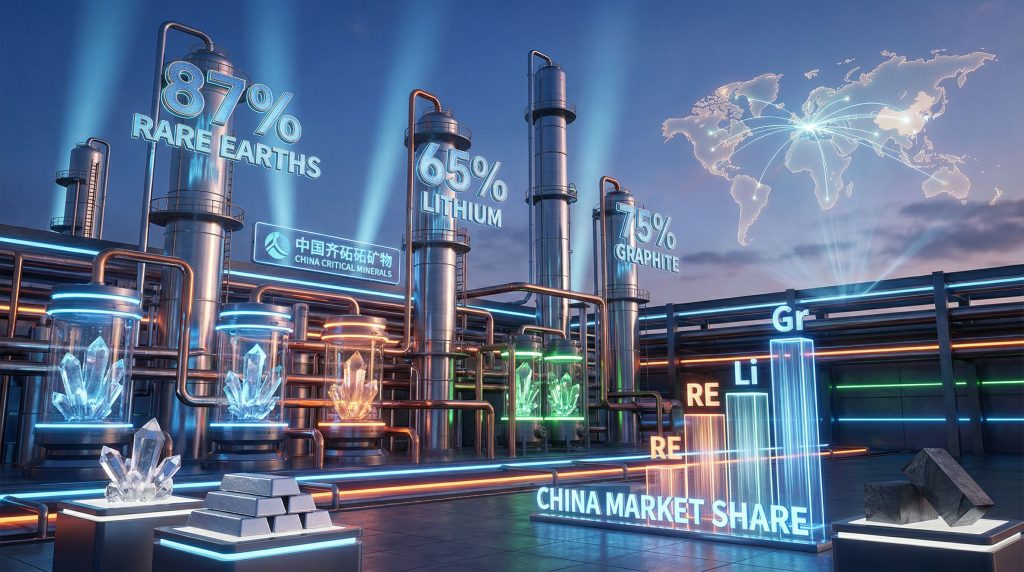
Table: China's Processing Market Share Across Critical Minerals (2024-2025)
| Mineral Category | China's Processing Share | Strategic Applications |
|---|---|---|
| Rare Earth Elements | 87% | Defence systems, renewable energy, electronics |
| Lithium Refining | 65% | EV batteries, energy storage |
| Graphite Processing | 75% | Battery anodes, steel production |
| Cobalt Refining | 68% | High-performance batteries |
| Copper Smelting | 47% | Infrastructure, electronics |
The International Energy Agency reports that China controlled approximately 85-90% of rare earth separation capacity as of 2024, with similar dominance across other critical processing sectors. Furthermore, this processing control creates bottlenecks that cannot be resolved simply by opening new mines in friendly jurisdictions.
The technical complexity underlying these percentages reveals why China's processing dominance proves so durable. Rare earth processing, for instance, requires mastery of hydrometallurgical techniques involving 15-25 sequential extraction stages to separate individual elements from mixed ore concentrates. In addition, a single processing facility can cost $500 million to $2 billion and requires 3-5 years of construction and permitting timelines.
What Makes Processing Dominance More Powerful Than Mining Control?
The critical distinction between mining and processing reveals why China's advantage extends far beyond geological fortune. However, mining operations extract raw ore with typical grades ranging from 3-8% REO concentration for rare earths. Processing transforms this ore through complex chemical pathways into separated oxides, refined metals, and ultimately functional products like permanent magnets.
Processing operations demand fundamentally different capabilities than mining:
- Technical expertise accumulated over decades in specialised chemical engineering
- Environmental management capabilities for handling radioactive thorium waste and fluorine compounds
- Integrated supply chains connecting multiple sequential processing stages
- Capital intensity that creates high barriers to entry and long payback periods
Key Insight: A mine can produce ore, but without processing capabilities, that ore remains strategically worthless. China recognised this early and invested accordingly.
The Vertical Integration Strategy
China's approach differs fundamentally from Western fragmented markets through state-owned enterprises like China Northern Rare Earth Group, China Minmetals, and China Molybdenum. Consequently, these firms operate across the entire value chain, enabling them to:
- Absorb losses at one stage while capturing profits downstream in magnet manufacturing
- Maintain pricing flexibility during commodity market volatility
- Coordinate supply and demand signals across multiple industrial sectors
- Leverage economies of scale across integrated operations spanning mining to electronics
This integration creates what analysts term a "cross-subsidy" model where individual business units can operate at breakeven or losses whilst the overall enterprise maintains profitability through downstream value capture. Western companies, operating in fragmented markets with distinct profit centres, cannot easily replicate this strategic flexibility.
Processing facilities also require specialised equipment supply chains for corrosion-resistant alloys, specialised pumps, and monitoring systems with long lead times. For instance, a Western engineer trained in conventional mining typically lacks expertise in solvent extraction chemistry or rare earth separation cascades, creating genuine technical gaps beyond simple capital constraints.
When big ASX news breaks, our subscribers know first
Why Western Counter-Strategies Face Structural Limitations
Recent Western initiatives, while significant in scale and political commitment, address symptoms rather than root causes of China's processing dominance. However, government interventions have focused heavily on individual project support rather than building comprehensive processing ecosystems necessary for true supply chain independence. The development of a new European CRM facility demonstrates efforts to address these gaps.
Government Intervention Analysis
Current Western Response Mechanisms:
-
Price Floor Guarantees
- MP Materials receives 10-year magnet offtake agreements with price protection from the U.S. Department of Defence
- Canadian government provides fixed-price graphite agreements for domestic processors
- Risk: Creates two-tier pricing that increases downstream manufacturing costs
-
Equity Stakes and Strategic Investments
- U.S. Department of Defence becomes the largest shareholder in MP Materials with $120 million in grants
- Allied investments totalling $3.5 billion across Australia and Central Asia projects
- Risk: Selective support creates market winners and losers rather than ecosystem development
-
Tariff and Trade Barriers
- Import restrictions on Chinese processed materials under Section 232 authority
- Export controls on critical processing technologies
- Risk: Retaliatory measures and supply disruption during transition periods
The EU Critical Raw Materials Act allocated €1.2 billion for strategic projects, whilst similar initiatives across allied nations demonstrate unprecedented policy coordination. Nevertheless, these measures remain fragmented across competing national priorities and lack the integrated industrial planning that enabled China's original dominance. The relationship between critical minerals & energy security becomes increasingly relevant to these policy decisions.
The Industrial Ecosystem Gap
Western efforts focus heavily on individual projects rather than building comprehensive processing ecosystems. This project-by-project approach faces several structural challenges:
- Skills shortage in specialised hydrometallurgical and separation techniques
- Environmental permitting delays averaging 2-3 years for complex refining operations
- Capital allocation fragmented across multiple competing initiatives without coordination
- Market coordination lacking between mining, processing, and manufacturing sectors
Case studies illustrate these limitations. Lynas Rare Earths, despite operating one of the world's highest-grade rare earth deposits at Mount Weld, required partnerships with Japanese trading house Sojitz Corporation to access processing expertise and sales channels. Even with this support, Lynas achieved only 11,000 tonnes of REE annually as of 2024, representing roughly 12% of China's separation capacity.
Moreover, Energy Fuels Inc. attempted rare earth processing at its White Mesa Mill in Utah but struggled to optimise extraction recovery rates, achieving 85-92% recovery compared to Chinese facilities' 96-99% efficiency. The company ultimately de-prioritised rare earth processing in favour of uranium, which requires less complex chemistry.
How Long Would It Take to Break China's Processing Monopoly?
Scenario Analysis: Timeline for Supply Chain Diversification
| Timeframe | Achievable Milestones | Remaining Vulnerabilities |
|---|---|---|
| 2025-2027 | Selective mining project completions, limited processing capacity | 70%+ dependence on Chinese processing |
| 2028-2032 | Regional processing hubs established, recycling infrastructure | 40-50% dependence on Chinese processing |
| 2033-2040 | Mature alternative supply chains, technology substitution | 20-30% dependence on specialised processes |
Meaningful reduction in China's processing dominance requires 10-15 years of sustained investment, with initial progress visible in 3-5 years for select materials. Complete independence remains economically impractical due to specialised processing requirements for certain heavy rare earth elements and complex alloy production. The broader context of mining industry innovation provides insight into technological advances that could accelerate this timeline.
Critical Success Factors for Diversification
-
Coordinated Allied Investment
- Shared technology development costs across G7 nations
- Standardised environmental and safety protocols for faster permitting
- Joint procurement and offtake agreements to guarantee market access
-
Skills Development Programmes
- University partnerships for specialised metallurgical training
- Technology transfer agreements with existing Asian operations
- International expert exchange programmes to accelerate learning curves
-
Recycling Infrastructure
- Urban mining of electronic waste containing rare earths
- Magnet recycling capabilities to reduce primary material demand
- Closed-loop manufacturing systems for automotive and wind applications
The technical barriers remain formidable. Processing yield optimisation requires years of operational experience, environmental compliance involves managing radioactive thorium waste and corrosive chemicals, and equipment supply chains for specialised materials-of-construction have extended lead times that create bottlenecks even with adequate capital.
What Are the Economic Costs of Supply Chain Independence?
The transition away from Chinese processing involves significant economic trade-offs that policymakers must carefully consider across multiple dimensions of cost and strategic benefit. Furthermore, analysis of current pricing differentials and project economics reveals the true magnitude of these choices.
Cost-Benefit Analysis Framework
Short-term Costs (2025-2030):
- Higher material costs for downstream manufacturers ranging from 20-40% premiums over Chinese alternatives
- Reduced competitiveness in global markets for electric vehicles and renewable energy equipment
- Taxpayer burden from government subsidies totalling $3.5+ billion in the United States alone
- Potential supply disruptions during transition periods affecting critical applications
Long-term Benefits (2030+):
- Reduced geopolitical vulnerability to export restrictions and trade conflicts
- Domestic job creation in high-tech metallurgical and manufacturing sectors
- Innovation spillovers to related chemical processing and materials science industries
- Strategic autonomy in critical defence and clean energy technologies
Economic Reality Check: True supply chain independence may cost 20-40% more than Chinese alternatives in the medium term, requiring sustained political commitment across multiple election cycles.
Current examples illustrate these cost dynamics. MP Materials' Fort Worth processing facility produces rare earth oxides at costs of $5,000-$7,000 per kilogram compared to $3,000-$4,000 per kilogram for Chinese equivalents. These higher costs cascade through supply chains, affecting everything from electric vehicle pricing to wind turbine economics.
The two-tier pricing structure that has emerged creates additional complexities. Western manufacturers face choices between cheaper Chinese materials with supply security risks versus premium-priced domestic alternatives with government backing. Consequently, this market fragmentation reduces overall economic efficiency whilst increasing system complexity. Lessons from mining strategic transformation initiatives can inform these pricing strategies.
Which Alternative Technologies Could Reduce Dependence?
Material substitution and technological innovation offer potential pathways to reduce critical mineral dependencies, though these approaches face their own technical and economic constraints. In addition, research investments in alternative technologies could fundamentally reshape demand patterns for Chinese-processed materials.
Emerging Substitution Technologies
-
Rare-Earth-Free Motors
- Induction motor designs for electric vehicle applications
- Switched reluctance motor technologies with ferrite magnets
- Timeline: 5-10 years to commercial scale deployment
-
Alternative Battery Chemistries
- Sodium-ion batteries for stationary energy storage applications
- Iron-phosphate cathodes reducing cobalt dependency
- Solid-state designs with different critical material requirements
-
Recycling Breakthroughs
- Advanced separation techniques for mixed electronic waste
- Automated disassembly systems for permanent magnet recovery
- Hydrometallurgical processes for rare earth element recovery
Innovation Investment Priorities
Table: R&D Investment Areas for Supply Chain Resilience
| Technology Area | Investment Priority | Timeline to Commercial Scale |
|---|---|---|
| Magnet recycling | High | 3-5 years |
| Alternative battery chemistry | High | 5-8 years |
| Rare-earth-free motors | Medium | 5-10 years |
| Advanced separation | Medium | 8-12 years |
Recycling could potentially provide 20-30% of critical mineral needs by 2035, particularly for rare earths and battery materials. However, this requires significant infrastructure investment and technology development beyond current capabilities. Urban mining operations face challenges in collection logistics, separation efficiency, and economic viability compared to primary production.
The automotive industry shows particular interest in rare-earth-free motor technologies as insurance against supply disruptions. Major manufacturers are investing in alternative permanent magnet designs and induction motor systems, though performance trade-offs remain in applications requiring high power density.
How Do Geopolitical Tensions Accelerate Change?
Recent export controls and trade restrictions have fundamentally altered the strategic landscape for critical minerals, creating new incentives for supply chain diversification whilst also raising the costs of transition. Furthermore, China's October 2025 export controls triggered unprecedented Western coordination that accelerated previously slow-moving initiatives. The executive order on critical minerals exemplifies these accelerated policy responses.
Policy Response Evolution
China's export restrictions on gallium, germanium, and graphite processing triggered cascading Western responses:
- Accelerated project timelines for strategic mining and processing investments
- Emergency stockpiling programmes across allied nations totalling thousands of tonnes
- Technology sharing agreements between traditional competitors in mining sectors
- Industrial policy coordination through G7 and allied mechanisms
These measures represent a significant departure from previous market-based approaches toward more direct government intervention in critical minerals markets. The U.S. Defence Production Act invocations, EU Critical Raw Materials Act funding, and similar allied initiatives demonstrate political willingness to absorb economic costs for strategic objectives.
Market Fragmentation Consequences
The emergence of separate supply chains creates new market dynamics with long-term implications:
- Premium pricing for non-Chinese materials creating parallel markets
- Quality standardisation challenges across different suppliers and regions
- Logistics complexity from managing multiple supply sources and transportation routes
- Financial risk from volatile alternative markets with limited liquidity
Market fragmentation also creates opportunities for strategic stockpiling and price arbitrage. Western governments are building strategic reserves whilst private companies hedge supply security through long-term contracts with premium pricing structures.
The technology sector has begun adapting product designs to accommodate supply chain constraints. Automotive manufacturers are developing platform flexibility to use different magnet types, whilst renewable energy companies are investing in rare-earth-free generator designs for wind turbines.
The next major ASX story will hit our subscribers first
What Does Success Look Like for Western Supply Chain Strategy?
Defining clear metrics for supply chain resilience helps evaluate progress and adjust strategies toward measurable objectives rather than symbolic achievements. Success requires balancing security objectives with economic efficiency across multiple dimensions.
Success Metrics Framework
-
Quantitative Targets
- Reduce Chinese processing dependence below 40% by 2035 across critical minerals
- Establish 3-6 month strategic stockpiles for critical materials in allied nations
- Achieve 30% recycling rates for key minerals by 2030 through urban mining
-
Qualitative Objectives
- Maintain technological competitiveness in downstream applications like electric vehicles
- Preserve alliance coordination during supply disruptions and trade conflicts
- Balance security objectives with economic efficiency for consumer markets
-
Risk Management Indicators
- Supply chain stress test performance during simulated disruption scenarios
- Alternative supplier reliability metrics across different geographic regions
- Innovation pipeline development progress in substitution technologies
The Path Forward: Integration Over Fragmentation
Successful supply chain diversification requires moving beyond individual project support toward comprehensive ecosystem development. This means coordinating investments across the entire value chain rather than focusing solely on mining announcements and processing capacity additions.
Essential elements include:
- Coordinated investment across mining, processing, and manufacturing sectors
- Skills development programmes spanning multiple allied countries and institutions
- Technology sharing agreements that accelerate learning and reduce duplication costs
- Market mechanisms that support long-term planning whilst maintaining competitive dynamics
Strategic Conclusion: Breaking China's processing dominance requires patient, coordinated industrial policy sustained across decades, not just mining announcements and symbolic deals. The question remains whether Western democracies can maintain this focus through multiple political cycles.
The semiconductor industry provides relevant precedents for both the challenges and possibilities of supply chain restructuring. Whilst critical minerals face unique environmental and technical constraints, successful diversification will require similar levels of coordinated public-private investment and international cooperation sustained over extended periods.
Frequently Asked Questions
How quickly can Western nations reduce dependence on Chinese processing?
Meaningful reduction requires 10-15 years of sustained investment, with initial progress visible in 3-5 years for select materials like lithium and graphite. Complete independence remains unlikely due to economic and technical constraints, particularly for heavy rare earth processing.
What role do recycling and urban mining play in supply chain security?
Recycling could provide 20-30% of critical mineral needs by 2035, particularly for rare earths and battery materials. However, this requires significant infrastructure investment and technology development beyond current capabilities. Collection logistics and separation efficiency remain key challenges.
Are there successful examples of supply chain diversification from other industries?
The semiconductor industry provides relevant lessons, though critical minerals face unique challenges around processing complexity and environmental requirements that make diversification more difficult. The coordination of public-private investment and international cooperation required is similar in scope.
Disclaimer: This analysis involves forecasts and speculation about future geopolitical and market developments. Critical minerals markets are subject to rapid changes in technology, policy, and global economic conditions. Readers should conduct independent research and consult with qualified professionals before making investment or policy decisions based on this analysis.
Looking to Capitalise on ASX Critical Minerals Opportunities?
Discovery Alert's proprietary Discovery IQ model delivers instant notifications when significant critical minerals discoveries hit the ASX, ensuring subscribers can identify emerging opportunities in lithium, rare earths, and other strategic commodities before the broader market reacts. With Western nations investing billions to reduce reliance on Chinese processing dominance, Australian critical minerals projects are positioned for substantial growth potential. Begin your 30-day free trial today to gain immediate access to real-time discovery alerts and secure your competitive advantage in this rapidly evolving sector.