August 23, 2026
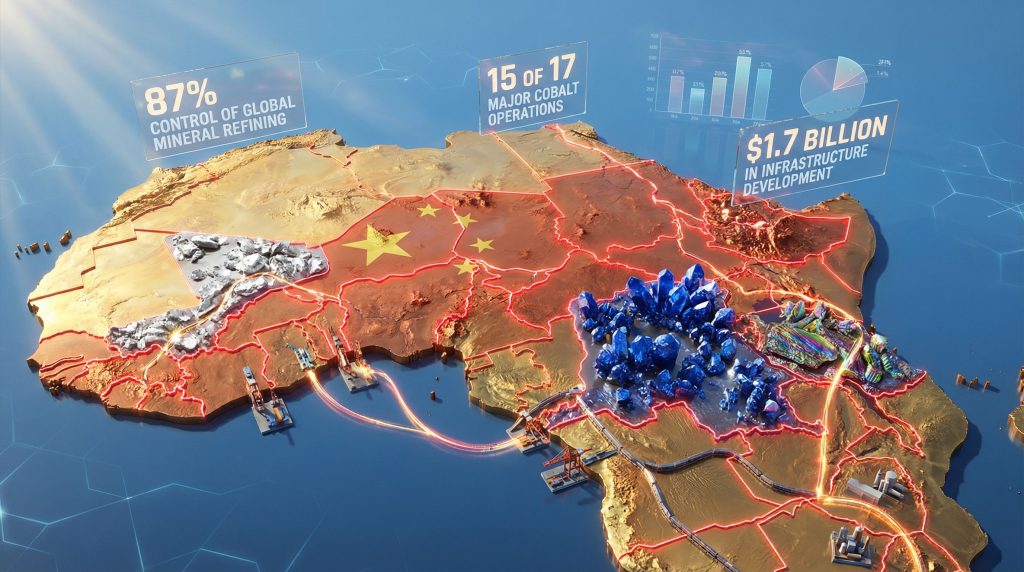
China's mineral strategy in Africa represents a transformative approach to resource security that combines state-backed investment, integrated supply chain control, and long-term strategic planning. This comprehensive framework has established Chinese dominance across multiple critical mineral sectors, fundamentally reshaping global supply chains and creating new dependencies that extend far beyond traditional commodity markets.
What Makes China's Mineral Strategy in Africa Fundamentally Different?
The Three-Pillar Framework Behind Beijing's Success
Beijing's approach to African mineral resources operates through a comprehensive three-tier system that distinguishes it from conventional Western mining models. The first pillar involves upstream acquisition through state-backed capital deployment, where Chinese entities secure equity stakes in mining operations rather than relying on market-based procurement contracts. This ownership approach provides long-term supply certainty that transcends price volatility and market disruptions.
The second pillar centers on midstream processing monopolisation through domestic refining capacity. Chinese refineries process approximately 70% of global rare earth mining output and maintain 87% control over critical mineral refining operations, according to the U.S. Geological Survey. This processing dominance creates structural dependencies that extend well beyond raw material extraction.
The third pillar involves downstream integration through manufacturing ecosystem control. China produces 93% of global permanent magnets, particularly neodymium-iron-boron magnets essential for electric vehicles and renewable energy applications. This vertical integration ensures that even non-Chinese mining operations often depend on Chinese processing and manufacturing capabilities.
Why Traditional Mining Models Failed to Counter Chinese Expansion
Western mining companies historically operated on extraction-focused business models that prioritised short-term profit maximisation over strategic supply chain positioning. This approach created vulnerabilities that Chinese state-backed enterprises systematically exploited through patient capital deployment and long-term planning horizons.
Traditional mining houses like Anglo American and Glencore concentrated on individual project development rather than coordinated supply chain strategies. Chinese entities, by contrast, implemented systematic approaches that secured mining assets, transportation infrastructure, and processing capacity as integrated systems.
The fundamental difference lies in risk tolerance and capital availability. Chinese state-owned enterprises access concessional financing through development banks at terms Western competitors cannot match, enabling acquisition of African assets even when immediate returns remain uncertain.
When big ASX news breaks, our subscribers know first
Which African Countries Hold the Keys to Global Mineral Security?
The Democratic Republic of Congo: Cobalt's Strategic Chokepoint
The Democratic Republic of Congo maintains an overwhelming position in global cobalt production, accounting for approximately 70% of worldwide mine output. Chinese entities control significant stakes in major Congolese cobalt operations, including the Kolwezi copper-cobalt complex and multiple smaller-scale artisanal mining cooperatives.
Annual cobalt production from the DRC reached approximately 610,000 metric tonnes of contained cobalt in 2023, with the majority flowing to Chinese refineries for processing into battery-grade materials. This concentration creates a strategic chokepoint where supply disruptions in a single country could affect global electric vehicle and energy storage markets.
Chinese mining companies have invested heavily in DRC infrastructure development, including:
• Mine site processing facilities that increase local value addition
• Transportation networks connecting remote mining areas to export corridors
• Power generation projects supporting energy-intensive refining operations
• Worker housing and community development programs that build local political support
Mali's Lithium Triangle: The Emerging Battleground
Mali's lithium sector represents one of Africa's most significant untapped battery metal opportunities. The Goulamina lithium project, operated by Mineral Resources Limited, commenced commercial production in late 2024 with proven and probable reserves of approximately 100 million tonnes at 1.0% lithium oxide equivalent.
These reserves potentially support over 40 years of operation at planned production rates, making Mali a critical component of global lithium supply security. The project's strategic location provides access to both Atlantic and Mediterranean shipping routes through existing rail networks.
Investment in Mali's lithium sector includes:
• Australian and European mining companies leading extraction operations
• Chinese equipment suppliers providing processing technology
• West African development banks financing infrastructure projects
• Regional governments implementing beneficiation requirements to capture processing value
Tanzania's Rare Earth Potential: Heavy Elements Strategy
Tanzania's Ngualla rare earth project contains among the world's highest concentrations of heavy rare earth elements, particularly dysprosium and terbium. These materials are critical for high-temperature permanent magnets used in electric vehicle motors and wind turbine generators.
Heavy rare earth elements represent a strategic vulnerability for Western supply chains because:
• Processing requires specialised technical expertise concentrated in Chinese facilities
• Alternative sources are geographically limited and technically challenging to develop
• Demand growth from renewable energy applications is accelerating rapidly
• Environmental regulations in developed countries limit domestic processing options
The Tanzanian government has implemented domestic processing requirements aimed at capturing more value from rare earth exports, creating both opportunities and risks for international investors seeking diversified supply chains.
How Does China's Infrastructure Strategy Lock in Mineral Access?
The Belt and Road Logistics Network
Chinese infrastructure investments across Africa create integrated transportation systems specifically designed to support mineral extraction and export. These projects differ fundamentally from traditional development aid because they explicitly serve resource security objectives rather than general economic development.
| Infrastructure Component | Countries Covered | Strategic Function |
|---|---|---|
| Deep-water port facilities | 12 coastal locations | Direct shipping to Chinese refineries |
| Heavy-haul rail corridors | 8 African nations | Bulk mineral transportation from mines |
| Processing plant complexes | 15 integrated facilities | Value-added manufacturing before export |
| Power generation projects | 20+ mining regions | Energy supply for mineral processing operations |
The Lobito Corridor Case Study
The Lobito Corridor represents a 1,344-kilometre rail connection linking the Democratic Republic of Congo and Zambia to Angola's Atlantic coast. This infrastructure project creates an alternative export route that bypasses traditional South African ports and reduces transportation costs for copper and cobalt concentrates.
The corridor's strategic significance includes:
• 15-20 day reduction in transport times from DRC mines to international markets
• $15-25 per metric tonne cost savings in logistics expenses
• Direct shipping access to Chinese refineries via established Atlantic routes
• Alternative export capacity that reduces dependence on South African infrastructure
Development financing for the Lobito Corridor involves the World Bank, U.S. Development Finance Corporation, and European development institutions, representing a Western alternative to Chinese-dominated infrastructure projects. This diversified funding structure demonstrates growing competition for strategic mineral transportation networks.
"Port management agreements often extend 20-30 years beyond construction completion, giving financing entities long-term control over mineral export logistics regardless of ownership changes at mining operations."
What Are the Economic Implications for Global Supply Chains?
Market Concentration Creating Structural Dependencies
China's dominance across multiple stages of mineral processing creates systematic risks that extend far beyond individual commodity markets. The concentration of refining capacity means that even mines owned by non-Chinese entities often depend on Chinese processing facilities to convert raw materials into usable industrial inputs.
Key concentration statistics include:
• Rare earth processing: 70% of global mining, 87% of refining capacity
• Lithium refining: 65% of global hydroxide and carbonate production
• Cobalt processing: 72% of refined output from African raw materials
• Permanent magnet manufacturing: 93% of neodymium-iron-boron magnet production
Price Discovery and Market Power Dynamics
Chinese refineries effectively set global benchmark prices for processed critical minerals through their dominant market position. This pricing power extends beyond direct commodity sales to influence upstream mining economics and downstream manufacturing costs.
Western manufacturers face 18-24 month supply chain vulnerabilities when Chinese processing capacity is constrained or restricted. Battery manufacturers and electric vehicle producers maintain strategic reserves to mitigate disruption risks, but these inventories represent significant capital costs and storage challenges.
Export restriction capabilities create additional leverage for Chinese policymakers. Recent restrictions on gallium and graphite exports demonstrated how processing monopolies can be leveraged for geopolitical objectives, affecting global semiconductor and battery supply chains. Furthermore, these developments reflect broader US-China trade war strategies that prioritise supply chain security over economic efficiency.
Where Are Western Companies Finding Success in Africa?
The Pensana Model: Localisation as Competitive Strategy
British mining company Pensana has demonstrated that Western entities can successfully compete in African rare earth markets through strategic localisation approaches. Operating in Angola, Pensana has built partnerships with African financial institutions rather than depending solely on Chinese capital sources.
Pensana's approach includes:
• Collaboration with local business communities and government stakeholders
• Employment of African technical professionals in senior management positions
• Processing facility development that creates domestic value addition
• Environmental compliance standards that exceed minimum regulatory requirements
This localisation strategy creates political sustainability that pure extraction models cannot achieve. Moreover, it demonstrates that Western companies can compete effectively when they invest in local capacity building and long-term partnership development.
U.S. Investment Pivot Toward Central Africa
Recent diplomatic developments, including peace agreements between Rwanda and the Democratic Republic of Congo, have opened new opportunities for American private equity investment in African mineral projects. U.S. investors are targeting approximately $2.3 billion in African mineral investments over the next five years.
Strategic focus areas include:
• Rare earth element projects outside existing Chinese spheres of influence
• Lithium mining operations with direct shipping access to North American markets
• Copper mining investments that serve Western manufacturing demand
• Technical services and equipment supply for mining operations
American development finance institutions are providing political risk insurance and concessional financing to support these investments. Additionally, they're creating competitive alternatives to Chinese state-backed capital, which aligns with broader critical minerals strategy initiatives across Western nations.
How Are African Nations Reshaping Mineral Governance?
Export Control Strategies Gaining Momentum
African governments are increasingly implementing export restrictions designed to capture more value from mineral resources through domestic processing requirements. These policies represent a fundamental shift from pure extraction models toward beneficiation and value-added manufacturing.
| Country | Mineral Focus | Policy Implementation | Projected Revenue Impact |
|---|---|---|---|
| Tanzania | Rare earth elements | Local processing mandates | +40% government revenues |
| Malawi | Graphite and lithium | Export licensing restrictions | +25% domestic value capture |
| Namibia | Lithium and uranium | Beneficiation requirements | +60% local processing capacity |
| Zambia | Copper and cobalt | Refined metal export incentives | +35% value addition |
The Resource Nationalism Trend
Contemporary African mineral governance increasingly emphasises sovereign control over resource development and export policies. This trend includes:
• Constitutional amendments requiring majority domestic ownership in strategic mineral projects
• Joint venture mandates that ensure African partners in mining operations
• Technology transfer requirements for foreign mining companies seeking operating licences
• Local content requirements for equipment procurement and technical services
These policies create both opportunities and risks for international investors. Companies that embrace local partnership and capacity building may find preferential treatment, while purely extractive approaches face increasing regulatory barriers. Consequently, this evolving landscape requires adaptive strategies that recognise changing global mining landscape dynamics.
The next major ASX story will hit our subscribers first
What Scenarios Could Disrupt China's African Mineral Dominance?
Geopolitical Risk Factors
Several potential developments could challenge Chinese mineral control in Africa:
African Union mineral sovereignty initiatives could create coordinated policies that limit foreign control over strategic mineral assets. Regional cooperation mechanisms might enable smaller African countries to negotiate collectively with international investors.
Western counter-investment through development finance represents growing competition for Chinese infrastructure projects. The U.S. Development Finance Corporation, World Bank, and European development institutions are increasing funding for mineral sector alternatives.
Climate change impacts on mining infrastructure could disrupt existing supply chains and create opportunities for new investment approaches that emphasise environmental resilience and community adaptation.
Technology Disruption Possibilities
Technological developments could reduce dependence on specific critical minerals:
• Alternative battery chemistry development might reduce cobalt demand through iron-phosphate or sodium-ion technologies
• Advanced recycling technology could decrease virgin material requirements by recovering critical minerals from end-of-life products
• Synthetic rare earth element production through biotechnology or advanced materials science might provide alternative supply sources
These technological shifts would require significant research investment and commercial scaling. However, they represent potential pathways toward reduced mineral supply concentration, particularly as Chinese mining meets weak governance in Africa creates opportunities for technological alternatives.
Why Traditional Diversification Efforts Have Struggled
The Infrastructure Gap Challenge
Creating alternative mineral supply chains requires massive infrastructure investments that Western entities have been reluctant to undertake. Estimated investment needs include:
• $180 billion for alternative transportation and processing infrastructure
• 8-12 year development timelines for new mining operations to reach commercial production
• Technical expertise requirements currently concentrated in Chinese engineering and processing firms
Financial Structure Limitations
Western project finance models create structural disadvantages compared to Chinese state-backed investment:
Higher return thresholds: Private investors typically require 15-25% internal rates of return, while Chinese state-owned enterprises accept 8-12% returns for strategic projects.
Environmental compliance costs: Western mining operations face stricter environmental standards that increase development expenses but may create long-term competitive advantages through operational sustainability.
Political risk assessment: Commercial insurance for African mining projects is expensive and often excludes specific risks that Chinese state-backed entities can absorb through sovereign guarantee mechanisms. These challenges mirror broader patterns observed in Zijin Mining expansion strategies that leverage state support for overseas acquisitions.
What Does the Future Hold for African Mineral Geopolitics?
Scenario Planning for 2030 Supply Chain Architecture
Three primary scenarios emerge for African mineral development over the next decade:
Scenario 1: Continued Chinese Dominance (70% probability)
Chinese entities maintain 75%+ market share in critical mineral processing through continued infrastructure investment and patient capital deployment. African governments balance resource nationalism with pragmatic acceptance of Chinese technical capabilities and financing.
Scenario 2: Partial Diversification (25% probability)
Western investment and African governance reforms achieve 40-60% Chinese market share, with meaningful alternative supply chains serving European and North American markets. This scenario requires sustained political commitment and coordinated investment strategies.
Scenario 3: Significant Disruption (5% probability)
Technological breakthroughs, major geopolitical shifts, or resource nationalism reduce Chinese control below 50% of critical mineral supply chains. This scenario would require unprecedented coordination between Western investors and African governments.
Investment Implications for Resource Sector Stakeholders
The evolving mineral landscape creates specific investment considerations:
Premium valuations for mining companies with diversified supply chain exposure and minimal Chinese processing dependence reflect investor recognition of supply security risks.
Political risk management has become a primary investment consideration, with successful companies demonstrating strong local partnership capabilities and government relations.
Environmental, social, and governance (ESG) compliance creates competitive advantages for Western mining operators, particularly as African governments implement stricter environmental standards and community development requirements. These trends reflect broader mining industry evolution patterns toward sustainable practices and stakeholder engagement.
The ongoing competition for Africa's strategic mineral resources reflects broader geopolitical tensions between major powers. China's mineral strategy in Africa has fundamentally altered global supply chain dynamics, creating new dependencies while simultaneously spurring diversification efforts from Western nations and African governments seeking greater resource sovereignty.
Disclaimer: This analysis involves forecasts and speculation about future mineral market developments. Actual outcomes may differ significantly from projected scenarios due to technological changes, policy shifts, or unforeseen geopolitical events. Investment decisions should incorporate comprehensive risk assessment and professional financial advice.
Further Exploration:
Readers interested in learning more about mineral supply chain security can explore educational content from the U.S. Geological Survey, International Energy Agency, and various policy institutes that analyse critical mineral markets and geopolitical implications.
Ready to Position Yourself Ahead of Market-Moving Mineral Discoveries?
Discovery Alert provides instant notifications on significant ASX mineral discoveries using its proprietary Discovery IQ model, helping subscribers identify actionable opportunities as they unfold in real-time. While global mineral supply chains reshape and major discoveries continue to drive substantial market returns, explore Discovery Alert's dedicated discoveries page to see how historic mineral discoveries have generated exceptional investor outcomes and begin your 30-day free trial today to secure your market-leading advantage.