
August 4, 2026
Understanding China's Rare Earth Market Control Mechanisms
Strategic materials markets operate under fundamentally different dynamics when government coordination replaces pure market forces. Chinese state backing for Shenghe Resources exemplifies how integrated industrial policy transforms competitive landscapes, creating advantages that extend far beyond traditional commercial financing or regulatory support.
The architecture of Chinese state involvement in rare earth enterprises reflects a sophisticated understanding of supply chain vulnerabilities and long-term resource security. Unlike Western rare earth companies that operate within shareholder-driven frameworks, Chinese state-backed entities benefit from coordinated planning horizons that align commercial operations with national strategic objectives. Furthermore, this approach demonstrates the broader critical minerals energy transition strategy that China has implemented.
What Makes State-Backed Rare Earth Companies Different?
State-backed enterprises in China function within a mixed ownership model that fundamentally differs from traditional state-owned enterprises. This hybrid structure combines direct government oversight with commercial operational flexibility, creating entities that can respond to market conditions while maintaining alignment with national strategic priorities.
Chinese state backing provides several distinct advantages:
- Access to development bank financing at rates typically 1.5-3% below market levels
- Coordination across the entire value chain from mining through processing to end-product manufacturing
- Integration with diplomatic and trade policy initiatives for international expansion
- Long-term planning capabilities that extend beyond quarterly earnings pressures
The Chinese model integrates rare earth supply chain decisions directly into national security frameworks. This coordination enables rapid mobilisation of resources for capacity expansion, technology development, and international asset acquisition in ways that purely commercial entities cannot match. In addition, this strategy aligns with their broader defence critical materials strategy objectives.
Why Shenghe Resources Represents China's Evolving Strategy
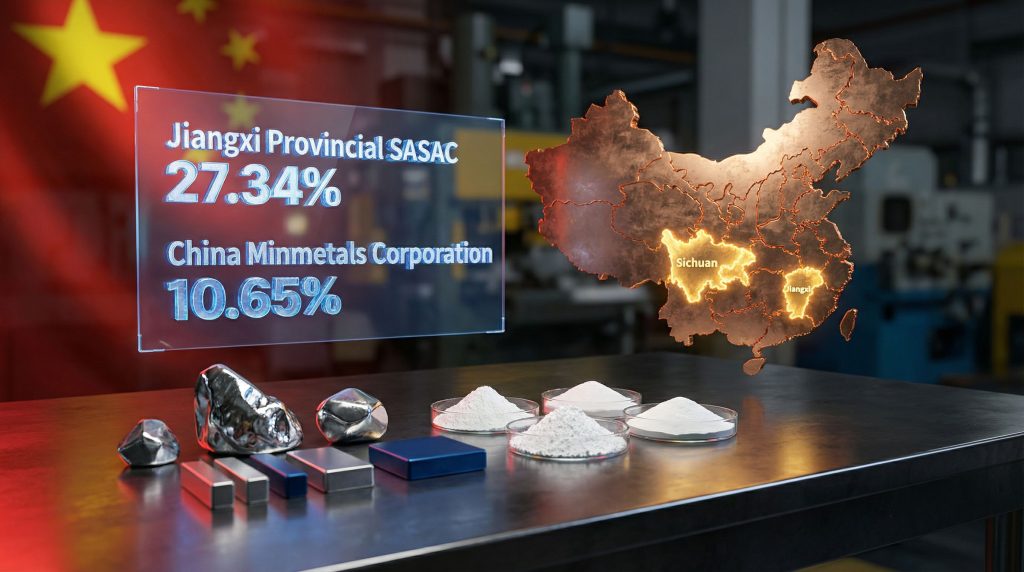
Shenghe Resources demonstrates the evolution from traditional state-owned enterprises toward sophisticated hybrid models that combine state strategic control with commercial efficiency. The company's ownership structure reveals the complexity of Chinese state backing mechanisms.
Current Ownership Distribution:
| Ownership Entity | Percentage | Strategic Function |
|---|---|---|
| Jiangxi Provincial SASAC | 27.34% | Regional economic coordination |
| China Minmetals Corporation | 10.65% | Central SOE integration |
| Jiangxi Rare Earth Group | 8.50% | Industry-specific expertise |
| Ministry of Finance | Controlling Authority | Ultimate state oversight |
This multi-layered ownership structure enables coordination between regional economic development objectives, central government strategic priorities, and industry-specific operational expertise. The December 18 visit by Zhang Yong, Deputy Director of Sichuan Provincial Department of Economy and Information Technology, exemplifies this integrated approach to strategic oversight.
The dual role of Xie Bing as both Director of the Chengdu Institute and Chairman of Shenghe Resources highlights China's emphasis on commercialisation of research. This integration ensures that government-funded technological development directly serves commercial and strategic objectives without the delays typically associated with technology transfer processes.
When big ASX news breaks, our subscribers know first
The Architecture of Chinese State Support Systems
Provincial Government Integration and Strategic Coordination
Chinese provinces operate within a system of decentralised economic authority while maintaining subordination to central strategic directives. This model, sometimes characterised as federalism with Chinese characteristics, grants provincial governments substantial autonomy over industrial policy implementation.
Sichuan Province controls a GDP of 5.73 trillion yuan (~$814 billion USD), making it China's fourth-largest provincial economy. This economic scale enables provincial governments to provide substantial support for strategic industries through multiple mechanisms:
- Direct equity participation through provincial State-owned Assets Supervision and Administration Commissions
- Preferential tax treatment and land-use concessions for priority sectors
- Infrastructure investment coordination to support industrial development
- Personnel coordination between government institutions and strategic enterprises
The provincial role extends beyond passive support to active strategic guidance. Zhang Yong's visit included discussions of technological innovation, international expansion strategies, and integration with broader national objectives. This demonstrates how provincial officials maintain direct oversight over strategic companies to ensure alignment with both regional development goals and national security priorities.
Financial and Operational Support Mechanisms
Chinese state backing operates through interconnected financial and operational support systems that create competitive advantages unavailable to purely commercial entities. These mechanisms include preferential financing, coordinated supply chain integration, and technology transfer facilitation.
Access to State Development Banking:
Chinese development banks provide strategic enterprises with financing terms that reflect national priorities rather than purely commercial risk assessments. China Development Bank and Export-Import Bank of China offer:
- Concessional loan rates for capacity expansion projects
- Extended repayment periods aligned with strategic timelines
- Equity injection capabilities for major international acquisitions
- Integration with Belt and Road Initiative financing mechanisms
Technology Transfer and Research Integration:
The Chengdu Institute's relationship with Shenghe Resources exemplifies China's approach to rapid technology commercialisation. Government-funded research institutions maintain direct operational connections with commercial entities, enabling immediate deployment of technological innovations without market validation delays.
This integration was emphasised during the December 18 visit, where officials praised the Institute's ability to transform dormant mines into active operations, convert low-grade resources into high-value assets, and develop single deposits into multi-product systems. This language reflects specific technological capabilities in rare earth beneficiation, separation, and processing optimisation.
Supply Chain Coordination Mechanisms:
Chinese state backing enables coordinated decision-making across the rare earth value chain through:
- Cross-holding arrangements between state enterprises creating interlocking governance structures
- Shared access to processing infrastructure owned by related state entities
- Coordinated procurement contracts that optimise capacity utilisation across multiple facilities
- Information sharing agreements that enable strategic pricing and allocation decisions
How State Backing Enables Global Market Expansion
International Resource Development Strategy
Chinese officials explicitly encouraged Shenghe to expand overseas resource development while emphasising national security considerations. This combination signals coordinated strategy for foreign asset acquisition and supply chain control that extends Chinese influence beyond domestic rare earth resources.
The encouragement for overseas expansion reflects China's understanding that domestic rare earth resources, while substantial, may not be sufficient to maintain long-term supply chain dominance as global demand increases. Chinese entities have acquired or developed over 20 significant rare earth projects outside China since 2008, with investments concentrated in Southeast Asia, Africa, and Latin America. However, this expansion also faces significant US-China trade impacts that influence strategic planning.
Strategic Advantages in International Markets:
Chinese state backing provides competitive advantages in international resource acquisition:
- Diplomatic coordination through Chinese embassies and commerce departments
- Access to concessional financing for overseas investments through development banks
- Integration with Belt and Road Initiative frameworks in resource-rich countries
- Coordination with other Chinese state enterprises for comprehensive country strategies
Technology Leadership and Processing Dominance
China's emphasis on high-end, intelligent, and green development in rare earth processing creates competitive advantages that extend beyond raw material control. Chinese state-backed enterprises like Shenghe focus on developing capabilities in areas where Western supply chains remain weakest.
Processing and Separation Capabilities:
China controls approximately 60-70% of global rare earth processing capacity, with state-backed enterprises managing the majority of advanced separation and purification facilities. This processing dominance creates strategic leverage even over rare earth deposits owned by Western companies. For instance, companies following the Zijin Mining strategy face similar integration challenges.
The technical complexity of rare earth separation requires specialised knowledge, equipment, and operational expertise that has been concentrated in Chinese facilities over decades. State backing enables continuous investment in processing technology development and capacity expansion without short-term profitability pressures.
Functional Materials Development:
State support extends beyond primary processing to development of functional materials and end-products. This vertical integration strategy ensures that Chinese enterprises capture value-added manufacturing opportunities while maintaining control over critical supply chain segments.
Investment Implications and Market Dynamics
Competitive Positioning Against Western Companies
Chinese state backing for Shenghe Resources creates competitive dynamics that fundamentally differ from traditional market competition. Western rare earth companies face challenges in competing against enterprises that benefit from coordinated state support across multiple dimensions.
Key Competitive Advantages:
- Financial resilience: Access to state development bank financing provides stability during commodity price volatility
- Long-term planning capabilities: Strategic timelines that extend beyond quarterly earnings pressures
- Integrated supply chain control: Coordination with other state enterprises across the value chain
- Technology development resources: Direct integration with government-funded research institutions
Risk Factors for International Stakeholders:
Chinese state backing also creates risks for international investors and customers:
- Geopolitical tensions affecting business relationships and market access
- Regulatory scrutiny in Western markets regarding national security implications
- Dependency on Chinese supply chains for critical materials
- Potential for supply allocation decisions based on political rather than commercial considerations
These challenges are particularly evident when considering China market challenges more broadly.
Strategic Implications for Global Markets
The explicit state backing for Shenghe's global expansion signals China's intention to strengthen its position as the dominant allocator of rare earth resources worldwide. This strategy has implications for Western industrial policy and supply chain security initiatives.
Market Structure Evolution:
Chinese state coordination in rare earth markets is leading toward increased concentration of supply chain control in state-backed entities. This concentration creates leverage over pricing, allocation, and technology access that extends Chinese influence into Western industrial sectors. Furthermore, Shenghe Resources' strategic positioning demonstrates the evolution of this approach.
Western Policy Responses:
The coordinated Chinese approach highlights the need for Western governments to develop comprehensive strategies that extend beyond individual mining projects toward full-spectrum mine-to-magnet capabilities. This includes:
- Investment in domestic processing and separation capabilities
- Technology development partnerships with allied nations
- Strategic stockpiling initiatives for critical materials
- Regulatory frameworks that reduce dependency on Chinese supply chains
Investment Consideration: The explicit state backing for Shenghe Resources represents a strategic commitment that extends beyond commercial considerations, creating both opportunities and risks for international stakeholders in rare earth markets.
Long-Term Strategic Scenarios and Market Evolution
Scenario Analysis for Global Rare Earth Markets
Chinese state backing for Shenghe Resources operates within broader strategic scenarios that could reshape global rare earth markets over the next decade. Understanding these potential pathways is critical for investors, policymakers, and industrial users of rare earth materials.
Scenario 1: Accelerated Chinese Consolidation
Continued state support could enable Chinese entities to acquire additional international rare earth assets while expanding processing capabilities. This scenario would increase Chinese market share beyond current levels of 60-70% of processing capacity, potentially reaching 80%+ by 2030.
Market implications include:
- Enhanced Chinese pricing power across the value chain
- Reduced supply security for Western industrial users
- Increased leverage in technology transfer negotiations
- Greater integration between rare earth supply and broader geopolitical objectives
Scenario 2: Supply Chain Regionalisation
Western governments may accelerate efforts to develop alternative supply chains outside Chinese control. This could include coordinated investment in processing facilities, technology sharing agreements, and strategic stockpiling initiatives. According to recent analysis, these efforts are becoming increasingly urgent.
Timeline considerations:
- 3-5 years: Initial capacity development in allied nations
- 5-8 years: Meaningful alternative processing capabilities
- 8-10 years: Potential for reduced Western dependency on Chinese supply chains
Scenario 3: Technology Leadership Expansion
Chinese state support for advanced materials development could extend Chinese advantages into next-generation applications including electric vehicle motors, wind turbine generators, and defence systems.
Strategic implications:
- Control over emerging technology applications
- Influence over green energy transition timelines
- Leverage over defence industrial base capabilities in allied nations
Policy and Regulatory Landscape Evolution
Chinese industrial policy integration of rare earth strategy with broader economic planning creates challenges for Western policymakers attempting to develop coherent responses. The multi-level coordination between provincial governments, central authorities, and commercial enterprises enables rapid strategy adaptation.
International Response Requirements:
Effective responses to Chinese state backing require coordination across multiple policy areas:
- Trade and investment policy to address state subsidy issues
- Technology development funding for alternative processing methods
- Diplomatic coordination with resource-rich allied nations
- Defence industrial base planning for critical materials security
The explicit encouragement for Shenghe's overseas expansion during the December 18 visit demonstrates that Chinese strategy continues to evolve toward greater international integration rather than domestic consolidation alone. As industry experts note, this expansion has significant implications for global supply chains.
The next major ASX story will hit our subscribers first
Future Outlook and Strategic Implications
The Evolution of State-Backed Resource Enterprises
Shenghe Resources represents a model that China is likely to replicate across other critical materials sectors. The combination of state strategic control with commercial operational efficiency creates competitive advantages that purely market-driven entities struggle to match.
The integration of research institutions directly into commercial operations, as demonstrated by Xie Bing's dual role, provides a template for rapid technology deployment that Western companies may need to emulate through alternative mechanisms.
Investment and Partnership Considerations
International investors and potential partners must evaluate Chinese state backing for Shenghe Resources as both an opportunity and a risk factor. State support provides financial stability and growth potential, but also creates exposure to geopolitical tensions and regulatory scrutiny.
Due Diligence Factors:
- Assessment of state ownership structure and decision-making processes
- Understanding of strategic objectives beyond commercial returns
- Evaluation of regulatory risks in multiple jurisdictions
- Analysis of technology transfer requirements and restrictions
Partnership Strategy Implications:
Western companies considering partnerships with Chinese state-backed enterprises must balance commercial opportunities against potential national security implications and regulatory compliance requirements in their home markets.
Disclaimer
This analysis is based on publicly available information and should not be considered investment advice. Rare earth markets involve significant volatility, and Chinese industrial policy may evolve in ways that affect market dynamics. Investors should conduct independent due diligence and consider geopolitical risks when evaluating rare earth investments.
Ready to capitalise on strategic mineral discoveries?
Discovery Alert's proprietary Discovery IQ model delivers instant notifications on significant ASX mineral discoveries, transforming complex geological data into actionable investment insights for both short-term traders and long-term strategic investors. Explore why major mineral discoveries can generate exceptional returns by examining our comprehensive analysis of historic market successes, then begin your 30-day free trial today to secure your competitive advantage in the evolving critical materials market.