
July 1, 2026
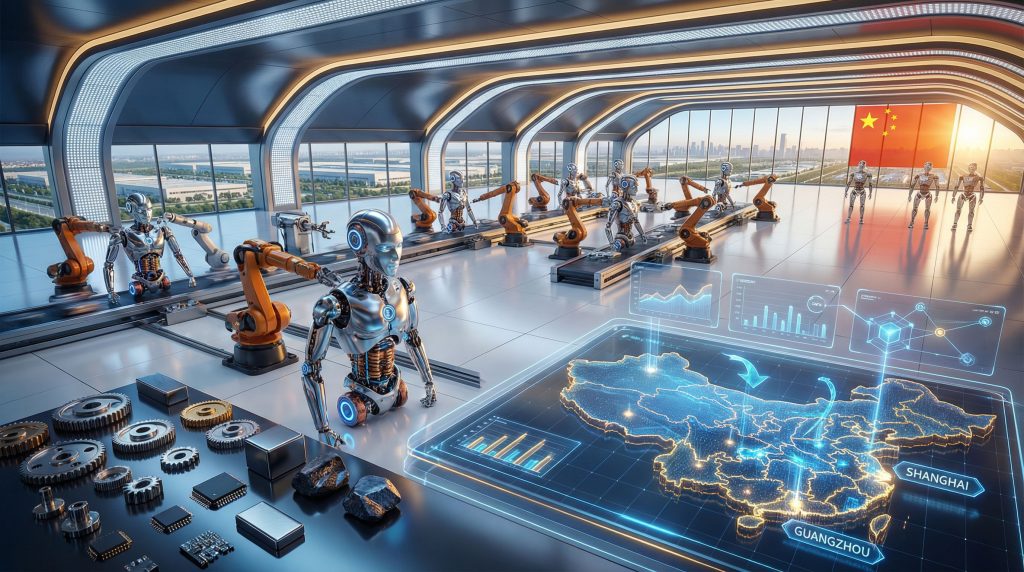
China's supply chain in robotics reveals intricate dependencies that transcend traditional manufacturing paradigms. As artificial intelligence converges with physical systems, the fundamental architecture of component production determines which nations can scale robotic technologies effectively. Furthermore, understanding these supply chain realities requires examining not just final assembly capabilities, but the deep technical infrastructure that enables modern robotics manufacturing at unprecedented scale.
What Makes China's Robotics Supply Chain Globally Dominant?
China's emergence as the central hub for robotics supply chains stems from decades of strategic industrial development across multiple interconnected sectors. The nation's manufacturing ecosystem demonstrates remarkable depth in component production, from precision electronics to specialised materials processing. This integration creates self-reinforcing advantages that become increasingly difficult for competitors to replicate.
Vertical Integration Across the Manufacturing Ecosystem
The Chinese robotics manufacturing model operates through comprehensive vertical integration that spans raw material extraction through final assembly. Companies can source critical components within domestic supply networks, reducing lead times and enabling rapid iteration cycles. This integrated approach allows manufacturers to maintain quality control across the entire production chain while achieving cost efficiencies impossible through fragmented global sourcing.
Manufacturing facilities often co-locate with component suppliers, creating industrial clusters that optimise logistics and enable just-in-time production methodologies. These clusters facilitate knowledge transfer between suppliers and manufacturers, accelerating innovation cycles and reducing development costs for new robotic systems.
Key advantages of Chinese vertical integration:
• Direct control over component specifications and quality standards
• Reduced transportation costs and supply chain complexity
• Faster response times to design changes and market demands
• Enhanced intellectual property protection through domestic partnerships
• Streamlined regulatory compliance across production stages
Geographic Clustering and Industrial Park Advantages
China's industrial park model concentrates robotics manufacturing within specialised economic zones designed to maximise operational efficiency. These parks provide shared infrastructure, including power systems, waste management, and logistics networks optimised for robotics production. The clustering effect reduces per-unit infrastructure costs while creating economies of scale in workforce development and technical services.
Industrial parks often feature research institutes and testing facilities shared among multiple manufacturers, enabling collaborative development while maintaining competitive independence. This shared infrastructure model allows smaller robotics companies to access sophisticated testing equipment and development resources that would be prohibitively expensive to develop independently.
Cost Competitiveness Through Scale Economics
The scale of China's supply chain in robotics creates cost advantages that extend beyond simple labour cost differentials. Volume procurement of specialised materials enables better pricing negotiations with global suppliers, while high-volume production runs reduce per-unit manufacturing costs across all component categories.
Chinese manufacturers benefit from established relationships with global machinery suppliers, allowing them to procure advanced manufacturing equipment at competitive prices. The concentration of robotics production creates sufficient demand to justify specialised tooling and equipment investments that serve multiple manufacturers within each industrial cluster.
When big ASX news breaks, our subscribers know first
How Do China's Core Component Strengths Shape Global Robotics?
According to NVIDIA CEO Jensen Huang, Chinese capabilities in microelectronics, motors, rare earth elements, and magnets represent the world's most advanced production in these foundational robotics technologies. This technical leadership in core components creates dependencies that shape global robotics development strategies and competitive positioning.
Rare Earth Element Monopolisation and Motor Technologies
China's dominance in rare earth element extraction and processing creates significant advantages in motor manufacturing for robotics applications. The nation controls approximately 80% of global rare earth processing capacity, enabling domestic motor manufacturers to access critical materials at preferential pricing and delivery terms. These critical minerals strategy implications extend far beyond robotics.
Critical rare earth applications in robotics:
• Neodymium: Essential for high-performance permanent magnet motors
• Dysprosium: Improves motor performance at elevated temperatures
• Terbium: Enhances magnetic properties in precision servo motors
• Praseodymium: Used in specialised motor magnet alloys
• Europium: Critical for sensor and detection systems
Motor technologies benefit from this material access through improved power-to-weight ratios and enhanced precision control capabilities. Chinese motor manufacturers can experiment with advanced magnetic formulations while maintaining cost competitiveness, creating performance advantages in robotics applications requiring precise movement control.
The integration of rare earth processing with motor manufacturing enables Chinese companies to develop proprietary magnetic materials optimised for specific robotics applications. This vertical integration creates technical capabilities that competitors struggle to replicate without similar access to processed rare earth materials.
Precision Manufacturing in Reducers and Servo Systems
Chinese manufacturers have developed sophisticated capabilities in precision reducer production, particularly in harmonic drive and cycloidal gear systems essential for robotic joint mechanisms. These components require extremely tight manufacturing tolerances and specialised metallurgy knowledge that Chinese companies have cultivated through sustained investment in precision manufacturing infrastructure.
Servo system production benefits from China's electronics manufacturing expertise, combining mechanical precision with advanced control algorithms. The integration of servo motor production with reducer manufacturing within the same supply networks enables optimisation of complete motion control systems rather than discrete component approaches.
Advanced manufacturing capabilities include:
• Gear tooth precision to within 0.001mm tolerances
• Specialised heat treatment processes for gear durability
• Advanced bearing manufacturing for reduced friction losses
• Custom servo controller programming for specific applications
• Integrated testing systems for complete motion control validation
Microelectronics and Sensor Production Capabilities
China's microelectronics manufacturing infrastructure supports robotics through specialised semiconductor packaging and sensor production facilities. These capabilities enable domestic production of critical components including accelerometers, gyroscopes, force sensors, and vision processing units essential for modern robotic systems.
The semiconductor industry's presence in China provides robotics manufacturers with access to custom chip design and manufacturing services tailored to specific robotics applications. This capability allows Chinese robotics companies to develop proprietary control systems and sensor fusion algorithms implemented in custom silicon.
Sensor production benefits from established supply chains for specialised materials including piezoelectric crystals, optical components, and MEMS fabrication equipment. The concentration of these capabilities within China enables rapid prototyping and iteration of sensor designs optimised for robotics applications.
Which Regional Clusters Drive China's Robotics Manufacturing Power?
China's robotics manufacturing distributes across several specialised regional clusters, each developing distinct competitive advantages through concentrated industrial development. Understanding these geographic centres reveals how China's supply chain dominance emerges through coordinated regional specialisation rather than centralised planning.
Yangtze River Delta: Shanghai's Innovation Hub
The Shanghai-centred Yangtze River Delta region serves as China's primary robotics innovation centre, combining advanced research institutions with sophisticated manufacturing capabilities. Unitree Robotics' decision to pursue its 4.2 billion yuan IPO on Shanghai's Star Market demonstrates the region's importance as a capital formation centre for robotics companies.
This cluster benefits from proximity to multiple universities conducting robotics research, creating talent pipelines for both technical development and manufacturing management. The region's established financial services sector facilitates robotics company funding through both public and private capital markets.
Yangtze River Delta advantages:
| Factor | Advantage |
|---|---|
| Research Institutions | Multiple top-tier universities with robotics programmes |
| Financial Services | Advanced capital markets and venture funding |
| Port Infrastructure | Direct export capabilities to global markets |
| Skilled Workforce | High concentration of engineering talent |
| Government Support | Regional policies favouring robotics development |
Pearl River Delta: Shenzhen and Guangzhou Manufacturing Centres
The Pearl River Delta region, anchored by Shenzhen and Guangzhou, provides large-scale manufacturing capabilities optimised for electronics-intensive robotics production. This region's established electronics supply chains enable robotics manufacturers to source components locally while maintaining access to international shipping infrastructure.
Shenzhen's concentration of electronics manufacturers creates unique advantages for robotics companies requiring custom printed circuit boards, sensors, and control systems. The city's rapid prototyping capabilities allow robotics developers to iterate designs quickly while maintaining cost efficiency through established supplier relationships.
Guangzhou's manufacturing infrastructure supports larger-scale robotics assembly operations, particularly for industrial robotics applications requiring heavy mechanical components. The city's automotive manufacturing presence provides skilled workforce and supplier networks applicable to robotics production.
Emerging Secondary Clusters and Specialised Zones
Beyond the primary coastal clusters, China develops specialised robotics manufacturing zones in interior regions focusing on specific applications or components. These secondary clusters often concentrate on particular aspects of robotics production, creating depth in specialised technologies while benefiting from lower operational costs.
Notable emerging clusters include:
• Xi'an: Military and aerospace robotics applications
• Changsha: Construction and heavy industry robotics
• Hefei: Agricultural and service robotics specialisation
• Wuhan: Medical and rehabilitation robotics development
• Chongqing: Logistics and warehouse robotics systems
These specialised zones develop unique technical capabilities while maintaining connections to the primary coastal clusters for component sourcing and technology transfer. The distributed approach creates redundancy in China's robotics manufacturing capacity while optimising costs through regional specialisation.
What Strategic Vulnerabilities Exist in China's Robotics Supply Chain?
Despite China's comprehensive advantages in robotics manufacturing, several structural vulnerabilities could impact the sustainability of current dominance patterns. Understanding these potential weaknesses provides insight into how global supply chain dynamics might evolve as geopolitical tensions and technological developments reshape competitive landscapes.
High-End Component Import Dependencies
Chinese robotics manufacturers maintain dependencies on imported components for the most sophisticated applications, particularly in advanced semiconductor processing and precision optical systems. High-performance computing processors for AI applications often require fabrication technologies not yet fully developed within China's domestic semiconductor industry.
Critical import dependencies include:
• Advanced AI processing units for autonomous navigation
• High-precision laser sensors for industrial applications
• Specialised servo controllers for aerospace applications
• Medical-grade sensors requiring FDA or CE certification
• Military-specification components with export control restrictions
These dependencies create potential supply chain disruption points during periods of international tension or export control implementation. Chinese companies increasingly invest in domestic alternatives, but technical gaps remain in the most demanding applications requiring cutting-edge performance specifications. The US‑China trade impacts further complicate these dependencies.
Intellectual Property and Technology Transfer Challenges
The rapid development of China's supply chain in robotics raises questions about intellectual property protection and sustainable innovation pathways. While Chinese companies demonstrate strong manufacturing capabilities, concerns exist regarding long-term technological independence and innovation leadership.
Foreign robotics companies operating in China face complex decisions about technology sharing and joint development programmes. The balance between accessing China's manufacturing advantages and protecting proprietary technologies creates ongoing strategic tensions that could impact future collaboration patterns.
Intellectual property challenges include protecting core algorithms, maintaining competitive advantages in global markets, ensuring compliance with international licensing requirements, and managing technology transfer obligations in joint ventures.
Export Control and Geopolitical Risk Factors
International export control regimes increasingly target advanced robotics technologies, particularly those with dual-use applications in military or surveillance systems. These restrictions could limit Chinese robotics companies' access to critical components or their ability to serve international markets.
Geopolitical tensions create uncertainty around long-term supply chain relationships, potentially encouraging diversification efforts by both Chinese companies and their international customers. The stability of current supply chain arrangements depends partly on broader diplomatic relationships that extend beyond commercial considerations.
How Are Global Companies Navigating China's Supply Chain Dominance?
As NVIDIA CEO Jensen Huang acknowledged, the Western robotics industry relies deeply on China's ecosystem and supply chain, creating strategic dependencies that require careful navigation. Companies develop various approaches to balance the advantages of Chinese manufacturing with the risks of over-reliance on single-source suppliers.
Western Robotics Firms' Dependency Strategies
Major robotics companies implement risk management strategies that acknowledge China's current irreplaceable role while developing contingency capabilities. These strategies often involve maintaining primary sourcing relationships with Chinese suppliers while investing in alternative source development for critical components.
Common dependency management approaches:
• Dual sourcing: Maintaining Chinese primary suppliers with backup sources in other regions
• Strategic inventory: Holding larger component inventories to buffer against supply disruptions
• Design flexibility: Developing products compatible with components from multiple suppliers
• Local partnerships: Establishing joint ventures to access Chinese supply chains while maintaining presence
• Graduated transitions: Slowly shifting component sourcing to reduce dependency over time
Alternative Supply Chain Development Efforts
Western governments and companies invest in developing alternative robotics supply chains, particularly in allied nations with advanced manufacturing capabilities. These efforts focus on critical components where Chinese dominance creates strategic vulnerabilities, though progress remains limited by cost and capability gaps.
Regional alternative development includes:
| Region | Focus Areas | Development Status |
|---|---|---|
| Southeast Asia | Assembly and basic components | Rapidly expanding capacity |
| India | Electronics and software | Early development stage |
| Mexico | North American market supply | Growing automotive robotics |
| Eastern Europe | Precision manufacturing | Established in automotive sector |
| Japan/South Korea | High-end components | Maintaining competitive niches |
Joint Venture and Partnership Models
International robotics companies increasingly pursue joint venture arrangements that provide access to China's supply chain in robotics while maintaining some control over technology and operations. These partnerships enable companies to benefit from Chinese manufacturing capabilities while developing local market presence.
Successful partnership models often involve technology sharing arrangements where Western companies provide advanced algorithms or design expertise while Chinese partners contribute manufacturing and supply chain capabilities. These arrangements require careful structuring to protect intellectual property while enabling effective collaboration.
Partnership benefits include access to cost-competitive manufacturing, local market knowledge and relationships, established supplier networks, and regulatory compliance support. However, challenges include intellectual property protection, technology transfer expectations, and long-term strategic alignment between partners.
What Does China's Humanoid Robot Surge Mean for Global Competition?
China's advancement in humanoid robotics, exemplified by companies like Unitree Robotics, represents a significant shift in global robotics competition. The company's successful demonstration of the G1 humanoid robot at Tokyo's International Robot Exhibition in December 2025 and subsequent IPO filing seeking 4.2 billion yuan illustrates the commercial viability and investor confidence in Chinese humanoid robotics development.
Domestic Market Scale and Government Procurement
China's large domestic market provides robotics companies with the scale necessary to achieve cost-competitive production while refining technologies for international expansion. Government procurement programmes, particularly in manufacturing automation and service sectors, create predictable demand that supports sustained investment in robotics development.
The domestic market serves as a testing ground for humanoid robotics applications, allowing companies to iterate designs and improve reliability before pursuing international sales. This market-driven development approach enables Chinese companies to optimise products for real-world performance rather than laboratory demonstrations.
Domestic market advantages:
• Large-scale deployment opportunities across multiple sectors
• Government support for automation initiatives
• Established manufacturing integration requirements
• Service sector adoption in retail and hospitality
• Healthcare and elderly care application development
Export Growth Patterns and International Expansion
Chinese robotics companies increasingly pursue international markets, leveraging cost advantages developed through domestic scale to compete with established Western and Japanese manufacturers. Export strategies often focus initially on price-sensitive market segments before advancing to higher-performance applications.
The demonstration of Unitree's G1 robot at an international exhibition represents growing confidence in competing directly with established global robotics leaders. Chinese companies use international exhibitions and demonstrations to establish credibility and technical capability recognition in global markets.
International expansion patterns typically begin with emerging markets before progressing to developed economies as technical capabilities and brand recognition develop. This approach allows Chinese companies to build international experience while continuously improving product capabilities.
Technology Advancement in AI Integration
As Jensen Huang noted, the integration of AI as "the brain" for physical systems represents the crucial enabling technology for modern robotics. Chinese companies benefit from both domestic AI development capabilities and access to international AI platforms and algorithms for robotics applications.
The convergence of AI with robotics enables more sophisticated applications including autonomous navigation, complex manipulation tasks, and human-robot interaction. Chinese robotics companies increasingly develop proprietary AI algorithms optimised for specific applications while maintaining compatibility with standard AI development platforms.
AI integration capabilities include:
• Computer vision for autonomous navigation and object recognition
• Natural language processing for human-robot interaction
• Machine learning algorithms for adaptive behaviour
• Sensor fusion for environmental awareness
• Predictive maintenance and performance optimisation
The next major ASX story will hit our subscribers first
How Will Geopolitical Tensions Reshape Robotics Supply Chains?
Current geopolitical dynamics create pressure for supply chain diversification while the technical realities of China's supply chain in robotics dominance limit practical alternatives in the near term. Understanding potential reshaping scenarios helps illuminate future investment opportunities and strategic planning considerations for robotics companies.
Decoupling Scenarios and Supply Chain Resilience
Complete decoupling from Chinese robotics supply chains appears unlikely given the integrated nature of component production and the cost implications of alternative sourcing. However, partial decoupling focused on critical or sensitive technologies could reshape certain segments of the supply chain while maintaining Chinese dominance in commodity components.
Potential decoupling scenarios:
• Selective decoupling: Limited to military or surveillance applications
• Gradual diversification: Slow development of alternative sources over decades
• Regional bloc formation: Separate supply chains for different geopolitical regions
• Technology-specific separation: Decoupling in AI and advanced semiconductors only
• Contingency preparation: Maintaining current relationships while building backup capabilities
Supply chain resilience strategies focus on identifying critical dependencies and developing alternatives for components essential to national security or economic competitiveness. These efforts require sustained investment and coordination among multiple countries and companies. The challenges extend beyond traditional bismuth export controls to encompass broader technology restrictions.
National Security Considerations in Robotics
Governments increasingly view robotics supply chains through national security lenses, particularly for applications in defence, critical infrastructure, and surveillance systems. These concerns drive policies encouraging domestic manufacturing capabilities in specific robotics segments while potentially restricting access to certain Chinese technologies.
National security frameworks typically differentiate between commercial robotics applications and those with potential military or surveillance implications. This distinction creates market segmentation where different supply chain strategies apply to different application categories.
Security considerations include:
• Embedded software and potential remote access capabilities
• Data collection and transmission capabilities in service robots
• Critical infrastructure automation and potential vulnerability
• Military application dual-use technology transfer
• Supply chain interruption impacts on essential services
Future Supply Chain Diversification Strategies
Long-term supply chain diversification requires coordinated investment in alternative manufacturing capabilities, workforce development, and technology transfer initiatives. Success depends on developing cost-competitive alternatives rather than simply duplicating existing Chinese capabilities at higher costs.
Diversification strategies often focus on specific technology domains where particular countries or regions can develop competitive advantages through specialised expertise or existing industrial capabilities. This approach creates complementary rather than directly competitive supply chain alternatives.
Regional specialisation patterns may emerge where different geographic areas focus on specific robotics technologies or applications based on existing industrial strengths and development priorities. This evolution could create more distributed global supply chains while maintaining efficiency through regional concentration. Additionally, developments in areas such as battery recycling breakthrough demonstrate China's expanding influence across interconnected technologies.
What Investment Opportunities Emerge from China's Robotics Ecosystem?
The dominance of China's supply chain in robotics creates various investment opportunities for both direct participation in Chinese companies and indirect exposure through supply chain relationships. Understanding these opportunities requires analysing different investment approaches and their associated risk-return profiles.
Public Market Opportunities in Chinese Robotics
Unitree Robotics' pending IPO on Shanghai's Star Market represents the type of direct investment opportunity available in China's robotics sector. The company's 4.2 billion yuan fundraising target and surge in 2025 revenue demonstrate investor confidence in Chinese robotics commercialisation prospects.
Investment considerations for Chinese robotics stocks:
| Factor | Opportunity | Risk |
|---|---|---|
| Market Access | Direct exposure to China's domestic robotics growth | Regulatory restrictions on foreign investment |
| Technology Leadership | Access to advanced manufacturing capabilities | Intellectual property and technology transfer concerns |
| Cost Advantages | Benefit from scale economics and supply chain integration | Currency fluctuation and trade policy risks |
| Export Potential | International market expansion opportunities | Export control and geopolitical restrictions |
Supply Chain Infrastructure Investments
Investment opportunities exist in the infrastructure supporting China's robotics supply chains, including specialised manufacturing equipment, logistics networks, and component supplier companies. These investments provide indirect exposure to robotics growth while potentially offering more stable returns than direct robotics manufacturer investments.
Infrastructure investments often benefit from broader industrial automation trends beyond robotics, creating diversified exposure to China's manufacturing modernisation. These opportunities include precision manufacturing equipment, specialised materials processing, and industrial automation systems.
Infrastructure investment categories:
• Manufacturing equipment: Specialised machinery for robotics component production
• Materials processing: Rare earth refinement and specialised alloy production
• Logistics networks: Transportation and warehousing optimised for robotics supply chains
• Testing and certification: Facilities supporting quality assurance and international compliance
• Research infrastructure: Universities and institutes advancing robotics technology
Technology Transfer and Licensing Models
International companies can access China's supply chain in robotics advantages through technology licensing and joint development agreements that provide revenue streams while accessing Chinese manufacturing capabilities. These arrangements often involve sharing advanced algorithms or design expertise in exchange for manufacturing cost advantages and market access.
Licensing models allow companies to monetise intellectual property while benefiting from Chinese production capabilities without direct investment in manufacturing facilities. These arrangements require careful structuring to protect core technologies while enabling productive collaboration.
Joint development programmes create opportunities for Western companies to combine their technological expertise with Chinese manufacturing capabilities, potentially creating competitive advantages in global markets through optimised design-for-manufacturing approaches. Furthermore, these partnerships often benefit from China's strengths in energy security minerals essential for advanced robotics systems.
Frequently Asked Questions About China's Robotics Supply Chain
Why Can't Other Countries Replicate China's Robotics Supply Chain?
Replicating China's supply chain in robotics requires more than simply building manufacturing facilities, as the ecosystem depends on integrated networks spanning from raw material processing through final assembly. The development timeline spans decades and requires coordinated investment across multiple industrial sectors simultaneously.
Critical factors that create barriers to replication include the massive scale required to achieve cost competitiveness, established supplier relationships and industrial clustering effects, specialised workforce development and institutional knowledge, integrated infrastructure optimised for electronics manufacturing, and government coordination across multiple industrial policy areas.
The rare earth element processing monopoly creates a particular challenge, as alternative supply chains would require developing both extraction and processing capabilities that currently exist primarily in China. This materials processing foundation underlies advantages in motors, magnets, and other critical robotics components.
How Dependent Are Western Robotics Companies on Chinese Components?
As NVIDIA's Jensen Huang acknowledged, Western robotics companies rely deeply on Chinese supply chains for foundational components including microelectronics, motors, rare earth elements, and magnets. This dependency varies by application, with consumer and commercial robotics showing higher dependence than specialised military or aerospace applications.
Dependency levels vary significantly:
• Consumer robotics: 70-90% component sourcing from China
• Industrial automation: 50-70% Chinese component content
• Service robotics: 60-80% reliance on Chinese suppliers
• Military/aerospace: 10-30% Chinese component usage
• Medical robotics: 40-60% Chinese supplier relationships
Complete independence from Chinese suppliers would require fundamental redesign of many robotic systems and acceptance of significantly higher production costs. Most companies pursue risk mitigation strategies rather than complete supply chain replacement.
What Timeline Exists for Supply Chain Diversification?
Meaningful diversification of robotics supply chains away from Chinese dominance requires sustained investment over multiple decades to develop alternative capabilities. Simple assembly operations can relocate within 3-5 years, but developing integrated component supply chains requires 10-20 years of coordinated development effort.
Realistic diversification timelines:
• Basic assembly: 2-3 years for facility establishment and workforce training
• Component sourcing: 5-10 years to develop alternative supplier networks
• Materials processing: 10-15 years for rare earth and specialised alloy alternatives
• Advanced manufacturing: 15-25 years for precision component production capabilities
• Ecosystem development: 20-30 years for complete integrated supply chain alternatives
The timeline depends heavily on government support, private investment levels, and international coordination among countries pursuing supply chain alternatives. Market forces alone may not drive diversification given China's cost advantages and established capabilities. However, developments in related sectors suggest how China's AI-powered robots could reshape global industrial dynamics within shorter timeframes.
This analysis is based on publicly available information and expert assessments as of March 2026. Robotics supply chain dynamics continue evolving rapidly, and investors should conduct thorough due diligence before making investment decisions. Geopolitical factors may significantly impact supply chain relationships and investment outcomes.
Ready to Capitalise on China's Robotics Supply Chain Disruption?
The dramatic shifts in global robotics manufacturing present significant market opportunities, particularly for investors tracking ASX-listed companies exposed to critical minerals and technology supply chains. Discovery Alert's proprietary Discovery IQ model identifies real-time opportunities across commodities essential to robotics production, from rare earth elements to advanced materials processing, helping subscribers position themselves ahead of major market movements in this rapidly evolving sector.