August 22, 2026
Global energy markets are undergoing fundamental restructuring as sanctioned commodity flows reshape traditional supply chains and pricing mechanisms. China's Russian oil imports have emerged as a critical component of this transformation, with the strategic reallocation of crude oil supplies reflecting broader geopolitical tensions intersecting with economic optimization, creating new bilateral dependencies that transcend conventional market relationships.
How Are Shifting Global Sanctions Reshaping China's Energy Import Strategy?
The Macro-Economic Context Behind China's Energy Pivot
China's strategic approach to energy security has evolved dramatically as Western sanctions create unexpected market opportunities. The nation's independent refiners have capitalised on geopolitical disruptions to secure discounted crude supplies, fundamentally altering Asia-Pacific energy trade patterns. This shift represents more than opportunistic purchasing; it reflects a calculated strategy to diversify energy sources while maintaining competitive refining margins.
Furthermore, the sanctions regime targeting Russian energy exports has inadvertently created price arbitrage opportunities that Chinese purchasers are exploiting systematically. Rather than achieving the intended reduction in Russian export revenues, these measures have primarily redirected commodity flows toward more receptive markets, highlighting significant oil price movements throughout global energy systems.
This outcome demonstrates the complex interplay between geopolitical objectives and market forces in global energy trade. Chinese energy procurement strategy now emphasises supply chain resilience over traditional cost optimisation alone. The integration of geopolitical risk assessment into purchasing decisions reflects a maturation of China's energy security planning.
Quantifying the Scale of China's Russian Energy Expansion
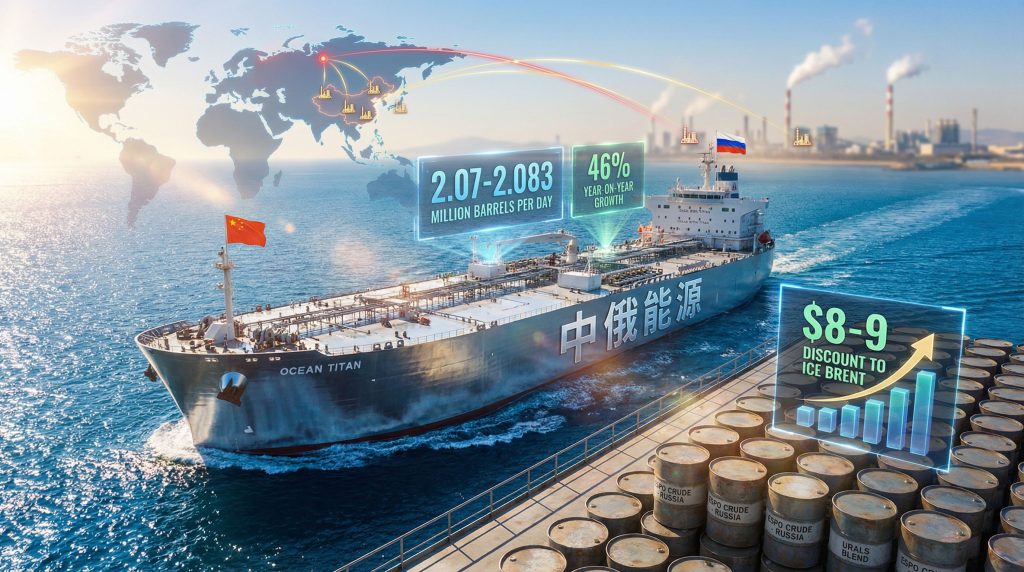
February 2026 marked a watershed moment for China's Russian oil imports, with preliminary data revealing unprecedented volumes flowing into Chinese ports. Vortexa Analytics estimated imports at 2.07 million barrels per day, while Kpler's provisional assessment reached 2.083 million bpd for February deliveries.
This represents a remarkable 21.4% month-on-month increase from January's baseline of approximately 1.7 million bpd. The magnitude of this expansion becomes clearer when viewed against historical patterns, with China officially replacing India as Moscow's primary seaborne crude customer in November 2025.
| Month | Vortexa Analytics (million bpd) | Kpler Data (million bpd) | Month-on-Month Change |
|---|---|---|---|
| January 2026 | 1.7 | 1.718 | Baseline |
| February 2026 | 2.07 | 2.083 | +21.4% |
These volumes now position China as the dominant recipient of Russian crude exports, fundamentally altering Moscow's customer base and revenue distribution. The concentration of Russian exports in Chinese markets reduces Moscow's diversification while strengthening Beijing's negotiating position for future supply agreements.
When big ASX news breaks, our subscribers know first
What Economic Factors Are Driving Independent Chinese Refiners' Purchasing Decisions?
Price Arbitrage Opportunities in Sanctioned Oil Markets
Chinese independent refiners, colloquially known as teapots, have emerged as the world's largest consumers of sanctioned crude from Russia, Iran, and Venezuela. These facilities possess unique advantages in processing discounted feedstock that traditional integrated oil companies cannot access due to sanctions compliance requirements.
Russian ESPO blend commanded substantial discounts of $8-9 per barrel below ICE Brent for March 2026 deliveries, while Urals crude traded at historically wide discounts of $9-11 per barrel below benchmark pricing. These price differentials represent the lowest Urals discounts in years, creating extraordinary margin opportunities for processors capable of handling these grades.
In addition, the economic comparison with alternative sanctioned supplies reveals Russian crude's competitive positioning. Iranian Light crude traded at $10-11 below ICE Brent, making Russian supplies relatively more attractive when accounting for quality specifications and processing yields.
However, these pricing dynamics intersect with broader concerns about oil geopolitics supply chains and their impact on global market stability. A senior Chinese trader who regularly engages with independent refiners observed that Russian oil processing economics now exceed Iranian alternatives when evaluating total refining margins.
The Teapot Refinery Revolution and Market Dynamics
Independent Chinese refiners have demonstrated remarkable agility in adapting to changing feedstock availability and pricing dynamics. Their operational flexibility allows rapid switching between crude grades based on economic optimisation rather than long-term supply contracts that constrain larger integrated refiners.
Shandong Province serves as the epicentre of China's independent refining sector, housing numerous facilities capable of processing various Russian crude grades. These refineries have optimised their operations for handling both Far East supplies like ESPO and European-origin grades including Urals.
Consequently, Iranian crude deliveries into China declined from 1.25 million bpd in January to 1.03 million bpd in February 2026, reflecting the substitution effect as Russian supplies became more economically attractive. This 17.6% monthly decline demonstrates the fluid nature of sanctioned crude procurement among Chinese independent refiners.
The logistical complexity of Iranian crude imports, often rebranded as Malaysian origin to circumvent US sanctions, adds operational risk and cost compared to more straightforward Russian supply arrangements. This complexity factor reinforces the economic attractiveness of Russian crude beyond simple price differentials.
How Is India's Strategic Withdrawal Creating Market Opportunities for China?
India's Trade Policy Recalibration and Its Ripple Effects
India's dramatic reduction in Russian crude purchases reflects a deliberate recalibration balancing energy security needs against bilateral trade negotiations with the United States. December 2025 marked a turning point as Indian imports fell to two-year lows, with February 2026 projections indicating further decline to 1.159 million bpd.
This strategic withdrawal represents more than temporary market adjustment; it signals India's prioritisation of Western trade relationships over opportunistic energy procurement. The US-China trade war dynamics have influenced regional energy procurement strategies across Asia-Pacific markets.
The geopolitical implications extend beyond immediate supply arrangements. India's retreat from Russian energy markets eliminates a significant competitive force that previously absorbed substantial volumes of discounted crude, particularly Urals grade loaded from European ports that historically favoured shorter voyage routes to Indian destinations.
Supply Chain Reallocation Across Asian Energy Markets
Urals crude traditionally destined for India has found new pathways to Chinese ports, despite longer transportation distances that previously made such routes uneconomical. This reallocation demonstrates how geopolitical factors can override traditional logistics optimisation in commodity markets.
The transportation economics favouring India for European-loaded Russian crude have been superseded by market access considerations. Chinese purchasers now absorb Urals volumes despite higher freight costs, indicating the strength of demand and pricing advantages that justify additional logistics expenses.
For instance, Russian export grade diversification has expanded beyond traditional ESPO shipments from Kozmino port to include European-origin grades like Sokol and Varandey. This diversification provides Chinese refiners access to a broader range of crude specifications while reducing Russia's dependence on Far East export infrastructure.
What Are the Long-Term Implications for Global Energy Security?
Sanctions Effectiveness and Unintended Market Consequences
The Western sanctions regime targeting Russian energy exports has achieved market reallocation rather than volume reduction, creating unintended consequences for global energy security architecture. Russian crude previously distributed across multiple customer bases now concentrates in Chinese markets, potentially strengthening bilateral energy interdependence.
This outcome challenges traditional assumptions about sanctions effectiveness in energy markets. Rather than reducing Russian export revenues, the sanctions have primarily altered destination patterns while maintaining overall export volumes through price discounting that attracts new customer bases.
However, these developments contribute to broader commodities market volatility as traders adapt to evolving supply chain patterns. The concentration of Russian energy exports in Chinese markets reduces Moscow's customer diversification while enhancing Beijing's negotiating leverage for future supply arrangements.
Strategic Energy Partnership Development
China's expanded role as Russia's primary energy customer positions both nations for deeper infrastructure integration and long-term supply agreements. The current opportunistic purchasing patterns may evolve into strategic partnerships with dedicated transportation and processing infrastructure.
Pipeline capacity optimisation and maritime terminal throughput increases support the structural shift toward China-centric Russian energy exports. Kozmino terminal and other Far East facilities have demonstrated capacity to handle increased volumes, while European loading points redirect traditional Indian-bound cargoes toward Chinese destinations.
The development of dedicated energy trade relationships extends beyond crude oil to encompass natural gas, refined products, and potential petrochemical integration. This comprehensive approach suggests the current trade patterns may represent the foundation for permanent strategic energy partnerships.
How Are Market Fundamentals Responding to These Structural Changes?
Pricing Dynamics and Market Efficiency Analysis
The substantial discounts achieved by Russian crude grades reflect both sanctions pressure and competitive positioning against alternative sanctioned supplies. ESPO blend discounts of $8-9 per barrel and Urals discounts of $9-11 per barrel represent historically wide spreads that attract opportunistic purchasing.
| Crude Grade | Discount to Brent | Quality Profile | Loading Region |
|---|---|---|---|
| Russian ESPO | $8-9 per barrel | Premium Far East blend | Kozmino terminal |
| Russian Urals | $9-11 per barrel | Medium sour European | European ports |
| Iranian Light | $10-11 per barrel | Medium sweet Middle East | Persian Gulf |
These pricing dynamics reflect the intersection of geopolitical risk premiums and market access constraints. The relative attractiveness of Russian grades compared to Iranian alternatives demonstrates how sanctions regimes create unexpected competitive advantages for different sanctioned suppliers.
Supply Chain Logistics and Infrastructure Utilisation
Russian export infrastructure has demonstrated remarkable adaptability in redirecting traditional supply chains toward new destinations. The optimisation of Far East terminals like Kozmino supports increased throughput to Chinese customers, while European facilities maintain operations through destination switching.
Transportation route efficiency has become subordinate to market access considerations, with Chinese purchasers accepting longer voyage times for European-loaded Russian crude that previously favoured Indian destinations. This shift indicates the strength of economic incentives overriding traditional logistics optimisation.
Moreover, maritime shipping capacity allocation reflects the structural changes in Russian export patterns, with vessel chartering patterns adapting to support China-bound cargoes regardless of loading location. This flexibility demonstrates the shipping industry's adaptation to changing geopolitical trade flows.
What Does This Mean for Global Energy Investment Strategies?
Portfolio Implications for Energy Sector Investors
Chinese independent refining sector benefits significantly from discounted feedstock access, creating competitive advantages in downstream product markets. These margin improvements support enhanced profitability for teapot refiners capable of processing sanctioned crude grades, requiring careful consideration of investment strategy components in energy-focused portfolios.
Russian energy export revenue sustainability despite sanctions pressure demonstrates the resilience of commodity markets to geopolitical disruption when alternative customers emerge. This dynamic suggests sanctions effectiveness requires broader international coordination to prevent market substitution.
The impact on competing crude suppliers includes potential market share erosion as discounted Russian and Iranian supplies capture incremental Chinese demand. Traditional Middle Eastern suppliers may face pricing pressure to maintain market position against sanctioned crude alternatives.
Future Market Structure Considerations
The current supply chain realignment may create permanent structural changes extending beyond immediate geopolitical tensions. Infrastructure investments supporting Russia-China energy trade suggest long-term commitment to bilateral supply relationships that could persist through future political changes.
Furthermore, China's growing influence in global oil price formation reflects its expanding role as the marginal buyer for multiple sanctioned crude suppliers. This position provides Beijing with enhanced leverage in international energy markets and price discovery mechanisms.
Strategic petroleum reserve implications for China include the opportunity to build inventory at historically attractive pricing levels while diversifying storage across multiple crude grades. According to data from Trading Economics, this approach supports both commercial optimisation and energy security objectives.
The next major ASX story will hit our subscribers first
Frequently Asked Questions About China's Russian Oil Import Surge
Why Are Chinese Refiners Preferring Russian Over Iranian Oil?
Quality specifications favour Russian crude processing yields in Chinese independent refinery configurations, particularly for ESPO blend which offers premium characteristics compared to Iranian Light crude. Processing optimisation studies indicate superior margin potential from Russian grades when accounting for total refining economics.
Reliability concerns regarding Iranian supply continuity have intensified amid US-Iran nuclear negotiations and potential military confrontation risks. Emma Li, Vortexa's China analyst, noted that uncertainty over potential US military strikes on Iran has made Russian oil appear more reliable to Chinese purchasers concerned about supply disruption risks.
Price competitiveness has shifted in favour of Russian supplies despite historically attractive Iranian crude pricing. The relative discount narrowing between Russian and Iranian grades, combined with quality advantages, has created economic incentives supporting the procurement shift.
How Sustainable Is This Import Growth Trajectory?
Chinese domestic refining capacity utilisation supports continued growth in crude processing demand, particularly among independent refiners operating below optimal throughput levels. Teapot refinery expansion in Shandong Province provides infrastructure capacity for sustained China's Russian oil imports growth.
Russian export capacity constraints may ultimately limit supply availability as infrastructure optimisation reaches maximum throughput levels. Kozmino terminal capacity and pipeline limitations could restrict future export volume growth to Chinese destinations.
Potential policy interventions affecting long-term supply agreements include evolving sanctions regimes and bilateral trade relationship changes that could alter current purchasing patterns. Nevertheless, Reuters reports that the established infrastructure and commercial relationships suggest structural durability beyond short-term political fluctuations.
Investment Disclaimer: This analysis contains forward-looking assessments regarding energy market developments, crude oil pricing, and geopolitical risk factors. Energy commodity markets involve substantial volatility and investment risk. Sanctions regimes, geopolitical tensions, and international trade policies may change rapidly, affecting market conditions and investment outcomes. Past performance does not guarantee future results. Investors should conduct independent research and consider professional financial advice before making investment decisions based on energy market analysis.
The transformation of China's Russian oil imports represents more than opportunistic commodity trading; it signals a fundamental restructuring of global energy security relationships. Independent Chinese refiners have successfully leveraged geopolitical disruptions to secure competitive feedstock access while Russian exports maintain revenue generation through customer base diversification. This strategic realignment may establish enduring bilateral energy partnerships that reshape Asia-Pacific commodity flows for years to come, regardless of evolving sanctions regimes or diplomatic developments.
Looking to Capitalise on Commodity Market Disruptions?
Discovery Alert's proprietary Discovery IQ model delivers real-time alerts on significant ASX mineral discoveries, instantly empowering subscribers to identify actionable opportunities as global commodity markets undergo fundamental restructuring. Begin your 14-day free trial today and position yourself ahead of these transformative market shifts.