May 11, 2026
China's Strategic Resource Dominance Revolution
The global race for strategic resource dominance has entered a new phase as nations recognise that control over critical minerals will determine economic leadership in the post-carbon economy. Furthermore, this transformation extends far beyond traditional mining paradigms, encompassing sophisticated supply chain integration, technological supremacy, and geopolitical influence across multiple continents. China's investment in critical minerals represents the largest coordinated resource acquisition strategy in modern history, fundamentally reshaping how nations conceptualise mineral security and industrial competitiveness.
China's systematic approach to securing these essential materials operates through an interconnected three-pillar strategy. However, the critical minerals energy transition demonstrates how this extends beyond mere extraction to complete value chain control.
When big ASX news breaks, our subscribers know first
China's Comprehensive Resource Security Framework
China's investment in critical minerals operates through an interconnected three-pillar strategy that combines upstream resource control, processing dominance, and downstream manufacturing integration. This approach targets materials essential for renewable energy infrastructure, including lithium for battery storage, copper for electrical systems, nickel for high-performance batteries, rare earth elements for permanent magnets, and cobalt for energy density optimisation.
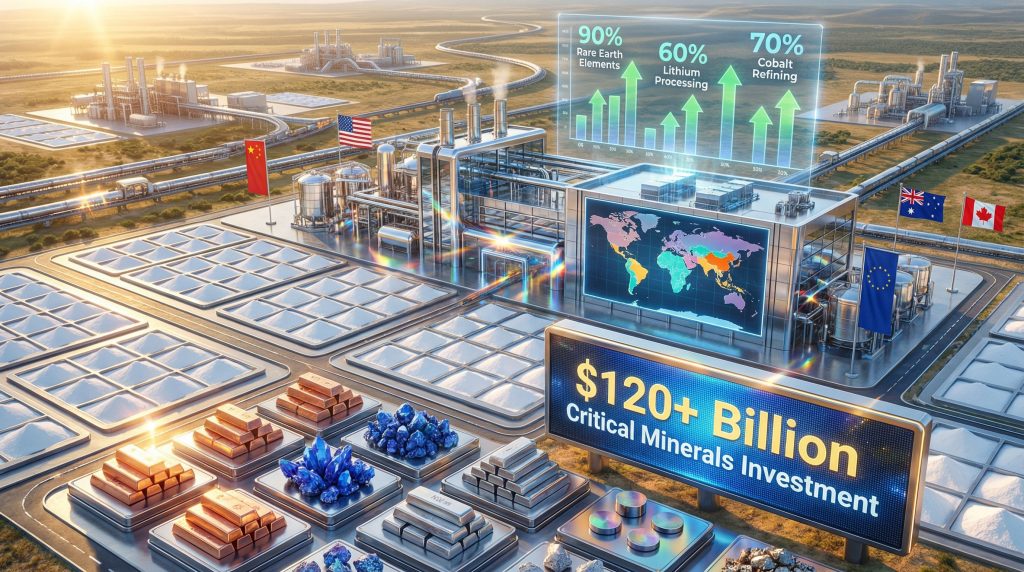
Since 2023, Chinese entities have deployed over $120 billion specifically toward overseas mining and primary processing operations. This figure represents only the extraction and initial refinement segment of a broader $340+ billion investment strategy encompassing the complete clean energy value chain.
The investment architecture differs fundamentally from traditional resource extraction models by creating vertically integrated supply chains spanning mine-to-market operations. In addition, this integration provides multiple strategic advantages including supply security through direct material flow control, price influence capabilities through integrated operations that can absorb temporary losses at specific stages, and technology transfer mechanisms where processing expertise enhances upstream efficiency.
Strategic Investment Distribution Across Sectors
| Sector | Investment (USD Billions) | Strategic Objective |
|---|---|---|
| Mining & Primary Processing | $120+ | Raw material extraction and initial refinement control |
| Battery Manufacturing | $85 | Lithium-ion cell production facility development |
| Electric Vehicle Production | $75 | Integrated EV assembly and component manufacturing |
| Renewable Infrastructure | $60 | Solar, wind, and grid technology deployment |
This comprehensive capital deployment creates what researchers describe as "green energy statecraft" – a coordinated policy framework integrating industrial strategy, geopolitical objectives, and economic dominance across clean energy value chains. The approach represents a deliberate evolution from earlier resource extraction models toward systematic control over technological transformation pathways.
Processing Dominance Across Critical Material Categories
China's strategic positioning extends significantly beyond raw material extraction into processing and refinement capabilities that create genuine supply chain dependencies for global competitors. Furthermore, the concentration of processing expertise represents a more strategically valuable position than resource ownership alone, particularly given the technical complexity and capital intensity required for specialised material refinement.
China's Global Processing Market Control
| Material | Processing Share | Strategic Significance |
|---|---|---|
| Rare Earth Elements | 90% | Essential for permanent magnets in wind turbines and electric vehicles |
| Battery Cathode Materials | 90% | Direct control over electric vehicle battery production capabilities |
| Lithium Processing | 60% | Critical for all lithium-ion battery applications and energy storage |
| Cobalt Refining | 70% | Key component for high-performance battery energy density |
| Graphite Processing | 85% | Anode material for lithium-ion battery manufacturing |
The 90% rare earth processing dominance represents not merely volume control but concentrated technical expertise in complex separation and purification processes. Consequently, processing rare earth elements into permanent magnets suitable for wind turbine generators and electric vehicle motors requires specialised solvent extraction, ion exchange chromatography, and calcination processes that cannot be rapidly replicated elsewhere.
Technical Processing Complexities
Lithium-ion battery performance depends critically on cathode material composition, including lithium cobalt oxide for consumer electronics, lithium iron phosphate for grid storage, and nickel-based variants for electric vehicle applications. Chinese processors control both the material refinement processes and intellectual property in manufacturing optimisation, enabling quality control that downstream manufacturers worldwide depend upon.
Graphite anode material processing involves both natural graphite purification and synthetic graphite manufacturing pathways. The 85% Chinese processing share reflects accumulated expertise in specialised thermal and chemical processing, where operational margins depend heavily on scale economies and technical optimisation that competitors struggle to match economically.
A practical illustration demonstrates this dependency: a single wind turbine permanent magnet generator requires approximately 600 kilograms of rare earth elements. The complete production pipeline from rare earth oxide to refined metals to finished magnets remains dominated by Chinese processors, meaning any global wind turbine manufacturer depends on Chinese processing capabilities or must maintain expensive in-house alternatives.
Geographic Investment Patterns and Resource Integration
Chinese capital deployment follows distinct geographic patterns aligned with resource availability, political relationships, and infrastructure development potential. This geographic diversification strategy reduces single-country dependency risks whilst positioning China across multiple resource-rich regions.
Regional Investment Concentration Areas
| Region | Primary Resources | Investment Approach | Strategic Benefits |
|---|---|---|---|
| Democratic Republic of Congo | Copper, Cobalt | Joint ventures with state entities | Access to approximately 50-70% of world cobalt reserves |
| Indonesia | Nickel | Integrated smelting operations | Control over laterite nickel processing for battery applications |
| Zimbabwe | Lithium | Processing facility development | African lithium processing hub establishment |
| Guinea | Bauxite, Iron Ore | Infrastructure-for-resources agreements | Aluminum supply chain vertical integration |
| Chile | Lithium | Technology partnerships | Access to established brine extraction operations |
The Zijin Mining expansion strategy exemplifies how Chinese mining giants leverage global acquisitions to secure critical mineral supplies worldwide.
Indonesia's Nickel Processing Transformation
Indonesia's evolution demonstrates China's adaptive investment strategy. When Indonesia prohibited nickel ore exports in 2014 to encourage domestic processing, Chinese companies responded by developing laterite nickel processing facilities rather than seeking alternative sources. This created integrated operations producing nickel-cobalt mixed hydroxide precipitate (MHP), an intermediate product optimised for battery manufacturing rather than traditional stainless steel applications.
By 2026, this vertical integration generated approximately 25-30% of global nickel supply, transforming Indonesia from ore exporter to processed material supplier. The processing infrastructure requires specialised hydrometallurgical operations distinct from conventional nickel refining, demonstrating how Chinese investment adapts to policy constraints by developing host-country processing capacity.
Infrastructure Integration Model
China's "minerals-for-infrastructure" approach creates comprehensive development packages extending beyond traditional mining agreements:
- Transportation Networks: Railways, ports, and logistics systems facilitating resource export and regional connectivity
- Energy Infrastructure: Power generation facilities supporting energy-intensive processing operations
- Digital Systems: Telecommunications networks enabling operational coordination and technology transfer
- Social Infrastructure: Housing, education, and healthcare facilities for local communities and workforce development
This infrastructure development serves dual purposes: supporting immediate resource extraction whilst creating long-term economic relationships that extend Chinese influence beyond extractive operations into broader regional development frameworks.
Economic Impact Assessment for Resource-Rich Nations
Chinese investment models have evolved significantly from earlier extractive approaches toward collaborative frameworks providing measurable benefits to host countries whilst securing long-term resource access for Chinese industrial requirements.
Quantifiable Benefits for Host Countries
- Employment Generation: Local hiring requirements create direct employment in mining operations and indirect employment in supporting services
- Skills Transfer: Training programmes in mining techniques, processing technologies, and operational management
- Infrastructure Legacy: Transportation, energy, and communication systems serving broader economic development beyond resource extraction
- Revenue Streams: Royalty payments, corporate taxes, and export duties contributing to government budgets
- Value Addition: In-country processing capturing higher margins than raw material export
Risk Factors and Concerns
Despite economic benefits, Chinese investment patterns present several strategic concerns for host nations:
"Debt Sustainability Challenges: Large infrastructure loans may create long-term financial obligations that constrain future policy flexibility and economic sovereignty."
- Market Concentration Risk: Over-reliance on Chinese markets for commodity exports creates vulnerability to demand fluctuations or trade disputes
- Environmental Compliance Variations: Different environmental protection standards may create long-term remediation liabilities
- Technology Dependency: Reliance on Chinese technical expertise may limit indigenous capability development
The Democratic Republic of Congo illustrates both opportunities and risks. Chinese investment accelerated copper and cobalt extraction whilst developing processing capabilities, creating employment and government revenues. However, concerns persist about environmental standards, labour practices, and the concentration of export markets that may limit future negotiating flexibility.
Recent reports from China's leading research institutes highlight how China's $169 billion investment blitz into global critical minerals has reshaped market dynamics across resource-rich nations.
Western Strategic Responses to Chinese Mineral Dominance
Recognition of Chinese supply chain control has prompted coordinated responses from Western governments and private sector entities seeking to diversify critical mineral sources and reduce strategic dependencies.
United States Diversification Initiatives
- Minerals Security Partnership: 14-nation alliance targeting supply chain diversification through coordinated investment and policy frameworks
- Defence Production Act Funding: Government capital supporting domestic processing capability development
- Strategic Reserve Expansion: Emergency stockpiling of critical materials for national security applications
- Technology Innovation Investment: Research funding for advanced extraction, processing, and recycling technologies
European Union Strategic Programs
- Critical Raw Materials Act: €22.5 billion investment framework for strategic processing projects
- Global Gateway Initiative: Infrastructure partnerships with resource-rich developing nations
- Circular Economy Targets: Recycling requirements reducing primary material import dependencies
- Bilateral Supply Agreements: Direct government-to-government resource access arrangements
The European CRM facility development represents a significant milestone in reducing European dependency on Chinese processing capabilities.
Challenges Confronting Alternative Supply Development
Several structural factors complicate Western efforts to reduce dependence on Chinese critical mineral supply chains:
- Capital Intensity Requirements: Mining and processing infrastructure development requires massive upfront investments with long payback periods
- Technical Knowledge Gaps: Limited processing expertise outside China creates operational and optimisation challenges
- Development Timelines: Alternative supply source development requires decades rather than years for full capacity realisation
- Economic Competitiveness: Chinese operations benefit from scale economies, integrated supply chains, and state financial support
- Environmental Regulatory Constraints: Stricter Western environmental standards increase processing costs and limit facility siting options
The scale challenge is particularly significant. If Chinese processors maintain 20-30% cost advantages through operational scale and regulatory arbitrage, alternative capacity development faces sustained economic headwinds beyond initial technical barriers.
The next major ASX story will hit our subscribers first
Market Dynamics and Future Demand Projections
Multiple interconnected trends will drive critical mineral demand growth through 2035, creating both opportunities and supply constraints that will test global production and processing capacity.
Demand Growth Drivers Through 2035
- Electric Vehicle Adoption: Projections indicate 50% of global automotive sales will be electric by 2030, requiring massive battery material increases
- Renewable Energy Expansion: Solar and wind capacity projected to triple by 2035, demanding increased copper, rare earths, and steel
- Grid Storage Requirements: Renewable energy integration requires massive battery installations for grid stability and load balancing
- Industrial Electrification: Manufacturing processes transitioning from fossil fuel inputs to electrical systems
Critical Material Demand Multipliers
| Application | Key Materials | Demand Multiplier (2024-2035) |
|---|---|---|
| Electric Vehicle Batteries | Lithium, Nickel, Cobalt | 4-6x current consumption |
| Wind Turbine Magnets | Rare Earth Elements | 3-5x current consumption |
| Solar Panel Systems | Silver, Copper, Polysilicon | 2-4x current consumption |
| Grid Storage Systems | Lithium, Vanadium, Manganese | 8-12x current consumption |
An electric vehicle battery pack contains approximately 8-10 kilograms of processed cathode material. With global EV production projected to reach 50 million units annually by 2030, cathode material demand will increase from current levels of approximately 400,000 tonnes annually to over 2 million tonnes, requiring massive processing capacity expansion.
Geopolitical Risk Scenarios and Supply Chain Vulnerabilities
Growing strategic competition between major powers creates multiple potential disruption scenarios that could significantly impact global critical mineral availability and pricing. Furthermore, the US-China trade war impact demonstrates how geopolitical tensions can disrupt established supply chains.
High-Impact Disruption Scenarios
- Selective Export Restrictions: Targeted limitations on critical material exports during diplomatic or trade disputes
- Technology Transfer Constraints: Restrictions on sharing processing expertise with competing nations
- Infrastructure Targeting: Physical or cyber attacks on critical supply chain nodes and processing facilities
- Financial System Restrictions: Banking limitations complicating international resource trade financing
"Supply Chain Concentration Risk: Current Chinese processing dominance creates single points of failure where disruption to key facilities could impact global clean energy technology production for months or years."
The rare earth processing concentration illustrates vulnerability mechanisms. If diplomatic tensions led to export restrictions on rare earth magnets, wind turbine manufacturing globally would face immediate supply constraints, as alternative processing capacity requires 3-5 years minimum development time and billions in capital investment.
Risk Mitigation Strategies
- Strategic Stockpiling: Government and industry reserves providing supply buffers during disruption periods
- Supply Source Diversification: Multiple supplier relationships across different geographic regions and political systems
- Recycling Capacity Development: Circular economy approaches reducing primary material dependencies
- Substitute Material Research: Alternative technologies reducing dependence on scarce or concentrated materials
Investment Opportunities and Market Positioning
Supply chain restructuring creates distinct investment themes across different segments of critical mineral value chains, with varying risk-return profiles and development timelines.
Upstream Investment Opportunities
- Alternative Mining Projects: Operations in stable jurisdictions outside Chinese control, particularly in Canada, Australia, and select African nations
- Advanced Extraction Technologies: Innovations improving recovery rates from lower-grade ores or unconventional sources like geothermal brines
- Exploration Companies: Firms developing new resource discoveries in regions with favourable geology and political frameworks
The China gold discovery showcases how new resource finds can significantly alter global supply dynamics and investment landscapes.
Midstream Processing Investments
- Western Processing Facilities: Plants reducing dependence on Chinese refining capacity, particularly for lithium and rare earth processing
- Recycling Infrastructure: Systems recovering materials from end-of-life batteries, electronics, and renewable energy equipment
- Logistics Networks: Transportation, storage, and distribution facilities for critical materials
Investment Risk Considerations
Critical mineral investments face unique risk profiles requiring careful evaluation:
Operational and Market Risks
- Regulatory Evolution: Changing government policies on resource extraction, environmental standards, and foreign investment
- Technology Disruption: Alternative materials or manufacturing processes reducing demand for specific inputs
- Price Volatility: Commodity cycles driven by supply-demand imbalances and speculative trading
- Geopolitical Instability: Political changes in resource-rich regions affecting operational continuity
Financial and Strategic Risks
- Capital Intensity: Large upfront investments with long payback periods and execution risks
- Environmental Liabilities: Long-term costs associated with mining operations, waste management, and site remediation
- Market Access: Potential restrictions on export markets or processing technology access
- Currency and Inflation: Exchange rate fluctuations and input cost inflation affecting project economics
According to the Lowy Institute's analysis, China's $120 billion minerals blitz has fundamentally altered the global competitive landscape for critical mineral investments.
Strategic Implications for Global Energy Transition
China's comprehensive critical mineral strategy creates both accelerating factors and constraining elements for worldwide decarbonisation efforts, influencing the speed, cost, and geographic distribution of clean energy deployment.
Positive Transition Impacts
- Cost Optimisation: Economies of scale in processing reduce material costs for clean technologies globally
- Supply Consistency: Integrated supply chains ensure reliable material availability for renewable energy and electric vehicle manufacturing
- Innovation Acceleration: Concentrated expertise accelerates technological advancement in processing techniques and material optimisation
- Infrastructure Development: Resource extraction creates supporting infrastructure in developing nations, facilitating broader economic development
Potential Constraint Mechanisms
- Vulnerability Concentration: Supply chain bottlenecks create single points of failure that could disrupt global clean energy technology production
- Geopolitical Dependencies: Trade relationships and diplomatic tensions may influence material availability and pricing
- Alternative Development Delays: Western supply chain development may lag behind demand growth, creating temporary shortages
- Technology Access Limitations: Restricted sharing of processing expertise may slow global capacity expansion
Long-Term Strategic Trajectories
The intersection of demand growth, supply concentration, and geopolitical competition will likely drive three potential scenarios through 2035:
- Chinese Consolidation: Continued expansion of integrated supply chain control, with other nations remaining dependent on Chinese processing capabilities
- Multipolar Competition: Successful development of alternative Western and allied processing capacity, creating multiple supply chain options
- Technology Leapfrogging: Innovation in recycling, substitution, and alternative extraction methods reducing dependence on traditional supply chains
"Investment Implication: The trajectory China's investment in critical minerals follows will significantly influence clean energy technology costs, deployment speed, and geopolitical relationships for the next decade and beyond."
Understanding these dynamics becomes essential for investors, policymakers, and industry leaders navigating the intersection of resource security, technological transformation, and strategic competition in the global economy's evolution toward sustainable energy systems.
Disclaimer: This analysis incorporates forecasts, market projections, and strategic assessments that involve inherent uncertainties. Commodity markets, geopolitical relationships, and technology development timelines may evolve differently than projected. Investment decisions should consider multiple sources of information and professional guidance appropriate to specific circumstances and risk tolerances.
Interested in Capitalising on Critical Mineral Market Opportunities?
Discovery Alert's proprietary Discovery IQ model delivers real-time alerts on significant ASX mineral discoveries, enabling investors to identify actionable opportunities ahead of broader market awareness. As global demand for critical minerals continues accelerating, subscribers gain immediate insights into potential discoveries that could reshape supply chains and generate substantial returns. Begin your 14-day free trial today to secure your market-leading advantage in this rapidly evolving sector.