June 15, 2026
The global energy storage landscape continues its rapid transformation as manufacturing strategies evolve beyond traditional export models. Battery technology companies increasingly recognise that establishing localised production capabilities represents a fundamental shift in market approach, driven by regulatory frameworks, supply chain optimisation, and long-term competitive positioning rather than short-term cost considerations.
What Drives Chinese Battery Manufacturers to Target European Markets?
Market Access and Trade Dynamics
European battery regulations create compelling incentives for manufacturers to establish regional production facilities rather than relying solely on import strategies. The regulatory environment includes local content requirements, evolving tariff structures, and compliance obligations that favour domestic manufacturing approaches over traditional export models.
According to the Battery Atlas 2026 from RWTH Aachen University, approximately 673 GWh of announced European cell production capacity is led by Asian companies, representing the largest share of European battery manufacturing expansion. This substantial commitment reflects strategic positioning decisions rather than opportunistic market entry approaches.
The European regulatory framework creates distinct advantages for manufacturers establishing local operations:
- Regulatory Compliance: Direct access to EU battery passport requirements and traceability standards
- Market Integration: Streamlined distribution networks across EU member states
- Policy Alignment: Participation in regional development programmes and industrial policy initiatives
- Supply Chain Proximity: Reduced logistics complexity for both raw material inputs and finished product distribution
Supply Chain Resilience Imperatives
Critical mineral processing capabilities in Europe provide strategic advantages for battery manufacturers seeking to reduce supply chain vulnerabilities. Furthermore, transportation cost optimisation for grid-scale projects creates measurable operational benefits when production facilities are located closer to end-market applications.
Global battery cell shipments for energy storage reached 612.39 GWh in 2025, representing a 94.59% year-on-year increase. In the industrial-scale segment specifically, shipments reached 556.74 GWh, up 96.73% year-on-year, demonstrating the scale of market opportunity driving localisation strategies.
Hithium's strategic positioning illustrates this trend, as the company ranked second globally in both total energy storage cell shipments and industrial-scale battery shipments in 2025. This market leadership provides foundation for European expansion through the Hithium battery factory investment in Spain, representing a €400 million commitment to establishing regional manufacturing capabilities.
However, the renewable energy transition creates additional complexity for supply chain resilience frameworks. For instance, the supply chain framework encompasses multiple operational considerations:
- Raw Material Security: Reduced exposure to international shipping disruptions
- Quality Control: Direct oversight of manufacturing processes and standards compliance
- Customer Proximity: Faster response times for technical support and system integration
- Regulatory Adaptation: Ability to modify products based on evolving European standards
When big ASX news breaks, our subscribers know first
How Does Spain Position Itself in Europe's Battery Manufacturing Race?
Regional Competitive Advantages
Spain's renewable energy infrastructure creates significant cost advantages for energy-intensive battery manufacturing operations. The country's solar and wind resources provide competitive electricity pricing that directly impacts production economics for battery cell and system manufacturing.
The Navarre region specifically offers a combination of industrial capabilities that attracted Hithium's €400 million investment:
- University partnerships for technical workforce development and research collaboration
- Technology centres providing specialised training programmes and innovation support
- Vocational training infrastructure capable of transitioning automotive sector expertise to battery manufacturing
- Energy sector expertise from existing industrial operations and renewable energy companies
According to Navarre's industry minister, the Hithium battery factory investment in Spain represents the result of three years of institutional development work, demonstrating the region's systematic approach to attracting advanced manufacturing investments.
Infrastructure and Logistics Assessment
Spain's strategic location provides advantageous access to both European markets and North African opportunities. Port connectivity through Barcelona, Valencia, and Bilbao offers efficient import channels for critical minerals and raw materials required for battery manufacturing operations.
The industrial infrastructure requirements for large-scale battery manufacturing include:
| Infrastructure Element | Requirement | Spanish Capability |
|---|---|---|
| Power Supply | High-voltage grid connections | Renewable energy integration available |
| Water Systems | Cooling and processing capacity | Industrial zone infrastructure established |
| Transportation | Bulk material handling | Multi-modal logistics networks |
| Workforce | Specialised technical skills | Automotive industry transition programmes |
Grid integration capabilities represent a crucial advantage for battery manufacturers, particularly companies like Hithium that produce both cells and complete containerised energy storage systems. In addition, the ability to test and validate products using local grid infrastructure reduces development timelines and operational complexity.
What Investment Models Shape Battery Factory Development in Europe?
Public-Private Partnership Structures
The Hithium battery factory investment in Spain employs a joint venture model between the Chinese manufacturer and Sodena, the Navarrese public development agency. This partnership structure represents an evolving approach to foreign direct investment that balances private sector efficiency with public sector strategic objectives.
The joint venture framework includes several key elements:
- Risk Sharing: Distribution of capital and operational risks between foreign manufacturer and regional development agency
- Stakeholder Alignment: Regional government co-investment creates incentives for long-term facility success
- Regulatory Navigation: Public sector expertise in EU subsidy compliance and environmental permitting processes
- Workforce Development: Coordination between private investment and public training programmes
Financial Incentive Optimisation
European regional aid regulations establish maximum subsidy thresholds that significantly influence investment location decisions. For projects in designated supported areas, subsidies of up to 20% of eligible investment costs are available through EU regional aid mechanisms.
The €400 million Hithium investment potentially qualifies for up to €80 million in public subsidy support, though actual awards depend on detailed eligible cost calculations and final regional government approval processes.
Financial Structure Components:
- Phase 1 Investment: Initial facility development with 750 direct job creation targets
- Phase 2 Expansion: Additional 300 positions planned for expanded production capacity
- Operational Timeline: Target facility operation by 2027
- Subsidy Integration: EU regional aid compliance throughout development phases
Long-term financing structures for capital-intensive projects typically combine multiple funding sources, including project finance arrangements, corporate debt instruments, and development bank financing. Furthermore, the public-private partnership model creates additional opportunities for favourable financing terms through government-backed guarantees and reduced risk profiles.
Which Market Segments Drive Battery Manufacturing Investment Decisions?
Grid-Scale Storage Market Analysis
Industrial-scale energy storage represents the dominant market segment driving manufacturing investment decisions. The 556.74 GWh in industrial-scale battery shipments during 2025 demonstrates the scale of opportunity in utility-scale applications.
Market Segment Breakdown:
- Utility-Scale Projects: Grid stabilisation and renewable energy integration applications
- Commercial & Industrial: Behind-the-meter applications for demand management
- Industrial Applications: Process optimisation and backup power systems
- Renewable Integration: Solar and wind power storage solutions
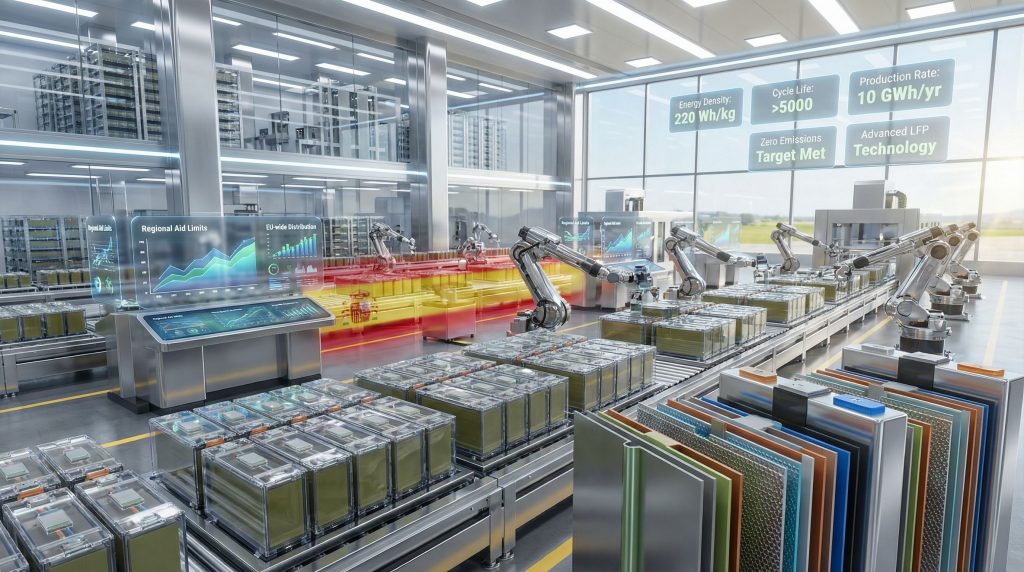
The Hithium battery factory investment in Spain specifically targets these market segments through production of both lithium iron phosphate (LFP) battery cells and complete containerised energy storage systems. This integrated approach addresses customer requirements for turnkey solutions rather than component-level products.
Industrial and Commercial Applications
Commercial and industrial energy storage adoption patterns in Spain reflect broader European trends toward distributed energy resources and grid independence. Behind-the-meter applications create consistent demand for battery systems that can integrate with existing facility infrastructure.
Revenue Stream Diversification:
- Peak Shaving: Demand charge reduction for commercial facilities
- Time-of-Use Optimisation: Energy arbitrage through price differential capture
- Backup Power: Uninterrupted operation during grid outages
- Grid Services: Ancillary service participation and grid stabilisation revenue
Integration with renewable energy development projects creates additional market opportunities, particularly for manufacturers capable of providing complete system solutions rather than standalone battery components. Additionally, the evolving battery metals landscape influences long-term supply chain strategies for these applications.
How Do Technology Specifications Influence Manufacturing Location Choices?
Lithium Iron Phosphate (LFP) Production Requirements
Hithium's technology platform centres on lithium iron phosphate chemistry, which offers specific advantages for stationary energy storage applications. LFP batteries provide superior cost-efficiency compared to nickel-cobalt-aluminium (NCA) or nickel-cobalt-manganese (NCM) chemistries for grid-scale applications.
LFP Technology Advantages:
- Cost Optimisation: Lower material costs due to iron-based cathode chemistry
- Safety Profile: Superior thermal stability and reduced fire risk
- Cycle Life: Extended operational lifespan for stationary applications
- Supply Chain Security: Reduced dependence on cobalt and nickel resources
Manufacturing process considerations for LFP chemistry include specialised equipment requirements, quality control standards, and environmental compliance procedures. The Hithium battery factory investment in Spain incorporates these technical requirements into facility design and operational planning.
Consequently, advancements in direct lithium extraction technologies could significantly impact future raw material sourcing strategies for LFP production facilities.
Research and Development Ecosystem Integration
University partnerships and innovation centre development create long-term competitive advantages for battery manufacturers establishing European operations. The Navarre region's ecosystem of technology centres and specialised training programmes provides foundation for continuous technology improvement and workforce development.
R&D Integration Elements:
- Technology Transfer: University research collaboration and intellectual property development
- Workforce Pipeline: Specialised degree programmes and vocational training alignment
- Innovation Networks: Connection with European battery research initiatives
- Product Development: Local testing facilities and prototype development capabilities
Intellectual property considerations for foreign manufacturers include technology transfer requirements, local content obligations, and research collaboration mandates that may accompany public subsidy programmes.
What Employment and Skills Development Patterns Emerge from Battery Investments?
Workforce Development Strategies
The Hithium battery factory investment in Spain projects creation of 1,050 total positions across two development phases, demonstrating significant employment impact potential. Phase 1 targets 750 direct jobs with Phase 2 adding 300 additional positions, indicating scalable workforce development requirements.
Skills Development Framework:
- Technical Training: Battery manufacturing process expertise and quality control systems
- Safety Certification: Hazardous material handling and industrial safety protocols
- Automation Skills: Advanced manufacturing equipment operation and maintenance
- System Integration: Complete energy storage system assembly and testing procedures
Specialised training programmes for battery manufacturing represent a transition opportunity for workers from traditional automotive and industrial sectors. The technical skills required for battery cell production and system assembly build upon existing manufacturing expertise while incorporating emerging technology requirements.
Value Chain Integration Opportunities
Local supplier development creates multiplier effects beyond direct manufacturing employment. Battery production facilities require extensive supply chains for materials handling, logistics coordination, maintenance services, and quality assurance functions.
Employment Multiplier Categories:
- Direct Manufacturing: Cell production, system assembly, and facility operations
- Supply Chain: Local procurement, transportation, and warehousing services
- Technical Services: Installation, maintenance, and system monitoring support
- Professional Services: Engineering, project management, and regulatory compliance functions
Long-term career pathway development in emerging industries requires coordination between manufacturers, educational institutions, and regional development agencies to ensure workforce capabilities evolve with technology advancement.
The next major ASX story will hit our subscribers first
How Do Regulatory Frameworks Shape Investment Timing and Structure?
European Battery Regulation Compliance
Battery passport requirements and traceability standards create operational obligations that influence manufacturing facility design and operational procedures. Environmental, social, and governance (ESG) reporting requirements add compliance complexity that favours established manufacturers with systematic approach capabilities.
Regulatory Compliance Elements:
- Battery Passports: Comprehensive product documentation and lifecycle tracking systems
- Recycling Mandates: End-of-life processing requirements and circular economy obligations
- Supply Chain Transparency: Raw material sourcing verification and ethical procurement standards
- Performance Standards: Technical specifications and safety certification requirements
The Hithium battery factory investment in Spain must incorporate these regulatory requirements into operational planning, facility design, and product development processes from initial construction phases.
Moreover, recent developments in Chinese battery recycling technologies could influence end-of-life processing strategies for European manufacturing facilities.
National and Regional Policy Alignment
Industrial policy coordination between national and regional governments creates opportunities for streamlined permitting processes and integrated development support. Environmental permitting procedures for manufacturing facilities require coordination across multiple regulatory jurisdictions and compliance frameworks.
Policy Coordination Benefits:
- Streamlined Approval: Integrated permitting processes across government levels
- Infrastructure Development: Coordinated investment in supporting infrastructure
- Training Programmes: Aligned workforce development initiatives and educational partnerships
- Market Access: Coordinated trade promotion and export facilitation services
Grid connection procedures for energy-intensive operations represent critical path items for facility development timelines. Manufacturing facilities require substantial electrical infrastructure that must integrate with regional grid planning and capacity allocation processes.
However, recent policy changes such as the critical minerals order could impact long-term supply chain strategies and regulatory compliance requirements.
What Market Intelligence Reveals About Global Battery Manufacturing Trends?
Production Capacity Analysis
The Battery Atlas 2026 report identifies significant consolidation occurring within the European battery sector. While over 2,000 GWh of cell production capacity was announced in 2023, realistic forecasts for early 2026 stand at approximately 1,190 GWh, reflecting market maturation and capital allocation constraints.
Capacity Utilisation Trends:
| Metric | 2025 Performance | Growth Rate |
|---|---|---|
| Total Energy Storage Shipments | 612.39 GWh | 94.59% YoY |
| Industrial-Scale Shipments | 556.74 GWh | 96.73% YoY |
| European Announced Capacity | 1,190 GWh | Revised from 2,000+ GWh |
| Asian Company Leadership | 673 GWh | Majority of European expansion |
Market share dynamics among leading manufacturers indicate consolidation around companies with established supply chains, proven technology platforms, and adequate capital resources. Hithium's second-place global ranking in industrial-scale battery shipments positions the company advantageously for European market expansion.
Technology Evolution and Investment Cycles
Manufacturing equipment lifecycle considerations influence facility design decisions and capital allocation strategies. Battery production equipment represents significant capital investment with multi-year depreciation cycles that must align with technology evolution timelines.
Investment Cycle Considerations:
- Equipment Longevity: Manufacturing line useful life and upgrade requirements
- Technology Transition: Capability to adapt to advancing battery chemistries
- Capacity Scalability: Modular expansion options based on market demand validation
- Competitive Positioning: Technology leadership maintenance through continuous investment
Next-generation battery chemistry development timelines create both opportunities and risks for manufacturers establishing European facilities. The Hithium battery factory investment in Spain focuses on proven LFP technology while maintaining capability for future chemistry integration.
How Should Investors Evaluate Battery Manufacturing Investment Opportunities?
Risk Assessment Framework
Technology obsolescence risks in rapidly evolving markets require careful evaluation of manufacturing facility flexibility and adaptation capabilities. Regulatory compliance costs and timeline uncertainties create additional complexity for investment return calculations.
Risk Categories:
- Technology Risk: Potential for chemistry advancement to reduce current technology competitiveness
- Market Risk: Demand volatility and competitive pressure on pricing and margins
- Regulatory Risk: Evolving compliance requirements and policy change impacts
- Operational Risk: Manufacturing complexity and quality control challenges
Market demand volatility reflects the emerging nature of grid-scale energy storage markets, where project development timelines, regulatory approval processes, and financing availability create demand uncertainty. Long-term growth projections support investment rationale while acknowledging near-term variability.
Value Creation Metrics
Return on investment calculations for industrial projects must incorporate multiple value streams beyond direct operational profitability. Strategic value considerations include market position establishment, technology platform development, and supply chain optimisation benefits.
Value Creation Elements:
- Direct Returns: Operational profitability from manufacturing and system sales
- Strategic Value: Market position establishment and competitive advantage development
- Portfolio Benefits: Risk diversification through geographic and technology diversification
- Platform Value: Foundation for additional European market expansion opportunities
The Hithium battery factory investment in Spain represents portfolio diversification benefits in clean energy infrastructure while establishing European market presence for long-term growth opportunities.
What Future Scenarios Could Shape Spain's Battery Manufacturing Sector?
Market Development Trajectories
Spain's potential to become a regional manufacturing hub depends on successful execution of current investments and continued attraction of additional battery sector companies. Integration with broader European battery value chain development creates opportunities for specialised supplier networks and technical expertise clusters.
Development Scenarios:
- Hub Development: Multiple manufacturers establishing regional operations and supplier ecosystems
- Specialisation: Focus on specific battery chemistries or application segments
- Integration: Coordination with automotive and renewable energy sectors for demand alignment
- Export Platform: Serving European and North African markets from Spanish production bases
Competition with other European locations for future investments requires continued investment in workforce development, infrastructure enhancement, and regulatory framework optimisation. The Hithium battery factory investment in Spain establishes foundation for additional sector development.
Technology and Policy Evolution
Impact of advancing battery technologies on manufacturing requirements creates both opportunities and challenges for existing facilities. Potential changes in trade policies affecting investment decisions include tariff structures, subsidy programmes, and international cooperation agreements.
Evolution Factors:
- Technology Advancement: Solid-state batteries, sodium-ion chemistry, and advanced manufacturing processes
- Policy Changes: Trade relationships, environmental regulations, and industrial policy priorities
- Market Maturation: Demand stabilisation and pricing pressure development
- Supply Chain Evolution: Raw material availability and processing capability development
Long-term sustainability requirements and their operational implications include circular economy mandates, carbon footprint reduction targets, and social responsibility standards that will influence facility design and operational practices.
According to Stellantis' recent announcement, the automotive giant and CATL plan to invest up to €4.1 billion in a joint venture for a large-scale LFP battery plant in Spain, demonstrating the growing confidence in Spanish manufacturing capabilities. Furthermore, recent industry reports highlight that CATL will send 2,000 Chinese workers to Spain to commission their new EV battery plant, underscoring the scale and technical complexity of these investments.
"Investment Outlook": The European battery manufacturing landscape continues consolidating around companies with proven technology platforms, adequate capital resources, and strategic market positioning. Spain's combination of renewable energy access, skilled workforce availability, and supportive policy frameworks creates competitive advantages for attracting continued foreign direct investment in the sector.
Disclaimer: This analysis contains forward-looking statements and market projections based on current industry trends and available data. Actual investment returns, market development, and technology evolution may differ significantly from projections presented. Readers should conduct independent research and consult qualified advisors before making investment decisions related to battery manufacturing or energy storage sector opportunities.
Looking to Capitalise on the Battery Manufacturing Boom?
Discovery Alert's proprietary Discovery IQ model delivers real-time notifications on significant ASX mineral discoveries, instantly identifying companies positioned to benefit from the surging demand for critical battery materials like lithium, nickel, and cobalt. Explore Discovery Alert's dedicated discoveries page to understand how historic mineral discoveries have generated substantial returns, then begin your 14-day free trial to gain the market-leading advantage in this transformative sector.