July 29, 2026
The Geopolitical Reconfiguration Behind a $33.5 Billion Capital Surge
Global infrastructure financing has rarely followed a straight line. Historically, capital flows into developing regions have mirrored the prevailing geopolitical order, expanding during periods of multilateral cooperation and contracting when that order fractures. The current era represents one of those inflection points, where the fracturing of established trade relationships is not merely disrupting commerce but actively redirecting enormous pools of investment capital toward new geographic frontiers.
Africa, long described as an emerging market perpetually on the cusp of transformation, is now at the centre of one of the most consequential infrastructure financing surges in modern economic history, driven by Chinese Belt and Road investment in Africa reaching levels that few analysts anticipated at this pace.
Understanding what is unfolding requires looking beyond the headline numbers and examining the structural logic that produced them.
When big ASX news breaks, our subscribers know first
Why H1 2026 Marks a Defining Moment for Chinese BRI Capital Flows
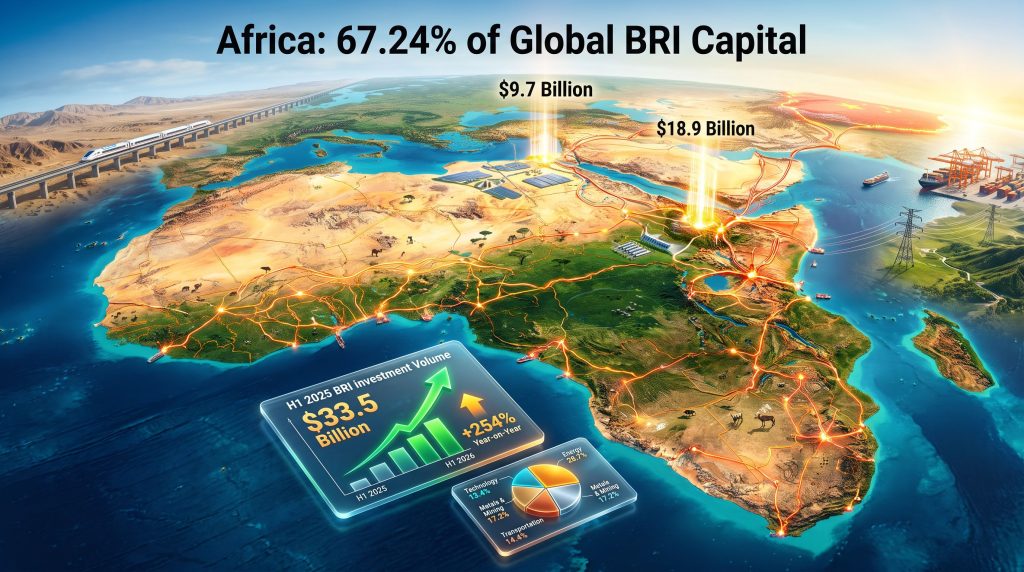
Data published in late July 2026 by a joint research effort from the Asia Pacific Centre for Industry Transitions, affiliated with the University of Queensland, and the Green Finance and Development Center, affiliated with Fudan University in China, revealed that Chinese Belt and Road investment in Africa reached $33.5 billion across the first six months of 2026. That figure represents a 254% increase compared to the equivalent period in 2025, a rate of growth that is extraordinary by any historical benchmark for cross-border infrastructure investment.
To contextualise the magnitude of this shift, consider the global distribution of BRI capital during the same period. Africa captured 67.24% of all Chinese BRI investment worldwide, positioning the continent not merely as an important destination but as the overwhelmingly dominant one. Every other major region, including Central Asia, the Middle East, and Latin America, recorded declining BRI investment flows year on year.
The only other region posting growth was East Asia, where investment surged 437%, yet the absolute figures tell a very different story. East Asian BRI flows rose from $34 million to $182 million, a rounding error by comparison. Africa's position as the primary theatre for Chinese outbound infrastructure capital is not incidental. It reflects a deliberate, multi-layered strategic calculation.
| Region | H1 2026 BRI Investment | Year-on-Year Change |
|---|---|---|
| Africa | $33.5 billion | +254% |
| East Asia | $182 million | +437% |
| All other regions | Declining | Negative |
The Tariff Displacement Thesis: Geopolitical Pressure as an Investment Catalyst
One of the least widely discussed drivers behind this capital surge is what analysts have termed the tariff displacement thesis. The escalating US-China trade war has progressively led the United States and the European Union to raise trade barriers against Chinese-manufactured goods, leaving Chinese industrial enterprises with structurally reduced access to Western consumer markets through direct export channels. This creates a powerful incentive to establish production capacity in third-party jurisdictions that retain preferential market access to those same Western economies.
Many African nations occupy precisely this position. Under frameworks such as the African Growth and Opportunity Act in the United States and various Economic Partnership Agreements with the European Union, numerous African countries can export goods to Western markets at significantly lower tariff rates than Chinese manufacturers face directly. For a Chinese enterprise seeking to maintain access to American or European retail shelves, establishing or financing manufacturing operations in an eligible African country transforms the tariff equation entirely.
Furthermore, the broader tariff impacts on supply chains have reinforced this dynamic, pushing Chinese firms to seek alternative routing strategies through Africa's preferential trade corridors.
Escalating tariff regimes imposed by Western economies on Chinese-manufactured goods appear to be catalysing a strategic reorientation, with Chinese enterprises increasingly establishing African production bases to access preferential trade routes into Western consumer markets that African nations retain.
This logic does not fully explain the entire $33.5 billion figure, but it provides important context for why investment is accelerating rather than retreating in the face of global trade uncertainty. The expansion of bilateral trade agreements between China and individual African nations further amplifies this dynamic, creating additional market routing opportunities for Chinese commercial interests.
Ethiopia and Egypt: Anchoring the Continental BRI Footprint
Within Africa's dominant position, two countries stand apart in scale. Ethiopia attracted $18.9 billion in Chinese BRI engagement during the first half of 2026, placing it among the four largest BRI destinations globally. Egypt received $9.7 billion, also ranking among the top four worldwide.
| Country | H1 2026 Chinese BRI Engagement | Global Ranking |
|---|---|---|
| Ethiopia | $18.9 billion | Top 4 globally |
| Egypt | $9.7 billion | Top 4 globally |
| Africa (Total, investment + construction) | $46.99 billion | Largest regional recipient globally |
Why Ethiopia Has Become a BRI Anchor
Ethiopia's attractiveness stems from several converging factors. The country sits at a strategic intersection of Horn of Africa trade routes, commands a large and young labour force, and has developed an industrial park model specifically designed to attract foreign manufacturing investment. Chinese-financed special economic zones in Ethiopia, most notably the Hawassa Industrial Park and the Eastern Industry Zone near Addis Ababa, have served as templates for replicating export-oriented manufacturing across the continent.
Egypt's Strategic Gateway Role
Egypt's engagement reflects a different but equally compelling strategic logic. The Suez Canal corridor positions Egypt as a critical transit node for global maritime trade. Ongoing investment in the New Administrative Capital project, energy infrastructure including natural gas and renewable capacity, and logistics connectivity underscores Egypt's role as a Mediterranean and Red Sea gateway that Chinese commercial networks are deeply motivated to integrate into BRI supply chains.
Sectoral Allocation: Where the Capital Is Actually Going
The sectoral breakdown of Chinese BRI activity globally in H1 2026 reveals investment priorities that carry direct implications for African development trajectories.
| Sector | Share of Global BRI Activity (H1 2026) |
|---|---|
| Energy | 28.7% |
| Metals and Mining | 17.2% |
| Transportation | 14.4% |
| Technology | 13.4% |
Energy infrastructure commands the largest share, encompassing power generation across hydroelectric, thermal, and increasingly solar and wind assets, as well as transmission networks connecting production centres to population hubs. For much of sub-Saharan Africa, chronic energy deficits remain the single most significant constraint on industrial productivity, and Chinese BRI financing has moved into this gap at a scale that multilateral lenders have not matched. Indeed, the importance of energy security and minerals to long-term economic resilience makes these investments strategically significant beyond their immediate infrastructure value.
Metals and mining at 17.2% reflects a strategic objective that extends well beyond commercial return. China's industrial economy requires reliable, long-term access to lithium, cobalt, copper, manganese, and a range of rare earth elements that African geology provides in exceptional quantities. The surging critical minerals demand for electric vehicles, battery storage, and advanced electronics makes BRI-linked mining investments a structured means of securing these commodity supply chains for Chinese manufacturing.
Transportation infrastructure, accounting for 14.4% of BRI activity, encompasses rail corridors, highway networks, and port development. The cumulative legacy of Chinese BRI construction in Africa now includes more than 12,000 kilometres of roads and railways and over 20 ports, fundamentally altering the continent's internal connectivity and its integration into global shipping routes.
Technology investment at 13.4% reflects the Digital Silk Road dimension of BRI engagement, covering undersea cable infrastructure, terrestrial fibre networks, data centres, and telecommunications equipment. Chinese technology firms have established substantial positions across African digital infrastructure, a factor that carries its own set of geopolitical implications for data sovereignty and network dependency.
The Construction Contract Contraction: A Critical Distinction
While direct BRI investment in Africa surged, a parallel metric told a sharply different story. Chinese construction contracts signed in Africa during H1 2026 totalled $13.49 billion, representing a 60.8% decline year on year. This divergence is not a contradiction. It reflects a fundamental structural transition in how Chinese engagement with Africa is being financed.
For most of BRI's first decade, the dominant financing model involved Chinese state-owned policy banks, principally the Export-Import Bank of China and China Development Bank, extending sovereign loans to African governments to fund Chinese-constructed infrastructure. These loans financed roads, railways, ports, and power plants, with repayment secured against future commodity revenues or government guarantees.
That model has contracted significantly as multiple African economies, including Zambia, Ethiopia, Ghana, and others, have entered debt restructuring processes in which Chinese sovereign lending features prominently. The sharp decline in construction contract values reflects a deliberate pullback in loan-financed project delivery, even as equity-financed direct investment has accelerated.
The shift from debt-financed construction to equity-financed direct investment carries profound implications:
- Equity investments do not create the same sovereign debt obligations as loan-financed contracts
- Equity investors take on commercial risk rather than placing it entirely on host governments
- Ownership structures under equity models create different long-term questions about asset control and profit repatriation
- The transition may indicate Chinese recognition that further sovereign lending in highly indebted African economies carries unacceptable credit risk
The next major ASX story will hit our subscribers first
Competing Frameworks: How BRI Compares to Western and Multilateral Alternatives
The scale of Chinese BRI engagement in Africa has prompted intensified responses from Western governments and multilateral institutions, each operating under distinct financing philosophies and conditionality frameworks.
| Financing Source | Primary Focus in Africa | Conditionality Level | Estimated African Engagement Scale |
|---|---|---|---|
| China BRI | Infrastructure, energy, mining | Low-to-moderate | $46.99 billion (H1 2026 alone) |
| U.S. DFC | Critical minerals, clean energy | High | Expanding significantly in 2025-2026 |
| EU Global Gateway | Transport, digital, green energy | Moderate-to-high | Multi-year pipeline, billions committed |
| Multilateral Banks | Broad development | High | Ongoing, multi-sector |
The U.S. International Development Finance Corporation has expanded its presence in West Africa's mining sector, evaluating critical mineral extraction and processing projects as part of a broader effort to secure non-Chinese supply chains for battery materials and strategic commodities. This represents a direct competitive dynamic in mineral-rich jurisdictions such as the Democratic Republic of Congo, Guinea, and Zimbabwe.
The Belt and Road Initiative has evolved considerably since its 2013 launch, and the European Union's Global Gateway initiative now positions itself as an alternative infrastructure financing vehicle emphasising environmental standards, labour conditions, and governance transparency. However, the aggregate financing volumes committed under Global Gateway have not yet approached the pace of Chinese BRI deployment, and the conditionality requirements associated with European and multilateral financing make approval processes considerably more complex for recipient governments.
For African policymakers, this competitive landscape creates genuine negotiating leverage, a relatively new dynamic compared to earlier BRI years when Chinese capital faced less organised alternatives.
Development Outcomes: The Heterogeneity Problem
Academic and policy analysis consistently highlights that African nations' experiences with BRI engagement are far from uniform. Countries with robust governance frameworks and diversified financing strategies have generally extracted stronger developmental returns, while those with weaker institutional capacity have faced heightened debt vulnerability. Consequently, the geopolitical mining landscape across the continent has become increasingly complex as competing external interests shape how African resources are developed and financed.
Several dimensions of this heterogeneity deserve close attention:
-
Infrastructure access versus ownership: Roads, railways, and power plants built under BRI may be operated by Chinese entities under concession agreements, limiting the degree to which host nations capture ongoing economic value from the assets they nominally own.
-
Employment generation: Chinese construction contractors have historically imported significant portions of their skilled and even semi-skilled workforce, limiting local employment spillovers. Industrial park models have shown more mixed results, with some, like Hawassa in Ethiopia, demonstrating genuine employment creation while others have underperformed expectations.
-
Technology transfer: The extent to which BRI engagement results in genuine capability transfer to local workforces and enterprises varies enormously across project types and contracting structures.
-
Fiscal sovereignty: Commodity-secured loan arrangements, where repayment is structured against future mineral or energy revenues, can constrain host governments' future policy flexibility even when individual project economics appear favourable at signing.
The Cumulative Picture and What Comes Next
China's total cumulative BRI investment and construction activity reached $1.539 trillion by mid-2026, spanning 186 active projects across 67 of the 150 countries that have joined the initiative since its 2013 launch. Africa's share of this cumulative legacy includes over 12,000 kilometres of transport infrastructure, more than 20 major port developments, and an expanding network of power generation and digital connectivity assets.
The 2026 acceleration in Chinese Belt and Road investment in Africa is not a temporary anomaly driven by a single project or bilateral relationship. It represents the convergence of multiple structural forces, as Brookings Institution research on BRI infrastructure in Africa has also documented. Specifically, these forces include:
- Geopolitical fragmentation between China and Western economies intensifying the search for alternative trade architectures
- African geology and demography providing the raw material and labour prerequisites that Chinese industrial strategy requires
- The tariff displacement dynamic creating commercial incentives for Chinese manufacturers to establish African production footholds
- A transition from debt-financed construction toward equity-financed direct investment as sovereign lending risk in Africa has become less manageable for Chinese state banks
For African governments, the central strategic question is neither whether to engage with BRI nor whether to reject it entirely. The more sophisticated question is how to structure that engagement so that the infrastructure dividend translates into durable economic sovereignty, equitable employment, genuine technology transfer, and fiscal resilience rather than long-term dependency on a single external financier. The answer to that question will define the continent's economic trajectory for decades to come.
This article contains forward-looking analysis and macroeconomic interpretation. Readers should be aware that investment flows, geopolitical conditions, and financing frameworks are subject to significant change. Nothing in this article constitutes financial or investment advice.
For ongoing sector-focused reporting across African economic domains including finance, energy, mining, and transport, Ecofin Agency at ecofinagency.com provides detailed coverage of developments across the continent.
Want to Track the Next Major Mineral Discovery Emerging From Africa's Resource Boom?
As Chinese BRI capital pours into African mining and critical minerals infrastructure, the race to identify transformative ASX-listed discoveries is accelerating — Discovery Alert's proprietary Discovery IQ model delivers real-time alerts on significant ASX mineral discoveries, turning complex geological and market data into actionable insights, while its dedicated discoveries page showcases the historic returns that major finds have generated for early-positioned investors. Begin your 14-day free trial today and ensure you are positioned ahead of the market when the next significant discovery is announced.