July 29, 2026
When Chokepoints Become Pressure Points: The Mechanics Behind the Oil Price Surge
Few variables in global energy markets carry the weight of a single waterway. The Strait of Hormuz, a narrow channel separating the Arabian Peninsula from Iran, has long functioned as the circulatory system of international crude oil supply. When military activity, diplomatic breakdowns, or strategic posturing threaten that corridor, the consequences ripple outward within hours, not weeks. Understanding why oil prices rise on US-Iran tension after Iraq strikes requires more than tracking headlines. It demands a structural analysis of how military escalation, physical supply dynamics, and institutional behaviour intersect to move markets with extraordinary speed.
When big ASX news breaks, our subscribers know first
The Escalation Sequence: What Actually Happened
The price surge recorded in late July 2026 was not triggered by a single event but by a rapid compression of compounding military and diplomatic failures within a 24-hour window.
The sequence unfolded as follows:
- US forces intercepted a ballistic missile attack launched by Iran targeting American military personnel in the Middle East region.
- Joint strikes by US and Saudi Arabian forces were conducted against Iran-backed armed groups operating inside Iraq, with both nations attributing responsibility for prior drone attacks on Saudi oil infrastructure.
- Iran rejected a regional waterway management proposal brokered through Oman, eliminating a near-term diplomatic off-ramp.
- Tanker traffic through the Strait of Hormuz fell to critically low levels, with only five commodity vessels transiting the passage on a single day during peak tension.
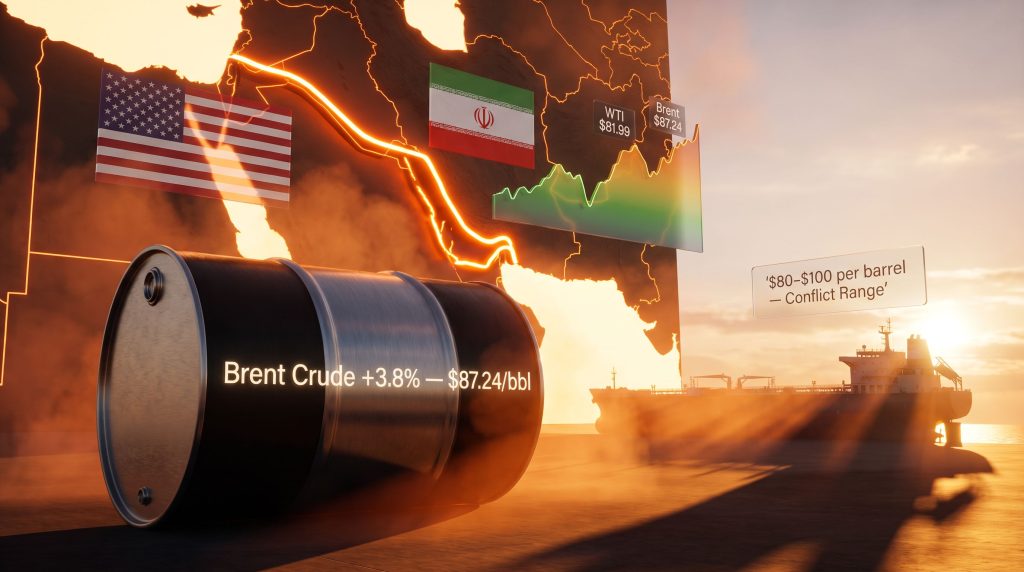
Each of these events independently would have generated a measurable market response. Occurring within hours of each other, they produced a compounding risk premium that pushed Brent crude futures up approximately 3.8% to $87.24 per barrel and WTI crude up roughly 3.4% to $81.99 per barrel by the early hours of July 29, 2026.
Brent and WTI: The Price Movement in Detail
The scale of this single-session move places the event in historically significant territory for geopolitically-driven oil price shocks. Furthermore, the broader context of oil trade and geopolitics helps illustrate why such movements are becoming increasingly common in today's environment.
| Benchmark | Price Level | Single-Session Gain | Percentage Change |
|---|---|---|---|
| Brent Crude Futures | ~$87.24/bbl | +$3.15 | +3.8% |
| WTI Crude Futures | ~$81.99/bbl | +$2.73 | +3.4% |
| Prior US-Iran Escalation Events | Variable | Variable | +3% to +9%+ |
For context, the range of Brent crude responses to prior US-Iran escalation events has historically spanned +3% to more than +9%, depending on the perceived severity of Hormuz disruption risk and whether diplomatic channels remained open. The current episode sits toward the moderate-to-severe end of that range, with the added complication that the diplomatic channel through Oman has now formally closed.
What distinguishes this event from earlier flashpoints is the simultaneity of military action and diplomatic failure. In past escalation cycles, markets could lean on the possibility of back-channel negotiations containing the situation. Iran's public rejection of the Omani framework removes that buffer entirely.
The Strait of Hormuz: A Geography Lesson That Moves Markets
To appreciate why energy markets respond so violently to Hormuz-related developments, it helps to understand what the waterway actually represents in volumetric terms.
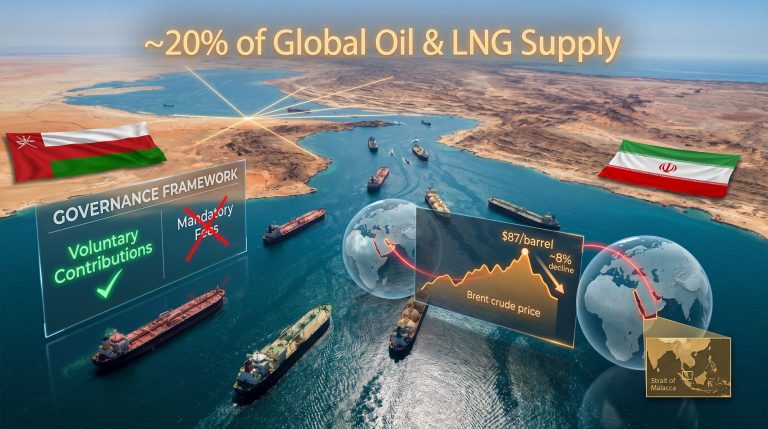
Before the current conflict intensified, the Strait of Hormuz served as the transit corridor for approximately one-fifth of all global crude oil and natural gas shipments. This includes not only Persian Gulf crude heading to Asia-Pacific refineries but also significant liquefied natural gas volumes destined for European and East Asian markets. In addition, the broader LNG supply implications of sustained Hormuz disruption represent a separate but equally serious dimension of this crisis.
The Strait of Hormuz is approximately 21 nautical miles wide at its narrowest point. Within that passage, two-lane shipping channels, each only two miles wide, carry the majority of the world's seaborne crude oil. Any physical or psychological disruption to traffic through those lanes has an immediate, measurable impact on global energy pricing.
The practical implication of only five commodity vessels transiting the Strait in a single day is stark when measured against normal operating volumes. Under standard conditions, dozens of laden tankers pass through daily. A collapse in transit volumes of this magnitude signals that shipping operators are already making real-time risk assessments that have shifted from insurance cost considerations to questions of physical vessel safety.
The Oman Proposal and Its Failure
A critical but underappreciated element of the current escalation is the collapse of the Omani mediation framework. Gulf states, working through Oman as an intermediary, presented Iran with a plan to formalise joint management of the Strait of Hormuz, which included a voluntary fee collection mechanism for commercial vessel transit.
Iran formally rejected this proposal. A senior Iranian official publicly ruled out the arrangement, characterising any attribution of regional instability to Tehran as a strategic error on the part of the United States and its partners. From a market-mechanics perspective, this rejection matters enormously because it eliminates the most credible near-term pathway to restoring normalised tanker traffic, which in turn prevents any meaningful removal of the risk premium currently embedded in crude prices. As The Guardian reports, tanker attacks in the Strait have further compounded these concerns.
What Analysts Are Pricing In: The $80 to $100 Per Barrel Framework
Suvro Sarkar, Head of Energy Research at DBS Bank, outlined a near-term Brent trading range of $80 to $100 per barrel, arguing that even partial de-escalation would leave a structural price floor near $80/bbl intact. The reasoning centres on the concept of incomplete conflict resolution.
Stop-start negotiations, where diplomatic engagement occurs without achieving a binding or operationally meaningful agreement on Hormuz access, maintain the optionality of disruption in Iran's strategic toolkit. Markets cannot price out a risk that has not been formally resolved. Consequently, the geopolitical risk premium persists even when active fighting temporarily subsides.
Scenario Comparison: Oil Price Outcomes Under Different Geopolitical Paths
| Scenario | Estimated Brent Range | Key Driver | Timeline |
|---|---|---|---|
| Full de-escalation, Hormuz reopened | $70 to $80/bbl | Binding diplomatic resolution | 3 to 6 months |
| Partial de-escalation, shipping restricted | $80 to $90/bbl | Incomplete negotiations | Near-term |
| Active escalation, blockade risk elevated | $90 to $100+/bbl | Supply disruption fears | Immediate |
| Prolonged conflict, OPEC+ supply response | $85 to $95/bbl | Output management plus risk premium | Medium-term |
The range of outcomes here is not merely academic. Each scenario carries materially different implications for refinery margins, airline fuel hedging programmes, and sovereign energy budgets across Asia-Pacific importing economies. Understanding crude oil volatility trends is therefore increasingly important for both investors and policymakers navigating this environment.
Three Supply-Side Forces Compounding the Geopolitical Premium
The oil price rise on US-Iran tension after Iraq strikes cannot be explained by geopolitics alone. Three independent supply-side variables have converged at the same moment to amplify the price movement significantly.
US Crude Inventory Drawdown
Data sourced from the American Petroleum Institute indicated that US crude stockpiles declined by approximately 3.3 million barrels in the week ending July 24, 2026. This drawdown matters in a conflict-period context for a specific reason: tighter physical inventories reduce the buffer capacity of markets to absorb any near-term supply shock. When geopolitical risk is elevated and storage cushions are simultaneously thinning, the price response to new threat signals becomes disproportionately large.
The Energy Information Administration's official confirmation of this figure was scheduled for release later that same day, meaning markets were acting on preliminary API data, which occasionally diverges from EIA measurements. This adds a speculative element to the intraday price move that could either be confirmed or partially reversed upon official publication. Investing.com notes that tightening US crude supplies have been a consistent driver of recent price rebounds.
OPEC+ Production Strategy
Separate from the immediate conflict dynamics, OPEC+ was reported to be considering a pause in planned output increases for approximately three months beginning in October 2026. This follows the scheduled reinstatement of barrels previously withheld under voluntary cut agreements among the producer group's member nations. The OPEC production impact of such decisions continues to be a defining feature of global energy markets.
The timing of this potential pause is strategically significant. By halting the return of additional supply precisely when geopolitical risk premiums are elevated, the producer group effectively prevents any price-moderating effect that increased output would normally provide. Whether this represents deliberate coordination with market conditions or a pre-scheduled programme review is a matter of interpretation, but the price-supportive impact is identical under either scenario.
The Three Converging Pressures
- Geopolitical risk premium arising from US-Iran military escalation and the credible threat of Hormuz disruption
- Physical inventory tightening reflected in a 3.3 million barrel weekly drawdown in US crude stockpiles
- OPEC+ output discipline through a prospective pause in production increases from the fourth quarter of 2026
The next major ASX story will hit our subscribers first
Downstream Exposure: Who Bears the Cost?
Asia-Pacific Import Dependency
The economies most structurally exposed to a prolonged Hormuz disruption are concentrated in Asia. India, China, Japan, and South Korea collectively account for a substantial share of Persian Gulf crude imports routed through the Strait. For these nations, a sustained reduction in tanker throughput is not merely a pricing issue. It creates genuine questions about refinery feedstock availability and short-term energy security planning.
India in particular sources a significant proportion of its crude from Middle Eastern producers, and any sustained Hormuz restriction would force a combination of emergency reserve drawdowns, alternative routing through longer and more expensive Cape of Good Hope passages, and spot market premiums for Atlantic Basin crude.
Inflation and Consumer Fuel Pricing
Sustained Brent crude pricing in the $85 to $100 per barrel range creates measurable inflationary pressure across fuel-dependent economies. The transmission mechanism operates through several channels:
- Retail fuel price increases typically lag crude price movements by two to four weeks depending on national pricing mechanisms
- Shipping insurance premiums in conflict-adjacent maritime zones have risen materially, adding a cost layer to freight rates independent of crude prices
- Industrial consumers with limited hedging capacity face immediate margin compression under elevated energy cost environments
Investment Positioning During Sustained Geopolitical Escalation
From an investment perspective, the futures curve behaviour during this kind of escalation cycle is instructive. Near-term contracts absorb the majority of the conflict premium while longer-dated contracts reflect more subdued expectations of eventual resolution. This backwardation-steepening pattern is a reliable marker of genuine physical supply anxiety rather than purely speculative positioning. However, oil price volatility driven by broader trade tensions adds an additional layer of complexity to any directional assessment.
Airlines, shipping operators, and large industrial consumers with active hedging programmes face difficult decisions during these windows. Locking in protection at current elevated levels reduces upside exposure if prices spike further but crystallises costs that may look excessive if diplomacy unexpectedly delivers a rapid resolution.
Commodity fund managers typically increase long exposure to crude during the initial phase of a geopolitical escalation cycle, then shift toward options strategies as volatility rises and directional conviction becomes harder to maintain. The current environment, where the diplomatic pathway has narrowed significantly, argues for the continuation of elevated long positioning in crude futures.
Frequently Asked Questions
Why did oil prices rise after the US-Iran escalation and Iraq strikes?
Oil prices rise on US-Iran tension after Iraq strikes because joint US-Saudi military operations in Iraq, combined with Iran's ballistic missile attack on US forces and the subsequent collapse of Oman-mediated diplomacy, dramatically increased the probability of Hormuz disruption. The Strait handles approximately one-fifth of global crude oil and gas shipments, making any credible threat to its operation an immediate market event.
What is the current Brent crude price following the escalation?
Brent crude futures rose approximately 3.8% to around $87.24 per barrel, while WTI advanced roughly 3.4% to approximately $81.99 per barrel as of late July 2026.
What is the analyst forecast for Brent crude under the current conflict scenario?
Energy research at DBS Bank projects Brent trading in a $80 to $100 per barrel range in the near term. Even under partial de-escalation, the structural floor is estimated near $80/bbl given the persistence of unresolved Hormuz access disputes.
How is OPEC+ responding to the current geopolitical situation?
OPEC+ is widely expected to pause planned output increases for approximately three months beginning in October 2026, a move that compounds the geopolitical risk premium by preventing any supply-side offset during a period of elevated market tension.
What would cause oil prices to fall back meaningfully from current levels?
A credible, binding diplomatic resolution that restores full and normalised Strait of Hormuz access, combined with a sustained ceasefire and verifiable de-escalation on all fronts, could push Brent back toward the $70 to $80 per barrel range. However, with Iran having formally rejected the Omani framework and diplomatic signalling remaining confrontational, this outcome is assessed as unlikely in the near term.
Disclaimer: This article contains forward-looking analysis, price forecasts, and scenario projections based on publicly available market data and analyst commentary as of late July 2026. These represent informed perspectives and not investment advice. Commodity markets are inherently volatile and outcomes may differ materially from any scenarios described. Readers should conduct independent research before making financial decisions.
Want to Stay Ahead of the Next Major Commodity Market Move?
Discovery Alert's proprietary Discovery IQ model scans ASX announcements in real time, delivering instant alerts on significant mineral discoveries across more than 30 commodities — turning complex market data into clear, actionable investment insights for both short-term traders and long-term investors. Explore how historic mineral discoveries have generated substantial returns on Discovery Alert's discoveries page, and begin your 14-day free trial today to position yourself ahead of the broader market.