July 9, 2026
The Global Power Shift Quietly Reshaping Base Metals Markets
For decades, the architecture of global metals pricing has been a Western construct. The London Metal Exchange, founded in 1877, remains the definitive benchmark venue for copper, aluminium, zinc, and nickel. Yet the institutions that dominate its trading floor, clearing infrastructure, and membership rolls have historically been European and American financial firms. That equilibrium is now being tested by a cohort of Chinese futures brokerages whose global expansion ambitions are accelerating at a pace that few in the market anticipated just two years ago.
Understanding why this shift is happening requires looking beyond the headlines of individual deals. The underlying logic is structural: China produces, consumes, and finances more metals than any other nation, yet its financial institutions remain underrepresented in the international derivatives infrastructure that sets the prices its companies pay and receive every day. Closing that gap is no longer a commercial afterthought. For Chinese futures brokerages, global expansion in metals markets has become a strategic priority embedded within a much larger industrial and financial transformation.
When big ASX news breaks, our subscribers know first
Why Chinese Capital Is Moving Into Global Metals at Unprecedented Speed
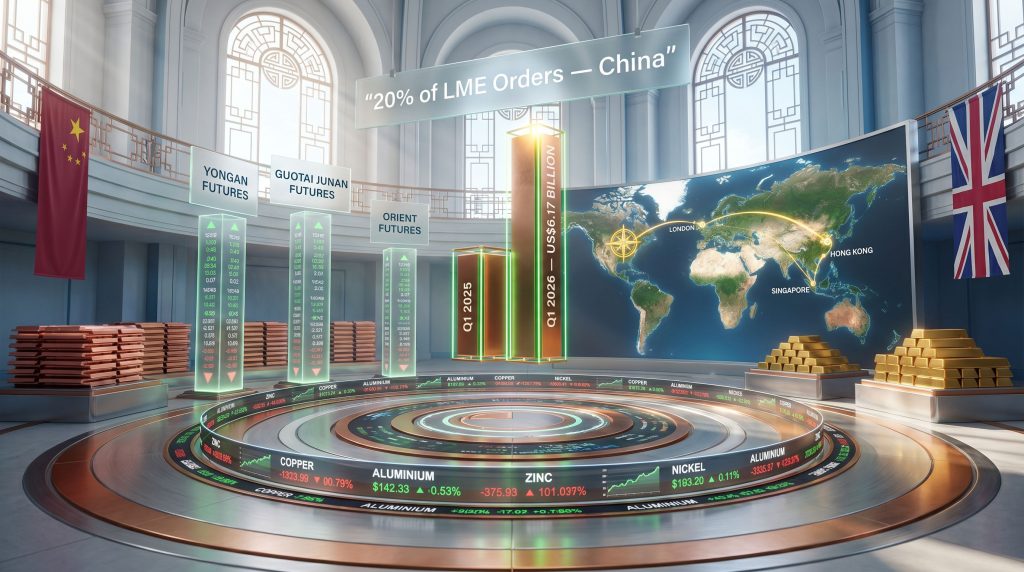
The numbers from the first quarter of 2026 are striking by any measure. Chinese mining and metals companies completed cross-border mergers and acquisitions totalling US$6.17 billion during that period, representing a more than tenfold increase compared to the equivalent quarter in 2025, according to data published by international consultancy EY. Perhaps more revealing is the composition of that figure: overseas resource acquisitions accounted for nearly half of China's total M&A activity by value during the same window.
This is not a cyclical reaction to short-term commodity price movements. The scale and concentration of capital deployment points to a deliberate, coordinated effort to secure physical resource access while simultaneously building the financial infrastructure needed to manage risk at a global level. Furthermore, evolving copper market trends are adding urgency to the pace at which Chinese institutions are moving.
The Zijin Mining Acquisition: A Blueprint for Resource Security
The quarter's defining transaction was executed by Zijin Mining, China's largest mining company by market capitalisation. Its acquisition of Canada's Allied Gold was structured at 28 billion yuan, equivalent to approximately US$4.12 billion, making it one of the most significant outbound mining deals in recent Chinese corporate history. The Zijin Mining expansion strategy reflects a broader institutional shift in how Chinese resource companies approach international asset acquisition.
The strategic rationale is instructive. Allied Gold holds 533 tonnes of verified gold reserves distributed across multiple international jurisdictions, with meaningful exposure to North American assets. For Zijin, the transaction is not primarily a financial investment. It is a supply chain anchor point designed to secure access to gold production ahead of what Chinese resource planners increasingly view as a period of intensifying competition for critical mineral access.
Gold and copper have emerged as the twin pillars of strategic resource planning among major global powers, functioning simultaneously as monetary reserves and critical industrial inputs for electrification and defence manufacturing. Writing in the April 2026 edition of Trade Finance magazine, Huang Zhuoran of Hong Kong-based China Construction Bank (Asia) described gold and copper as the most vital reserve asset and industrial metal from a national security perspective, noting that major powers have placed growing emphasis on strategic resource security and resilient supply chains.
This dual characterisation of gold and copper as both financial and industrial assets is reshaping how Chinese institutions approach global market participation. Access to physical supply and access to derivatives pricing mechanisms are now treated as two sides of the same strategic equation.
The London Metal Exchange: Why LME Membership Is the Tier-One Target
For Chinese futures brokerages pursuing global expansion in metals markets, the London Metal Exchange represents the most consequential single objective. Its position within the global metals derivatives architecture is without parallel. The LME sets benchmark prices that ripple through procurement contracts, mining project financing, and manufacturing cost structures on every continent.
Current data indicates that approximately 20% of LME order flow already originates from Chinese market participants, a figure that underscores how significant Chinese capital has become to the exchange's liquidity even before any major Chinese brokerage holds direct membership. According to recent Reuters reporting, that proportion is widely expected to grow as domestic capital flow liberalisation in China continues to progress and as Chinese industrial companies expand their international hedging requirements.
The pricing relationship between the LME and the Shanghai Futures Exchange creates a persistent arbitrage corridor that is actively traded by both Chinese and international participants. Copper, aluminium, zinc, and nickel all trade on both venues, with price differentials between London and Shanghai generating hedging and positioning opportunities that require efficient access to both markets simultaneously. For Chinese brokerages relying on intermediaries for LME execution, those intermediary costs represent a structural competitive disadvantage that direct membership would eliminate.
The Three Brokerages Reshaping the LME Membership Landscape
Three Chinese futures brokerages have emerged as the primary candidates for LME membership, each at a different stage of the regulatory and application process.
| Brokerage | UK Entity Established | FCA Licence Status | LME Application Status | Primary Domestic Exchange |
|---|---|---|---|---|
| Yongan Futures | Yes (2025) | Secured | Submitted | SHFE |
| Guotai Junan Futures | In progress | In process | Active application | SHFE |
| Orient Futures | Planned | Pending | Confirmed intent | SHFE |
Yongan Futures: The Most Advanced Candidate
Headquartered in Hangzhou, Yongan Futures has moved furthest through the regulatory pipeline. The firm established a UK legal entity in 2025 and subsequently secured a licence from the UK's Financial Conduct Authority, the mandatory regulatory prerequisite for LME membership. With FCA approval in hand, Yongan has formally submitted its LME membership application. Its existing operational presence across Hong Kong and Singapore positions the firm as an integrated cross-border platform rather than a simple London outpost.
Guotai Junan Futures: Strong Institutional Backing
Guotai Junan Futures is among the most commercially significant applicants given the institutional weight of its parent group. The firm is currently in an active LME application process and is working through the FCA licensing pathway in parallel. Its established position on the Shanghai Futures Exchange gives it deep expertise in metals derivatives that translates directly to the LME product suite.
Orient Futures: Strategic Commitment Without a Fixed Timeline
Orient Futures has publicly confirmed its intention to pursue LME membership, though the specific timeline for its application remains contingent on regulatory and operational readiness milestones. The firm's existing international footprint, built primarily through Singapore-based operations, provides a foundation for the more complex UK regulatory engagement required.
The Precedent Already Set: Nanhua Futures and Western Regulatory Navigation
The current LME expansion push does not emerge from a vacuum. Chinese brokerages have already demonstrated the ability to navigate complex Western regulatory frameworks at the highest level. Nanhua Futures became the first Chinese broker to register as a futures commission merchant with the US Commodity Futures Trading Commission, and subsequently established clearing membership across CME Group exchanges. That achievement created both a regulatory template and a proof of concept for the current generation of LME applicants.
At least five mainland Chinese firms have leveraged Hong Kong subsidiaries to secure trading memberships at CME Group, Eurex, and the Singapore Exchange. The progression from Singapore-first expansion strategies toward London and US clearing access reflects a deliberate, multi-stage internationalisation roadmap. This pattern is explored in detail within early research on Chinese broker internationalisation, confirming that the current wave builds on established institutional behaviour rather than opportunistic market entry responses.
The Metals at the Centre of the Expansion
The commercial logic of LME membership for Chinese brokerages centres on four metals where the SHFE-LME overlap is most commercially significant:
- Copper: The highest-priority overlap between the two exchanges. Copper's role in electrification infrastructure, EV manufacturing, and grid investment makes it the single most strategically significant metal in the Chinese industrial policy context. Price risk management across both venues is a pressing need for Chinese copper producers and consumers.
- Aluminium: A high-volume contract on both exchanges with deep Chinese production exposure. Critical for aerospace, packaging, and battery enclosure manufacturing, aluminium hedging requirements continue to grow alongside EV sector expansion.
- Zinc: Significant Chinese domestic production creates natural hedging demand. Galvanisation requirements in construction and infrastructure maintain consistent industrial consumption.
- Nickel: Elevated strategic importance driven by battery technology demand. Nickel's price volatility since 2022, which included one of the most dramatic short squeezes in commodity market history, has materially increased the urgency of sophisticated cross-border hedging access for Chinese manufacturers exposed to this metal.
The volatility environment across global metal prices since 2022 has been a key commercial accelerant. Chinese mining and manufacturing companies face compounding price risk from simultaneous exposure to domestic SHFE benchmarks and international LME valuations. Direct brokerage membership at the LME would reduce hedging costs, eliminate intermediary execution fees, and improve trade execution speed at precisely the moment when price risk management has become most operationally critical.
The next major ASX story will hit our subscribers first
Regulatory Complexity as Both Barrier and Differentiator
Pursuing LME membership requires Chinese brokerages to build compliance architectures capable of operating across Chinese, UK, and potentially US regulatory jurisdictions simultaneously. The requirements are substantive:
- FCA licensing is a non-negotiable gateway requirement for UK-based exchange participation.
- Capital adequacy standards under LME membership rules are materially higher than those applicable to domestic SHFE operations.
- Client asset segregation, reporting obligations, and conduct requirements under UK financial services regulation require dedicated compliance infrastructure.
- Geopolitical scrutiny adds a layer of complexity that purely commercial applicants have historically not faced, as Western regulators apply increasing attention to Chinese institutional expansion into systemically important financial infrastructure.
The tension between commercial opportunity and host jurisdiction national security considerations is a real constraint on the pace of expansion. However, Chinese brokerages are structuring their international entities carefully, building regulatory credibility through existing Western licences before advancing to the most sensitive exchange membership applications. US-China trade tensions add a further layer of complexity to this already intricate regulatory environment.
What This Structural Shift Means for Global Metals Markets
The long-term implications of successful Chinese brokerage entry into LME membership extend well beyond the commercial interests of the individual firms involved. Greater direct Chinese participation in LME order flow has the potential to deepen liquidity across base metals contracts, particularly in the copper and aluminium markets where China metals demand already drives global price formation.
More significantly, increased integration between SHFE and LME pricing mechanisms could gradually erode the persistent arbitrage gaps between the two venues. For industrial users on both sides of that trade, tighter price convergence would reduce hedging costs and improve market efficiency. For existing LME members, it would introduce well-capitalised new competitors into a market that has historically been dominated by a relatively concentrated group of Western financial institutions.
Notably, the LME nickel crisis of 2022 demonstrated just how consequential gaps in exchange governance and participant diversity can become under stress conditions. Consequently, the entry of Chinese futures brokerages into the LME membership structure represents more than commercial expansion. It signals a fundamental rebalancing of influence within the global metals derivatives ecosystem, with Chinese financial institutions transitioning from price-takers in Western markets to active participants in the price formation process itself.
The pace of that transition will depend on regulatory outcomes, geopolitical conditions, and the continued liberalisation of Chinese capital flows. But the direction of travel is now clearly established. Chinese futures brokerages pursuing global expansion in metals markets are not testing the boundaries of Western financial infrastructure. They are systematically building the access, licences, and relationships needed to become permanent fixtures within it.
Key Facts at a Glance
- Chinese cross-border M&A in mining and metals reached US$6.17 billion in Q1 2026, more than ten times the equivalent period in 2025, per EY data.
- Overseas resource deals represented nearly half of China's total M&A value during the same period.
- Zijin Mining's Allied Gold acquisition was valued at US$4.12 billion, securing 533 tonnes of global gold reserves.
- Approximately 20% of LME order flow currently originates from Chinese market participants.
- Yongan Futures has secured FCA regulatory approval and formally submitted its LME membership application.
- Nanhua Futures holds the distinction of being the first Chinese broker registered as a CFTC futures commission merchant with CME Group clearing access.
- Copper, aluminium, zinc, and nickel are the four metals at the commercial centre of the LME expansion strategy.
Disclaimer: This article is intended for informational purposes only and does not constitute financial or investment advice. Forward-looking statements and projections regarding deal activity, regulatory outcomes, and market share are inherently uncertain and subject to change. Readers should conduct independent research before making any investment decisions.
Want to Capitalise on the Next Major ASX Mineral Discovery Before the Market Moves?
Discovery Alert's proprietary Discovery IQ model delivers real-time alerts on significant ASX mineral discoveries across copper, gold, and beyond — cutting through complex data to surface actionable investment opportunities the moment they hit the exchange. Start your 14-day free trial today, or explore historic discoveries and their returns to understand just how transformative early positioning in major mineral finds can be.