June 17, 2026
Europe's Energy Storage Market Is Entering a New Era of Cost Complexity
For most of the past decade, the dominant narrative in European battery energy storage procurement has been one of falling prices. Chinese manufacturing scale, subsidised inputs, and aggressive export pricing created conditions where developers could reliably forecast lower costs year after year. That structural tailwind is now reversing. Chinese export tax rebate cuts to raise European BESS costs is not a future concern — it is an unfolding procurement reality. A convergence of upstream lithium price pressure, phased policy withdrawal of export incentives, and expanding EU regulatory compliance requirements is reshaping the cost architecture in ways that are not yet fully priced into project models.
Understanding why this shift is happening, and what it means for procurement decisions over the next two years, requires looking beyond today's FOB quotes and into the layered policy mechanics driving the change.
When big ASX news breaks, our subscribers know first
What China's VAT Export Rebate System Actually Did for Battery Pricing
The Hidden Subsidy Inside Every Battery Shipment
China's value-added tax system applies a standard rate of 13% to manufactured goods, including lithium-ion batteries and energy storage systems. For decades, Beijing maintained a parallel mechanism that allowed exporters to reclaim a portion of this VAT upon export, effectively reducing the tax cost embedded in the final product price. For battery and energy storage system manufacturers, this rebate historically stood at the full 13% rate, functioning as a structural cost advantage that allowed Chinese suppliers to price aggressively in overseas markets without sacrificing margin.
The practical effect was significant. FOB prices for Chinese BESS exports reflected a cost base that had been partially relieved of its domestic tax burden. European developers and investors buying on price were, in many cases, benefiting from a policy instrument they had no visibility over. Now that instrument is being withdrawn. Furthermore, understanding the broader battery raw materials context helps clarify just how layered this cost restructuring has become.
The Three-Stage Rebate Phase-Down Timeline
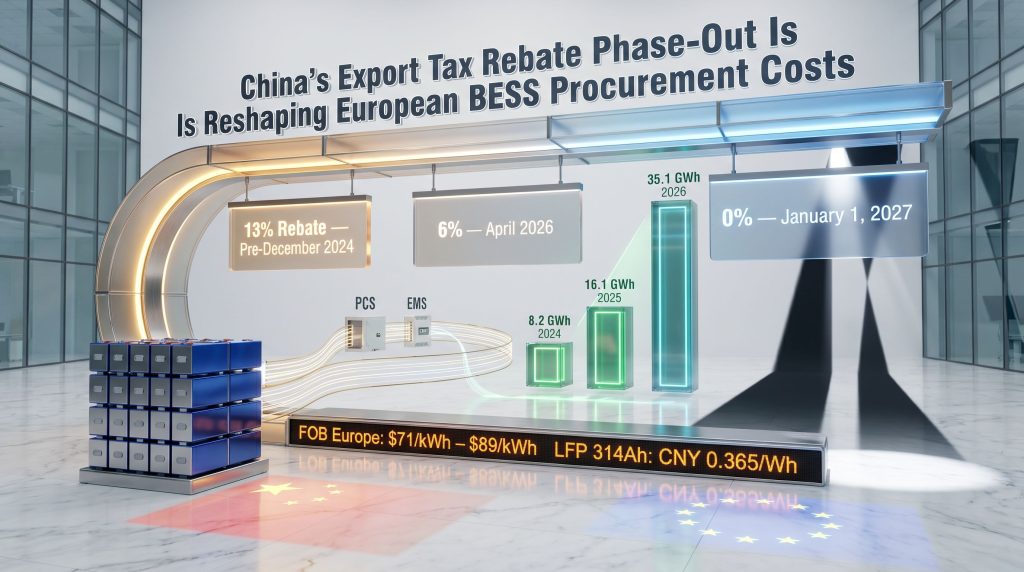
| Phase | Rebate Rate | Effective Date | Estimated Cost Impact |
|---|---|---|---|
| Pre-reform baseline | 13% | Pre-December 2024 | Lowest structural export cost floor |
| Partial reduction | 6% | April 2026 | Moderate upward cost pressure emerging |
| Full elimination | 0% | January 1, 2027 | Maximum cost exposure for overseas buyers |
"The phased withdrawal of China's export VAT rebate is not a sudden regulatory shock. It is a deliberate, sequenced policy signal that fundamentally changes the long-term cost baseline for Chinese battery exports into Europe. Developers who treat this as a short-term pricing event are likely underestimating the structural implications."
Critically, the rebate reduction does not automatically translate into a proportional price increase for European buyers. In the near term, Chinese suppliers facing overcapacity conditions and weak domestic demand have strong incentives to absorb the cost reduction rather than pass it through and risk losing market share. However, as the rebate is fully eliminated in January 2027, the structural pressure on export cost floors becomes harder to absorb without margin erosion. For additional context on how these VAT rebate changes are reshaping export economics more broadly, the implications extend well beyond batteries alone.
Europe's BESS Market Scale: What Is Actually at Stake
Deployment Figures That Define the Exposure
The scale of the European market determines how much procurement volume is directly exposed to Chinese export cost restructuring. The numbers are substantial:
- Europe installed 25.3 GWh of total energy storage capacity in 2025
- Annual additions are forecast to reach 35.1 GWh in 2026
- Utility-scale storage capacity additions nearly doubled from 8.2 GWh in 2024 to 16.1 GWh in 2025
- Residential storage saw a modest contraction from 10 GWh to 9.2 GWh in 2025, though recovery is anticipated in 2026 as national support measures roll out across multiple countries
The near-doubling of utility-scale additions in a single year is particularly important context. Large-format projects require the highest volume of BESS hardware and are most sensitive to equipment cost movements. A cost shift of even a few dollars per kilowatt-hour across tens of gigawatt-hours of procurement has material implications for project economics.
Geographic Expansion Broadens the Risk Surface
Historically, the UK, Germany, and Italy have accounted for the majority of European storage deployment. That concentration is shifting. Bulgaria is advancing large-scale storage deployment under domestic policy incentive frameworks, while Spain has formally incorporated energy storage into its national energy transition strategy as a designated asset class.
This geographic broadening means more procurement pipelines across more markets are exposed to Chinese supply chain cost dynamics simultaneously. In addition, Europe's critical minerals supply chain is also undergoing its own restructuring, adding another dimension of complexity for developers sourcing equipment across the continent.
"As European BESS deployment scales and diversifies geographically, the volume of procurement directly affected by Chinese export cost restructuring is growing, not shrinking."
The Current Cost Landscape: Lithium, Cells, and FOB Pricing
Upstream Lithium: The First Layer of Cost Pressure
Before factoring in the rebate phase-out, European BESS procurement is already absorbing upstream cost pressure from China's lithium market. Battery-grade lithium carbonate equivalent (LCE) spot prices surpassed CNY 190,000 (~$28,000) per metric tonne in early May 2026, a 20% increase month-on-month. This represents a meaningful firming of the lithium market after an extended period of price weakness.
The relationship between lithium spot prices and cell-level pricing is not linear. Cost pass-through from lithium into LFP cell prices was relatively effective in the first quarter of 2026, but began to weaken once prices moved above CNY 150,000/MT. This suggests that downstream integrators have a practical ceiling for price acceptance. Isolated cases of project deferrals and contract defaults in China's domestic utility-scale market have already been reported as a result of this latest pricing cycle. Consequently, lithium supply dynamics are becoming an increasingly critical variable in European procurement modelling.
LFP Cell and System Pricing: The Middle of the Supply Chain
| Product | Current Price Level |
|---|---|
| 314 Ah LFP cells | ~CNY 0.365/Wh (most new orders above CNY 0.36/Wh) |
| Two-hour BESS (China, system level) | ~CNY 0.58/Wh |
| Four-hour BESS (China, system level) | ~CNY 0.51/Wh |
The pricing stalemate at the cell level reflects a market caught between rising input costs and weakening downstream demand. System-level margins remain compressed despite the recovery in nominal prices from earlier lows, and downstream integrators are increasingly resistant to further price escalation.
European FOB Pricing: Where Buyers Are Transacting Today
For European procurement desks, current market conditions translate to FOB prices for two-hour DC-side BESS ranging from $71/kWh to $89/kWh. European prices sit modestly below equivalent US market levels, partly reflecting the comparatively lower tariff environment that currently applies to Chinese battery imports into Europe.
The FOB cost of core Chinese energy storage equipment delivered to the European market — encompassing DC-side battery containers, power conversion systems (PCS), and energy management systems (EMS) — is estimated at approximately $75/kWh under current conditions. This figure represents the baseline against which both the rebate phase-out and EU compliance costs will operate. For a detailed breakdown of how battery export costs are being restructured under China's VAT policy changes, the trajectory is clearly upward.
How the Rebate Phase-Out Translates Into Procurement Risk
Why Cost Pass-Through Is Never Automatic
The mechanics of cost pass-through are frequently misunderstood in procurement discussions. The rebate reduction narrows the margin buffer available to Chinese exporters, but whether that cost reaches the European buyer depends on a set of intervening variables:
- Manufacturing overcapacity in China: excess production capacity suppresses supplier pricing power and incentivises absorption over pass-through
- Contract timing and structure: projects with signed supply agreements have limited repricing flexibility regardless of upstream cost shifts
- Tier-1 versus tier-2 supplier dynamics: larger manufacturers with stronger balance sheets can absorb cost compression for longer; smaller suppliers cannot
- Competition intensity in European tenders: more bidders per procurement process reduces any individual supplier's ability to raise prices unilaterally
- Inventory positioning: suppliers with pre-built stock at lower cost can buffer near-term price pressure while maintaining competitive quotes
A Two-Horizon Scenario Framework
Near-Term (2026, Partial Rebate Reduction from 13% to 6%):
Current procurement activity in Europe since April 2026 indicates that the rebate reduction is not yet the dominant price driver. Rising upstream lithium costs are having a more immediate and visible effect on European BESS pricing. Supplier competition remains intense, and European buyers retain limited capacity for price increases. Near-term absorption by Chinese exporters remains the most likely outcome.
Medium-Term (Post-January 2027, Full Rebate Elimination):
Complete removal of the rebate raises the structural export cost floor for every Chinese battery manufacturer simultaneously. Suppliers with weaker operational efficiency face the greatest margin compression. European procurement quotes are expected to reflect higher baseline costs, though the degree will continue to be moderated by competition dynamics and demand conditions. The cost increase will not be uniform across all suppliers or all product categories.
"Ongoing Chinese manufacturing overcapacity and subdued domestic demand could partially counteract the upward cost pressure created by rebate elimination. The phase-out is a clear and measurable upward cost force, but it does not guarantee a proportional one-for-one increase in European BESS procurement prices."
EU Regulatory Complexity: A Compounding Cost Layer
The EU Battery Regulation (2023/1542): Raising Compliance Entry Barriers
Beyond China's domestic policy changes, European developers must contend with a progressively more demanding domestic regulatory environment. The EU Battery Regulation, which entered into force in 2023 and is being implemented in phased stages, introduces mandatory compliance requirements that affect every battery product entering the European market regardless of origin:
- Battery passports documenting product composition, carbon footprint, and end-of-life management pathways
- Carbon footprint declarations across the full manufacturing lifecycle
- Supply chain due diligence obligations covering critical raw material sourcing
- Recycled content thresholds that will apply from defined dates as the regulation phases in
These requirements add administrative and operational cost layers to all market participants, but they fall disproportionately on suppliers without established European compliance infrastructure. For Chinese manufacturers serving Europe, building battery passport readiness and governance structures aligned with EU expectations represents a meaningful incremental investment. The broader European raw materials strategy is accelerating these compliance demands further.
The May 2026 EU Funding Restriction: A Material Financing Barrier
The European Commission's policy update in May 2026 extended an existing funding restriction that had previously applied to inverters from designated high-risk countries in solar and wind applications. That restriction now formally covers energy storage power conversion systems (PCS) as well.
The practical consequences are direct: BESS projects that incorporate Chinese-sourced PCS equipment face obstacles when applying for EU public financing, including support from the European Investment Bank (EIB). This applies to both standalone storage projects and co-located storage assets, affecting a substantial portion of the European renewable energy development pipeline.
| Equipment Type | EU Funding Restriction Status |
|---|---|
| Solar inverters (high-risk countries) | Restricted (pre-existing) |
| Wind inverters (high-risk countries) | Restricted (pre-existing) |
| BESS power conversion systems (high-risk countries) | Restricted (from May 2026) |
"For European developers evaluating BESS investments, the financing eligibility of their chosen supply chain configuration is now as strategically important as the unit procurement price itself."
Europe's domestic inverter and PCS manufacturing capacity is assessed as adequate to meet current demand volumes, but transitioning utility-scale projects from Chinese to European suppliers introduces measurable additional system costs. Developers must now model a genuine trade-off between lower-priced Chinese equipment and access to EU financing mechanisms worth potentially hundreds of millions of euros per project.
The next major ASX story will hit our subscribers first
How European Developers Should Respond
Reframing Procurement Strategy for a Two-Year Cost Horizon
The instinct to optimise procurement around today's lowest available quote is increasingly a liability rather than an advantage. A more robust procurement framework weights the following factors in parallel:
- Two-year cost trajectory: incorporating rebate phase-out milestones, lithium market dynamics, and EU compliance cost escalation
- Financing eligibility: mapping supply chain configuration against EIB and EU funding criteria before finalising specifications
- Delivery certainty: assessing supplier capacity to meet contracted timelines as cost pressures intensify
- Compliance readiness: evaluating battery passport readiness, carbon footprint declaration capability, and supply chain due diligence records as part of standard due diligence
Supply Chain and Contract Structuring Considerations
For developers currently in active procurement, several practical steps can reduce exposure to the cost restructuring underway:
- Evaluate blended supply chain configurations that incorporate both Chinese and Western-manufactured components to preserve EU financing eligibility while managing system cost
- Build price adjustment mechanisms into long-term supply agreements, specifically referencing the January 2027 rebate elimination as a contract milestone
- Negotiate delivery schedule flexibility to allow inventory positioning ahead of the full rebate phase-out
- Identify alternative financing structures for projects that cannot qualify for EU funding under their preferred equipment configuration
What Chinese Suppliers Must Do to Remain Competitive
For Chinese BESS manufacturers, the erosion of the rebate-driven price advantage creates an imperative to compete on different dimensions. Furthermore, advances in Chinese battery recycling suggest that some manufacturers are already pivoting toward sustainability credentials as a differentiating factor in European tenders:
- Restructuring product architecture and corporate governance to satisfy EU financiability requirements
- Building local European delivery capacity, system integration capability, and compliance track records
- Investing in battery passport infrastructure and supply chain traceability to meet EU Battery Regulation obligations
- Shifting the value proposition from price-per-kilowatt-hour toward quality, service reliability, and delivery certainty
The suppliers that succeed in European markets over the next five years will be those that treated the rebate phase-out as a signal to invest in non-price competitive advantages, not those that waited for the market to find a new price equilibrium.
FAQ: Chinese Export Tax Rebate Cuts and European BESS Costs
What is the Chinese export VAT rebate and how does it affect BESS prices in Europe?
China's VAT export rebate system returns a portion of value-added tax to manufacturers on exported goods. For battery and energy storage products, this rebate historically stood at 13%, effectively reducing the export cost floor. Its reduction and eventual elimination raises the minimum viable export price for Chinese manufacturers, which can translate into higher procurement costs for European buyers over time.
When will China's battery export VAT rebate be fully eliminated?
The rebate was reduced from 13% to 6% in April 2026 and is scheduled to be fully eliminated on January 1, 2027.
Will European BESS prices definitely increase as a result of the rebate phase-out?
Not automatically or proportionally. Near-term absorption by suppliers seeking to maintain European market share is likely. More pronounced price effects are expected from 2027 onward as the full elimination takes hold and Chinese manufacturing overcapacity gradually eases.
How does the EU Battery Regulation affect BESS procurement costs?
The EU Battery Regulation (2023/1542) introduces progressive compliance requirements including battery passports, carbon footprint declarations, and supply chain due diligence. These add administrative and operational costs, particularly for suppliers without established European compliance infrastructure, and will progressively raise the cost of market entry for non-compliant products.
Can European BESS projects still access EU funding if they use Chinese PCS suppliers?
Following the European Commission's May 2026 policy update, BESS projects using power conversion systems from designated high-risk countries — which includes Chinese suppliers — face restrictions on accessing EU public financing including European Investment Bank support.
What is the current FOB price range for Chinese BESS exports to Europe?
As of mid-2026, FOB prices for two-hour DC-side BESS destined for Europe range from approximately $71/kWh to $89/kWh, with core equipment costs estimated at around $75/kWh in Europe's comparatively low-tariff environment.
From Price Competition to Value-Chain Differentiation
The simultaneous convergence of Chinese export tax rebate cuts to raise European BESS costs, firming upstream lithium prices, expanding EU Battery Regulation compliance requirements, and EU public financing restrictions creates a fundamentally different procurement environment from the one that defined European BESS markets over the past five years.
The era of reliably declining prices and straightforward cost optimisation is giving way to a more complex evaluation framework in which financing eligibility, regulatory compliance, delivery certainty, and long-term cost trajectory carry equal or greater weight than the unit price in any given tender response.
"The most strategically important number in European BESS procurement is no longer today's FOB quote. It is the fully loaded, financing-eligible, compliance-adjusted cost of delivered energy storage capacity modelled across the two-year project development horizon."
For developers, investors, and procurement teams operating in this market, the analytical capability to anticipate and model supply chain cost restructuring is becoming a core project development competency. Those who build it now will have a structural advantage over those who discover its importance after procurement decisions have already been locked in.
This article contains forward-looking analysis and cost projections based on current market data and policy announcements. Actual BESS procurement prices and cost pass-through dynamics may differ materially from projections depending on supply-demand conditions, exchange rate movements, regulatory implementation timelines, and individual contract structures. This content does not constitute financial or investment advice.
Want to Stay Ahead of the Next Major Battery Minerals Discovery?
As the European BESS cost landscape reshapes procurement strategies across the continent, the race to secure critical battery materials is intensifying — and significant ASX mineral discoveries are emerging at pace. Discovery Alert's proprietary Discovery IQ model delivers real-time alerts the moment significant lithium and battery mineral discoveries are announced on the ASX, transforming complex geological data into actionable investment insights; explore historic discovery returns on Discovery Alert's discoveries page and begin your 14-day free trial to position yourself ahead of the market.